

Wall Stickers for Living Room Styles and Setup
A tenant is staring at a magnolia wall that makes the sofa look flat. A new homeowner wants personality without spending a weekend with a paintbrush. Someone else is tired of a neglected corner but doesn't want the dust, drying time and disruption that come with redecorating.
That's where wall stickers for living rooms earn their place. They're not just a quick decorative fix. Chosen carefully, a vinyl or fabric decal can act as a reversible feature wall, a way to frame furniture, or a visual upgrade that sits between framed art and full-scale renovation.
The right decision depends on more than whether a design looks attractive on a product page. You need to assess the wall surface, the scale of the room, the amount of natural light, the adhesive, the finish and how long you expect the design to stay in place. This guide covers those decisions, from style and placement to air quality, installation and buying a suitable ready-made or custom design.
Why Wall Stickers Work in Modern Living Rooms
Wall stickers work because they change the visual character of a room without asking you to rebuild it. Paint requires preparation, multiple coats and time for the room to dry. Wallpaper demands more precise installation and usually creates a stronger commitment. A well-made decal gives you a more controlled intervention, particularly when one wall needs interest but the entire room doesn't need redecoration.
The rental market makes that flexibility especially relevant. In the year ending March 2024, approximately 19% of UK households lived in privately rented accommodation, while around 65% were owner-occupiers and 17% lived in social rented housing, according to the latest UK private rented sector statistics. Private renters also tend to have shorter housing horizons, with only about 15% remaining in the same tenancy for more than 10 years, compared with 58% of owner-occupiers.
A flexible alternative to a full wall treatment
That housing pattern doesn't prove that renters buy wall stickers. It does establish a strong context for décor that can be changed or reversed without commissioning permanent work. In England, the private rented sector grew from 3.1 million households in 2008–09 to 4.7 million in 2023–24, a 52% increase, which reinforces the long-term relevance of flexible personalisation.
Use a decal when you want to:
- Create a focal point: Place a large botanical, abstract or typographic design behind the sofa.
- Hide everyday wear: A carefully sized motif can disguise scuffs in a high-use area, though it won't repair damaged plaster.
- Zone an open-plan room: A graphic can define the sitting area without adding a physical divider.
- Refresh a temporary home: Renters can add character without wallpapering or repainting.
- Change the mood: Seasonal, playful or calming designs can be replaced as your taste changes.
A wall sticker isn't automatically cheaper or better than paint. A badly sized design on a dusty, textured wall can look untidy and fail early. The strategic advantage comes from matching the product to the room, then installing it with enough care to make the result look intentional. For more context on why this approach has moved beyond novelty décor, see the changing role of wall stickers in home decorating.
Popular Styles for Living Room Walls
Choose the visual language before choosing the product. The best wall sticker supports the furniture, lighting and architecture already in the room. It shouldn't compete with every cushion, lamp and artwork on the same wall.
Botanical and leaf designs remain the safest choice for a calm, welcoming scheme. Fine eucalyptus stems, oversized tropical leaves and trailing foliage bring movement to neutral rooms. Use muted greens, charcoal or warm white for a restrained effect. These designs suit compact rooms when the foliage is open and lightly spaced, rather than densely packed.
Typographic decals make the wall personal and direct. A short family phrase, a meaningful word or a restrained line of lettering can anchor a reading nook or sofa wall. Keep the typeface aligned with the room. Clean sans-serif lettering works in a modern flat, while a hand-drawn script suits a softer, more relaxed interior.
Geometric and Scandinavian patterns bring structure to a contemporary room. Arches, circles, grids and simple line compositions work particularly well with pale timber, boucle upholstery and uncluttered shelving. Choose one or two colours rather than a busy multicolour arrangement.
Mural-style scenes create the strongest visual impact. Scenic views, woodland silhouettes and city skylines can occupy a broad wall and establish the room's identity. They need more planning than a small accent decal, especially around sockets, radiators, doors and television units.
| Style | Mood | Best Room Size | Colour Treatment | Suits |
|---|---|---|---|---|
| Botanical | Calm, organic and welcoming | Small to large, depending on density | Sage, olive, charcoal or soft white | Natural, relaxed and transitional rooms |
| Typography | Personal and expressive | Small accent walls or focused zones | Black, cream, muted colour or metallic detail | Family, minimalist and contemporary rooms |
| Geometric | Ordered and modern | Compact to medium rooms | Monochrome, tonal or two-colour contrast | Scandi, modern and mid-century interiors |
| Mural scene | Immersive and dramatic | Medium to large walls | Layered landscape tones or strong contrast | Statement rooms and high-ceiling spaces |
| Woodland or tree silhouette | Familiar and family-friendly | Medium to large feature walls | Deep green, charcoal, brown or muted blue | Family homes and cosy schemes |
| Skyline | Urban and architectural | Broad, uninterrupted walls | Black, grey, navy or metallic | City flats and industrial interiors |
| Abstract line art | Artistic and understated | Small, medium or gallery-style layouts | Single-line black, terracotta or tonal neutrals | Minimalist and contemporary rooms |
For a minimalist room, choose a single line-art or tonal geometric design. A maximalist room can handle a richer mural or layered botanical pattern. Family-friendly spaces benefit from woodland silhouettes and simple typography. Romantic interiors suit delicate foliage or flowing script, while mid-century rooms look sharper with arches, sunbursts and balanced geometric forms. If you prefer a restrained wall treatment, the principles in this guide to minimalist wall art are a useful reference.
Getting the Size and Placement Right
Most wall-sticker failures are placement failures, not design failures. A beautiful decal looks amateurish when it floats too far above the sofa, collides with a light switch or disappears behind a tall bookcase.
Start by measuring the uninterrupted section of wall. Record the width available between corners, door frames and fixed furniture, then measure the sofa or sideboard beneath the proposed design. The decal should relate clearly to that furniture. A design that is much narrower can look lost, while one that extends well beyond the furniture can make the arrangement feel unstable.
Build the composition before removing the backing
The visual centre of the sticker should sit close to the natural eye line from the main seating position. Don't measure only from the standing position. Sit on the sofa, identify where your eye naturally rests, and align the central motif or lettering with that sightline.
Use this planning sequence:
- Measure the wall and furniture: Include skirting boards, sockets, switches, radiators, shelving and television brackets.
- Create a paper template: Cut newspaper or lining paper to the approximate outer shape of the design.
- Fix the template temporarily: Use low-tack painter's tape so you can move it without marking the paint.
- Check the seated view: Walk around the room and inspect the design from the sofa, doorway and side angles.
- Photograph the layout: A phone photograph reveals awkward gaps and visual imbalance more clearly than a quick glance.
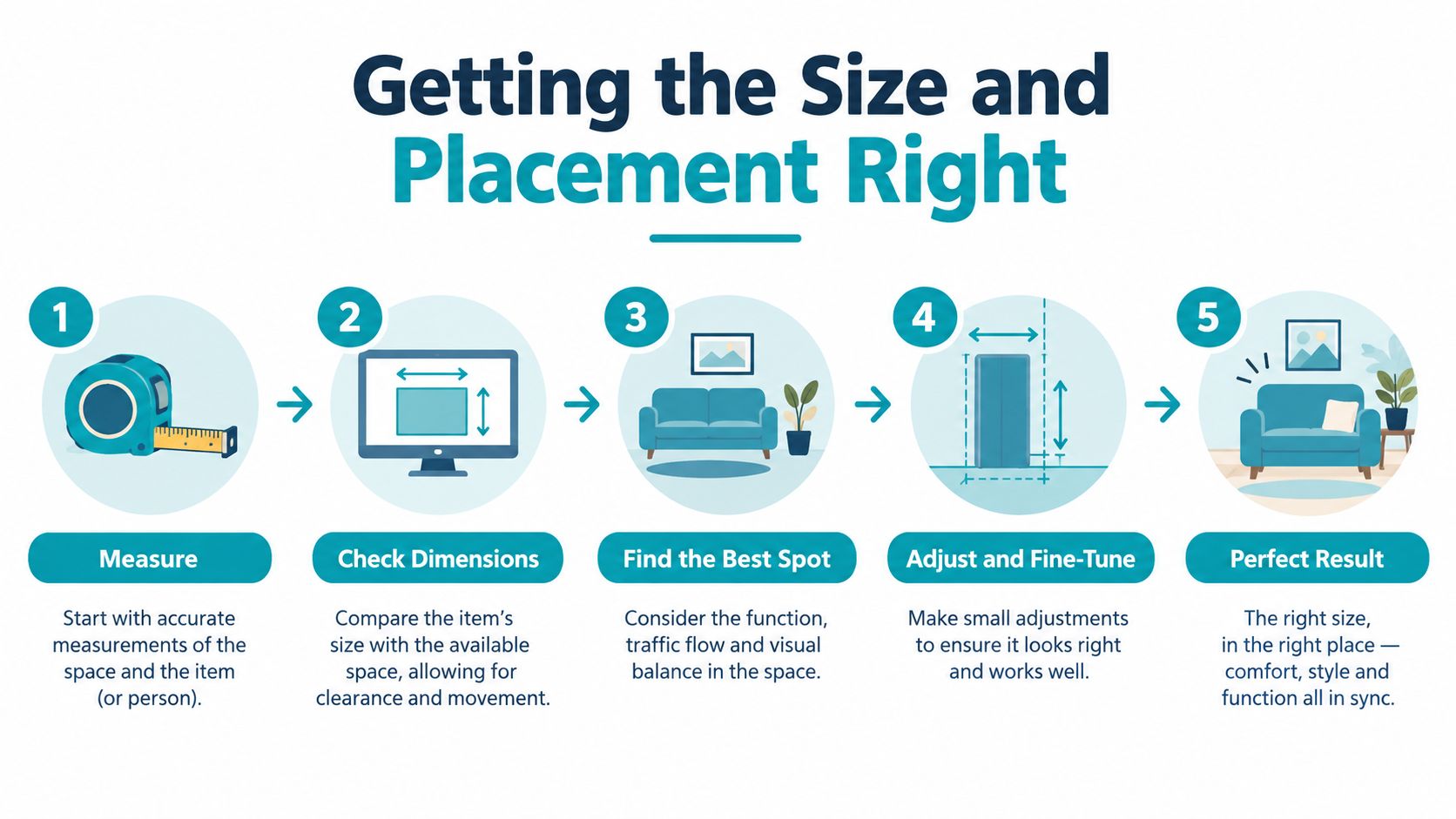
Leave clear breathing space around the design. Don't force a mural into a narrow strip between a corner and a radiator, and don't position delicate lettering where a door repeatedly brushes the wall. Above a sofa or sideboard, centre the sticker against the furniture rather than the entire room. In an open-plan space, centre it within the sitting zone.
Avoid placing a large design so high that it becomes disconnected from the furniture below. Avoid squeezing it around architectural obstructions, too. If the wall has a chimney breast, alcove or sloping ceiling, use that feature as the boundary and select a design that acknowledges the shape instead of pretending the wall is flat and uninterrupted.
Choosing Colours, Themes and Finishes
Colour selection becomes easier when you separate it into three decisions: the wall colour, the decal colour and the surface finish. Start with the wall, because the same charcoal design can look soft against warm white and severe against a cool grey.
For grey walls, try sage, dusty blue, white or muted terracotta. Navy walls benefit from warm white, pale gold, blush or soft grey. Sage green works with cream, charcoal, warm white and natural terracotta. Blush walls pair well with deep green, cocoa, black or a restrained metallic. Warm white gives you the broadest choice, while terracotta walls usually need cream, deep brown, muted navy or an earthy green to avoid visual competition.
| Wall Palette | Recommended Sticker Colours | Best Finish |
|---|---|---|
| Cool grey | White, sage, navy or dusty blue | Matte or soft satin |
| Sage green | Cream, charcoal, terracotta or muted brass | Matte or subtle metallic |
| Navy | Warm white, blush, pale gold or soft grey | Matte for calm, metallic for emphasis |
| Blush | Deep green, black, cocoa or cream | Matte or satin |
| Warm white | Almost any restrained accent colour | Matte for art-like results |
| Terracotta | Cream, olive, deep brown or muted navy | Matte or low-sheen satin |
Match the theme to the furniture
Botanical motifs soften angular furniture and work with rattan, linen and pale timber. Geometric patterns sharpen a simple Scandi room and complement mid-century legs, walnut tones and clean upholstery. Typography belongs where the room has a personal or family focus. Scenic murals need enough visual space to read as a scene, while abstract line art can sit comfortably beside framed prints without taking over.
Finish changes the character more than many buyers expect. Matte vinyl is forgiving in bright rooms because it reduces reflections. Satin adds a gentle lift without becoming too shiny. Gloss can work for small accents, but it may reflect lamps and windows. Metallic foil needs controlled placement, as changing viewing angles alter its appearance. Chalkboard finishes invite interaction, while glow-in-the-dark products suit playful settings rather than formal sitting rooms.
A single oversized motif reads as artwork. A repeated small pattern reads as surface decoration. Compact rooms usually benefit from open spacing and modest pattern scale, while a tall, uninterrupted wall can carry a more immersive composition.
Practical rule: Order or request a sample where possible, then view it beside the wall in daylight and under the lamps you use in the evening.
The wall itself matters as much as the decal. If you're deciding between a smooth and textured surface, this comparison of which wall finish is better offers useful background before you order.
Ready-Made Designs Versus Custom and DIY Options
There are three sensible ways to source a living-room wall sticker. Ready-made designs are the efficient route. Custom work gives you control. DIY suits small accents and people who enjoy the making as much as the finished wall.
Ready-made for speed
Off-the-shelf designs are the straightforward choice for a trend-led update. You can compare botanical leaves, quotes, rainbows, abstract shapes and scenic motifs without preparing artwork. The trade-off is limited originality and fixed proportions. A design may look excellent online but fail to fit neatly around your chimney breast or alcove.
Ready-made stickers also make practical gifts when you know the recipient's taste. Choose a neutral phrase, family-friendly motif or understated geometric pattern rather than something tied too closely to a particular room.
Custom for a statement wall
Custom printing makes sense when the wall has unusual dimensions, the colour needs to match existing furniture or the design carries personal meaning. You can commission a family name, a meaningful phrase, a simplified illustration or an image adapted for the space. Ask about artwork resolution, colour approval, material information and installation instructions before paying.
A mural painted directly onto a wall offers a different kind of permanence and craftsmanship. If you're comparing decals with a painted feature, this practical guide to paint a wall mural in Dublin helps clarify the preparation and commitment involved in that route.
DIY for small creative projects
Printable vinyl, a craft cutter and a stencil can produce simple dots, stripes, shapes and small lettering. DIY gives you maximum control over colour and placement, but it demands patience. Curves, alignment and transfer can become frustrating on a large wall, and an ambitious design may take longer than expected.
Use this decision rule:
- Choose ready-made for a quick, accessible style update.
- Choose custom for an architectural feature, exact colour match or personal statement.
- Choose DIY for small accents, craft projects and simple repeated shapes.
- Choose a different wall treatment when you want a permanent painted artwork and accept the preparation and disruption it involves.
The awkward spaces are the deciding test. Ready-made designs suit ordinary walls. Custom designs handle alcoves, chimney breasts and narrow sections more gracefully. DIY is best kept to areas where an imperfect edge won't dominate the room.
Installing and Maintaining Your Wall Stickers
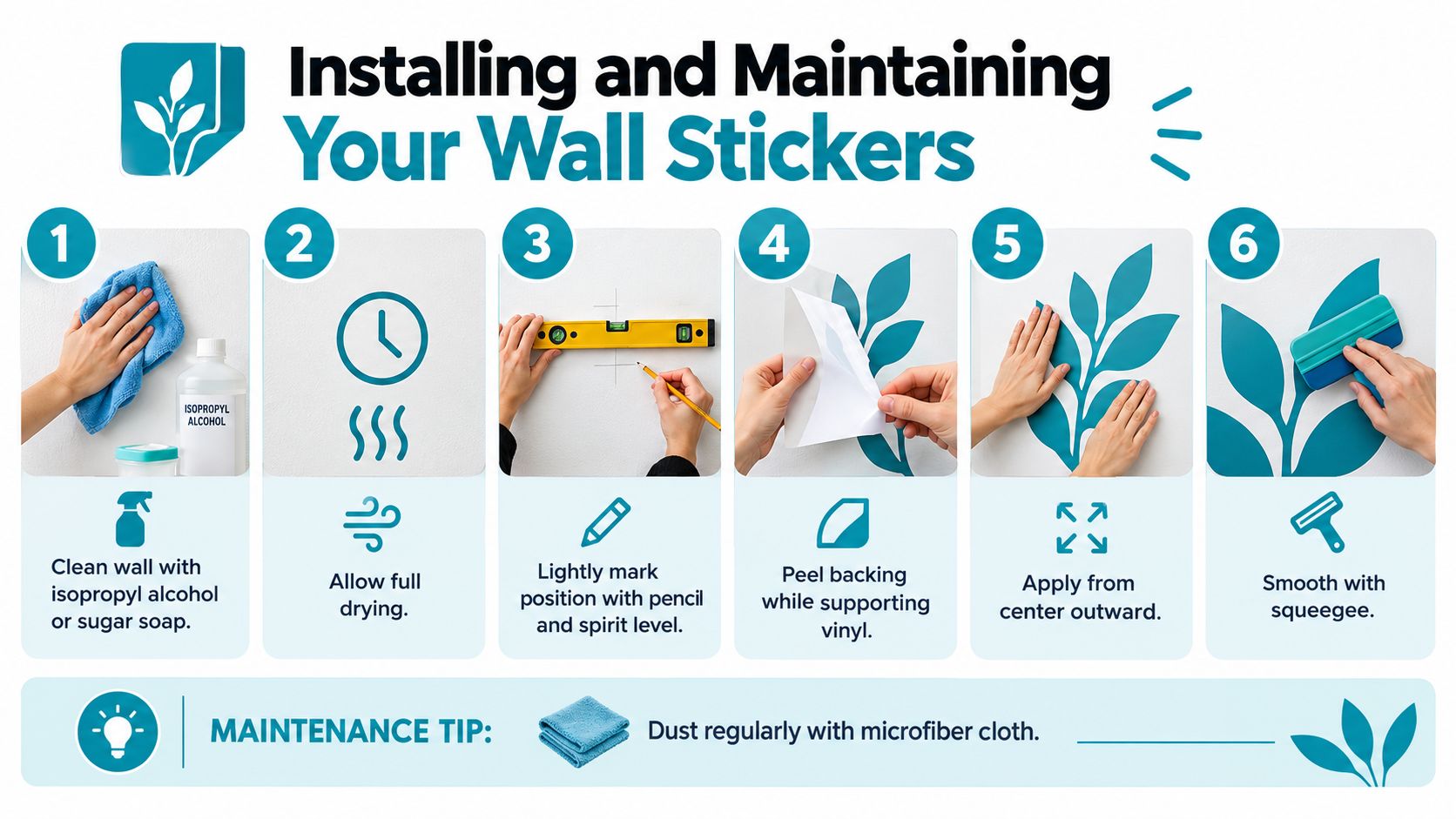
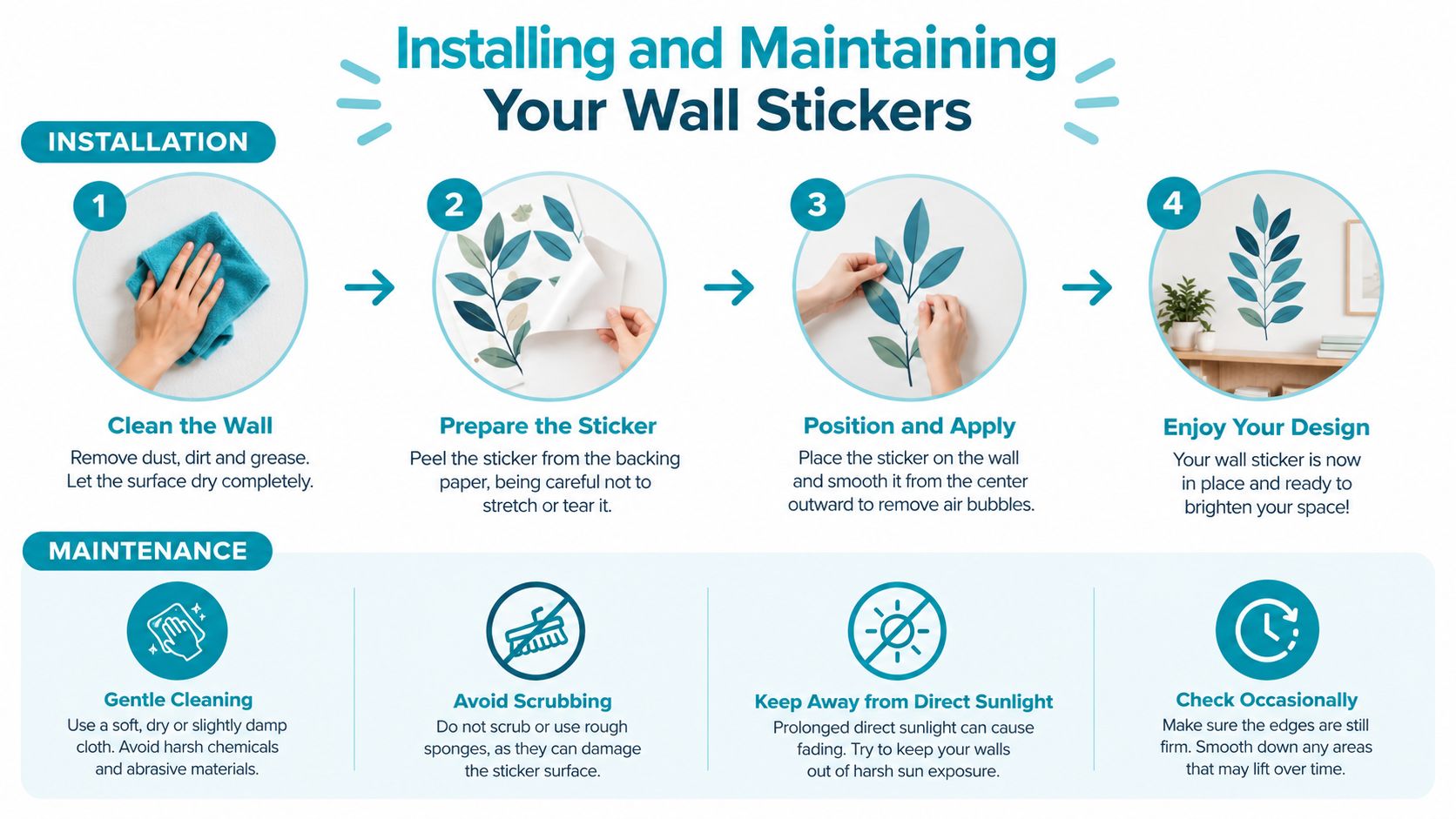
Preparation determines whether the finished wall looks crisp. Clean the surface with a suitable solution such as sugar soap, then allow it to dry fully. Remove dust, grease, flaking paint and residue. A sticker can't compensate for a weak or dirty surface.
Fresh paint needs particular caution. A wall can feel dry while the coating underneath is still curing, so follow the paint and sticker manufacturer's instructions rather than applying immediately after decorating. Test a small hidden patch, especially on rental-property paint, recently plastered surfaces or any wall that has been repaired.
Apply the decal without stretching it
Mark the position lightly with a pencil and spirit level. For a large design, ask another person to support the material while you work. Hold the decal flat, peel the backing gradually and apply from the upper area downwards. Use a squeegee or clean bank card to press from the centre towards the edges, forcing air out rather than trapping it.
Work slowly around corners and stop if the vinyl begins to stretch. Tension can cause shrink-back and edge lift later. Finish by pressing the perimeter firmly, then inspect the design under side lighting for bubbles, lifted corners or visible seams.
Keep the surface clean and remove it patiently
Dust the sticker with a soft microfibre cloth. Avoid abrasive cleaners, steam and solvent-based products near the vinyl. Radiators, strong sunlight and damp conditions can put extra stress on edges, so inspect those areas occasionally.
For removal, warm the decal gently with a hairdryer and peel it slowly at a shallow angle. If adhesive remains, use a suitable remover only after testing it on an inconspicuous area. Don't pull hard or rush across a painted surface.
Repositionable adhesives may allow limited adjustment, but every product behaves differently. Store unused stickers flat between sheets of baking paper, away from heat and moisture. For a more detailed application sequence, follow this guide to applying wall stickers.
Air Quality, Safety and Long-Term Performance
A wall sticker isn't automatically safe or unsuitable because it belongs to a particular product category. Vinyl, adhesive and backing materials vary, and marketing phrases such as “non-toxic”, “PVC-free” or “eco-solvent” don't tell you everything a household needs to know.
Public Health England's guidance on volatile organic compounds in indoor spaces identifies VOCs as indoor pollutants that can adversely affect health and recommends source control. NICE advises choosing products with low VOC and formaldehyde emissions where possible, following manufacturer instructions and increasing ventilation during decorating or renovation.
That makes air quality a materials-selection issue. Ask the supplier for emissions information covering the vinyl, adhesive and backing, not just a general statement about the finished sticker. In a living room used for long periods, ventilate during and after installation, and don't apply a large graphic immediately after painting.
What buyers should verify
Don't rely on a universal lifespan or assume every wall will release a decal cleanly. Performance depends on the coating, surface condition, humidity, sunlight, heat and the adhesive system. Brick, textured paint, wallpaper, damp plaster and unstable coatings are very different substrates from smooth, fully cured painted plaster.
| Material | VOC/Emissions | Fire Rating | Avg Lifespan | Residue on Removal |
|---|---|---|---|---|
| Vinyl film | Request product-specific emissions information | Confirm with supplier | Depends on surface and conditions | Depends on adhesive and removal method |
| Polyester film | Request product-specific emissions information | Confirm with supplier | Depends on surface and conditions | Depends on adhesive and removal method |
| Fabric decal | Request product-specific emissions information | Confirm with supplier | Depends on surface and conditions | Depends on adhesive and removal method |
| Paper-based product | Request product-specific emissions information | Confirm with supplier | More sensitive to moisture and handling | Depends on adhesive and wall coating |
| Custom printed film | Request information for the complete construction | Confirm with supplier | Depends on print, film, adhesive and wall | Test before full installation |
NICE's recommendations for indoor air quality support practical precautions for households with children, pets, allergies or asthma. Check intended indoor use, odour information, emissions documentation, fire classification and compatibility with your paint. A hidden-area adhesion test is sensible before committing to a prominent wall.
For broader background on ways to reduce VOC exposure indoors, focus on source control and ventilation rather than treating a “low VOC” label as a universal guarantee. Also avoid applying stickers over damp or mouldy walls. The decal may conceal the problem while the underlying surface continues to deteriorate.
A Practical Buying Checklist and Inspiration
Use this buying workflow before you add a design to your basket.
- Measure the available wall. Record the clear width and height, then compare it with the sofa, sideboard or television unit below. The design should feel anchored by the furniture rather than floating independently.
- Inspect the surface. Confirm that the wall is smooth, clean, dry and free from flaking paint, grease, damp and heavy texture. Test an unseen area if you're renting or the paint is unfamiliar.
- Choose the silhouette. Decide whether you want a single motif, a horizontal scene, vertical lettering, a repeated pattern or an abstract cluster. The silhouette often matters more than the individual colour.
- Match material to conditions. Consider sunlight, radiator proximity, room traffic, children, pets and the amount of handling the wall receives. Ask for material and emissions information before buying.
- Check the supplier's proofing. Look for a sample swatch, clear dimensions, application guidance, removal advice and photographs taken in believable daylight. For custom work, approve the artwork and colour before production.
- Plan the installation. Gather sugar soap, a clean cloth, painter's tape, a spirit level, a squeegee and a helper for a large design. Never begin by peeling the whole backing away at once.

A small neutral living room can become a botanical retreat with one open leafy design in sage or charcoal, supported by linen cushions and warm timber. A monochrome loft can take a sharper art-deco direction through a symmetrical geometric motif with restrained metallic detail. In a rental flat, one oversized typographic statement above the sofa can supply the personality that magnolia walls lack without covering every surface.
The strongest result usually comes from restraint. Pick one wall, one dominant idea and a scale that respects the furniture. Quote My Wall offers peel-and-stick vinyl wall stickers, including decorative designs, quotes and personalised options, so browse the Quote My Wall collection when you're ready to compare a ready-made design with a more personal living-room statement.