

Self Adhesive Wall Decals: UK Guide & Design Tips
You're probably looking at a wall right now that feels a bit tired. Maybe it's the nursery that still looks too plain, the rental flat you don't want to repaint, the care home room that needs clearer labels and a softer feel, or the old IKEA cabinet you're tempted to upcycle instead of replace.
That's exactly where self adhesive wall decals come in. They let you change the look of a space quickly, with far less mess than paint and far less commitment than wallpaper. You can add pattern, names, quotes, labels, logos, seasonal touches, or full feature art without turning the room upside down.
In the UK, that appeal is no longer niche. In 2024, Europe, including the United Kingdom as a leading market, accounted for approximately USD 2.2 billion of the global wall decal market according to wall decal market data. For everyday decorators, that means more people now see peel-and-stick décor as a normal, practical way to refresh a room without damaging the wall.
Your Instant Room Refresh Awaits
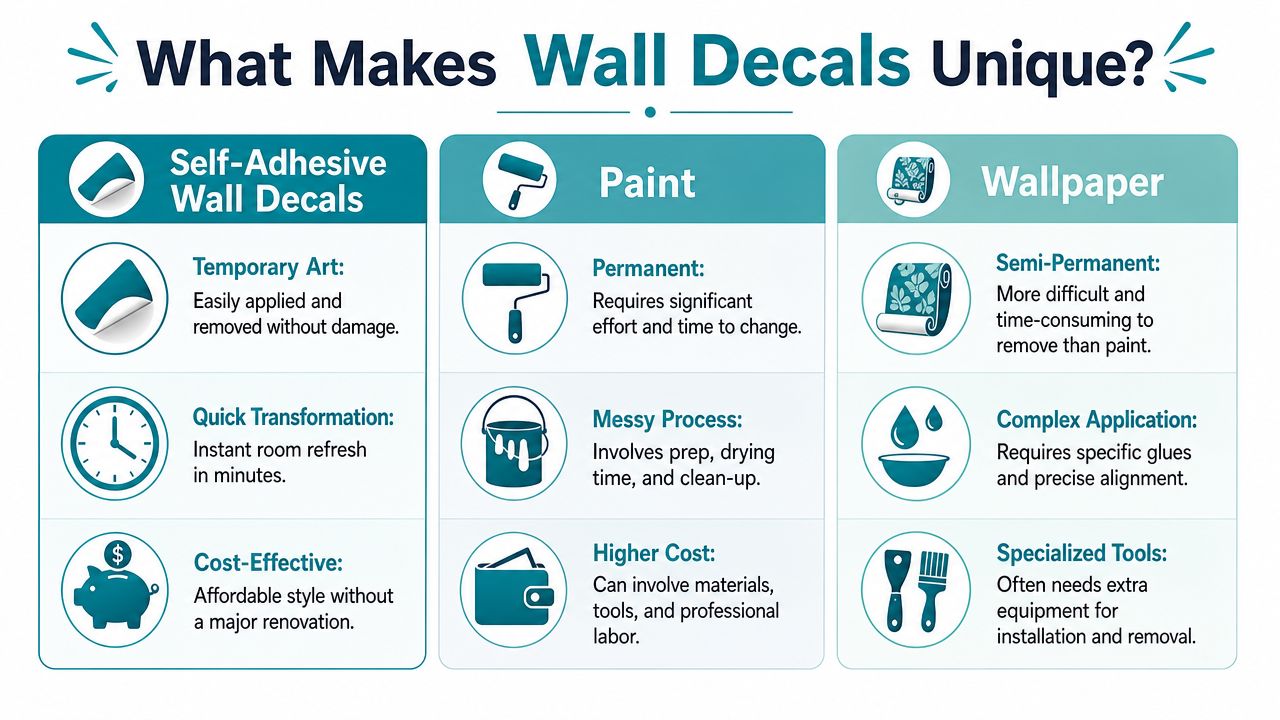
When people get stuck with a room, it's usually not because they lack ideas. It's because the usual decorating options feel too big. Paint means prep, drying time, and the risk of choosing the wrong colour. Wallpaper can look beautiful, but it asks for more commitment, more tools, and often more patience than most of us have on a Saturday afternoon.
Self adhesive wall decals sit neatly in the middle. They give you visual impact without asking you to redecorate the whole room. A branch of leaves above a cot can make a nursery feel thoughtful. A simple arch behind a sofa can turn a blank living room wall into a focal point. A set of tidy labels in a care setting can make a practical space feel more organised and more welcoming.
Why they suit UK homes so well
British homes are often a mix of lovely features and awkward details. You might have a narrow hallway, a box room used as a nursery, textured patches from old paintwork, or a flat where permanent changes aren't ideal. Decals work well because they don't need a full redesign to make a difference.
They're also flexible across very different uses:
- For parents: woodland animals, stars, rainbows, names, and growth chart styles can make a child's room feel personal without repainting every year.
- For renters: removable designs can add character without turning a tenancy into a decorating dispute.
- For care homes: clear, durable labels and calming wall graphics can make everyday spaces easier to find their way around.
- For small businesses: logos, opening times, menus, and simple branding elements can smarten up a wall or window fast.
Practical rule: If you want a room to feel finished, but you don't want the cost or disruption of a full makeover, a decal is often the simplest first move.
Understanding Self Adhesive Wall Decals
Self adhesive wall decals are a simple middle ground between a full decorating job and doing nothing at all. They give you shape, colour, wording, or pattern exactly where you need it, whether that is above a cot in a nursery, on a hallway wall in a rented flat, or on cupboard fronts in a care setting.
A decal usually arrives as a design cut from a sheet of material, ready to be pressed onto a smooth surface. Because the shape is cut to the artwork, the finished look is often much neater than a standard printed sticker. Names, stars, logos, arrows, leaves, labels, and even furniture graphics can all fall into this category.
That cut-out finish is one reason decals look more considered. Lettering can sit directly on the wall without a visible border. A branch or rainbow design may come in separate pieces so you can space it around sockets, shelves, or picture rails, which is especially helpful in older UK homes where walls are rarely as straightforward as they first seem.
What they're made from
In the UK, you'll commonly see two main types. Vinyl decals are the practical choice for sharp edges, tidy lettering, labels, and designs that need to cope with everyday wiping and wear. Fabric decals usually have a softer finish and are often easier to reposition during installation.
A simple way to separate them is this. Vinyl suits jobs where precision matters. Fabric suits jobs where a gentler look and a little more flexibility help.
| Feature | Vinyl Decals | Fabric Decals |
|---|---|---|
| Look | Crisp, clean edges | Softer, more textured appearance |
| Feel | Smooth | Textile-like |
| Best for | Lettering, shapes, labels, feature motifs | Murals, repositionable décor, softer finishes |
| Durability | Strong for everyday use | Depends on product, often gentler in feel |
| Reuse | Usually limited | Often better suited to repositioning |
| Cost | Often more budget-friendly | Often more premium |
If you are decorating a nursery and want to shuffle pieces around until the layout feels right, fabric can be less stressful to work with. If you are adding door labels in a care home, a business logo behind a reception desk, or a custom shape to upcycled furniture, vinyl is often the steadier option.
If removability is high on your list, our guide to removable wall decals for UK homes and renters explains what to look for before you buy.
What makes the adhesive work
The adhesive side matters because wall decals only behave well on the right surface. Most self adhesive decals use a pressure-sensitive adhesive, which means the bond improves as you press and smooth the material onto the wall.
In plain terms, it works a bit like applying contact film to a book cover. A calm, even pass gives you a tidy result. Rushing, trapping air, or sticking onto dusty paint usually leads to lifting edges or bubbles.
Surface condition makes a bigger difference than many buyers expect. Freshly painted walls can still be curing even when they feel dry to the touch. Some common UK finishes, especially chalky matt paint or older walls with flaky patches, can stop a decal from bonding properly. Bathrooms, utility rooms, and outside-facing walls in older properties can also be trickier because moisture in the room or wall can weaken the hold.
Decal versus wallpaper versus paint
A wall decal is best for targeted change. You are adding interest to one area rather than treating the whole room.
Paint changes the background of the room. Wallpaper creates a continuous surface. A decal works more like placing artwork or signage directly onto the wall, but with far less cost and disruption.
That makes decals particularly useful in spaces with a specific job to do. A parent might use small clouds above a changing table instead of papering the whole nursery. A renter in a London flat might add an arch shape behind a desk to define a work-from-home corner. A small café might use clean vinyl lettering for opening hours. A DIYer might apply a floral decal to a wardrobe or chest of drawers to give old furniture a second life without sanding and repainting every panel.
How to Choose the Perfect Wall Decal
Choosing the right decal isn't mainly about picking a pretty design. It's about matching the product to the wall, the room, and the way you live. A nursery wall and a café window don't ask for the same finish. Neither does a steamy bathroom and a dry upstairs bedroom.
Start with the wall, not the artwork
Before falling in love with a design, check the surface. Is the wall smooth? Recently painted? Slightly chalky? In a damp corner? Those details matter more than generally thought.
If you're choosing for a bathroom, utility area, or another high-humidity spot, the material needs to cope with moisture. For UK wall stickers, guidance on vinyl durability in UK conditions states that premium-grade vinyl has a minimum 3-year exterior lifespan, and that acrylic-based adhesives maintain more than 85% tack after 2,000 hours of water immersion. The same guidance says walls should have less than 10% moisture content before application, and that ultra-tack variants are the right choice for high-humidity zones such as bathrooms.
That gives you a simple buying rule:
- Bedrooms and living rooms: standard quality removable or standard adhesive vinyl is often suitable.
- Bathrooms and utility spaces: look for ultra-tack or humidity-suitable options.
- Outdoor signs or sheltered exterior use: choose premium-grade vinyl designed for exterior conditions.
- Rental walls with uncertain paint: test first, because the wall finish may be problematic itself.
Get the scale right
Small decals can disappear on a big wall. Oversized decals can make a narrow room feel crowded. Measure the width of the space you want to fill, then decide whether you want the decal to be the main event or a supporting detail.
A few reliable examples help:
- Over a cot, softer horizontal designs often feel calmer than one tall central motif.
- Behind a sofa, a wider decal usually looks more balanced than a narrow one.
- On furniture, a repeated smaller pattern often looks more polished than one giant graphic.
- In a small business, lettering should read clearly from the doorway, not only from up close.
A good decal should look intentional from across the room, not accidental when you step back.
Choose the finish for the effect you want
The same design can feel very different in matte and gloss.
Matte usually gives a more painted-on look. It suits calm interiors, nursery walls, Scandi schemes, and rooms with strong natural light where glare might distract.
Gloss tends to look sharper and more vibrant. It can work well for playful children's designs, high-contrast graphics, labels, and some business branding.
Pick the right adhesive type for your life
If you rent, move often, or like changing themes seasonally, removable styles are normally the safer choice. If you're decorating a long-term space and want a stronger bond, more permanent options may suit better. A practical overview of that difference appears in this guide to removable wall decals in the UK.
One sensible option for custom designs, nursery stickers, furniture wraps, and other self adhesive vinyl products is Quote My Wall, especially if you want something personalised rather than off-the-shelf.
A Step-by-Step Guide to Flawless Application
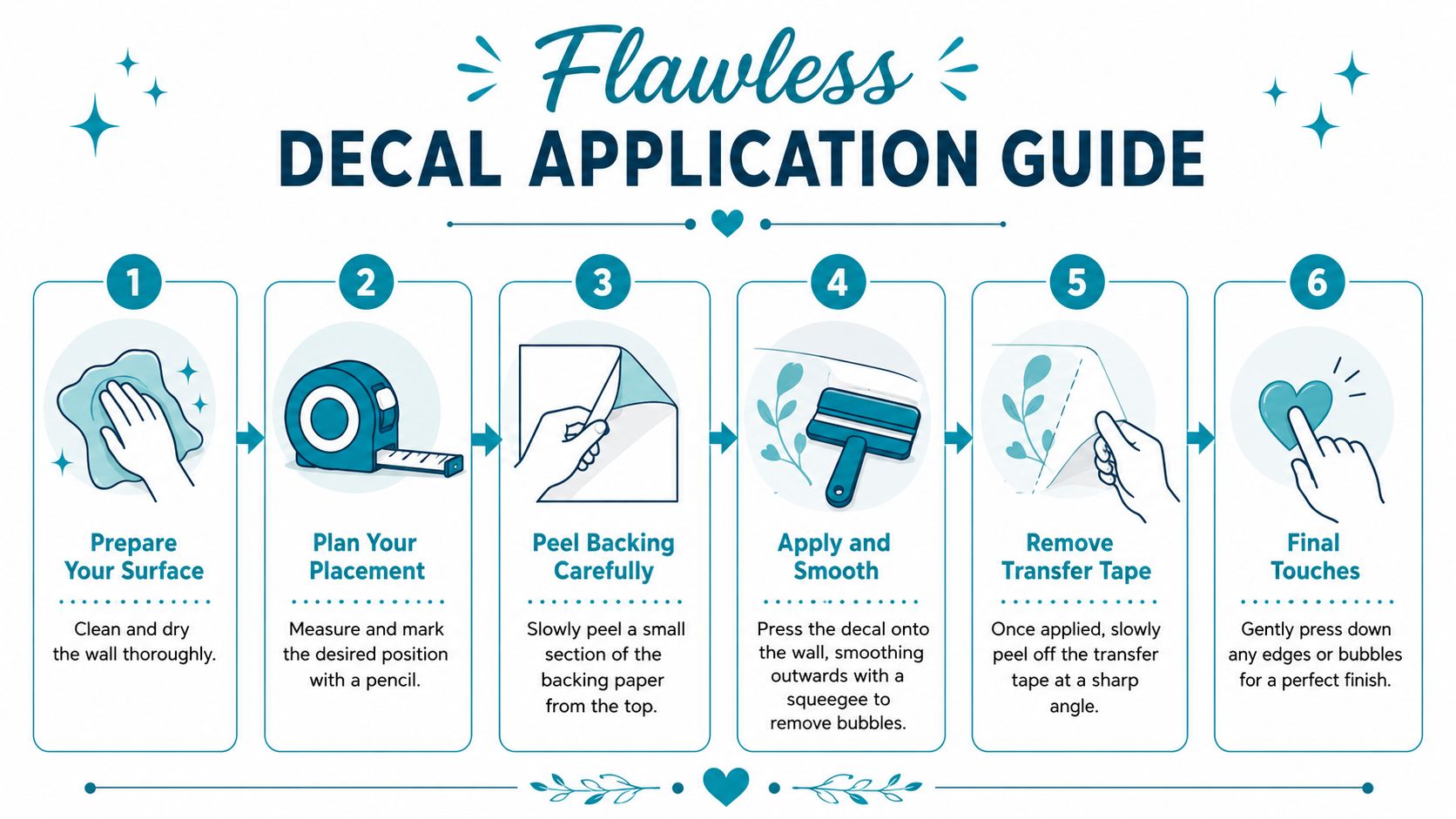
You have measured the space, chosen the design, and finally have a quiet half hour while the baby naps or the shop is still closed. This is the point where a wall decal either goes on neatly and looks built-in, or ends up slightly crooked with trapped air underneath. The difference is rarely special skill. It is usually method.
What you need before you start
A tidy result starts before any backing paper comes off. For most UK homes and small business spaces, a few basic tools are enough:
- A clean microfibre cloth: to lift dust and fine grit
- A tape measure: to place the decal evenly
- A pencil: for faint guide marks you can rub away later
- Masking tape: helpful for test positioning and the hinge method
- A squeegee or a bank card wrapped in a soft cloth: to press the vinyl down without scratching it
- A dry, fully cured wall: the surface matters as much as the decal
Fresh paint catches many people out. Even if it feels dry to the touch, it may still be curing underneath. On many UK emulsion paints, especially in newer flats or recently updated nurseries, giving the wall extra time can save you from poor adhesion later.
Temperature matters too. A cold exterior wall in winter, or a bathroom wall with lingering moisture, can make the adhesive less cooperative. Aim for a clean, dry room with a moderate temperature before you begin.
The method that keeps the decal under control
Large decals are easiest to apply in stages. The hinge method works a bit like hanging wallpaper with a temporary guide. You fix the position first, then stick it down gradually rather than trying to handle the whole piece at once.
Tape the decal onto the wall while the backing paper is still on. Step back several feet and check the height, spacing, and alignment. This matters even more in small London flats, where a decal that is only slightly off-centre can look much more obvious because the room is compact. Once you are happy, place a strip of masking tape across the middle to create a hinge.
Then follow this order:
- Lift one side of the decal.
- Peel back part of the backing paper.
- Trim or fold the loose backing out of the way.
- Press the exposed section onto the wall.
- Repeat on the other side.
That simple sequence gives you control. It stops the vinyl folding onto itself and reduces the chance of sticking one corner down in the wrong place.
How to smooth without trapping air
The easiest mistake is pressing a large area all at once. A decal behaves better when you work in small, overlapping passes, almost like ironing a shirt section by section rather than flattening the whole thing with your hands.
Start near the centre of the exposed area and smooth outward with steady strokes. Keep each pass slightly overlapping the last one. That overlap helps guide air toward the edges instead of sealing it underneath.
Smooth in small sections, from the centre outward, with steady overlapping strokes.
Use light pressure first. Once the decal is sitting where it should, go over it again more firmly. This is particularly helpful on lightly textured painted plaster, which is common in UK homes, because a second pass helps the adhesive make full contact.
A simple rhythm to follow
A calm routine usually gives the cleanest finish:
- Check position before peeling: use masking tape to hold it up and view it from across the room
- Expose a small section first: the top edge is often easiest to start with
- Press lightly, then firm up: this gives you a chance to catch alignment early
- Work steadily with your squeegee: keep the strokes controlled rather than fast
- Peel transfer tape back slowly: pull it back on itself at a low angle
If a corner lifts with the transfer tape, pause and press that section down again before continuing. Slow is faster here.
For a more visual walkthrough, this guide on how to apply wall stickers is useful to keep open on your phone while you work.
If you are applying decals in a rented property, careful prep and gentle technique also help with avoiding rental deposit disputes. That is especially relevant for tenants adding personality to children's bedrooms, home offices, or hallway walls without wanting problems at check-out.
Easy Removal and Troubleshooting Common Issues
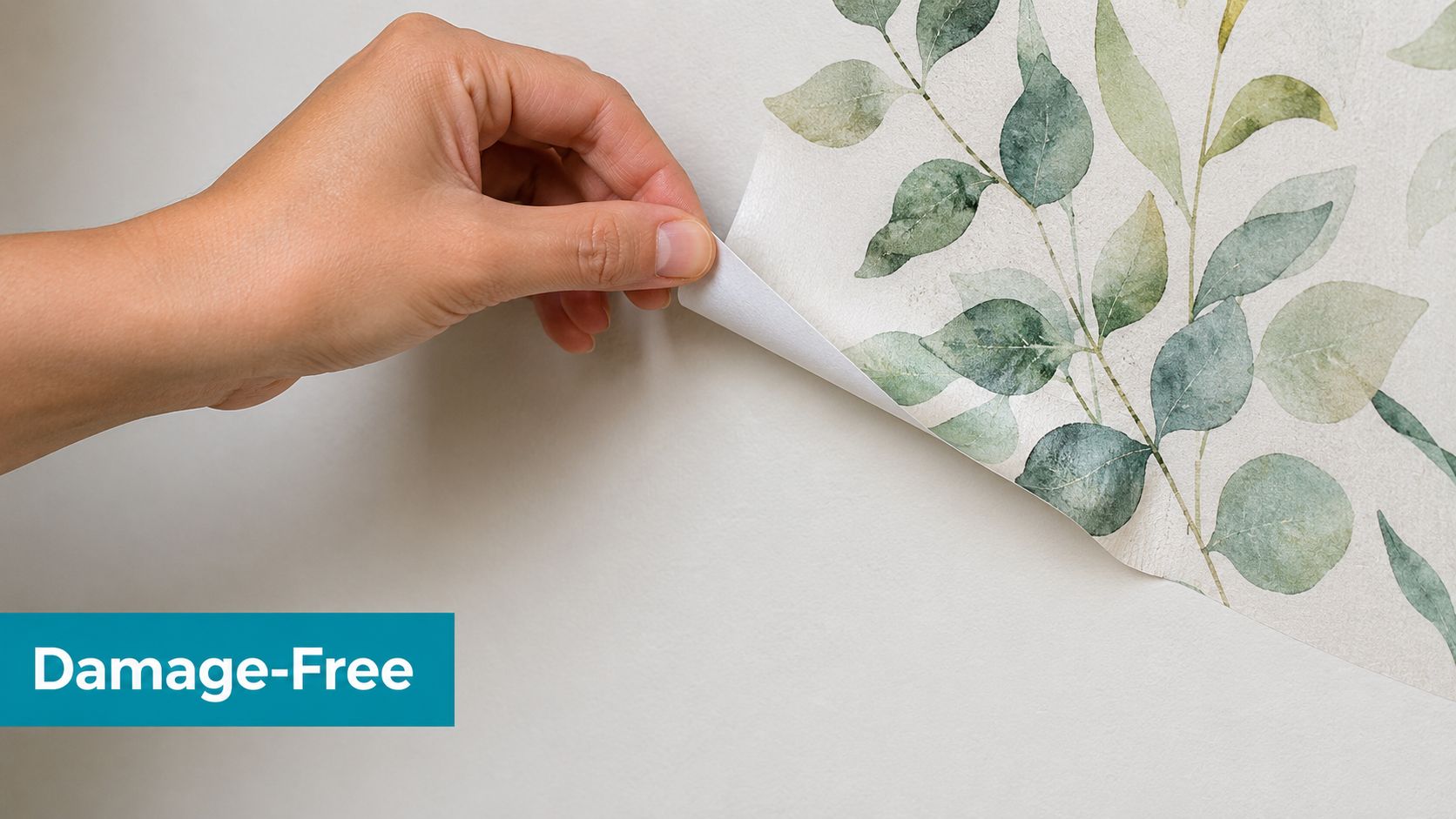
The biggest fear is usually the same. “Will this ruin my wall?” In many cases, no. But safe removal depends on the product, the wall condition, and how carefully you do it. A decal on a sound, painted, well-prepared wall behaves very differently from one stuck to flaky rental paint.
How to remove a decal safely
Start with gentle warmth. A hairdryer on a low setting can soften the adhesive enough to help the decal peel more cleanly. Hold it at a sensible distance, warm a small section, then lift one corner and pull slowly back against itself.
Don't yank forward. That puts more stress on the paint film.
A careful removal routine looks like this:
- Warm the surface lightly: enough to soften adhesive, not overheat the wall
- Lift an edge with your fingernail: avoid sharp metal tools where possible
- Peel low and slow: keep the angle shallow
- Pause if paint starts lifting: rewarm the area and go more slowly
- Wipe any residue gently: use a suitable cleaner for the surface if needed
If you want a fuller removal walkthrough, this article on how to remove a wall decal covers the process clearly.
Solving the common problems
Most decal issues are fixable if you catch them early.
Tiny bubbles often come from trapped air. You can usually smooth them toward the edge. If a tiny bubble remains, a very fine pin prick can release the air, followed by a gentle press.
Peeling edges usually point to dust, wall texture, moisture, or not enough pressure during application. Clean, dry edges and firm re-pressing can help. If the wall itself is chalky, the adhesive may be struggling because the paint surface is unstable.
Misalignment happens to everyone. Small decals are often forgiving. Large text or geometric designs need more patience. That's why dry positioning with masking tape first saves a lot of stress.
The rental wall problem in the UK
Rental properties can be the trickiest place to use self adhesive wall decals well. Some painted walls, especially those finished with lower-tack or powdery paints, don't give the adhesive a sound surface to bond to for the long term.
A commonly overlooked issue noted in guidance on wall sticker problems on rental walls is that decals can bubble or peel after 6 to 12 months on low-tack paints, and a UK Housing Survey noted that 68% of renters reported wall sticker damage during move-out. That's why preparation matters so much more in rentals than many shops admit.
If you rent, it also helps to understand what a landlord may class as normal wear versus avoidable damage. This guide on avoiding rental deposit disputes is worth reading before you decorate.
Rental walls need a test patch first. If the paint feels chalky on your fingers or marks easily, the wall may be the issue rather than the decal.
Inspiration for Every UK Home and Business
A decal works best when it solves a real decorating problem. That's why the most successful projects aren't always the biggest ones. They're the ones that make a room feel more useful, more personal, or more finished.
For nurseries and children's rooms
Parents often want a room that feels sweet without becoming too themed too quickly. A woodland line of trees behind the cot, a cloud cluster above a reading corner, or a child's name over a chest of drawers gives personality without locking you into a full mural.
There's also the practical side. If you already like a coordinated room, it makes sense to carry the same style into school organisation. Name labels for bottles, lunch items, and clothing can echo the room's colours or motif so everything feels considered rather than cobbled together.
For renters and first flats
A London flat often needs decorating tricks more than decorating budgets. You may have magnolia walls, limited floor space, and furniture that has to work harder than you'd like. A decal can create a headboard effect behind a bed, frame a tiny desk area, or break up a long blank hallway without paint.
Furniture wraps can do similar work. Instead of replacing a plain bedside cabinet, you can update drawer fronts or side panels for a cleaner look. DIYers often get the best results by keeping the palette narrow and letting one surface do the talking.
For upcycling projects
Some of the nicest results happen off the wall. A floral self adhesive vinyl panel on wardrobe doors, a geometric wrap on drawer fronts, or neat labels on toy storage can give tired furniture another life.
Good upcycling also comes down to restraint. One old IKEA unit with a smart wrap often looks more expensive than a room full of competing patterns.
For care homes and supported living spaces
Care settings often need two things at once. They need practical identification and a calmer visual atmosphere. Decals can help with both. Soft botanical art in communal rooms can make spaces feel less clinical, while clear labels on doors, memory boxes, and storage can support everyday routines.
The same principle carries over to clothing organisation. Durable stick-on clothing labels can reduce mix-ups in laundry and make life easier for staff and families.
For small businesses
Small businesses don't always need a signwriter and a full refit. A clean logo decal behind the counter, opening times on glass, menu highlights, wayfinding, or seasonal promotional graphics can all sharpen the space without major cost or downtime.
A café might use a simple script logo on a painted wall. A beauty room might add quiet line art and appointment information. A market stall might use removable branding panels that pack away daily.
If you like collecting ideas from outside the UK too, this piece on wall decor for Australian homes is useful for spotting broader styling approaches that can be adapted to British interiors.
Frequently Asked Questions About Wall Decals
Can I apply a decal to a textured wall
Sometimes, but smooth walls are much safer. Light texture may be manageable with smaller, simpler designs. Heavy texture makes full contact harder, so edges may lift and fine details may fail first. If you're unsure, test a small sample in an inconspicuous area.
Are self adhesive wall decals safe for a nursery
They can be, provided you buy from a reputable seller and check the product details. For a nursery, many parents prefer simple shapes, matte finishes, and designs placed out of grabbing height around cots. The wall condition matters too. A calm design on a clean, dry wall is the safer setup than sticking anything over unstable paint.
How do I clean a wall decal
For most indoor decals, a soft damp cloth is enough. Don't scrub aggressively, and don't soak the edges. Gentle wiping works better than harsh cleaning products, especially on printed or more delicate finishes.
Can I reuse a wall decal
It depends on the material and adhesive type. Vinyl decals are often designed for one good installation. Fabric-style decals are more likely to tolerate repositioning. If reusability matters to you, check that before buying rather than assuming all peel-and-stick products behave the same way.
What if my wall has just been painted
Wait until the paint is fully cured before applying anything adhesive. A wall can feel dry long before it's properly hardened. If you rush this, the decal may fail, or the paint may lift later.
Are they only for walls
Not at all. Many people use similar self adhesive vinyl products on wardrobes, toy boxes, shop windows, mirror frames, office doors, and storage tubs. The key question is always the same. Is the surface smooth, clean, and suitable for adhesive application?
If you're ready to refresh a room, label a practical space, or personalise furniture, Quote My Wall offers wall stickers, nursery designs, vinyl wraps, window films, and custom options that suit a wide range of UK homes and businesses. If you've got a specific idea in mind, it's also a useful place to explore personalised wall sticker designs and furniture upcycling projects.