

Privacy Window Film Mirror: A Practical UK Buyer's Guide
You open the curtains on a bright morning and gain a clear view of the street, but the trade-off is immediate. A neighbour's kitchen window looks directly into your sitting room, or pedestrians can see across the bay window as they pass. In many UK homes, privacy depends on keeping the curtains closed, even when you'd rather keep the daylight.
Privacy window film mirror products offer a tempting alternative. They can preserve an outward view during daylight while making the outside of the glass look reflective. The important qualification is that this isn't permanent one-way privacy. The result depends on changing UK light conditions, the type of glazing, and how you use the room after dark.
The Privacy Problem Most UK Homes Share
Terraced housing leaves little space between one property and the next. A neighbour's window may face yours across a narrow close, while a ground-floor maisonette can sit directly beside a pavement. Flats above shops often have large front windows at pedestrian height, and semi-detached homes may have side-facing glazing that looks straight into the next garden or hallway.
That layout creates a practical conflict. You want sunlight and an unobstructed view, but you don't want passers-by watching the room or neighbours seeing everyday family life. Net curtains soften the problem, although many homeowners find them dated. Full curtains give stronger privacy but take away daylight and can make a small room feel closed in.
Why British daylight makes the problem harder
UK daylight changes quickly. A low winter sun can make the outside of the glass much brighter than the room, creating a strong reflective effect during the day. Later, at dusk, the balance weakens. Once interior lamps are on and the garden, road or close is dark, the privacy effect reverses.
A streetlight can make this particularly confusing. The window may still look mirrored from inside, while someone outside can see the illuminated room. This is why a reflective film shouldn't be described as a complete privacy barrier for every hour.
Practical rule: Mirror film is mainly a daytime privacy product. If you need privacy whenever the lights are on, choose a solution that doesn't depend on the brighter side of the glass.
Where mirror film fits
For many homeowners and renters, mirror film sits between temporary coverings and major window changes. It can preserve more daylight than closed curtains and may also help with glare and solar heat. The broader UK window film market was estimated at USD 111.2 million in 2024 and is forecast to reach USD 145.0 million by 2035, according to Market Research Future's UK window film market outlook. A separate market estimate also points to multi-year expansion, although its reported market values differ because the methodology differs.
That wider category includes privacy, decorative and solar-control applications. Mirror film isn't a niche idea, but its suitability still depends on the individual window. A north-facing room, a shaded courtyard and a sun-exposed bay window won't produce the same result.
How One-Way Mirror Privacy Film Works
A front bedroom in a terraced house may feel private during a bright afternoon, yet expose the room once the indoor lights come on. One-way mirror film responds to the light balance on each side of the glass, rather than keeping one side permanently hidden.
The film is usually a thin polyester layer with a metallic coating. This layer reflects some visible light and lets the rest pass through. The brighter side therefore sees a stronger mirror effect, while the darker side can still see through the window. It works like a bright room reflected in a dim mirror: the reflection dominates where more light reaches the surface.
Understanding VLT
Visible Light Transmission, or VLT, indicates how much visible daylight passes through the film. Higher VLT generally means a brighter room and a lighter appearance. Lower VLT creates a darker tint and usually a more pronounced reflective finish.
UK product data shows why these measures need careful comparison. One EN 410-tested reflective silver specification reports around 60% visible light transmission, with visible light reflection of 60% externally and 13% internally, in the LLumar reflective film datasheet. Other products in UK technical datasheets list VLT of 14% to 17%, solar energy reduction of 74% to 78%, glare reduction of 78% to 85%, and UV reduction of 99%.
These figures apply to particular specifications, not to every film described as “mirror”. Check the product datasheet against the window's orientation, room size and usual daylight. A low-VLT film may suit a sunny south-facing bay, while a darker film could make a shaded hallway feel gloomy.
Why night-time privacy fails
During daylight, outdoor light is normally stronger than indoor light. After sunset, lamps reverse that relationship. Guidance from one UK specialist says the outside scene needs to be roughly seven times brighter than the room interior for the one-way effect to hold, as explained in its information on reflective privacy film performance.
That rule matters in British homes, where variable weather, close-set terraces and short winter daylight can change the balance quickly. Mirror film can provide useful daytime privacy and may reduce glare, solar heat and UV exposure, but those benefits do not make it a 24-hour privacy solution. If privacy is required whenever lights are on, pair it with blinds or curtains, or choose a covering that does not depend on which side of the glass is brighter.
Types of Mirror and Reflective Privacy Film
UK suppliers offer several reflective finishes. They differ in how much daylight they pass, how strongly they reflect the street, and how noticeable they look from inside. A classic silver film gives the clearest mirror effect, which can suit a front-facing window overlooking a pavement or neighbouring terrace. A lighter silver finish keeps more of the room's natural brightness, although its reflection is usually less pronounced.
Darker reflective products reduce visible light more sharply. They can work well on a bright, south-facing room, while a small sitting room, lower-floor flat or shaded hallway may feel gloomy behind the same film. Floor level and the changing daylight of British weather matter as much as compass direction. The darkest option is not automatically the most suitable one.
| Film Type | Typical VLT | Solar Rejection | Best For |
|---|---|---|---|
| Reflective silver | Around 14% to 17% for some darker specifications | Around 74% to 78% for some listed products | Strong daytime privacy and sun control |
| Lighter reflective silver | Around 60% in one EN 410-tested specification | Varies by specification | Preserving more daylight while adding reflectance |
| Dual-reflective film | Check the individual datasheet | Check the individual datasheet | Balancing external privacy with a clearer interior view |
| Coloured reflective film | Varies by specification | Varies by specification | Bronze or grey effects on period or traditional properties |
The figures are examples from particular products, not universal averages for each category. Treat VLT as the film's brightness setting. A lower VLT passes less visible light, while a higher VLT leaves the room brighter. Always compare the film specification with the existing glazing, room orientation and normal daylight before ordering.
Choosing the finish
Dual-reflective films use different reflective characteristics on their exterior and interior surfaces. The outside can retain a stronger reflection, while the room side appears less mirror-like. This suits buyers who want daytime privacy without making the glass a dominant feature indoors.
Bronze and grey variants can sit more comfortably alongside older brickwork, timber frames and period interiors than bright silver. That visual difference may matter on a traditional terrace or in a conservation area. Appearance still needs to be checked alongside glazing compatibility, particularly with double-glazed units and coated glass.
For rental properties, an internally fitted product is often more practical than externally bonded film because it avoids direct exposure to rain and temperature changes. Check approval for the specific uPVC frame, double-glazed unit and glass coating before purchase. A film that looks right in daylight still needs a separate privacy plan for evenings, when lights are on.
Mirror Film vs Frosted Film vs Blinds
The simplest comparison is also the most useful. Mirror film favours daytime privacy with an outward view. Frosted film favours privacy at all times. Blinds favour control. Your choice depends on whether you can accept closing a covering when the room is lit at night.
| Option | Daytime Privacy | Night Privacy with Lights On | Light Transmitted | Typical UK Cost |
|---|---|---|---|---|
| Mirror film | Strong when outside is brighter | Weak without a blind or curtain | Depends on VLT, from relatively bright to noticeably dark | Qualitative comparison only, supplier pricing varies |
| Frosted film | Strong, usually without an outward view | Strong | Depends on the frosting and product | Qualitative comparison only, supplier pricing varies |
| Blinds | Adjustable | Adjustable | Adjustable | Qualitative comparison only, fitting and product vary |
Mirror film has one major advantage over the other two options: it can combine daytime privacy with solar control. UK market guidance estimates the installed-value solar-control window-film segment at about £180–£220 million in 2026, projected to reach £310–£380 million by 2035, with around 4.5–5.5 million square metres installed annually in 2026, according to IndexBox's UK solar-control film analysis. That source also identifies retrofit activity and performance-led film choices as part of the market backdrop.
Match the product to the room
A south-facing living room may benefit from a reflective film because glare and heat are part of the problem. A north-facing bathroom that needs privacy after dark is a better candidate for frosted film. A front room that alternates between bright daytime use and evening entertaining may need mirror film plus a blind.
For more examples of how privacy requirements affect film selection, compare different privacy window film options before you buy. Don't treat a low price as a substitute for checking night-time behaviour, VLT and glazing suitability.
Measuring and Fitting Mirror Film Step by Step
Start with the visible glass, not the frame, gasket or opening. Measure the width and height of each pane twice, then allow a small clearance around the edge so the film doesn't press into the seal as temperatures change.
For a standard uPVC window, use a clean tape measure, isopropyl alcohol, lint-free cloths, a spray bottle, mild soap solution, a soft squeegee and a sharp trimming blade. Mirror film is commonly applied to the inside-facing surface, but the product datasheet must confirm that it suits the glass unit.
- Clean the pane carefully. Remove dust, grease and residue with isopropyl alcohol and a lint-free cloth. A tiny particle trapped beneath reflective film can remain visible.
- Cut the film oversize. Leave roughly 5 mm extra around the pane while positioning. This gives you room to trim accurately after the film has settled.
- Wet both surfaces. Spray the glass with a weak soap-and-water solution. Peel away the backing while keeping the adhesive side damp, then place the film against the wet glass.
- Squeegee from the centre. Push water and air towards the edges in overlapping strokes. Work slowly, lifting and re-wetting a section if it folds or traps a large bubble.
- Trim and finish. Use a fresh sharp blade and keep the cut just inside the frame. Leave a 1–2 mm gap at the seal so the edge can dry and doesn't sit against the rubber.
Large panes may benefit from a gentle heat-shrinking pass with a hairdryer, but excessive heat can distort the film or stress the glazing. Don't fit film to cracked glass, and take extra care with sealed units older than 15 years. For a fuller installation method, follow this window privacy film fitting guide, then check the film manufacturer's curing and cleaning instructions.
Safety, Glazing and Renting Considerations
A reflective film can solve a sightline problem and still be the wrong purchase for a particular pane. Before checkout, check the glazing, your permission to alter the window, and the building's planning constraints.
Older annealed glass can absorb more solar energy when a reflective film is applied. That may increase thermal stress, particularly where an insulated unit already has a failed seal or a low-emissivity coating. Look for the identification marking on the sealed unit, inspect for cracks and condensation between panes, and ask the film supplier for written compatibility information.
Three checks before installation
- Glazing condition: Don't cover chipped or cracked glass. A blown sealed unit, visible as misting between panes, needs attention before film is considered.
- Landlord or lease permission: A tenancy agreement may treat window film as an alteration. Ask for written consent before installation, even if the film is removable. Static or non-adhesive options may make removal easier, as discussed in this guide to non-adhesive privacy window film, but they don't remove the need to check your agreement.
- Planning and conservation status: Listed properties in England and Wales may need Listed Building Consent if an alteration changes the external appearance. Leasehold flats can also have restrictive covenants, and a reflective exterior may affect how the building looks from the street.
Think about safety as well as sightlines
Mirror film can create a strong focal reflection. In homes with young children, care settings or busy rooms, position cots, chairs and freestanding mirrors so the treated pane doesn't become a distracting visual feature. The film itself isn't a substitute for safe furniture placement or suitable guarding around windows.
A professional installer can check the glass and discuss thermal risk before applying a product. That consultation is particularly sensible for large panes, older double glazing, low-E units and properties with heritage restrictions.
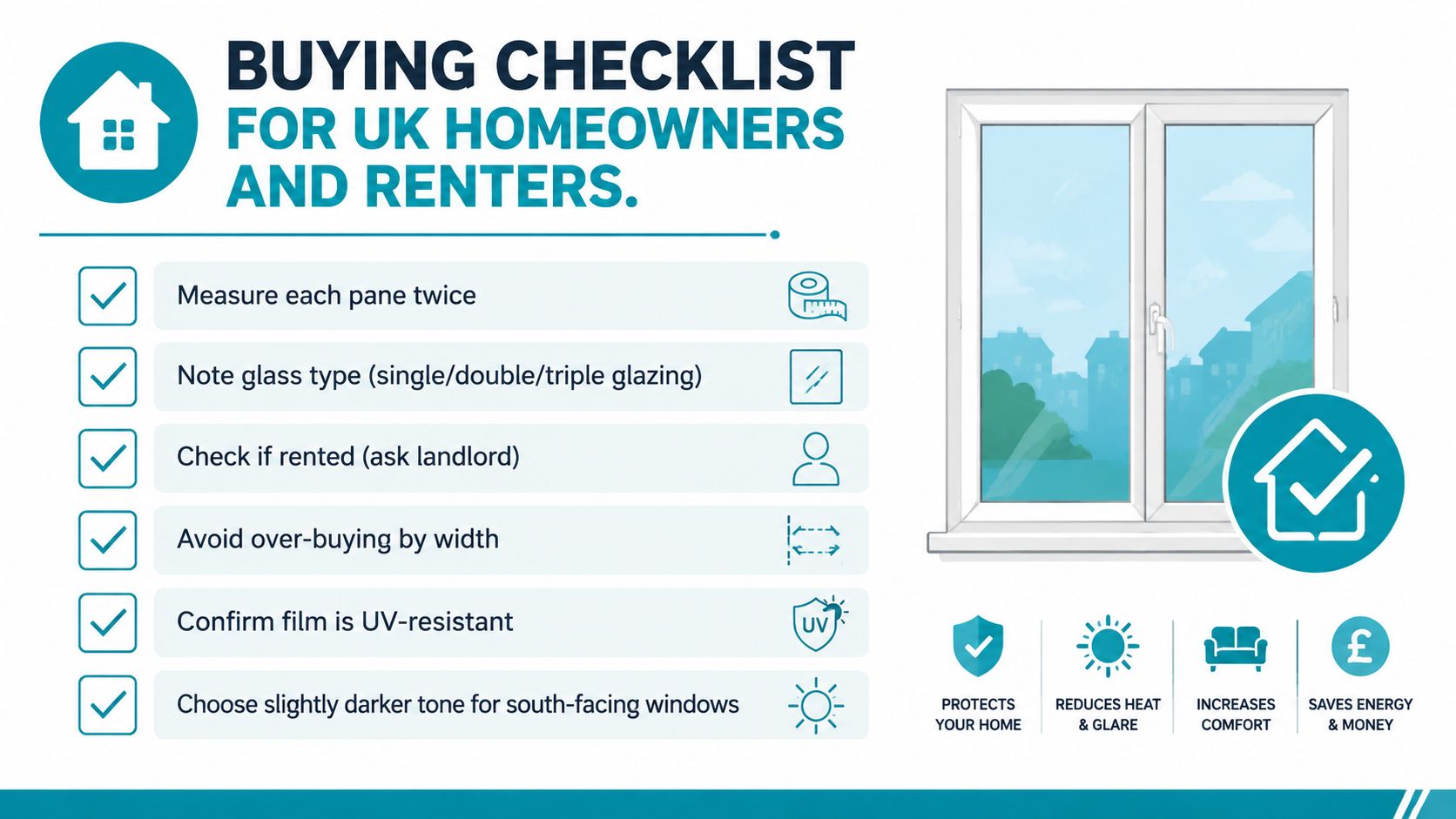
Buying Checklist for UK Homeowners and Renters
Treat the product page as a technical purchase, not a colour choice. A reliable listing should tell you the film's VLT, solar performance, intended application surface and warranty conditions.
Use this short checklist before ordering:
- Measure each pane twice: Record the glass size separately for every window. Bay windows and older terraces often have panes that look identical but aren't.
- Identify the glazing: Note whether each pane is single, double or triple glazed, and check for a low-E coating or other specialist treatment.
- Test a sample: Put a swatch on the actual window and view it in daylight, overcast conditions, at dusk and with the room lights on. A sample reveals more than a product photograph.
- Choose VLT by room use: A bright south-facing room may tolerate a darker film. A shaded north-facing room may need a lighter specification to avoid losing useful daylight.
- Order trimming tolerance: Allow extra material for accurate cutting, but don't buy a roll wider than the pane coverage requires. Confirm the supplier's recommended allowance rather than assuming a fixed overhang.
- Read the technical sheet: Look for visible light transmission, solar rejection, glass compatibility and warranty terms. A product rated for ordinary glass may not be suitable for every uPVC double-glazed unit.
Skip unnecessary upgrades unless your room needs them. Anti-graffiti or heavy scratch-resistant coatings may suit commercial glazing but add little value for many domestic windows. A sample, a complete datasheet and a clear removal policy are usually more useful to a renter than extra coating claims.
Choosing the Right Privacy Film for Your Window
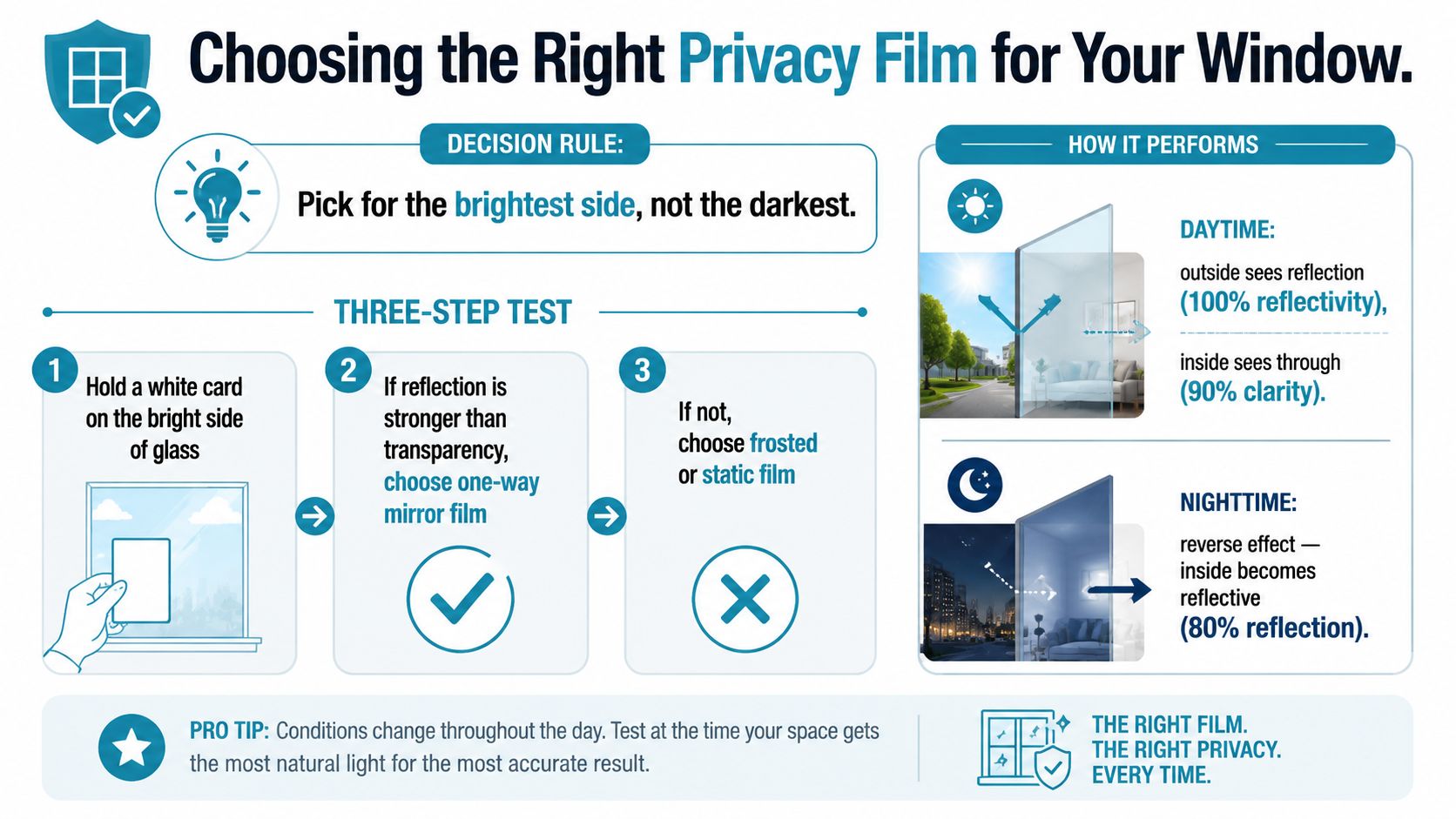
Use one decision rule: choose for the brightest side of the glass, not the darkest. Mirror film works when the brighter side produces enough reflection to overpower the view through the pane. In a UK home, that may be straightforward at midday and unreliable during a grey afternoon, dusk or winter evening.
Run this three-step test before ordering:
- Decide when privacy matters. If the problem is pedestrians looking in during the day, mirror film may suit you. If the room must remain private with lights on after dark, start with frosted film, blinds or a combination.
- Stand where the observer stands. Check the pavement, opposite windows, neighbouring garden and nearby street lighting. A close terraced-house sightline can remain intrusive even when the room feels bright.
- Assess the room's daylight. A sunny front room has more light to work with than a shaded north-facing bedroom. If the window is already dim, a darker reflective product may make the room feel oppressive.
The best privacy product responds to the window's real light conditions, not just the finish shown on a sample card.
Choose mirror film for daytime privacy, outward visibility and solar control. Choose frosted film when year-round privacy matters more than seeing through the pane. Choose blinds when you need adjustable control and can accept drilling, fittings or a visible covering.
Renters should confirm permission and consider removability before comparing finishes. Homeowners should check glazing compatibility and conservation restrictions. For broader information about how personal information is handled when researching suppliers online, you can see our privacy statement.
There isn't one universally correct answer. If you match the product to daylight, privacy hours, glazing and tenancy rules, you'll avoid the most common disappointment, expecting a daytime mirror film to behave like a permanent privacy window.
Quote My Wall offers window privacy films for homeowners and renters, including options designed to preserve daylight while improving privacy. Visit Quote My Wall to compare suitable designs and choose a film that fits your room, glazing and installation needs.