

Best Window Film for Privacy UK Guide
When people ask for the best window film for privacy, the answer is nearly always a frosted or opaque film. These are the workhorses of the privacy world, giving you excellent two-way privacy day and night while still letting that lovely natural light trickle in. If you're more concerned with daytime privacy—letting you see out while stopping people from looking in—then a one-way mirror film is a fantastic option, but just remember that trick reverses once the lights come on inside at night.
Choosing the Best Window Film for Your Privacy Needs
Finding the right balance between privacy and light is a classic problem, especially in the UK’s tightly-packed towns and cities. Window film is a brilliant solution—it’s practical, stylish, and often more affordable than traditional blinds or curtains. It lets you get the seclusion you crave without sacrificing a bright, welcoming home.
Of course, the ‘best’ film really comes down to your unique situation. A ground-floor London flat on a busy street has very different needs than a suburban bathroom window that overlooks a neighbour’s garden.
Privacy has shot up the priority list for homeowners and renters alike. In fact, the use of privacy films in the UK has jumped by over 25% since 2020, largely thanks to new housing developments and people upgrading their existing homes. It’s a clear sign that we’re all looking for more control over our personal space.
Understanding Your Primary Goal
First things first: what does "privacy" actually mean to you? Are you looking to completely block the view, or would a simple blur do the trick? Do you need that privacy around the clock, or is it just a daytime concern? Nailing down the answers to these questions is the key to finding the perfect film.
The main options on the market each solve a different problem. Frosted films are a timeless, elegant choice, whereas one-way mirror films offer a more modern, sleek look. And if you want to add a bit of personality, decorative films can obscure the view beautifully.
| Film Type | Best For | Privacy Level | Natural Light |
|---|---|---|---|
| Frosted/Opaque | 24/7 privacy in bathrooms & bedrooms | High (Two-way) | Diffused Light |
| One-Way Mirror | Daytime privacy on ground-floor windows | High (Day) / Low (Night) | Maintained |
| Decorative | Adding style while obscuring views | Medium to High | Varies by pattern |
| Blackout | Total light and view blocking | Complete (Two-way) | None |
Balancing Privacy with Other Needs
Your decision isn't just about who can see in. You also need to think about how much daylight you're willing to part with. A blackout film offers total privacy, but it will also turn your room into a cave. On the other hand, a frosted film keeps things private while maintaining a wonderfully bright, airy atmosphere.
The most effective approach is to match the film's properties directly to the room's function. A living room has very different privacy and light requirements compared to a nursery or a home office.
Before you make a final choice, it's worth getting a sense of all the available options. Taking a look at a comprehensive guide on the best window treatments for privacy can help you see how film stacks up against other solutions like blinds or shutters. It's the best way to feel confident you're making the right call for your home.
Comparing Top Window Privacy Film Types
Choosing the right window film for your home isn't just about ticking off features on a list. It’s about understanding how different films actually perform in the real world—especially in the UK, where the light and our privacy needs can shift from one room to the next, hour by hour. Let's break down the main contenders to see which one genuinely suits your space.
To get you started, think of this chart as a decision-making tool. It helps you work backwards from what you actually need—whether that's daytime privacy, round-the-clock seclusion, or just a touch of style—to find the perfect film.
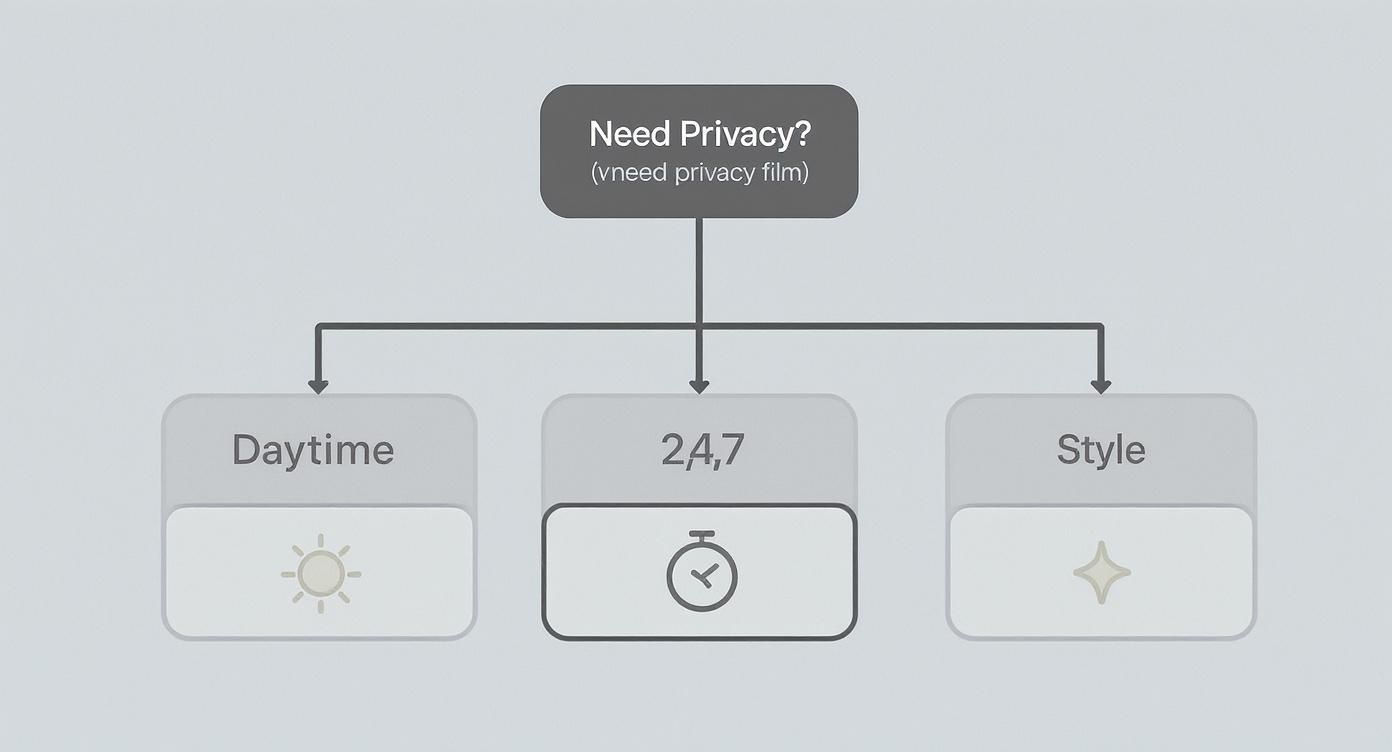
The biggest takeaway here is that there's no single "best" film. It's all about matching the right solution to the specific privacy problem you're trying to solve.
To make things even clearer, let's look at the options side-by-side. This table gives you a quick overview of how each film stacks up against the others in terms of privacy levels, light, and where they work best.
At-a-Glance Window Film Comparison
| Film Type | Daytime Privacy Level | Night-time Privacy Level | Natural Light Allowed | Best For |
|---|---|---|---|---|
| Frosted | Excellent | Excellent | High (Diffused) | Bathrooms, street-facing bedrooms, 24/7 privacy needs. |
| One-Way Mirror | Excellent | None (Reverses) | High (Slightly Tinted) | Ground-floor living rooms & offices needing daytime privacy. |
| Blackout | Absolute | Absolute | None | Nurseries, home cinemas, bedrooms for shift workers. |
| Decorative | Varies | Varies | Varies (Pattern Dependant) | Front doors, internal glass, adding style with privacy. |
Now that you've got the big picture, we can dive into the details of what makes each of these films unique and why you might choose one over the other.
Frosted Film: The 24/7 Privacy Champion
Frosted window film is the go-to choice for anyone needing consistent, reliable privacy. Its genius is in its simplicity. By diffusing light, it creates a sandblasted or etched glass effect that works perfectly, day or night. This makes it the undisputed champion for bathrooms, bedrooms, and any street-level windows where being overlooked is a concern.
What sets it apart is that its effectiveness doesn't rely on the lighting conditions. Whether it's the middle of a sunny day or you have a lamp on inside at night, the view is completely obscured. You get total peace of mind without ever having to reach for the curtains.
And despite its high privacy level, frosted film is brilliant at letting natural light through. It softens harsh, direct sunlight into a pleasant, ambient glow, brightening the room while keeping it private. This perfect balance is precisely why it’s a firm favourite among UK homeowners.
One-Way Mirror Film: The Daytime Privacy Specialist
One-way mirror film, often called reflective film, offers a sleek, modern fix for daytime privacy. It works by creating a mirror on whichever side is brighter. During the day, that means anyone outside sees their reflection, while you can see out perfectly clearly. It’s an ideal solution for ground-floor living rooms or home offices where you want to stop passers-by from peering in without sacrificing your view of the garden.
But there's a crucial catch that many people don't realise until it's too late.
At night, when it's dark outside and your lights are on inside, the effect completely reverses. Suddenly, people outside can see in perfectly, while all you'll see is a reflection of your own room. This is the 'reverse effect', and it’s the single most important thing to know before you buy.
Because of this, one-way film almost always needs to be paired with curtains or blinds for night-time privacy. It's a fantastic tool for dealing with daytime issues, but it's not a standalone, 24/7 solution. When looking into window treatments, it's worth comparing all options; for example, understanding the difference between solar screens versus window tint can give you a fuller picture of the technologies available.
Blackout Film: For Absolute Light and View Blocking
When you need to completely stop both light and visibility in their tracks, blackout film is the only real answer. Just as the name suggests, it blocks 100% of light, plunging a room into total darkness and providing absolute two-way privacy. This makes it a lifesaver for nurseries where a baby needs to nap during the day, for shift workers' bedrooms, or for home cinemas that demand a pitch-black setting.
The trade-off is obvious but significant: you lose all natural light. This makes blackout film a highly specialised product. You wouldn't use it in your main living areas, but for specific rooms where light control is the number one priority, it's invaluable. It creates an impenetrable barrier, so no one can see in or out, no matter the time of day.
With the rise of home working, the demand for privacy solutions like these has shot up. It's estimated that by 2024, 15% of UK homeowners had installed privacy films in at least one room, a clear sign of a growing trend in homes and offices alike.
Decorative Films: Where Style Meets Seclusion
Decorative films are a fantastic way to get the privacy you need while adding a real touch of personality to your home. They come in countless patterns, from elegant florals and smart geometrics to classic stained-glass effects. These films obscure the view to different degrees, depending on how complex and dense the pattern is.
This is your middle-ground option. It's not as absolute as frosted film, but it offers far more character. It’s a great choice for internal glass doors, the sidelights by your front door, or any window where you want to add a design feature while gently blurring the line of sight. The level of privacy you get is tied directly to the pattern—a busy, intricate design will offer more seclusion than a sparse, minimalist one. This versatility makes decorative films a stylish and practical choice for modern interiors.
Adhesive vs Static Cling: Which Application Method is Right for You?
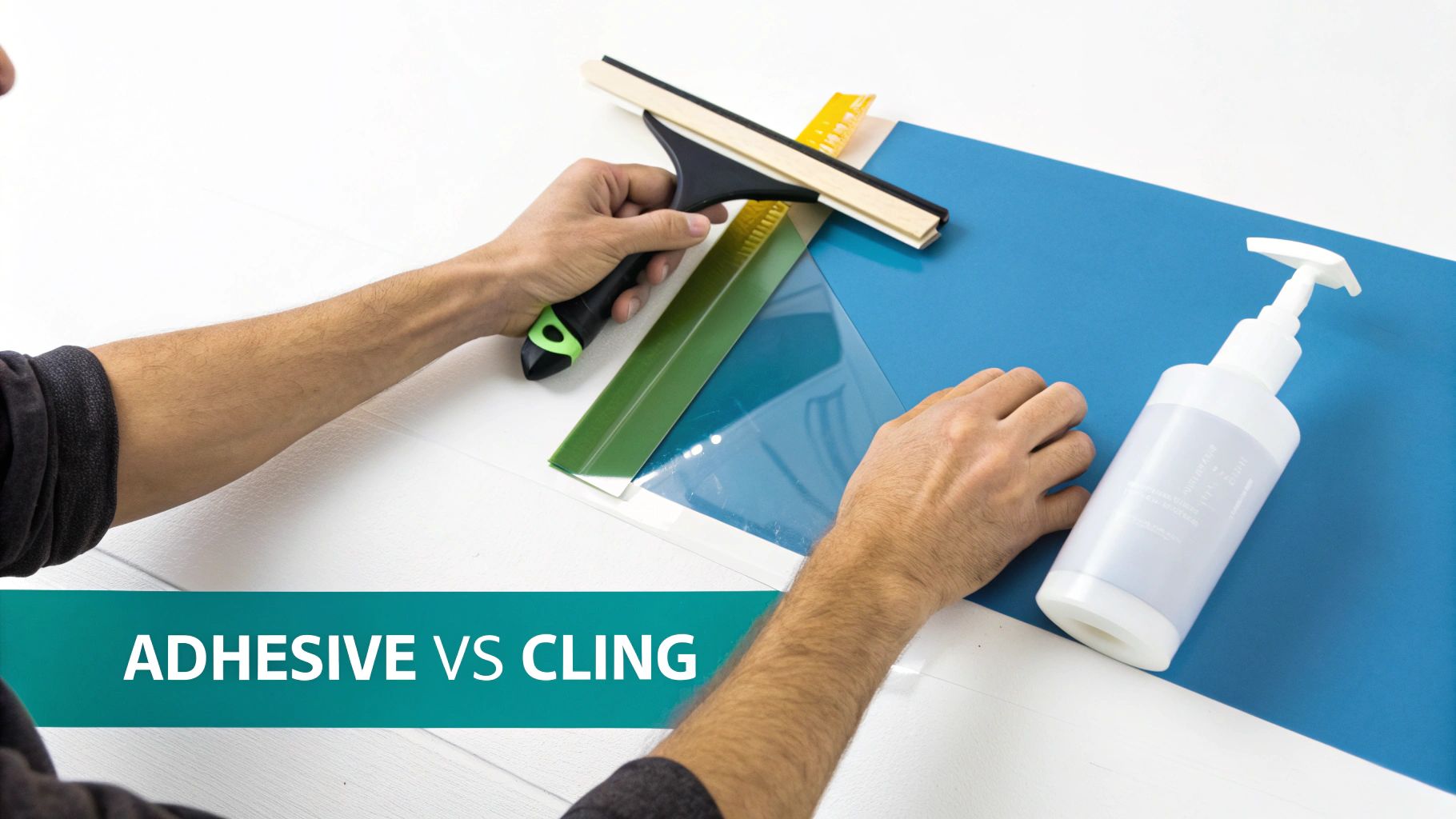
When you’re looking at window films, the material itself is only half the story. The other crucial decision is how it actually attaches to the glass. Are you going for a permanent adhesive or a more flexible static cling? This choice has a huge impact on the installation, how long it lasts, and whether you can take it with you if you move – a massive consideration for both UK homeowners and renters.
It’s not as simple as 'permanent' versus 'temporary'. Think of it more as longevity versus flexibility. An adhesive film is designed to stay put, forming a tough bond that can handle years of cleaning and British weather. On the other hand, static cling film is the non-committal option you can apply, remove, and even reuse whenever you fancy a change.
Each method has its own clear advantages depending on what you need and where you live. Getting this right is key to picking a film that fits your lifestyle perfectly.
The Case for Adhesive Window Film
Adhesive-backed film is your long-term, robust solution. It uses a strong, transparent adhesive to create a semi-permanent bond with the glass, making it incredibly durable. This is why it’s the go-to choice for high-traffic areas or steamy rooms like bathrooms, where there's less chance of it peeling away.
Getting it on the glass is a bit more meticulous. You'll generally use a wet application with a soapy water solution, which lets you slide the film into the perfect position before you squeegee the water out. Once it sets, that bond is solid and built to last for a decade or more without any trouble.
- Best for: Homeowners, bathrooms or other high-humidity rooms, and any window where a long-lasting, durable finish is the number one priority.
- Durability: Excellent. It stands up to peeling, bubbling, and regular cleaning far better than a static cling version.
- Removal: It can be removed, but it takes a bit more effort. You’ll likely need a hairdryer to warm the adhesive, then peel it back carefully. You might need a glass scraper for any stubborn bits of residue left behind.
Think of adhesive film as a real commitment. It's the 'fit and forget' option that gives the most professional, lasting finish – perfect if you're settled in your forever home.
The Flexibility of Static Cling Film
Static cling window film is the undisputed champion of temporary and renter-friendly decor. It sticks to glass using nothing more than static electricity and a mist of water, which means there’s absolutely no sticky residue to deal with when you take it down. For tenants, this is a dream – you can add privacy without worrying about your security deposit.
The application process is also incredibly forgiving. If you don't get it straight the first time, you just peel it off and have another go. This reusability is a major selling point. You could put a film up for winter, store it over summer, and reapply it next year. It’s also a brilliant way to test out different styles without making a permanent change.
This kind of non-adhesive vinyl is so versatile it’s become a favourite for all sorts of DIY projects. In fact, you'll see people using similar stick-on vinyls for quick furniture makeovers, just like in this BBC feature on furniture wraps that can completely transform a room.
Head-to-Head Comparison
To make the choice easier, here’s a straightforward comparison of the two methods based on the factors that matter most.
| Feature | Adhesive Film | Static Cling Film |
|---|---|---|
| Best For | Homeowners, long-term installs | Renters, temporary needs |
| Durability | High (10+ years) | Moderate (reusable) |
| Installation | Less forgiving, requires care | Very forgiving, repositionable |
| Removal | Requires heat and effort | Peels off cleanly in seconds |
| Residue | Possible, may need cleaning | None |
| Cost | Often slightly higher | Typically more affordable |
Ultimately, the best method really does come down to your situation. If you own your home and want a durable privacy solution that will stand the test of time, adhesive film is the clear winner. But if you're renting, love to switch up your decor, or just need something seasonal, the zero-commitment flexibility of static cling film is unbeatable.
Real-World Scenarios: Putting Privacy Film to the Test
It's one thing to know the difference between frosted and reflective film, but it's another to see how they actually solve those everyday privacy problems we all face. So, let's move from theory to practice.
Here are a few classic situations that UK homeowners and renters run into, and my top recommendation for the perfect film for the job. This should help you picture exactly how a specific film could work in your own home, whether you're in a busy city flat or a quiet suburban street.
Scenario 1: The Overlooked Bathroom Window
This is the big one, isn't it? You need absolute, around-the-clock privacy in the bathroom, but plunging it into darkness isn't an option. Nobody wants to lose that precious natural light that makes a space feel clean and airy. Plus, constantly pulling blinds in a steamy room is a recipe for damp and mould.
The Challenge: Getting 100% two-way privacy, day and night, without sacrificing sunlight.
The Solution: Frosted Window Film.
Hands down, frosted film is the champion for bathrooms. It does a brilliant job of completely obscuring the view from outside—turning any figures into vague, unidentifiable shapes—while beautifully diffusing the sunlight that comes through. This creates a soft, ambient glow that lights up the room perfectly. Best of all, it works just as well at night with the lights on as it does during the day, giving you total peace of mind.
A high-quality vinyl film is also built to handle moisture and humidity, making it a far better choice for a bathroom than traditional curtains or blinds. It's the ideal, no-compromise solution. You can also explore other innovative uses for vinyl wraps and wall stickers to transform your bathroom, giving the whole room a cohesive, stylish update.
Scenario 2: The Ground-Floor Living Room
If your living room window faces the street, you'll know that 'goldfish bowl' feeling. Every passer-by can glance in, which can make you feel a bit exposed when you're just trying to relax. You want to stop the prying eyes, but you still want to be able to see out into your garden or watch the world go by.
The Challenge: Stop people from looking in during the day, while keeping your own view clear.
The Solution: One-Way Mirror Film.
This is exactly what one-way mirror film (or reflective film) was made for. It works by reflecting the side with the most light. So, during the daytime, the outside of your window becomes a mirror, stopping anyone from seeing in. From your sofa, however, your view is perfectly clear. You can enjoy an unobstructed view without feeling like you're on display.
A crucial thing to remember: the effect reverses at night. As soon as you turn your lights on inside, making it brighter than the darkness outside, people will be able to see in. For that reason, it's always best to pair one-way mirror film with curtains or blinds for guaranteed night-time privacy.
Scenario 3: The Internal Glass Door
Lots of homes have glass panels in internal doors, maybe leading to a home office, utility room, or pantry. They’re great for letting light flow through the house, but they can also put clutter on display or fail to create a proper sense of separation between rooms.
The Challenge: Add a bit of privacy and style to an internal door without making the hallway dark.
The Solution: Decorative or Patterned Film.
This is where you can have some real fun. Decorative films are a fantastic way to add both personality and privacy in one go. You can find everything from elegant reeded glass effects and geometric patterns to lovely botanical prints, so it’s easy to pick a style that matches your home’s decor. A good pattern breaks up the line of sight just enough to hide what’s behind the door, turning a boring pane of glass into a real design feature.
The level of privacy you get will depend on how dense the pattern is. A busy, frosted design will hide more than a simple, clearer pattern. This makes decorative films a brilliantly versatile and attractive choice for inside the home.
The need for better privacy is a growing concern for UK households. In 2023 alone, over 500,000 UK households installed privacy films, driven by a desire for more control in increasingly built-up areas. This shows that people are seeing film not just as a design choice, but as a practical tool for creating a more private and secure home. You can learn more about the trends driving the European window film market on marketresearchfuture.com.
How to Get a Perfect Finish When Installing Window Film
Getting a flawless, professional-looking finish with window film is much easier than you might think. With the right prep and a bit of patience, you can get a smooth, bubble-free result that completely transforms your space. I'll walk you through the essential steps, from measuring up to applying the film like a seasoned pro.
Whether you've gone for an adhesive or a static cling film, the basic method is the same. The real secret is a squeaky-clean surface and a very wet application. This is what lets you slide the film into the perfect position before it sticks.
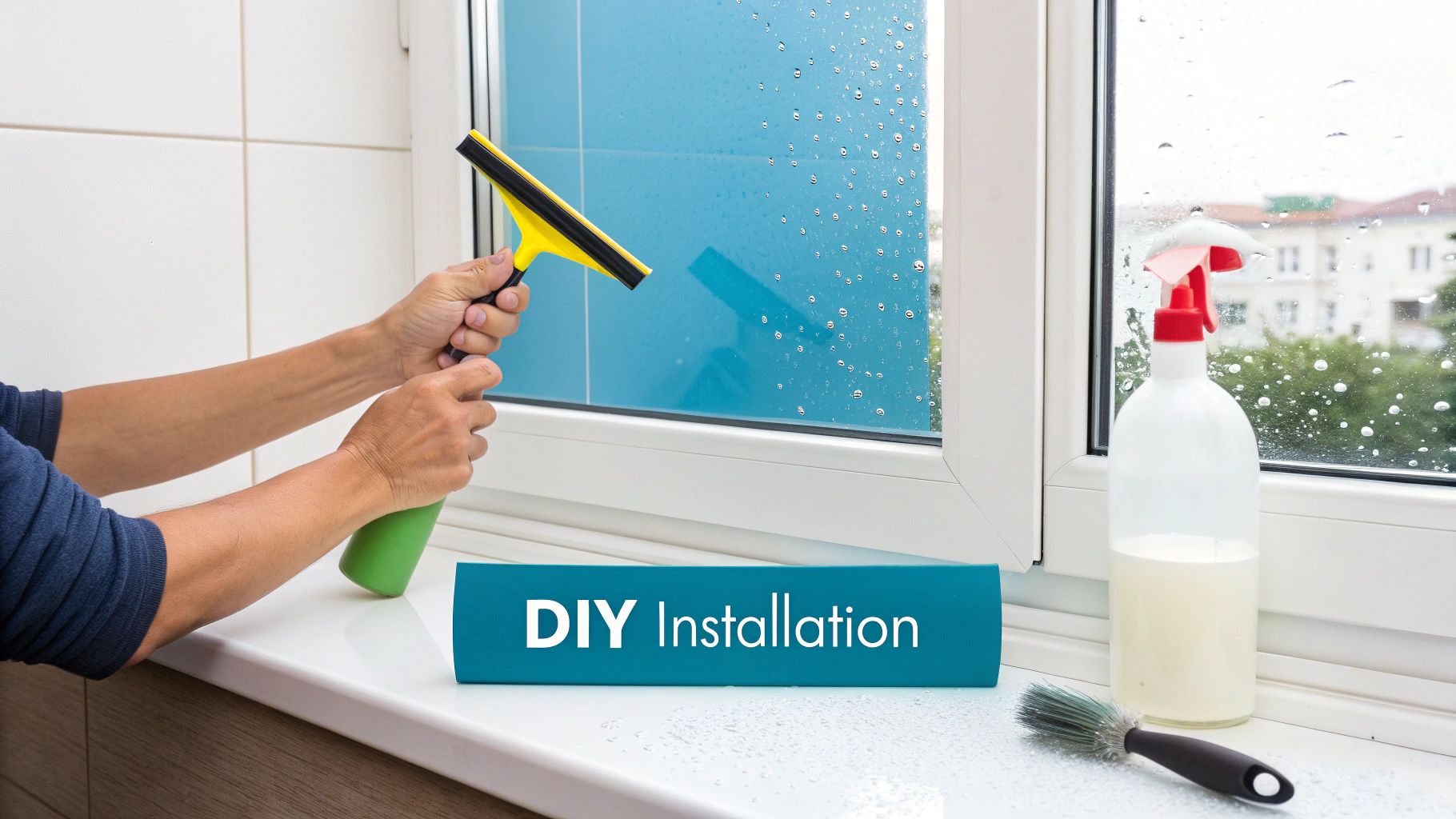
Gathering Your Tools and Prepping the Glass
Before you even think about unrolling your film, get your tools ready and, most importantly, get that window properly prepped. A pristine surface is absolutely non-negotiable for a good finish. Any tiny speck of dust or grime will become a frustrating little bubble trapped under the film.
Here’s what you’ll need to have on hand:
- Spray Bottle: Just fill it with water and add a few drops of a mild washing-up liquid. This soapy solution is your best friend, acting as a lubricant to help you position the film without any fuss.
- Squeegee or Credit Card: You need a firm but flexible edge to push out all the water and air bubbles. A proper squeegee is ideal, but a sturdy credit card wrapped in a soft cloth will do the job in a pinch.
- Sharp Craft Knife: This is for trimming the film to the exact size of your glass for that sharp, clean look.
- Lint-Free Cloth: Essential for cleaning the glass and mopping up any excess water.
- Tape Measure & Ruler: For accurate measurements and to give you a straight cutting edge.
Once your kit is ready, it's time to clean. Give the window a thorough wash with your soapy water and a clean cloth. Pay extra attention to the corners and edges, as that's where grime loves to hide. After washing, I recommend scraping the glass clean with your squeegee to make sure it's completely free of any residue.
A Step-by-Step Guide to a Flawless Application
With your window sparkling, you’re ready to get the film on. Just take your time with these steps and don’t be afraid to use plenty of that soapy water—it really is the key to getting a repositionable, bubble-free application.
- Measure and Cut: Carefully measure your window pane. A good rule of thumb is to cut the film about 2-3 cm larger on all sides. This extra margin gives you a bit of wiggle room and ensures full coverage, as you'll trim off the excess later for a perfect fit.
- Wet the Window: Generously spray the clean glass with your soapy water solution. Don't be shy here; the window should be dripping wet. This watery surface is what allows the film to glide into place.
- Peel and Apply: Start peeling the backing layer from the film. As you do, spray the newly exposed side of the film (the sticky or clingy part) with the solution as well. This clever trick stops it from curling and sticking to itself.
- Position the Film: Carefully place the wet side of the film onto the wet glass. That double layer of water will let you slide it around effortlessly until it’s exactly where you want it.
- Squeegee from the Centre: Once you’re happy with the positioning, grab your squeegee. Starting from the centre of the window, push the water and air bubbles out towards the edges. Work methodically from the middle outwards to ensure you get all that trapped moisture out.
- Trim the Edges: Using your ruler as a guide, press a sharp craft knife into the corner where the glass meets the frame. Trim away the excess film all the way around for a neat, professional edge.
- Final Squeegee: Give the film one last pass with the squeegee, focusing on the edges to push out any remaining water. Wipe the window and surrounding frame dry with your lint-free cloth, and you're done!
Top Tip: If you spot a stubborn bubble after the film has started to dry, don't panic. You can usually fix it by pricking it with a fine pin and then carefully pushing the trapped air out with your squeegee.
For a more detailed walkthrough, you can also check out our comprehensive guide on how to install window privacy film, which breaks down every single step.
Looking After Your New Privacy Film
Keeping your window film looking great is simple. To clean it, just use a soft, lint-free cloth and either a mild, non-abrasive cleaner or the same soapy water you used for the installation. Be sure to avoid any harsh chemicals or scrub brushes, as these can easily scratch or damage the film’s surface. With a little bit of care, your new film will provide privacy and style for years to come.
A Few Final Questions Answered
Even after weighing up all the options, you probably have a couple of lingering questions. That’s completely normal. Choosing the right window film is a balancing act between style, light, and pure practicality, so it’s smart to get every detail sorted before you make a decision. Let's tackle the most common queries we hear from customers.
Can People See Through Privacy Film at Night?
This is a big one, and the answer completely hinges on which type of film you've chosen. The effectiveness of certain films flips once the sun goes down, a crucial detail for ground-floor living rooms or bedrooms.
-
Frosted, Opaque, and Blackout Films: Rest easy. These types offer two-way privacy, day and night. Because they physically obscure the view, their performance doesn't depend on the lighting conditions. Once they’re up, you’re covered 24/7, even with the lights on inside.
-
One-Way Mirror (Reflective) Films: This is where it gets tricky. These films do not work for privacy at night. Their magic mirror effect is powered by a light imbalance – it needs to be much brighter outside than inside. At night, when your lights are on, that balance reverses. Suddenly, people outside can see in perfectly, while all you'll see is a reflection of your own room.
Because of this, we always recommend pairing one-way mirror film with curtains or blinds. It’s a brilliant solution for daytime privacy but can't be relied on for seclusion after dark.
Does Privacy Film Also Reduce Heat and Block UV Rays?
Yes, absolutely. Many privacy films are multi-taskers, offering some brilliant secondary benefits that protect your home and can even trim your energy bills.
Most of our films, including the frosted and decorative styles, are designed to filter out the vast majority of damaging ultraviolet light. We’re talking about blocking over 95% of UV rays – the main culprit behind faded furniture, flooring, and artwork. It’s an invisible shield for your interiors.
On top of that, some films are specifically engineered to tackle solar heat. Reflective mirror films are the champions here. By bouncing a portion of the sun’s energy away from the glass, they help keep rooms noticeably cooler in the summer. This means less work for your fans or air conditioning and a welcome saving on your electricity bill.
How Long Does Window Film Last and Is It Easy to Remove?
The lifespan and removal process really come down to one key difference: adhesive vs. static cling. Your choice depends on whether you're looking for a long-term fixture or a flexible, temporary solution.
A good-quality adhesive-backed film is a semi-permanent solution. When it's applied properly, you can expect it to last for 10-15 years without bubbling, peeling, or changing colour. Taking it off takes a bit of work. You’ll generally need a hairdryer to warm and soften the adhesive, then you can peel it away. A scraper might be needed for any stubborn residue.
Static cling film, on the other hand, is all about flexibility. It’s not quite as durable as its adhesive cousin, but it will still look great for several years with a bit of care. The real selling point? It peels off the glass in seconds, leaving absolutely no sticky residue. This makes it the perfect choice for renters or anyone who likes to switch up their decor. You can even store it and reuse it later.
Ready to find the perfect balance of light and privacy for your home? At Quote My Wall, we offer a fantastic range of renter-friendly static cling and durable adhesive window films to suit any space. Explore our collection and transform your windows today!