

Kids Vinyl Wall Stickers: Transform Rooms Safely
You're probably in one of two situations right now. Either your child has suddenly developed very firm opinions about dinosaurs, rainbows or jungle animals, or you're staring at a plain wall thinking, “I want this room to feel special, but I do not want a full decorating project.”
That's exactly where kids vinyl wall stickers come in. They give you colour, personality and a sense of occasion without the mess of paint, the commitment of wallpaper or the stress of calling in help for a “simple” bedroom update that somehow turns into a weekend-long job.
For parents in the UK, they make even more sense. Many families want a room that can grow with their child, work in a rented home, and still feel polished. A wall sticker can turn a cot corner into a nursery nook, lift a playroom that feels a bit chaotic, or soften a boxy bedroom with something playful and personal.
Done well, they look thoughtful rather than temporary. Done badly, they can peel, tear, smell odd or look out of proportion. That's why choosing them properly matters more than is commonly understood.
The Easiest Way to Create a Magical Kids Room
A lot of parents want the same thing. They want the room to feel magical for their child, but sensible for them. That usually means avoiding anything too permanent, too expensive or too disruptive.
I see this all the time with younger families. A child moves from cot to bed, toys start multiplying, and suddenly the room needs a stronger identity. You want stars over the bed, woodland animals near the book corner, or a name decal above a chest of drawers. But you also know tastes change fast, and children's rooms rarely stay the same for long.
That's one reason kids vinyl wall stickers have become so popular. They're easy to add, simple to update and much less daunting than wallpapering an entire room. The wider kids wall sticker market is projected to grow from $1.2 billion in 2024 to $2.5 billion by 2033, with a projected 9.5% CAGR, and the UK is identified as a primary adoption hub where parents favour stickers as a cheaper, non-permanent alternative to wallpaper, according to this market projection for the kids wall sticker segment.
Why parents reach for stickers first
There's a practical reason this works so well in children's rooms.
- Fast impact: A blank wall can change in an afternoon.
- Less commitment: If your toddler moves on from clouds to construction vehicles, you're not stuck.
- Rental-friendly appeal: Many parents want personality without the worry of a full redecoration.
- Room-by-room flexibility: You can decorate one wall, one corner or even one piece of furniture.
A child's room doesn't need a full makeover to feel transformed. Often, one focused visual area does the job better than a room crammed with themes.
What makes them feel magical rather than messy
The secret isn't choosing the busiest design. It's choosing a design with purpose.
A moon-and-stars cluster above the bed creates a bedtime zone. Animals around a reading chair make that corner feel intentional. A row of small decals near low-level storage can help a room feel playful without swallowing the space.
Parents often assume stickers are a compromise because they're easier than paint or wallpaper. In truth, they're often the smarter design decision. They let you test an idea, add charm where it counts and keep the room adaptable as your child grows.
Understanding Sticker Quality Safety and Materials
The prettiest design in the world isn't worth much if the material is poor. In kids' rooms, this matters even more because you're not only thinking about how a sticker looks. You're thinking about what it's made from, how it behaves on your walls and whether it belongs in a nursery or bedroom at all.
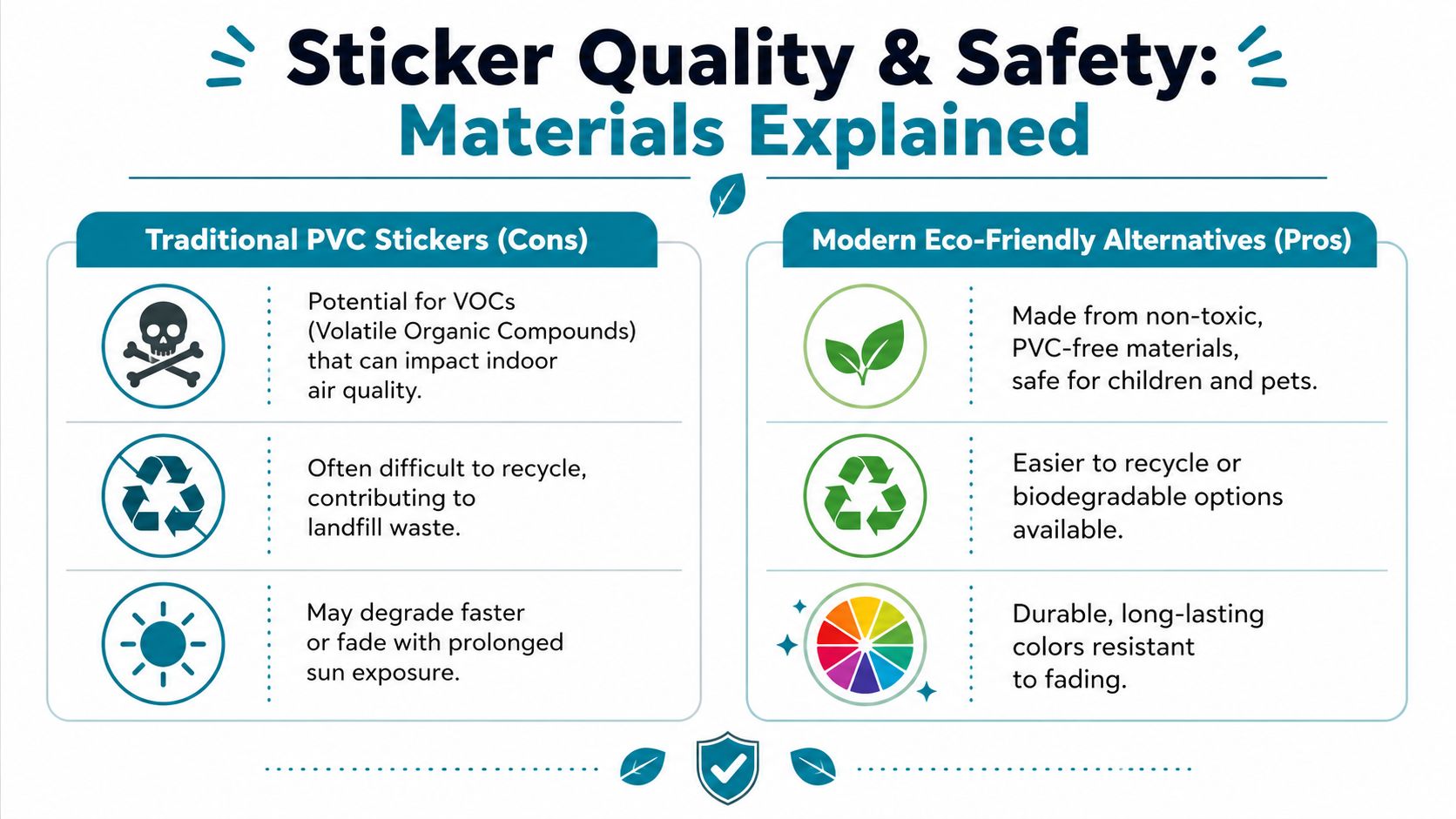
Historically, many vinyl products were made with PVC, and PVC-based materials can release VOCs that have been linked to worsening asthma and eczema in children. That's one reason many UK parents now look for non-toxic, phthalate-free options, as outlined in this explanation of non-toxic wall decals for nursery use.
What safety language actually means
Parents often get tripped up by product wording. “Vinyl” sounds straightforward, but not all vinyl products are equal.
Here's the plain-English version:
| Material question | What it means for your child's room |
|---|---|
| PVC-based | More reason to check safety details carefully |
| Non-toxic | A better starting point for bedrooms and nurseries |
| Phthalate-free | Important if you want to avoid common plastic additives |
| Low odour | Helpful, but not the same as a full safety claim |
If a listing is vague, I'd pause. In a nursery, “probably fine” isn't a standard.
Practical rule: If a seller clearly explains the material, the adhesive and where the sticker is suitable for use, that's a better sign than a listing that only talks about colour and style.
The durability detail most shoppers skip
Premium quality also shows up in how the material handles itself during application. A sticker that tears when you reposition it or scuffs while smoothing is frustrating from the start.
One useful technical benchmark comes from a wall sticker material sheet based on DIN EN ISO 527, which states a minimum tensile strength of 30 MPa along the material axis and 28 MPa across it. In practical terms, that strength helps the material resist tearing and scratching during application and removal, especially on uneven or slightly textured nursery walls, as shown in this technical wall sticker datasheet.
That sounds technical, but the benefit is simple. Stronger material is less likely to stretch out of shape, split at the edges or fail when you smooth it around corners and curves.
What to look for before you buy
When I'm helping a parent compare options, I suggest checking these points first:
- Material details: Look for clear mention of non-toxic and phthalate-free construction.
- Surface guidance: Good sellers say where the sticker works and where it doesn't.
- Finish quality: Matte and soft-sheen finishes usually look more like part of the room.
- Use case: Nursery walls, furniture panels and toy storage don't all need the same product.
If you're interested in stickers for hard surfaces too, the benefits of UV-DTF technology are worth understanding because that process is often useful for decor on objects and furniture rather than just flat painted walls.
For design-led inspiration that's still practical for family spaces, this guide to playroom wall stickers in the UK is a helpful starting point.
How to Choose the Perfect Sticker Design and Size
Most wall sticker mistakes aren't about taste. They're about scale. Parents pick something lovely, then it arrives and either disappears on the wall or overwhelms the whole room.
The easiest way to choose well is to start with the room's job. Is the room mainly for sleep, play, reading, or a bit of everything? A calm sleeping space suits softer placement and gentler shapes. A playroom can handle bolder arrangements and more movement.
Match the sticker to the wall's role
Think of walls in three simple categories.
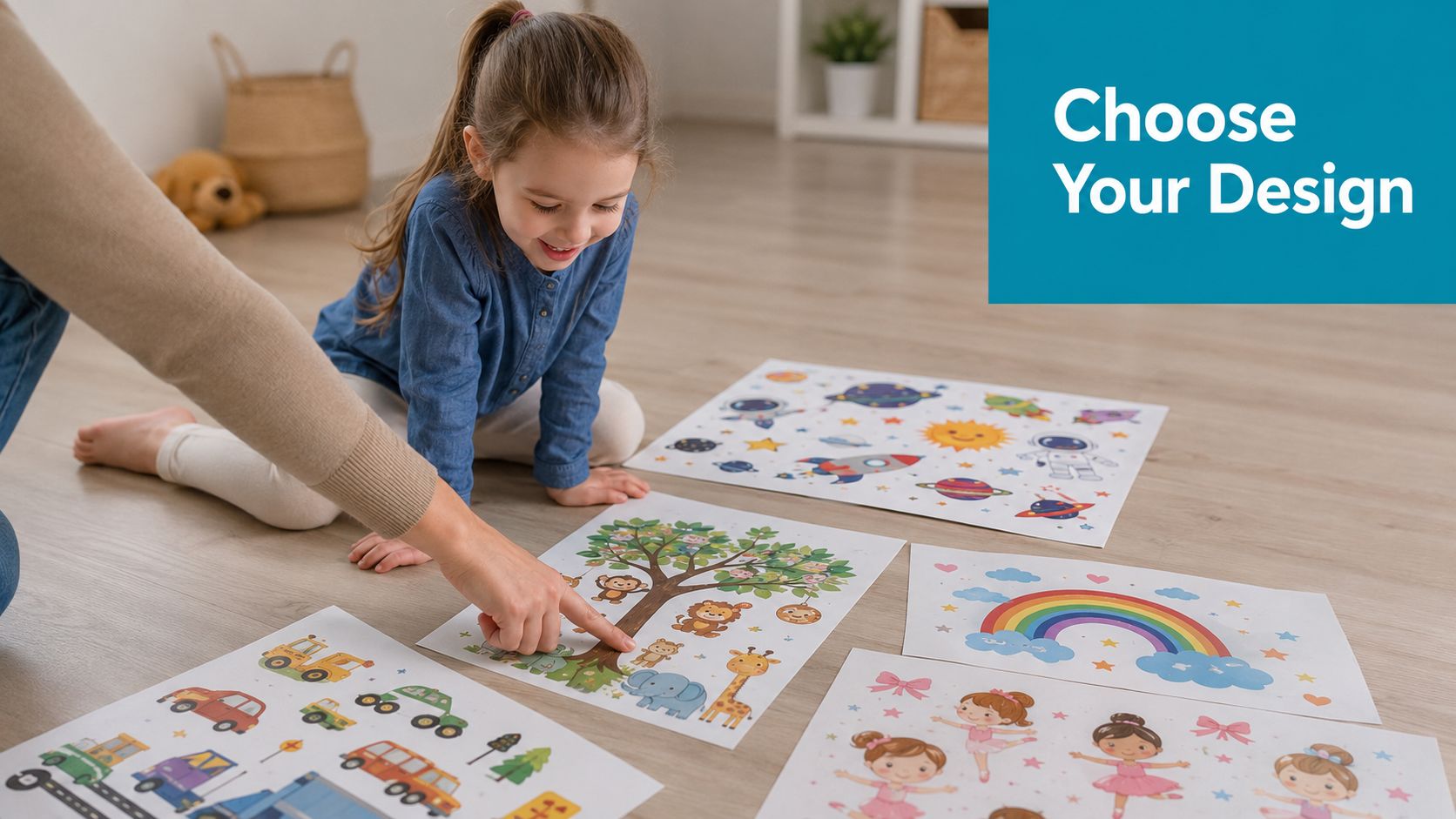
- Feature wall: Best for larger scenes such as safari animals, fairy woodland themes or clouds drifting behind a bed.
- Accent wall: Better for smaller clusters near shelving, desks or reading nooks.
- Support space: Ideal for names, stars, hearts, dots or a few tiny motifs that tie the room together.
A common error is trying to fill every blank bit of wall. Children's rooms usually look better when one wall leads and the others support.
A simple measuring method that works
You don't need a design app. You need a tape measure, masking tape and about ten calm minutes.
- Measure the width and height of the area you want to decorate.
- Mark out the sticker's likely footprint with masking tape.
- Step back to the doorway.
- Check it again from the child's eye level if you can.
- Notice what sits nearby, such as a bed frame, lamp, shelf or radiator.
That last point matters. A sticker doesn't live on the wall in isolation. It shares space with furniture, curtains and storage.
If the design only looks balanced when you stand right in front of it, it's probably the wrong size. It should make sense from the doorway first.
Choose styles that age well
Some themes have staying power because they're flexible. Stars, animals, florals, rainbows, maps and simple name decals can suit a room for years. Very age-specific graphics can still be fun, but they tend to have a shorter life.
Try this quick guide:
| If your room feels... | A good sticker choice |
|---|---|
| Small and boxy | Vertical elements like trees, rockets or floating balloons |
| Long and narrow | Repeating motifs spread across one side |
| Busy already | One larger focal design, not lots of mini decals |
| Plain and bland | Layered scene or grouped character set |
If you're unsure, choose the room's quietest wall and build from there. It's much easier to add a second small detail later than to undo an oversized first choice.
Your Foolproof Guide to Flawless Installation
Application worries put a lot of people off, but wall stickers are one of the simplest decorating jobs once you slow the process down. Most problems come from rushing, sticking onto dusty paint, or trying to handle a large decal all at once.
This is the point where preparation saves you.
Before the sticker touches the wall
Get your tools together first. You don't need anything fancy.
- A microfibre cloth: For dust and surface prep.
- Mild cleaner if needed: Only if the wall has marks or greasy patches.
- Painter's tape: To test the placement.
- A squeegee or old bank card: For smoothing.
- Small scissors: Helpful for separate elements.
The wall must be clean and fully dry. If there's dust, the adhesive grabs the dust instead of the paint. If there's moisture, the sticker may not settle properly.
The application rhythm that prevents bubbles
I always tell parents to think of it as a slow hinge movement, not a slap-on job.
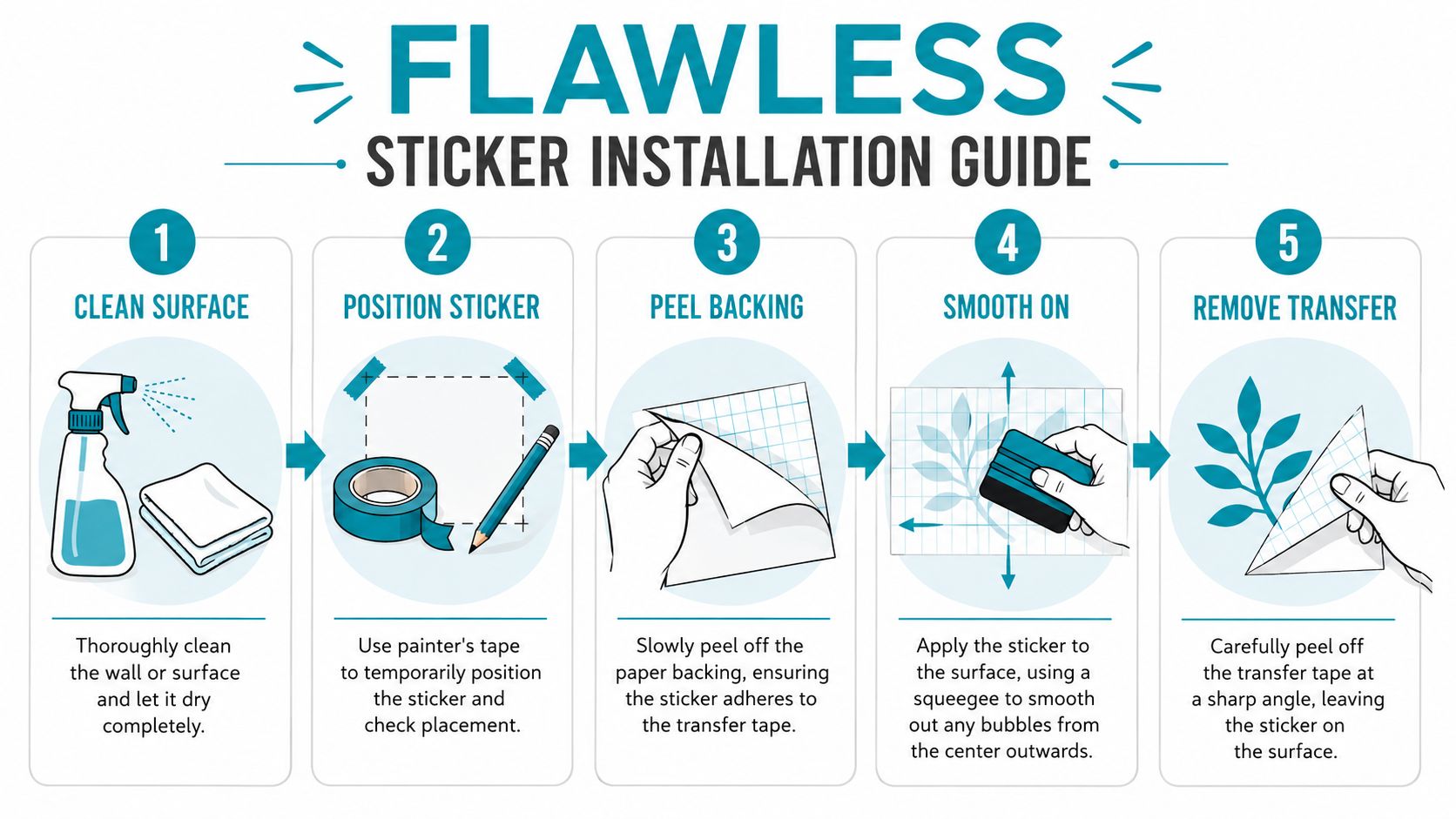
- Test the position first. Hold the sticker in place with painter's tape and stand back.
- Start from one edge or the top. Don't peel all the backing off immediately.
- Peel a little, stick a little. Smooth as you go rather than after the whole piece is on.
- Work from the centre out. That helps push trapped air away from the middle.
- Check corners and thin details. These are the parts most likely to lift if not pressed down properly.
If you're using individual shapes like stars or raindrops, lay them out on the floor first. That lets you spot spacing problems before you commit to the wall.
For a more visual walkthrough, this step-by-step guide on how to apply wall stickers can help if you prefer to see the process broken down.
What to do if something goes wrong
Small bubbles happen. They're usually easy to fix.
- A trapped bubble appears: Lift that section gently and smooth it back down.
- The sticker looks crooked: Stop early and reposition before pressing the whole thing firmly.
- A corner won't stay down: Press again with a cloth-covered squeegee and make sure the wall is clean.
- The design tears while handling: That often points to thinner, lower-grade material or over-stretching during placement.
Go slower with large decals than you think you need to. Most installation problems start with trying to finish quickly.
One more insider tip. Large wall stickers almost always look better if they sit a little lower than people first expect. That keeps them visually connected to the bed, chest or play area below rather than floating awkwardly in the top half of the room.
Safe Removal and Long-Term Sticker Care
One of the biggest reasons parents choose wall stickers is the freedom to change their minds. That matters in rentals, but it matters just as much in family homes where rooms need to evolve. A nursery becomes a toddler room, then a child's bedroom, and suddenly those sleepy little clouds don't fit anymore.
Removal is usually straightforward if you're gentle.
How to remove stickers without stressing the wall
The safest method is slow heat and slow peeling.
- Warm a small section with a hairdryer on a low setting.
- Start at a corner rather than the middle.
- Peel back gradually at a shallow angle.
- Keep adding gentle warmth as you go if the adhesive feels firm.
- If any residue remains, wipe it with a soft cloth and a mild surface-safe cleaner.
Don't yank. That's what risks lifting paint, especially on walls with older decorating layers or weaker paint adhesion.
If you want a more detailed walkthrough, this guide on how to remove wall stickers is useful for seeing the process in a more methodical way.
Daily care that helps them stay neat
Wall stickers don't need much maintenance, but a few habits help.
- Dust lightly: A dry microfibre cloth is usually enough.
- Avoid soaking the edges: Too much moisture can work its way under the adhesive.
- Watch direct heat: Stickers placed very near radiators may age faster.
- Check lifting early: Pressing down a corner early is easier than dealing with a curled edge later.
What renters should keep in mind
If you rent, it's sensible to test a small, less visible area first. The sticker may be removable, but the paint underneath also needs to be sound. Freshly painted walls, flaky patches and budget repaint jobs in older rentals can all be more delicate than you expect.
A good rule is this. If the wall surface already seems unstable, the sticker isn't the problem. It reveals a weak base.
Old paint, chalky paint and poorly prepared walls are the main reason a “removable” product becomes a tricky removal job.
With decent prep, careful use and calm removal, wall stickers are one of the least disruptive ways to update a child's room.
Creative Ideas Beyond Just the Walls
Some of the nicest children's rooms I've worked on didn't stop at the walls. They used matching or complementary vinyl details to pull the whole room together. That's often what makes a space feel designed rather than just decorated.
A plain room can change completely when the walls and furniture start speaking the same visual language.
The toy chest that becomes part of the theme
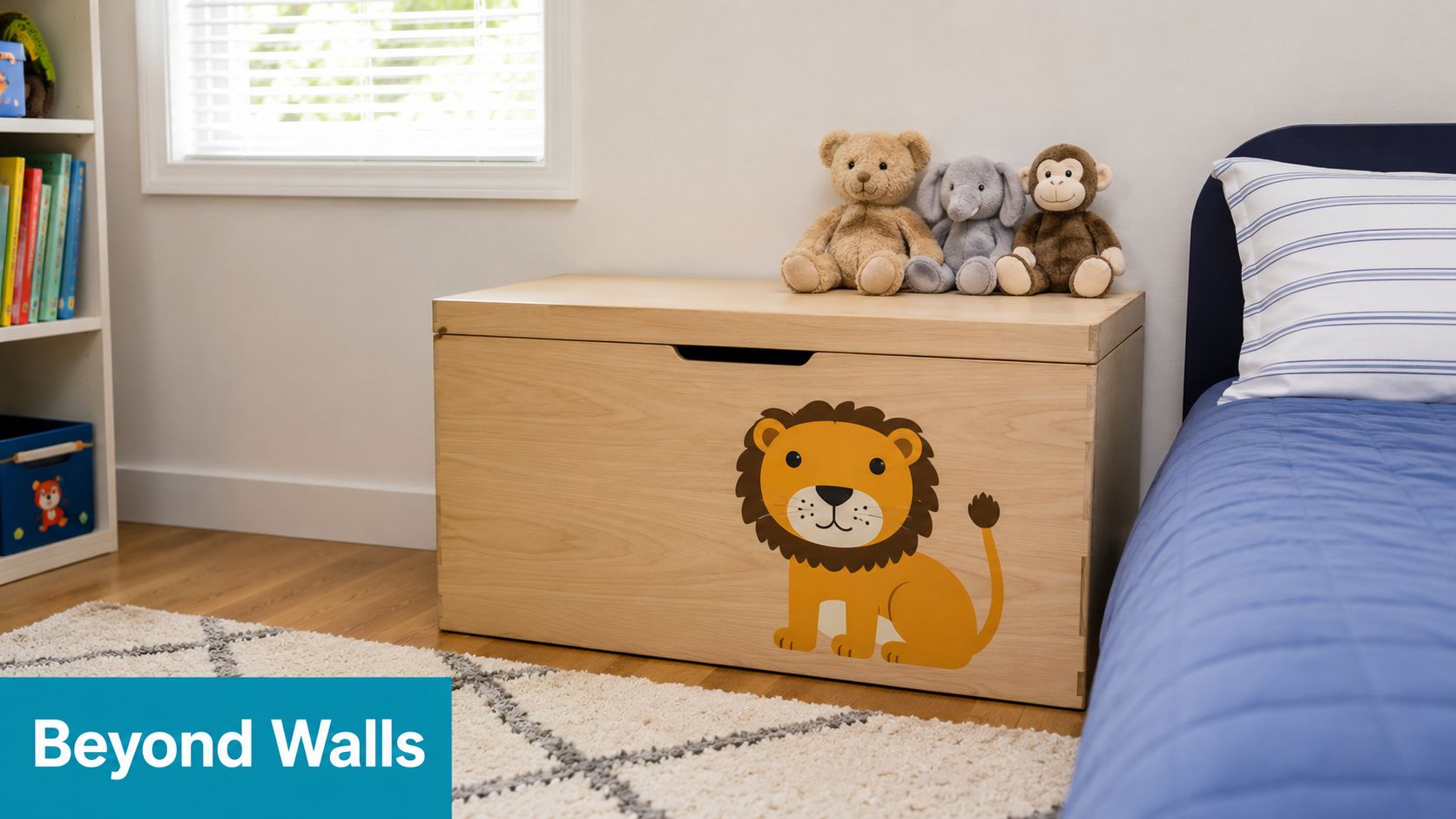
One of my favourite low-effort upgrades is a toy box. It's usually a practical piece first and a pretty one second. Add a simple animal decal, a set of stars or a name label, and suddenly it feels intentional.
A lion decal on a wooden chest can echo a safari wall theme. Soft flowers can tie into a cottage-style bedroom. A row of diggers can make storage feel fun enough that toys might even get put away more willingly.
Furniture pieces worth updating
You don't need to wrap an entire room. Start with one hardworking item.
- Bedside table fronts: Ideal for small motifs or patterned panels.
- Drawer units: Good for repeated shapes that make basic flat-pack furniture look custom.
- Wardrobe doors: Better for larger simple designs than lots of tiny details.
- Bookshelves: Great for playful side panels or labels that help organise toys and books.
This approach works especially well when the room is already furnished and you don't want to replace perfectly decent pieces just to match a new theme.
How to keep it tasteful
The trick is repetition, not overload. Pick one wall design, then echo one element elsewhere. If the wall has woodland animals, you might repeat leaves or acorns on a chest of drawers. If the room uses stars, repeat the stars on a bookcase side or storage bench.
For product options, one source parents often use is Quote My Wall, which offers nursery wall stickers and vinyl wraps for furniture, so the room can carry one theme across both walls and upcycled pieces without needing a complete refit.
A room feels more expensive when details relate to each other. That doesn't require a big budget. It just requires restraint.
Answers to Your Top Wall Sticker Questions
Parents usually ask the same practical questions once they've picked a design. These are the ones that matter most in real homes.
Can I apply them to textured walls
Sometimes, but it depends on the texture. Light texture may be manageable with a stronger, better-quality material. Heavy texture, crumbly plaster or rough paint usually causes trouble. The more uneven the wall, the harder it is for the adhesive to make full contact.
Are they suitable for bathrooms or humid areas
They can work on suitable surfaces, but children's wall stickers are usually happiest in dry, well-ventilated rooms. If you're using them outside a bedroom or playroom, pay close attention to the surface type and moisture in the space.
How do they hold up in damp UK homes
This is one of the most overlooked questions. 60% of UK homes experience condensation, especially in bedrooms, and many stickers are sold with broad durability claims rather than guidance for damp conditions. In practice, that means choosing a premium vinyl tested for the UK climate matters if you want to reduce peeling and edge lift over time.
Can I get custom stickers made
Yes, many suppliers offer personalised options such as names, custom colours and made-to-fit sizing. That's useful if you're working around alcoves, sloped ceilings, shelves or a very specific colour scheme.
Will they damage paint when removed
They shouldn't if the wall is in good condition and you remove them slowly. Most problems happen when the paint underneath is already weak, very fresh, or poorly bonded to the plaster.
What's the safest choice for a nursery
Look for clear material information, especially around non-toxic and phthalate-free construction. If a product description is vague about what it's made from, keep looking.
Are imported stickers always the same quality
Not necessarily. Two stickers can look similar online and behave very differently once they're on the wall. In UK homes, moisture and condensation make material quality and adhesive performance more important than the product photos suggest.
If you're ready to decorate without turning it into a full renovation, Quote My Wall offers kids' room wall stickers, nursery designs and furniture vinyl options that can help you create a room that feels playful, practical and easy to update as your child grows.