
Hot Air Balloon Wall Stickers: Designs and Placement
Your wall is bare, the cot arrives on Friday, and there's a half-used tin of matt emulsion in the cupboard under the sink. You want something up before the first night that looks like a decision rather than a gap, and a hot air balloon wall sticker looks like a twenty-minute job with no paint tray involved.
It can be that simple. It can also lift at the edges on silk paint, sit exactly where a toddler can pick at it, or cost you part of a deposit you'd rather keep. Almost nothing that decides which of those happens is visible in a product photo.
What follows runs in the order you'll decide it: which design, which wall, whether it belongs near a cot, what the materials do, how to fit it, and what your tenancy says.
Hot Air Balloon Wall Sticker Designs at a Glance
Five design types cover most of what UK shops sell, and they behave very differently once they're on a wall.
| Design | What it looks like | Approximate wall size | Pieces |
|---|---|---|---|
| Single large balloon | One balloon with basket on a plain background | 60-90 cm wide | 1 |
| Balloon cluster | Three to five balloons at different heights | 1-1.5 m wide | 3-5 |
| Balloon with clouds or rainbow | Balloon framed by cloud or rainbow shapes | 80-120 cm across | 2-4 |
| Silhouette over hills | Dark balloon outlines against a sunrise sky | 1-2 m wide | 1 large sheet |
| Panoramic trail | Balloons drifting in a line across the wall | 2-3 m long | 6 or more |
Read the table against your own wall, not against the styling photograph. A panoramic trail wants 2 to 3 m of unbroken width, which rules out most chimney breasts and any wall broken by a doorway. A single large balloon fits a narrow strip beside a wardrobe where a cluster would look cramped.
Single-piece designs go on in one pass. You position it once, smooth outwards, and you're finished. Multi-piece sets take longer because every balloon has to sit at the right height relative to the others, and each overlap point is somewhere a bubble or a lifted edge can start. On a newly painted or silk finish, fewer pieces mean fewer edges to watch.
Sizes above are typical rather than guaranteed, so check the product listing before ordering. The motif also has genuine British history behind it, useful if the sticker is for a child old enough to ask questions: the first manned balloon ascent in Britain came in 1784, and Lunardi's London flight that September drew around 200,000 spectators, as the BBC Bitesize history of early ballooning records.
If the balloon is one of several colour decisions in a rented neutral room, ways to add colour without painting is a sensible companion read before you settle on a palette.
Measure the usable wall width and the clear area around nearby furniture, then shortlist two designs that fit those numbers.
Matching Balloon Stickers to Each Room
| Room | Suitable wall | Keep clear of |
|---|---|---|
| Nursery | Side wall away from the cot | Cot, radiators, windows, blind cords |
| Child's bedroom | Wall facing the room, not above the bed | Area above the bed, headboard wall |
| Playroom | Wall at adult height or higher | Low walls children can reach and peel |
| Classroom or childminder | Display wall with good ventilation | Heaters, radiators, fire doors |
| Living room | Feature wall with clear space around it | Fireplace, heat sources, TV unit |
| Rental flat | Matt-painted wall with landlord consent | Gloss or silk paint, textured plaster |
Two rules generate every row in that table. The first is height: balloon scenes read best at adult eye level or above, where the bottom edge stays out of a small child's reach. The second is that nothing decorative belongs directly over a sleeping or resting place, however well it balances the wall.
Placement rule: choose the wall before you choose the design. A design that fits a 1.2 m gap will always work; a design you love will rarely fit a wall that's mostly window.
Nursery. Pick the side wall that faces the cot rather than the wall the cot stands against, so your baby can see the balloons while lying down and the sleeping space stays clear.
Child's bedroom. The wall facing the door gives the balloons the most visible run, and it keeps them off the headboard wall where a falling object would land on a bed. Hang them to one side of the bed instead of centred over it.
Playroom. Height is the whole game here. Anything within a toddler's reach gets picked at, so put the lowest balloon above shoulder height for an adult.
Classroom or childminder space. A display wall away from radiators and fire doors keeps the vinyl clear of sustained heat, and good ventilation matters if several stickers go up at once.
Living room. A feature wall with clear space around it looks deliberate. Kitchens and fireplace walls don't suit vinyl: heat, steam and grease all attack the adhesive, and the edges fail first.
Rental flat. A matt-painted wall gives the best adhesion and the cleanest removal. Gloss and silk finishes are where most peeling complaints start, and textured plaster won't hold a flat edge.
Before you peel any backing, mark the outline with masking tape and stand back to check the clear zone.
Nursery and Bedroom Placement Rules
A balloon scene arranged above a cot looks balanced in a photograph. It doesn't belong there. UK infant-sleep guidance advises positioning a cot away from wall decorations, windows, radiators, heaters and blind cords, and child-bedroom guidance warns against placing items above beds because objects can fall onto a sleeping child, as BabyCentre's nursery safety guidance sets out.
A flat decal is not the same as a framed print or a mobile. It reduces one hazard and introduces another: a sticker that curls at the corner is a piece of loose vinyl in a room where everything goes in a mouth.
Practical rule: a sticker is only as safe as its worst adhered edge. Check the edges, not the middle.
Three checks cover it. Press every edge firmly after installation, working right around the outline. Look for lifting once a month, particularly in the first fortnight, when any incompatibility with the paint shows up. Remove any peeled piece immediately, because loose vinyl is a small-parts and choking risk for a young child.
That last point is why we don't recommend moving wall stickers in children's bedrooms and nurseries at all, where a lifted piece can be a choking hazard. Treat placement as final.
The three questions parents ask most
Can a hot air balloon sticker go above a cot? No. Keep the sleeping area clear, and put the balloons on a side wall instead.
What if my child can reach the bottom edge? Move the design higher or onto another wall, then check that edge weekly until you're satisfied it's flat.
How do I check for lifting? Run a finger along each edge and look for gaps, curling or a shadow under the vinyl. If it lifts, take that piece off rather than pressing it back down.
If you're setting up the rest of the room at the same time, this safe nursery setup guide covers the furniture side of the same decisions, and our guide to baby nursery wall stickers has more on choosing designs for a sleep space.
Checking Fire and Air Quality Before You Buy
A sticker can look harmless and still change how a wall behaves in a fire. The thing being assessed is never just the balloon: it is vinyl, adhesive, paint or wallpaper, and the air in the room around it. Scottish domestic building guidance warns that multiple layers applied to a wall can increase flame spread and fire-growth rate, and it generally expects internal wall surfaces to reach reaction-to-fire Class C or better in ordinary rooms, with limited allowances for Class D depending on room size and total coverage, according to the Scottish building standards technical handbook.
Treat heat and build-up as the controllable parts. Keep balloons clear of radiators, heaters, spotlights and the warm wall above a fireplace. Avoid large areas of overlapping vinyl, and do not add a busy scene over old wallpaper in a nursery or rental bedroom where extra layers already raise the stakes. For a child-care setting, a rented flat or any higher-risk room, ask for the tested classification and the surface it was tested on.
Air quality deserves the same assembly check. UK guidance identifies wall coverings, adhesives, paints and coatings as potential VOC sources that may keep emitting over months or years, as the DEFRA indoor air quality report sets out. Choose low-emission materials and adhesives with documented emissions testing, let new paint finish curing, and ventilate during and after fitting.
For a rental, keep the seller's answer with your permission note; it supports the deposit conversation later. In a small, stuffy bedroom, use fewer pieces rather than a wall-wide scene. Scotland's handbook applies in Scotland; elsewhere in the UK, check the rules for your area and ask for test evidence either way.
How to Apply a Balloon Sticker Step by Step
A balloon scene usually fails in the same places: a silk painted wall lets an edge lift, the first balloon goes on slightly crooked, air gets trapped under a cloud, or a piece is pressed before its neighbour is aligned.
Work slowly and treat the first minute as the easy chance to adjust. Larger pieces and multi-piece scenes are not made to be lifted and moved once down, and moving them weakens the adhesive, so accuracy has to happen before pressure, not after.
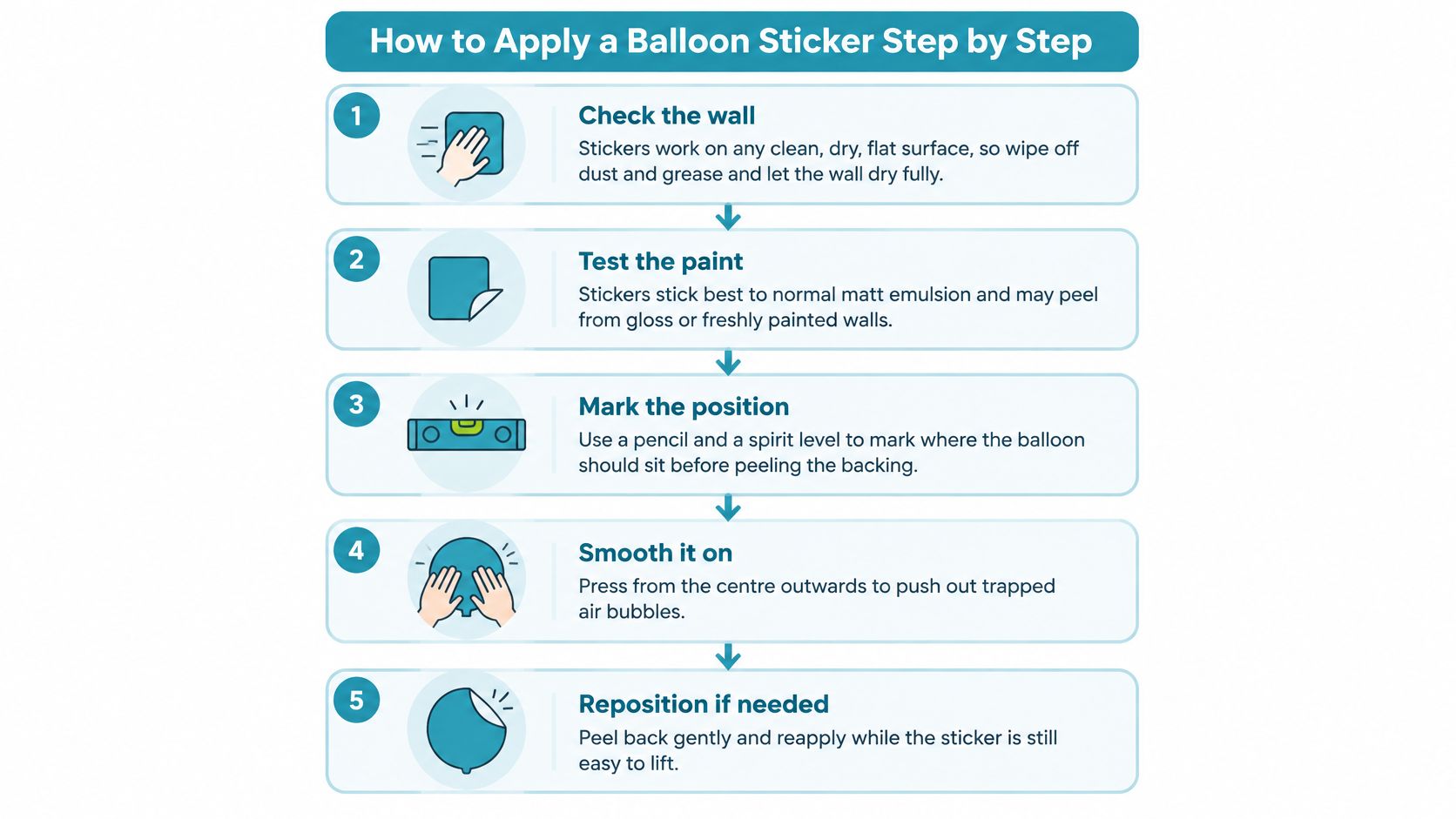
- Check the wall. Quote My Wall stickers are designed for any clean, dry and flat surface, including glass, tiles, furniture, mirrors, doors and walls. Wipe the area with a damp cloth and a drop of washing-up liquid, then let it dry completely. Dust is the most common reason a corner lifts within a week.
- Test the paint. The stickers stick best to walls painted with normal matt emulsion and may peel from glossy or silk paints. Tape a spare small sticker, or a piece of the backing, to a hidden corner and leave it for a day before you commit.
- Mark the position. Lay the design out on the floor first so the spacing makes sense before anything is stuck. Transfer the outline to the wall with low-tack masking tape and check it with a spirit level. Skipping this is how balloons end up visibly crooked, because a wall's top edge is rarely level.
- Smooth it on. Peel the backing from the top down, align the top edge to your tape line, and press outwards from the centre with a card scraper or soft cloth. Working from the edges inwards pushes air into the middle and traps it there.
- Align each overlap before pressing. On a multi-piece scene, work from the top down and line up every balloon against its neighbour before you smooth anything. Once pressed, an overlap cannot be nudged without stretching the vinyl.
- Check again after 24 hours. Press every edge again once the adhesive has had time to settle, and note any edge that has lifted.
Stickers can go over wallpaper and other card or paper-based products, but they may not come off cleanly from those surfaces, so choose the base before fitting rather than after. For scale on very large smooth panels, car wall sticker styling ideas show how printed vinyl sits on broad flat areas; interior walls still need the paint test and tape line above.
For corners, edges and awkward shapes, follow the walkthrough on how to apply wall stickers.
Renting and Removing Balloon Stickers Safely
"Peel and stick" describes how a product goes up. It says nothing about your deposit. Peel and stick stickers are removable and need no repainting, redecorating or wallpapering, but removability and deposit safety are two different questions.
Your tenancy agreement can still restrict decoration, and tenants may be charged for damage caused by unauthorised changes, as TNT Magazine's summary of renting and decoration rules explains. Landlord attitudes have shifted, though: recent UK research cited in the same piece found 73% of landlords are open to tenants personalising their homes, but half of those landlords expect tenants to cover any resulting damage. In practice that means written consent protects you more than a removable product does.
Renter checklist: read the tenancy agreement, request written consent, test an inconspicuous spot, photograph the wall before fitting, and record the removal.
Start with the agreement. Then ask in writing, naming the wall, the size and what you'll remove it with. Test a hidden corner behind a door. Photograph the bare wall with something for scale. Keep the reply.
What decides how it comes off
Four things decide the outcome: paint type, wall condition, adhesive strength and how long the sticker stays up. A matt emulsion in good condition usually releases cleanly. Freshly painted walls, silk finishes and old, chalky paint are where trouble starts.
Our wall stickers aren't designed to be removed and repositioned, because moving them weakens the adhesive. Large multi-piece scenes need the most care: lifted edges, overlaps, inside corners and textured plaster all give the vinyl somewhere to grip harder than you want.
Peel slowly at a low angle rather than pulling straight out. Warm a stubborn edge gently with a hairdryer on the lowest setting, then keep peeling in a steady line. Photograph the wall after removal, next to your before photos, so any dispute is settled with evidence rather than memory. There's a fuller method in our guide to how to remove wall stickers.
Final Checks Before You Order
A balloon sticker is the right buy when the design fits your measured wall, the room passes the placement table, and the paint and tenancy allow it. Five checks confirm all three.
- Measure the usable wall width and the clear zone around the cot, bed or furniture.
- Shortlist two designs from the size table, then mark each outline on the wall with masking tape.
- Confirm the finish is matt emulsion and that a hidden corner passed the one-day test.
- Check fire and emissions details where the sticker goes into a childcare, rental or higher-risk room, and match any low-emission claim to actual test evidence.
- Hold the paperwork if you rent: written consent plus before photos.
All Quote My Wall wall stickers are made to order in the UK, and you can design your own wall sticker on the website, so a balloon layout can be sized to your wall rather than squeezed into a standard sheet.
A balloon scene sized to your own wall beats one bent to fit a standard sheet, which is why every Quote My Wall sticker is made to order in the UK and why you can build your own layout on the site when none of the ready-made designs matches your measurements. Start with your wall width and clear zone, pick the design that fits, then check the paint and the tenancy before anything is peeled. Visit Quote My Wall to browse hot air balloon designs or design your own.