
8 Window Privacy Film Ideas for Every Room in 2026
A ground-floor bathroom that faces the street is a familiar UK bind. Net curtains kill the light, and a bare pane gives the pavement a clear view of the sink. The useful window privacy film ideas fix the view without a new window, but the right sheet depends on the room, whether you rent, and how much sun hits the glass.
These eight ideas each have a best use, a trade-off, and a way to finish the job cleanly. If the frame is rotten or the sealed unit has failed, film will not fix it. That is a glazing job, and SuperiorPRO window replacement services are the honest next step.
I judge a film by three tests. Can someone outside read a face or a phone screen? Does the room stay bright enough at midday without the light on? Can you take the sheet off if a landlord, a conservation officer, or your own taste changes? Frosted film wins the first two in most bathrooms. Mirror film helps a hot conservatory by day and fails after dark. Static cling wins for renters and struggles on a sash that never sits flat.
Clean the glass, cut the sheet slightly oversized, and use a sharp blade. The rest is room by room.
1. Frosted Etched-Glass Privacy Film
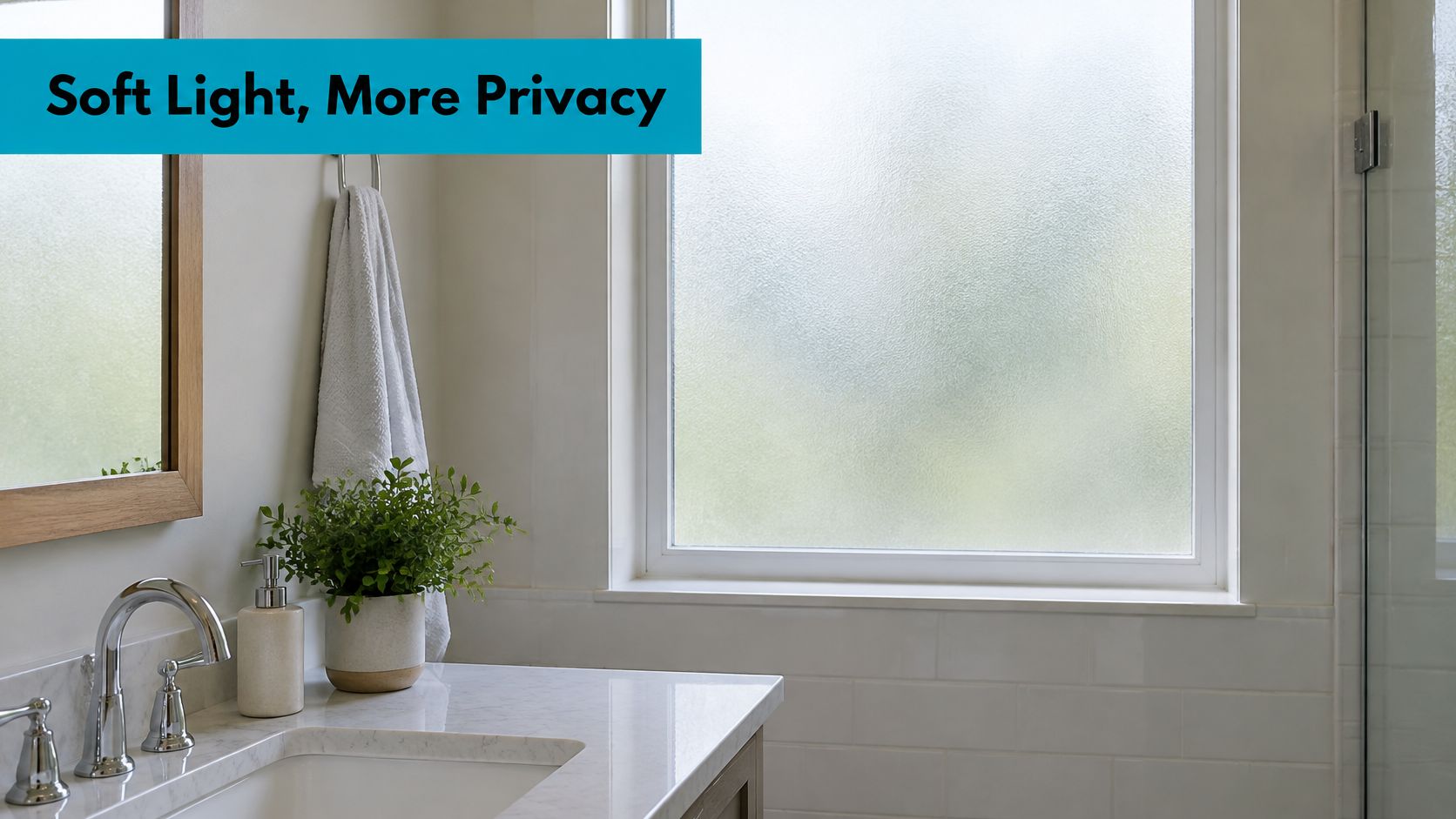
Frosted etched-glass privacy film is the workhorse. It copies the look of acid-etched or sandblasted glass, scatters the view, and still lets daylight through. Shapes and movement blur. Faces and screens do not read. It suits a bathroom in a terrace or semi, a kitchen that looks onto a neighbour's garden, and a meeting-room partition that should look finished rather than taped over.
Most of the housing stock can take it. The English Housing Survey reported that in 2023 about 22.5 million dwellings, 89% of the stock it covered, had all windows double glazed. Check the window maker's guidance before you stick anything to a sealed unit, because a film is not a reason to risk a warranty.
It will not give you a sharp outlook, and a very dense frost can make a north-facing room feel flat. For a small ensuite, compare it with choosing privacy glass for small ensuites if you are replacing the pane anyway. Film is the cheaper route when the glass is sound. Our frosted window film for privacy notes walk through coverage choices before you order a full sheet.
A clean fit on the first pass
- Measure, then add a margin: Order slightly oversized and trim to the frame so the edge does not fall short.
- Degrease the pane: Mild soap or isopropyl alcohol, then a dry lint-free cloth. Dust becomes a permanent bubble.
- Wet it if you need to slide: A few drops of soapy water let you reposition before the film grabs.
- Squeegee from the middle: Work outward. Lift a corner and re-lay rather than chasing one bubble across the pane.
Practical rule: If you can still read large print through the sample at arm's length, the frost is too light for a street-facing bathroom.
2. Decorative Patterned and Personalised Privacy Film
A bedroom that looks onto a shared path, or a living-room pane level with the pavement, needs a film that blocks the sightline without turning the glass into a blank office panel. A botanical repeat does that on the bedroom. A geometric band does it on the living room. Printed motifs, borders, quotes, and custom artwork also suit a home-office door, and the same approach scales to a small café that wants a logo on the glass without boarding the shopfront.
Grand View Research estimated the UK window-film market at US$840.3 million in 2025, with a forecast of US$1.5286 billion by 2033. That is a trade forecast, not a count of homes already using film, so plan by room rather than assuming every neighbour has fitted a pattern.
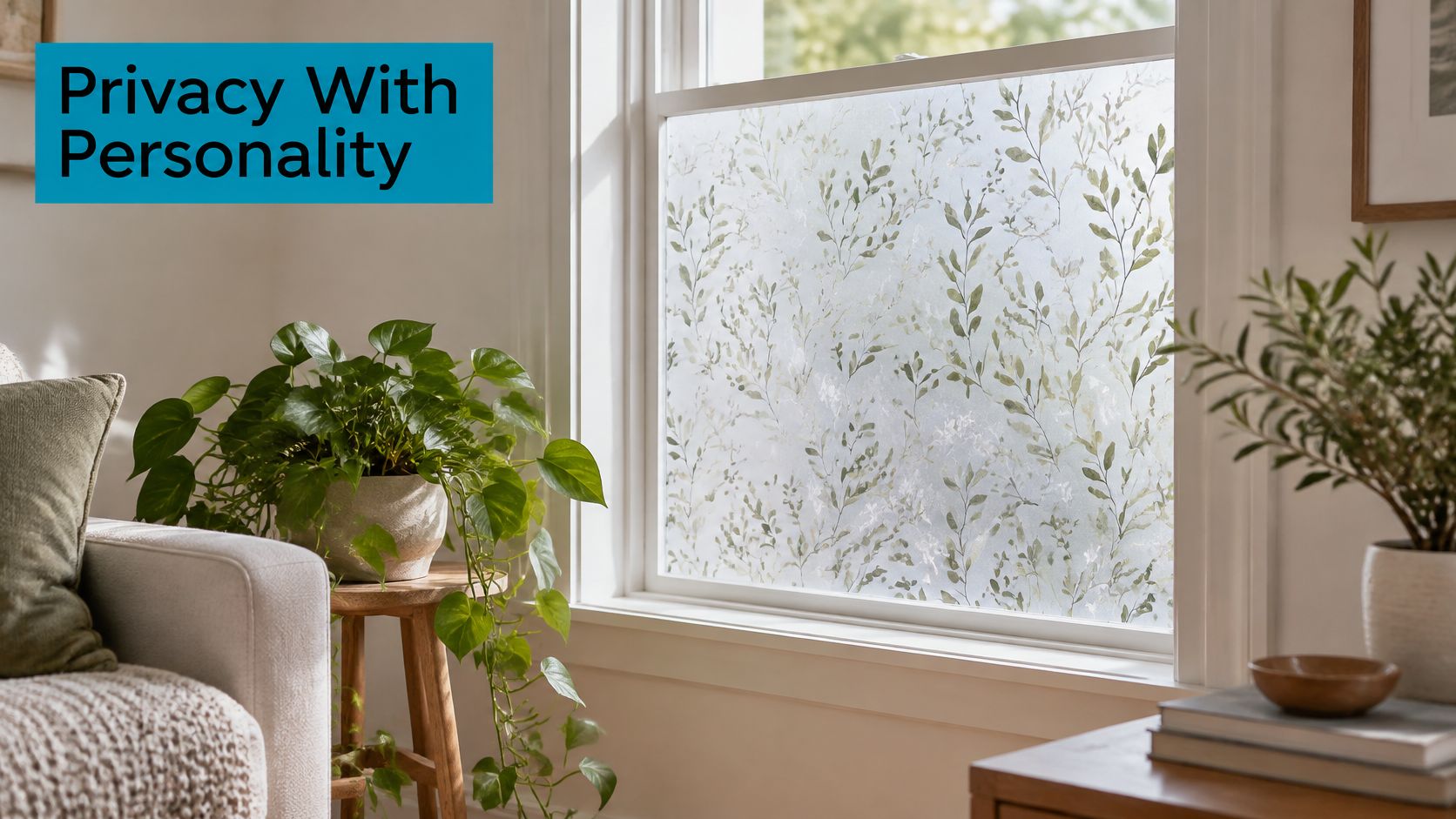
A full-coverage print hides more of the room, and it also hides the garden. On a living-room window that is the trade-off: stronger cover, less of the view you sit there for. A border or a corner panel keeps a slice of that view and still covers the sightline from the pavement. Match the ink to colours already in the room, or the window looks stuck on.
Send exact glass sizes for a custom piece. Trial a corner sample first if you are unsure how dense the print will look in your light. A busy motif that works on a bright café front can feel heavy on a smaller home-office door, where the pattern sits close to the desk all day.
A pattern fails when the clear gaps line up with eye level from the street. Put the densest motif where people actually look, not where it photographs best.
3. Static Cling Privacy Film
Adhesive is the wrong bet when you cannot mark the glass for good. Static cling holds by static, not glue, so you can lift it, shift it, and take it down without a residue scrape. That is the right sheet for a rented bathroom, a short let, a room you are dressing before a sale, and a child's bedroom that will change theme next year.
Say you are in a furnished flat and the bathroom window sits opposite the neighbour's landing. A frosted cling covers the pane for the tenancy. At the end you peel it, wipe the glass, and leave the unit as you found it. It will not grip as hard as a pressure-sensitive adhesive on a cold, dusty, or slightly bowed sash. Oil from hands and silicone from some glass cleaners kill the cling.
Making cling last
- Wash, then dry fully: Dust and skin oil are why a corner lifts by the weekend.
- Smooth from the centre: Trapped air looks like a failed adhesive job. It is only air. Work it to the edge.
- Store offcuts flat: Card either side stops a crease you will see on the next window.
- Refresh a tired sheet: Lightly dampen the glass and lay it again. Do not add tape.
Our notes on static cling film for windows cover the wet-versus-dry choice if the first lay will not sit. I would not use cling as a long-term fix on a window you hose down daily. Bathroom condensation is fine. A pressure washer is not.
4. Half-Height Band Privacy Film
A ground-floor bay looks onto the pavement, and the sofa sits in full view of anyone walking past. A half-height band frosts the lower panes and leaves the top clear. You cut the street-level sightline. You keep the sky, which is what stops that living room feeling boxed in.
The same cut works on a meeting-room window and on a shopfront. Passers-by still read the display. The counter stays out of view. Full coverage is more privacy than those rooms need, and it costs you the light the upper glass was there to bring in.
Daylight guidance in UK building practice is based on minimum daylight levels in habitable rooms. I would stop the film on a line rather than run it to the head. A clear upper band holds more daylight than a full frost. On a south-facing bay, that is the difference between a room that still feels open at midday and one that reads as shaded all day.
Setting the line
Mark the height with a spirit level and masking tape before you cut. Stand outside at the pavement, then inside at the sofa. The band has to cover both eye lines, not a height that only looks neat on a drawing. A straight edge and a fresh blade give one clean cut. Leave a narrow border along that cut so the edge does not look accidental.
Film on the lower third only will not hide a neighbour on a mezzanine looking down. Raise the band, or switch that one pane to a full frost. More covered glass means more privacy from above and less sky.
5. Gradient and Fade Privacy Film
A hard line across a bathroom window can look like a half-finished job. Gradient film goes dense at the bottom and clears toward the top, or the other way if you are screening a high sightline. You lose the sharp view at eye level and you keep a soft view of sky. It suits a bath under the window, a ground-floor kitchen in an open-plan room, and a hotel-style ensuite that should feel larger than it is.
Check the roll before you peel the backing. Gradients are easy to hang upside down, and the mistake only shows once the sheet is stuck. Sit and stand in the room, then place the densest zone on those two eye lines. An off-centre fade is more obvious than a crooked straight band, because the eye follows the fade.
Apply it on a dry, still day. Specks trapped in a fade show as dark dots in the clear zone, where a solid frost would have hidden them. This film will not give night-time blackout, and it will not hide a silhouette if you stand against the glass with the room lit and the garden dark. Pair it with a blind if the bathroom is used with the light on and the neighbour's path runs past the pane.
If the décor is already busy, a fade beats a botanical print. One soft transition is enough.
6. One-Way Reflective (Mirror) Privacy Film
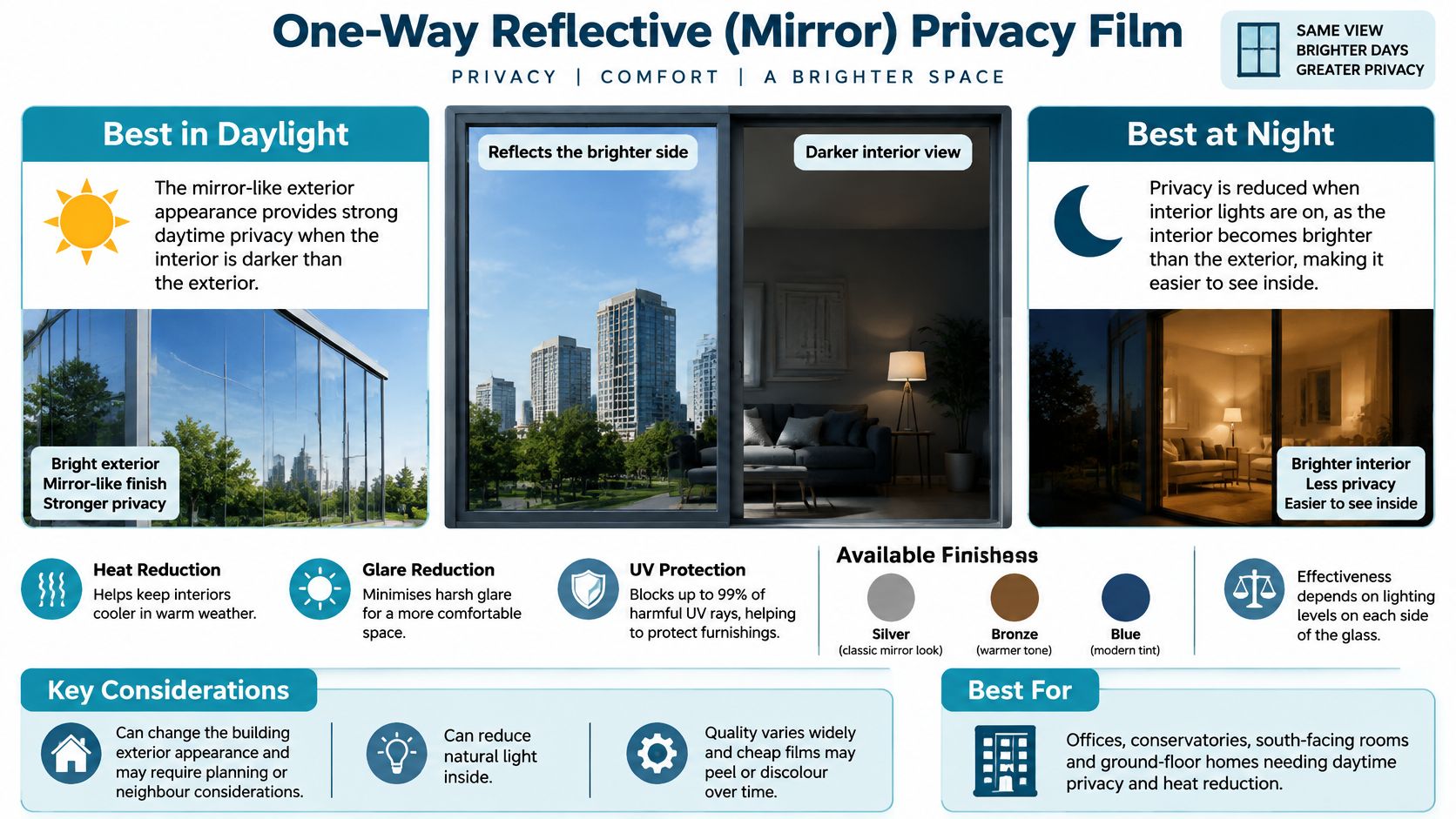
Mirror film is the one people expect to solve everything, and it does not. By day, when the room is darker than the street, the outside reads as a mirror and you still see out. It also cuts glare and some solar gain, which is why it earns a place on a south-facing conservatory, a west-facing office, and a ground-floor room on a busy road. After dark, with the lamps on, the mirror flips. The street sees in.
That limit is not a rumour. The Glass and Glazing Federation notes that frosted film blocks a clear view day and night, while a reflective film's one-way effect depends on the indoor and outdoor light balance. Loughborough University researchers reported in 2025 that around 20% of UK homes are already overheating, with unshaded glass letting solar heat in and trapping it. Mirror film can take the edge off that on sunny glazing. It is not a substitute for shading, and it is not a reason to keep the windows shut all evening.
What I would actually specify
Use frost where you need privacy with the lights on, including bedrooms and bathrooms. Use reflective film on sunny glazing where daytime heat and glare are the complaint, and keep a blind for night. Close the windows in the hottest part of the day, then ventilate when the air outside has cooled. Test a sample from the pavement at noon and again at 9pm before you cover a whole run. Large commercial panes are better fitted by someone who can control edges. Bubbles and lifted corners on a mirror show from the street.
Check the lease and any planning limit before you turn a period front into a mirror. A silver façade is a visible change, even when the film itself peels off.
7. Nursery and Children's Room Privacy Film
A nursery on the street needs privacy without turning the room into a cave. Soft frost, clouds, or a simple woodland motif blurs the view from the pavement and from the house opposite, and the room stays bright enough for daytime naps and play. A name on a glass door, or a small repeat in a playroom, does the same job with less coverage.
Keep the sheet out of grabbing height where you can, and check the edges every few months. A lifted corner is a peel toy. Do not film a pane that has to meet safety-glazing rules until you have checked that the film does not conflict with that duty. For a room you will redecorate when the child outgrows the theme, use removable cling rather than a high-tack adhesive.
Film will not make the room dark enough to sleep. Pair it with a proper blackout blind, and let the film handle daytime privacy so you are not living behind closed blinds at noon. Avoid tiny loose decals low on the glass in a toddler room. One continuous sheet is safer to clean and harder to pick at.
A playroom that only faces a fence can take a lighter pattern. A bedroom that faces a bus stop should take a denser frost on the lower panes, with any motif kept above the cot line.
8. Rental-Friendly Temporary Privacy Film
A six-month let with a shared bathroom and a bedroom looking into the next block needs privacy that comes off at the inventory. Static cling, or a low-tack film tested on a corner first, is the film I would fit here. Get written permission and photograph the bare glass before any sheet goes on.
A frosted cling on a flat bathroom window is the usual first job. A bedroom facing the next building needs coverage where you stand, not a thin border that still shows you. Cling repositions if you trap a bubble and leaves nothing to scrape on moving day. High-tack film stays flatter in a steamy bathroom, and it can also lift a glass coating.
Written landlord permission comes first. Check local planning or conservation rules before you apply anything. A listed house or a conservation area can treat window changes more strictly than an ordinary flat, even when the film is temporary. Ask the landlord, and on a listed house ask the conservation officer, before you treat film as automatically allowed.
Lift a corner after a day. If it drags the coating or leaves tack, stop and switch product. Date the photos of every pane. A text from the agent beats a verbal nod at checkout.
The same test-and-photograph habit is in our guide to removable wall decals in the UK. Do not assume every surface lets go cleanly. On rental glass, cling is the safer default. On a failed sealed unit, do not film over the misting and hope the inventory clerk will not notice.
How the eight window privacy film ideas compare
| Item | Best For | Removable | Daylight Impact | Install Effort |
|---|---|---|---|---|
| Frosted Etched-Glass Privacy Film | Bathrooms, kitchens, and ground-floor windows | Depends on the product: static-cling film lifts off, while adhesive film may take more effort to remove | High; diffuses light | Quick; careful alignment needed |
| Decorative Patterned and Personalised Privacy Film | Homes, shops, and event spaces wanting decorative privacy | Depends on the product; static-cling film lifts off, while adhesive film may take more effort to remove | Generally allows daylight; more coverage can reduce light | Moderate; custom sizing may be needed |
| Static Cling Privacy Film | Renters, students, and temporary privacy | Removable and reusable; can be repositioned | Generally maintains daylight; varies by design | Easy; no tools needed |
| Half-Height Band Privacy Film | Offices, open-plan spaces, and living rooms | Depends on the product; removable cling film lifts off, while adhesive film may take more effort to remove | High; leaves part of the glass clear | Moderate; requires precise cutting |
| Gradient and Fade Privacy Film | Bathrooms, spas, and modern homes | Depends on the product; removable cling film lifts off, while adhesive film may take more effort to remove | High; fades from opaque to clear | Moderate; careful alignment needed |
| One-Way Reflective (Mirror) Privacy Film | Daytime privacy and heat reduction | Depends on the product; adhesive film may take more effort to remove | Reduced; can lower indoor light | Moderate to difficult; professional fitting may suit large windows |
| Nursery and Children's Room Privacy Film | Nurseries and children's bedrooms | Often removable; check whether it uses adhesive or static cling | Generally maintains daylight | Easy to moderate; check edges regularly |
| Rental-Friendly Temporary Privacy Film | Renters and short-term occupants | Designed for removal and reuse | Generally maintains daylight; varies by design | Easy; quick to apply and remove |
Choosing the Right Window Privacy Film for Your Room
A rented bathroom that faces the street is a different job from a south-facing conservatory that overheats by noon. Start with the room and the rule that binds you. If you rent, use removable static cling, keep the permission, and photograph the glass before you fit anything. If the complaint is daytime heat on south or west glass, a reflective film can help while the sun is on that facade. You still need ventilation and a blind after dark, because the mirror look reverses once the room is brighter than the outside.
Measure each pane, including any curved corner the tape measure wants to skip. Test a small offcut in the corner in daylight and again with the room lights on. Read the lease. On older houses, check whether the window itself is restricted before you treat film as invisible.
Frosted film is the default I recommend for bathrooms and street-facing kitchens. It stops clear sightlines and still lets daylight through, while you lose a sharp view out. Patterned film suits rooms where the glass should look considered. Mirror film is a daytime comfort tool: useful against glare while the sun is high, weak as privacy once indoor lights are on. None of these sheets replaces failed glazing or a proper blind.
For the wider dressing of the room, window covering tips from Giorgi Bros Furniture sit alongside film rather than instead of it.
Quote My Wall supplies window privacy films for bathrooms, street-facing rooms, nurseries and rented homes. Match the film to the room, the light, and whether you need to remove it later. Visit Quote My Wall to order the sheet that fits your glass.