

A Renter-Friendly Guide to Static Cling Film for Windows
Ever found yourself wishing for a bit more privacy or a touch of style on your windows, but dreading the thought of sticky adhesives or permanent changes? That's where static cling film comes in – a brilliantly simple, adhesive-free solution that uses static electricity to hug the glass. It's a DIY dream, making it completely removable and reusable whenever you fancy a change.
What Is Static Cling Film and Why's Everyone Using It?
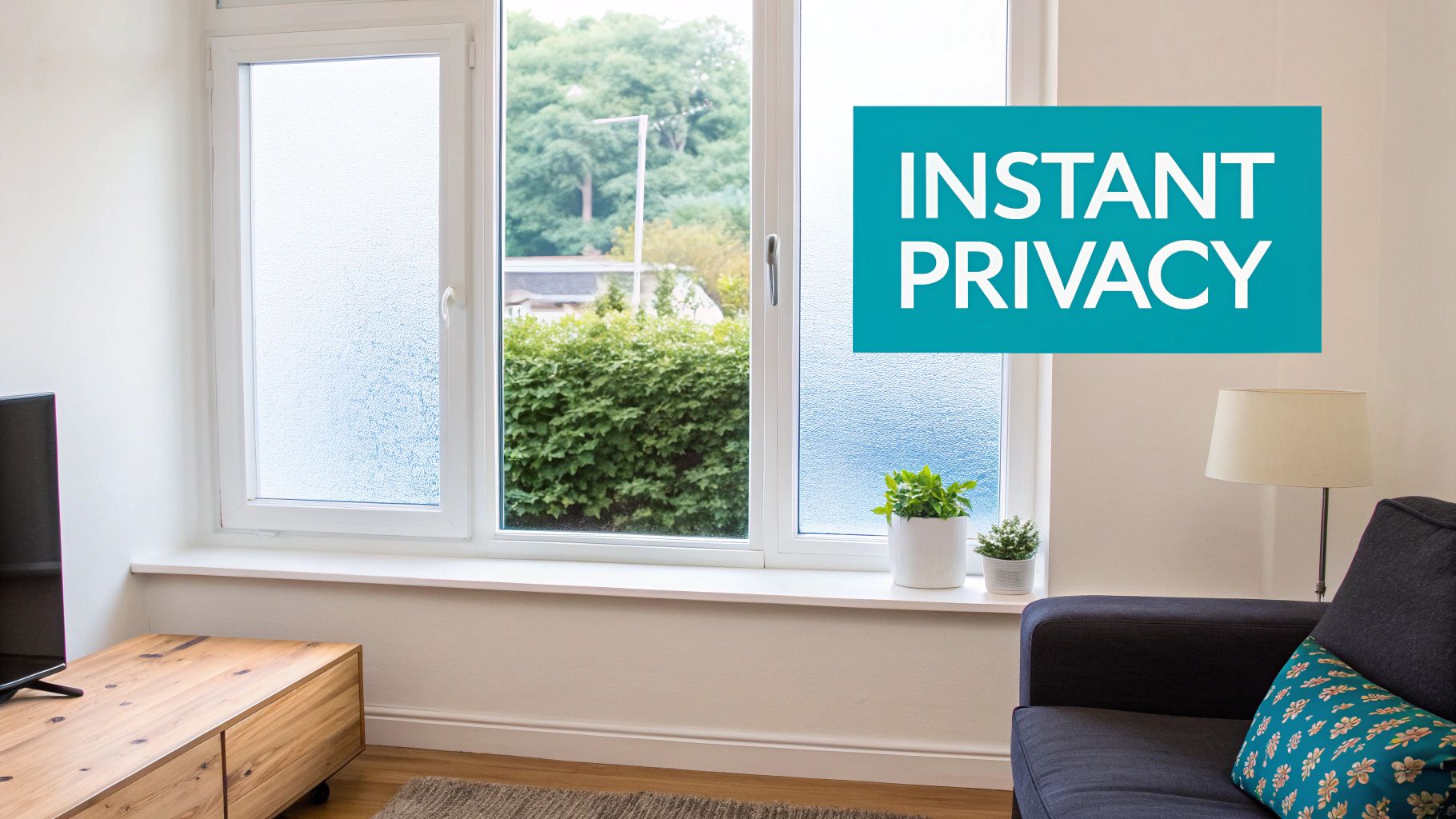
At its core, static cling window film is a thin sheet of vinyl that sticks to smooth glass without any glue. The magic is in the static. A little bit of moisture helps activate this powerful cling, creating a surprisingly secure bond that peels away cleanly when you're ready to remove it.
This lack of adhesive is precisely why it's become so popular. If you're renting or just someone who loves to switch up their decor, it's perfect. There's zero risk of damaging the windows or being left with that stubborn, sticky residue that’s a nightmare to scrub off.
More Than Just Easy to Apply
But the real appeal of static cling film goes well beyond its mess-free application. It’s a genuine problem-solver for so many common household niggles. For anyone with a ground-floor flat or an overlooked window, it offers instant privacy without plunging the room into darkness.
You can finally obscure the view from next door while your living room stays bright and welcoming. It tackles other daily annoyances, too:
- Cutting Down Glare: A sheet of frosted film on a home office window can make a huge difference to screen glare, making your desk a much more comfortable place to work.
- Protecting Your Furnishings: Many films are designed to block up to 99% of damaging UV rays. This simple layer helps stop your furniture, rugs, and artwork from fading in the sun.
- A Quick Style Upgrade: With endless patterns available – from elegant frosted effects to intricate stained-glass designs – you can transform the look and feel of a room in an afternoon.
It's one of those simple products that really is a game-changer. It gives homeowners and renters the power to fix privacy problems, manage sunlight, and show off their personal style without committing to pricey curtains or permanent blinds.
The Hidden Financial Perk
One of the lesser-known benefits is the film's quiet contribution to energy efficiency. By adding an extra layer to your glass, it offers a decent bit of insulation. This helps trap heat inside during the winter and keep it out in the summer, which can make a small but welcome difference to your energy bills.
This very feature is helping to fuel its popularity. The UK window film market, which includes these static cling options, has grown to USD 148.5 million in 2024, driven in part by households looking for ways to combat rising energy costs. Considering some films can reduce heat loss by up to 30%, they offer a remarkably affordable way to boost a home's efficiency without a major installation. If you're interested in the market dynamics, you can dive deeper in the full report.
Finding the Perfect Static Cling Film for Your Space
Picking the right static cling film doesn’t have to be complicated. It really all comes down to one simple question: what job do you need it to do? Once you know the 'why', finding the right 'what' becomes so much easier.
Think about the room itself. A ground-floor bathroom window that faces the neighbours needs total privacy, making a fully frosted or opaque film the obvious choice. It blocks the view completely but still lets in that lovely, soft, diffused light. But for a living room that gets the morning sun, you might just want a decorative touch. In that case, a patterned film with a floral or geometric design adds a bit of style without sacrificing all that beautiful daylight.
Getting to Grips with Privacy Levels and Styles
The first thing to understand is the different privacy levels on offer. Most static cling window films fall into one of a few categories, and each one is designed for a different purpose.
-
Full Privacy: These are your opaque and frosted films. They're perfect for bathrooms, bedrooms, or any window where you need to completely block the view from both sides. No one sees in, and you don't see out.
-
Semi-Private: This category includes films with patterns or textures, like a reeded glass effect or a sandblasted finish. They're brilliant for front doors or home offices because they blur distractions without making the space feel closed in.
-
Decorative: Think of these as window art. Stained-glass effects, subtle etchings, and colourful designs are all about adding an aesthetic feature rather than blocking views.
When it comes to style, your options are almost endless. A classic stained-glass film can add real character to an older home, while a sharp, minimalist geometric print looks fantastic in a modern flat. For more general guidance on choosing window furnishings, it’s always a good idea to think about how the design will work with your existing decor.
If you’re still not sure which way to go, our guide on the best window film for privacy has plenty of specific recommendations for different rooms.
To make it even easier, here's a quick comparison to help you decide at a glance.
Comparing Static Cling Film Types
| Film Type | Primary Use Case | Privacy Level | Light Allowance |
|---|---|---|---|
| Frosted/Opaque | Total privacy for bathrooms, bedrooms | Maximum | High (diffused) |
| Patterned/Textured | Blurring views, adding style to entrances | Medium | Medium to High |
| Decorative | Adding colour and design elements | Low | High |
| Sun Control/UV | Reducing heat, glare, and sun damage | Low to Medium | Varies (tinted) |
This table should give you a solid starting point for narrowing down your options based on what you need most.
More Than Just Looks: Films for Sun Control
Sometimes, privacy isn't the main issue. If you're dealing with a room that gets blasted by the sun, you'll want to look at performance-focused films. These are engineered to tackle glare, heat, and damaging UV rays, making them a godsend for south-facing rooms, conservatories, or home offices where you're trying to see a computer screen.
As you look at these films, you’ll come across terms like 'Visible Light Transmission' (VLT) and 'UV rejection'. VLT is just a fancy way of saying how much light gets through—a lower percentage means a darker film. UV rejection is key for protecting your furniture from fading, and thankfully, most quality films block over 99% of harmful UV rays.
These sun control films are becoming incredibly popular, especially with rising energy costs. A good film can cut down solar heat gain by as much as 35%. When you consider that windows can account for up to 60% of a home's heat loss, that’s a significant saving. It’s a simple, effective way to make your home more comfortable and energy-efficient.
Your Guide to a Flawless, Bubble-Free Installation
This is where the magic really happens. A good installation turns a simple roll of window film into a feature that looks like it was professionally done. Forget complicated instructions; the real secret to a perfect, bubble-free finish is all about a little prep and a steady hand.
If you take away just one thing, let it be this: don't be afraid to use plenty of water. Static cling film literally needs that moisture to activate its grip and, crucially, to let you slide it into the perfect position. Trying to apply it dry is a one-way ticket to frustration, wrinkles, and trapped air.
This handy visual guide breaks down how to think about your project, flowing from your initial need to the perfect style and function.
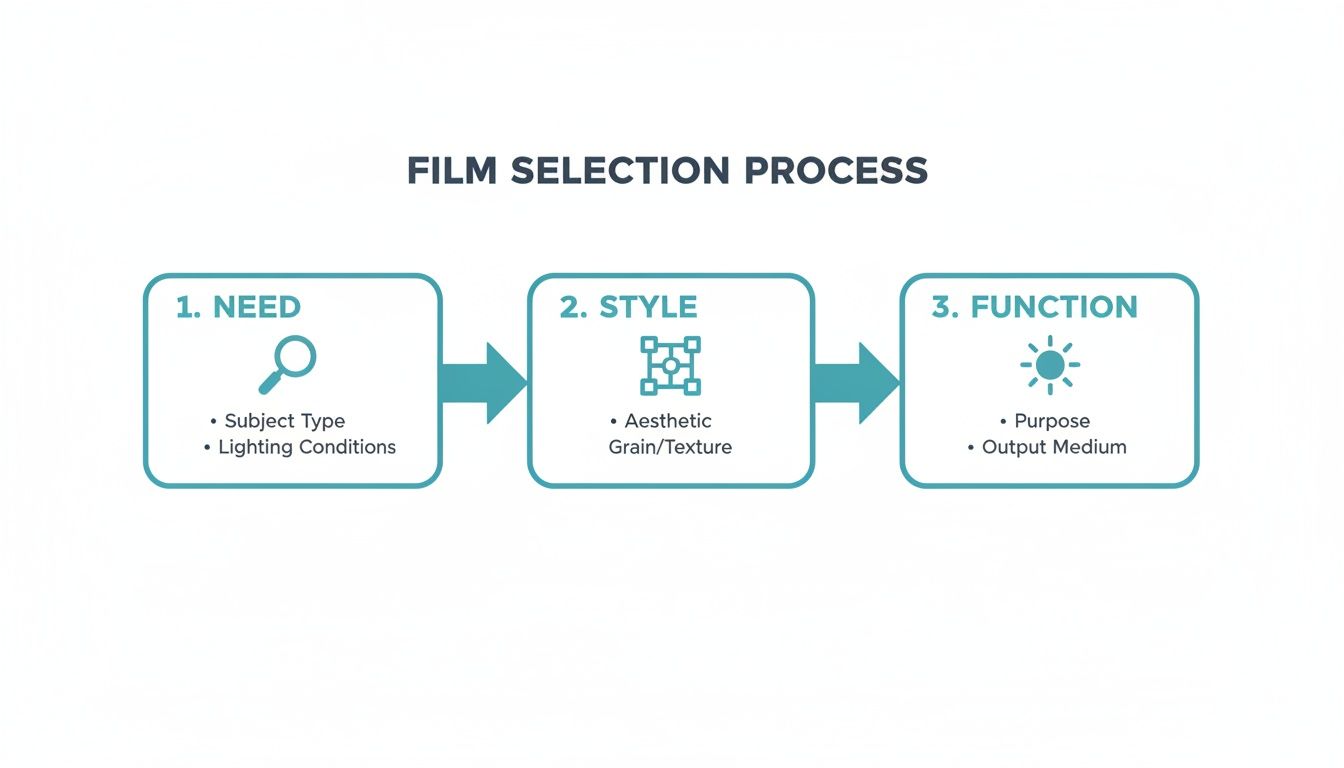
Getting this part right before you even think about installation is half the battle won. It sets you up for a result you’ll be genuinely happy with.
Prepping for Perfection
Before you even think about unrolling your film, the first job is to get your window surface immaculately clean. I mean it—absolutely spotless. Any tiny specks of dust, pet hair, or grime left on the glass will get trapped underneath, creating annoying little bumps and bubbles that will drive you mad.
- Gather Your Tools: You don't need a massive kit. Just grab a spray bottle, a few drops of washing-up liquid, a good squeegee (a credit card wrapped in a cloth works in a pinch), a sharp craft knife, a ruler, and a lint-free cloth.
- Mix Your Solution: Fill your spray bottle with water and add just two or three drops of washing-up liquid. Any more than that can leave a soapy residue that actually stops the film from clinging properly. Give it a gentle shake to mix.
- Clean the Glass Thoroughly: Spray the window generously with your solution and wipe it clean. Really get into the corners where dust loves to hide. For a truly streak-free finish, use your squeegee to dry it off.
A common mistake is cleaning the window and then getting distracted. Try to work in a clean, draft-free area, as any new dust that settles on your pristine glass will show up under the film.
Measuring and Cutting with Confidence
Accurate measurements are the bedrock of a professional finish. Take the time to measure your windowpane carefully from edge to edge, both horizontally and vertically.
Now for a pro tip I swear by: when you transfer these measurements to the film’s backing paper, add an extra 2-3 cm to both the height and width. This little bit of overlap is your safety net. It’s so much easier to trim a tiny sliver of excess film directly on the window than it is to live with a piece that’s just a fraction too short.
The Wet Application Method
With your film cut to size, you’re ready for the main event. The first challenge is often just peeling the backing paper away from the film. If you're struggling, place a bit of sticky tape on both sides of one corner and pull them apart—it works every time.
Now, spray the window again with your soapy solution until it’s literally dripping wet. Don't be shy here; more is definitely better! It’s also a good idea to lightly mist the shiny, static side of the film itself.
Carefully place the wet side of the film onto the wet glass. Thanks to all that water, you’ll be able to slide it around until it’s positioned exactly where you want it.
Once you’re happy with the placement, it’s time to lock it in. Lightly spray the front of the film (the side facing you) to lubricate it for the squeegee. To get that perfectly smooth finish, you need to master the squeegee technique.
- Start in the centre of the window.
- Work your way outwards using firm, overlapping strokes.
- The goal is to push all the water and any trapped air bubbles towards the edges.
Finally, use your ruler as a guide and run the craft knife along the edges to trim the excess film. This gives you that clean, perfect fit. Give the whole thing one last pass with the squeegee, paying close attention to the edges to ensure a tight seal.
For a more detailed walkthrough, you can find our complete guide on https://www.quotemywall.co.uk/blogs/news/how-to-install-window-privacy-film.
Troubleshooting Those Annoying Installation Problems
Even with the best preparation, sometimes a DIY project throws you a curveball. Applying static cling film for windows is usually straightforward, but if you hit a snag, don't panic. Getting that flawless, professional finish is still completely achievable, and most issues are surprisingly easy to fix.
The number one question I get is, "Why on earth won't my film stick?" Honestly, nine times out of ten it comes down to two culprits: a window that wasn't quite clean enough, or—and this is the big one—not using enough water. Static cling relies on a generous layer of moisture to create its grip. If a corner is lifting or the whole sheet just feels a bit loose, the glass was likely too dry.
What to Do If Your Film is Peeling or Won't Stick
The fix is beautifully simple: just peel it back and have another go. Don't hesitate to pull the whole sheet off if you need to. Give the window another quick but thorough clean to catch any rogue dust particles that might have snuck in.
Now, grab your spray bottle and really go for it. You want the glass to be dripping wet with your soapy water solution. This isn't the time to be shy! That layer of water is crucial for creating the static bond. Lay the film back on the wet glass and squeegee firmly from the centre out, pushing all that excess water to the edges.
Dealing with Pesky Bubbles That Won't Budge
It's perfectly normal to see a few tiny, cloudy spots right after you've finished. Those are just small water pockets, and they'll evaporate on their own over a couple of days as the film cures. The ones you need to worry about are the larger, trapped air bubbles. They need sorting out straight away.
If you see a stubborn air bubble, try to guide it towards the nearest edge with your squeegee. If it’s stuck in the middle and refusing to cooperate, just gently lift the closest corner of the film until you've passed the bubble. Give both the glass and the back of the film another quick spray, then smooth it back down.
The great thing about this film is how forgiving it is. As long as the glass and film are wet, you can lift, reposition, and re-squeegee as many times as you need. Never be tempted to just live with a big bubble; you can fix it!
Fixing Curled or Peeling Corners
You might find that a corner or an edge just won't lie flat, which often happens if the film has been stored in a roll for a while. The material develops a "memory" and wants to curl back up, preventing it from making good contact with the glass.
Here’s a great little trick I've learned. Squeegee the corner down as much as you can, then grab a hairdryer. Set it to low heat and gently warm the corner for a few seconds, holding it about 15-20 cm away. The vinyl will become a bit more pliable. Immediately press it down firmly with your squeegee or a cloth-wrapped card. That little bit of warmth helps it relax and cling properly.
Mastering these simple fixes is a useful skill, especially as static cling films are becoming more and more popular. Driven by a focus on energy efficiency, the UK's window film sector is projected to expand to USD 6.9 billion by 2031. These films are a brilliant, non-permanent way to improve a window's insulation. You can learn more about these UK window film market trends to see how the technology is advancing.
Keeping Your Film Clean and Ready for Reuse
One of the best things about static cling film for windows is just how long it lasts. Unlike traditional sticky-backed films, this stuff is made to be taken off, cleaned, and put back up again, making it a seriously clever and flexible choice for any home. A little bit of care is all it takes to keep it looking great every single time.
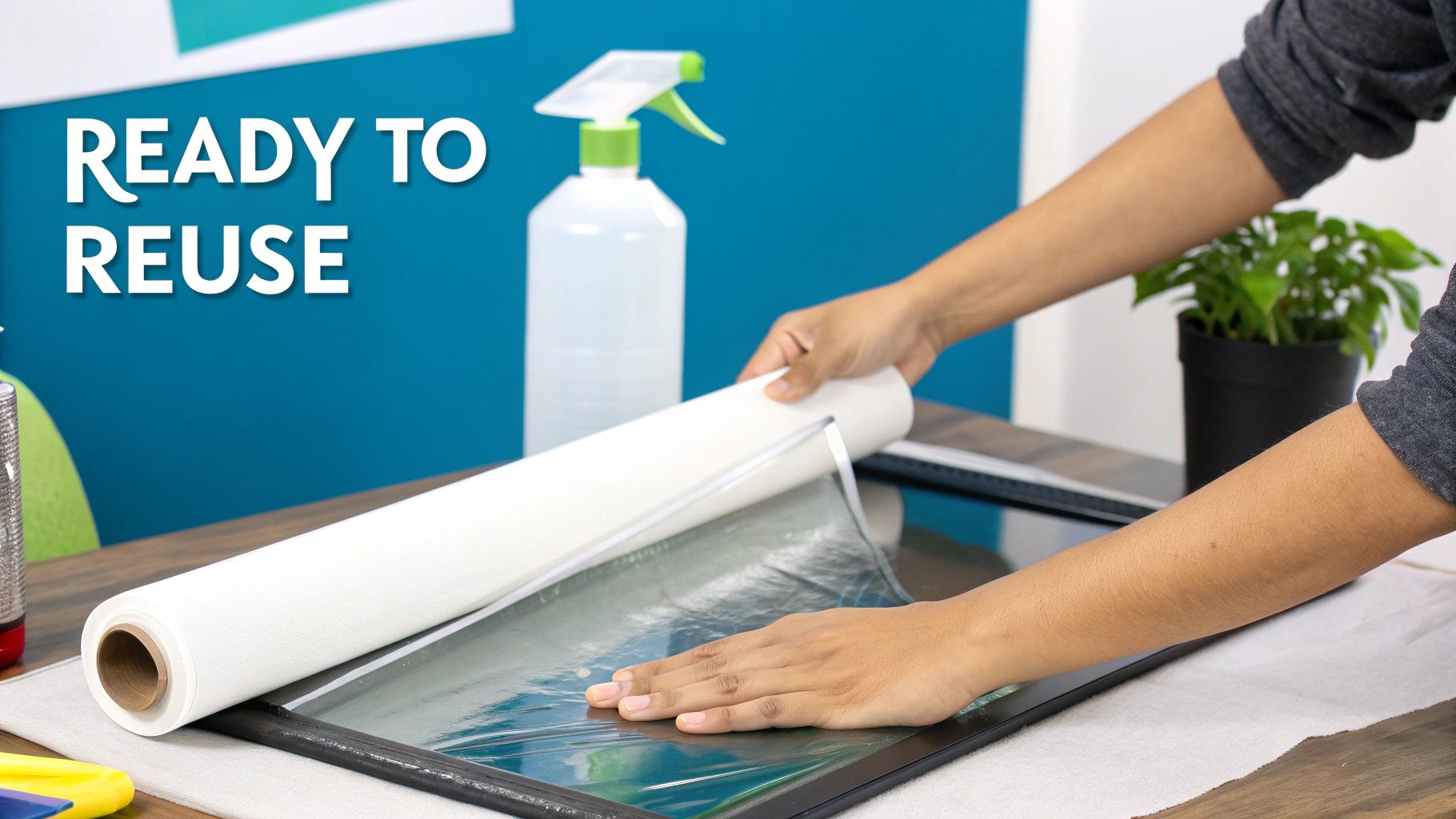
Luckily, cleaning the film couldn't be easier. You can forget about harsh chemicals or abrasive sponges; they’ll only scratch the surface and ruin the vinyl.
All you really need is a soft microfibre cloth and a very gentle cleaning solution. In fact, the same soapy water you used for installation is perfect—just a couple of drops of washing-up liquid in a spray bottle filled with water will do the trick. A quick mist over the surface and a gentle wipe is all it takes.
Best Practices for Cleaning Your Film
To keep your film in pristine condition and avoid any mishaps, just stick to these simple rules:
- Ditch the Ammonia: Never, ever use glass cleaners that have ammonia in them. Over time, it can make the vinyl brittle and weaken its static cling power.
- Stick to Soft Materials: A microfibre cloth or a soft sponge is your best friend here. Paper towels might seem fine, but they can leave behind tiny fibres that get trapped when you reapply the film.
- Go Gentle: There’s no need to put your back into it. A gentle wipe is more than enough to lift off everyday dust and fingerprints.
This simple routine ensures your privacy or decorative film stays looking crystal clear, ready for its next job—whether you're moving to a new house or just fancy a seasonal change.
How to Remove and Store Your Film Correctly
When it’s time for a change, taking the film down is just as straightforward as putting it up. Pick a corner and gently peel the film away from the glass. It should lift off in one clean sheet, leaving absolutely zero sticky mess behind.
The single most important thing for reusing your film is to keep the original backing paper. This slick, waxy paper is designed to protect the "cling" side from dust, dirt, and damage while it's stored away.
Once you’ve peeled the film off, lay it on a clean, flat surface with the static side facing up. Carefully place the backing paper back on, smoothing it down to get rid of any air bubbles. Now, roll the film up gently—never fold it, as that can cause creases that won’t come out. Store the roll somewhere cool and dry, like a cupboard or a drawer, well away from direct sunlight.
This careful storage method is a good principle for most removable decor. For similar tips, have a look at our guide on how to remove a wall sticker. Follow these steps, and your static cling film will be in perfect nick, ready for a flawless reapplication whenever you need it.
Got Questions About Static Cling Film? We’ve Got Answers.
Still on the fence? It’s completely normal to have a few questions before you start. I’ve put together answers to some of the most common queries I hear, tackling the finer details to help you get started with confidence.
One of the biggest questions people have is whether this clever, non-adhesive film plays nicely with modern windows. Let's clear that up.
Can I Put Static Cling Film on Double-Glazed Windows?
Yes, you absolutely can. For the vast majority of cases, standard static cling film for windows is perfectly safe to use on double-glazed units. Your typical decorative or privacy films simply don’t absorb enough solar heat to cause any issues with the glass or the crucial seals between the panes.
That said, it pays to be a little more cautious with speciality films. If you’re looking at very dark, heat-absorbing, or specific solar control films, it's worth a second look. These can sometimes increase thermal stress on certain types of double glazing. My best advice? Always double-check the film manufacturer's guidelines for your specific window type before you commit.
The real beauty of static cling film is its versatility. Unlike permanent adhesive films that demand a lot of forethought, most static cling options are designed for straightforward, worry-free use on standard residential windows, both old and new.
How Long Does Static Cling Window Film Actually Last?
With a decent application and a bit of care, you can expect a high-quality static cling window film to last for several years. How many years exactly often comes down to a couple of things: how much direct sunlight it's blasted with and the quality of the film you bought in the first place.
While there’s no adhesive to break down, the vinyl itself can lose a bit of its flexibility after years of hot and cold cycles. Even so, one of its best features is that you can still remove and reapply it multiple times throughout its life without it losing that signature cling.
Is Static Cling Film Genuinely Easy to Remove?
It is, and frankly, this is its standout feature. The removal process couldn't be simpler, which is a massive reason why it's such a hit with renters.
All you need to do is get your fingernail under one of the corners and gently peel it back. The film lifts away from the glass cleanly, usually in one satisfying piece.
- No Sticky Mess: Because it relies on static electricity instead of glue, it leaves zero sticky residue behind.
- No Scraping Needed: Forget spending an afternoon with a scraper and solvents. Your window is clean the moment the film is off.
- Instantly Reversible: This makes it the ideal choice if you love changing up your decor or just need a temporary privacy fix.
This simple, damage-free removal really seals the deal, making it a smart, flexible option for just about any home.
Ready to give your windows a stylish and practical upgrade? Quote My Wall has a fantastic range of high-quality static cling films for any project. Explore our collection and find your perfect design today.