

Wallpapers Union Jack: A Complete Style & Fit Guide
You've found the right room for a statement wall, but you're hesitating over the obvious choice. A Union Jack design could give a plain sitting room, games room, hallway, or bedroom the character it's missing. It could also make the space feel like a souvenir shop if the scale, colour, and surrounding furniture aren't carefully considered.
That tension is exactly why Union Jack wallpaper deserves more thought than a quick novelty purchase. The flag is a powerful geometric motif with genuine cultural and design history, but it needs restraint to look intentional in a contemporary UK home. You'll also need to consider the wallcovering's substrate, cleaning needs, installation method, and fire classification before ordering.
Why Union Jack Wallpaper Deserves a Second Look
A homeowner might start with a beige sofa, oak furniture, and a room that feels perfectly pleasant but strangely anonymous. They want warmth and personality, yet the phrase “Union Jack wallpaper” brings to mind loud red, white, and blue walls, pub-style interiors, or a teenager's themed bedroom. The instinct is to reject the idea before looking at the design itself.
That would be a mistake. Used selectively, the flag can function as a large-scale graphic pattern, much like a geometric mural or heritage textile. A faded print can introduce texture and history, while a cleaner interpretation can give a modern room a strong focal point without requiring a complete redecoration.
Start with the room, not the flag
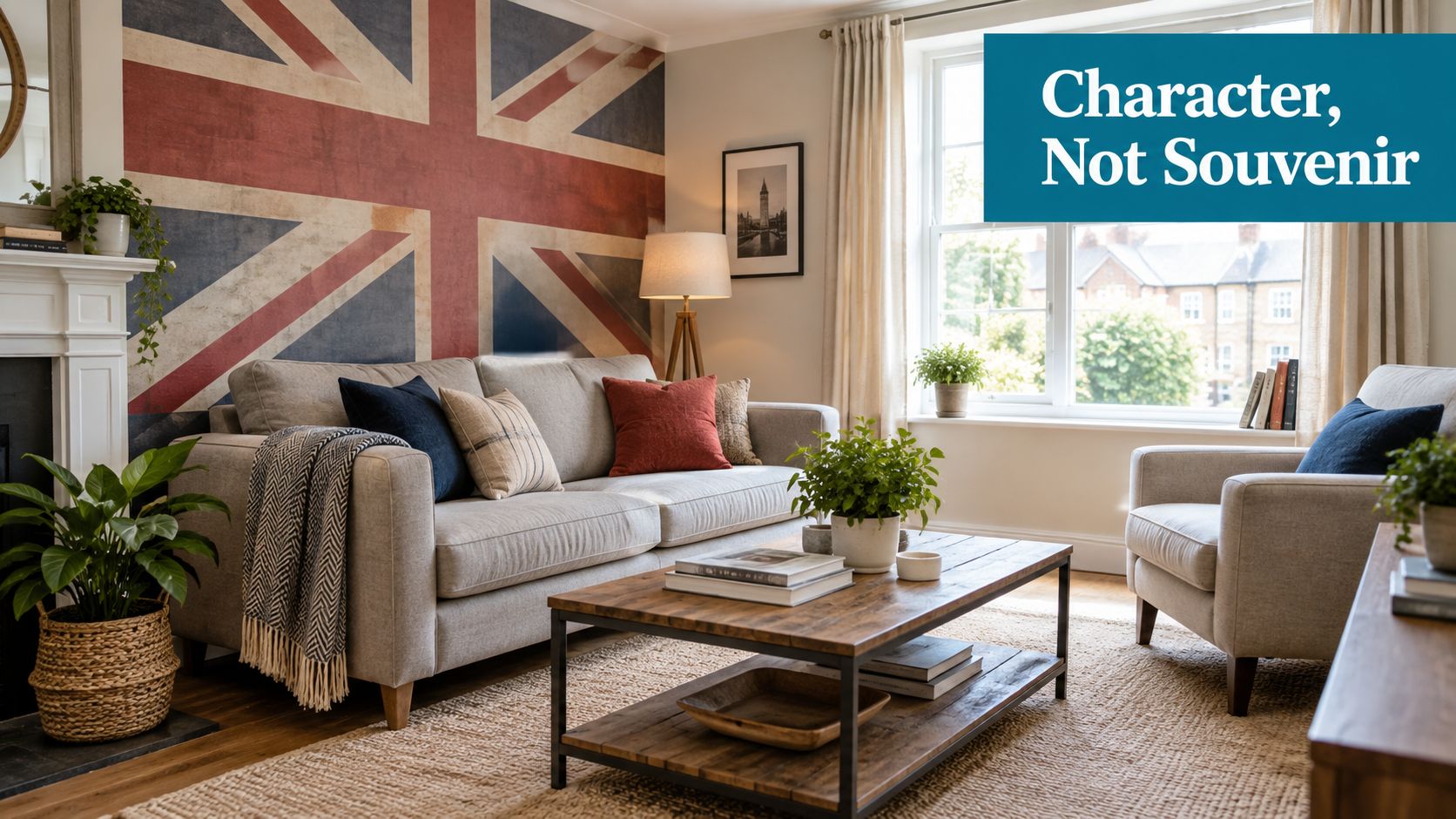
The most successful schemes usually make the wallpaper the expressive element and keep the rest of the room comparatively calm. A neutral sofa, natural timber, aged leather, linen curtains, and simple lighting allow the motif to read as design rather than decoration with a message.
Room context matters too. A flag wall can feel natural in a home office, music room, snug, hallway, or children's bedroom. In a formal bedroom or small lounge, a full-strength repeat may dominate the space, so a single wall or a muted colourway is often more comfortable.
Practical rule: If the wallpaper is the loudest object in the room, give the furniture quiet shapes and tactile materials.
UK interiors have also moved towards more expressive, personalised walls. Current trend coverage highlights bold colour, maximalist schemes, heritage references, and ceiling applications, creating room for identity-led patterns that are more considered than generic novelty décor. A Union Jack print can sit within that movement when you treat it as a controlled architectural accent.
The UK Trend Cycle Behind Union Jack Interiors
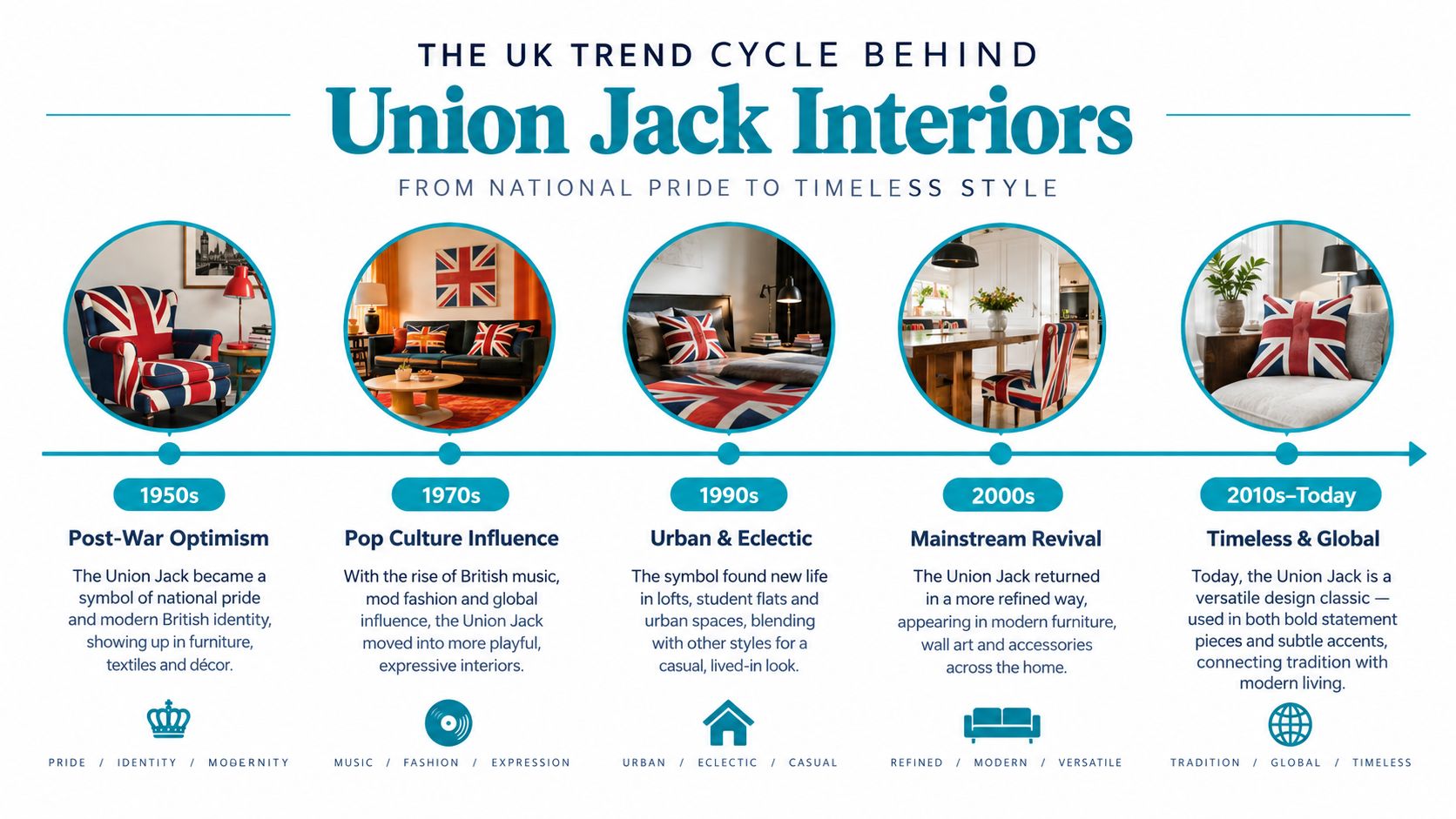
The Union Jack's interior history helps explain why some designs feel authentic while others look disposable. The motif has moved through a recognisable cycle, from mass-popular patriotic decoration to a period of decline and then a renewed interest in vintage and heritage-led interiors. Wallsauce's UK trend analysis describes flying the flag in home décor as having “fell out of fashion as fast as it came in”, while also identifying vintage Union Jack styling as a recurring feature in British homes. Wallsauce's analysis of the British patriotic décor trend connects the revival with the distressed-flag aesthetic associated with Vivienne Westwood and the Spice Girls era.
That history is useful when you're choosing a design. The most convincing vintage wallpapers don't reproduce a bright flag. They borrow from worn textiles, faded paint, old signage, and layered print. Their appeal comes from age and imperfection, not from adding more patriotic symbols to the room.
A design language shaped by fashion
A notable example is Vivienne Westwood's 2009 Union Jack wallpaper sample, manufactured by Cole & Son and held by the Victoria and Albert Museum. The V&A record describes a collection containing 10 different designs in multiple colourways, together with two non-repeating panel decorations, including a Union Jack panel. It identifies the design as a large digital-image panel showing a stained and faded flag, a treatment that places the motif within high-end interior and fashion culture rather than casual souvenir décor. The Victoria and Albert Museum record for the Union Jack wallpaper provides that documented context.
Why the revival still works
Today's interest isn't necessarily a return to brightly coloured patriotic rooms. It's part of a broader appetite for heritage, retro revival, and storytelling-led interiors. The Union Jack works best when its cultural associations are balanced by refined composition, restrained furnishings, or an unexpected application.
Look for designs that have one clear point of view. A distressed flag suits an industrial room with timber, metal, and leather. A simplified geometric version can work with contemporary furniture. A softer, faded colourway may feel more at home in a cottage, study, or layered bedroom.
Vintage Versus Modern Union Jack Wallpaper Styles
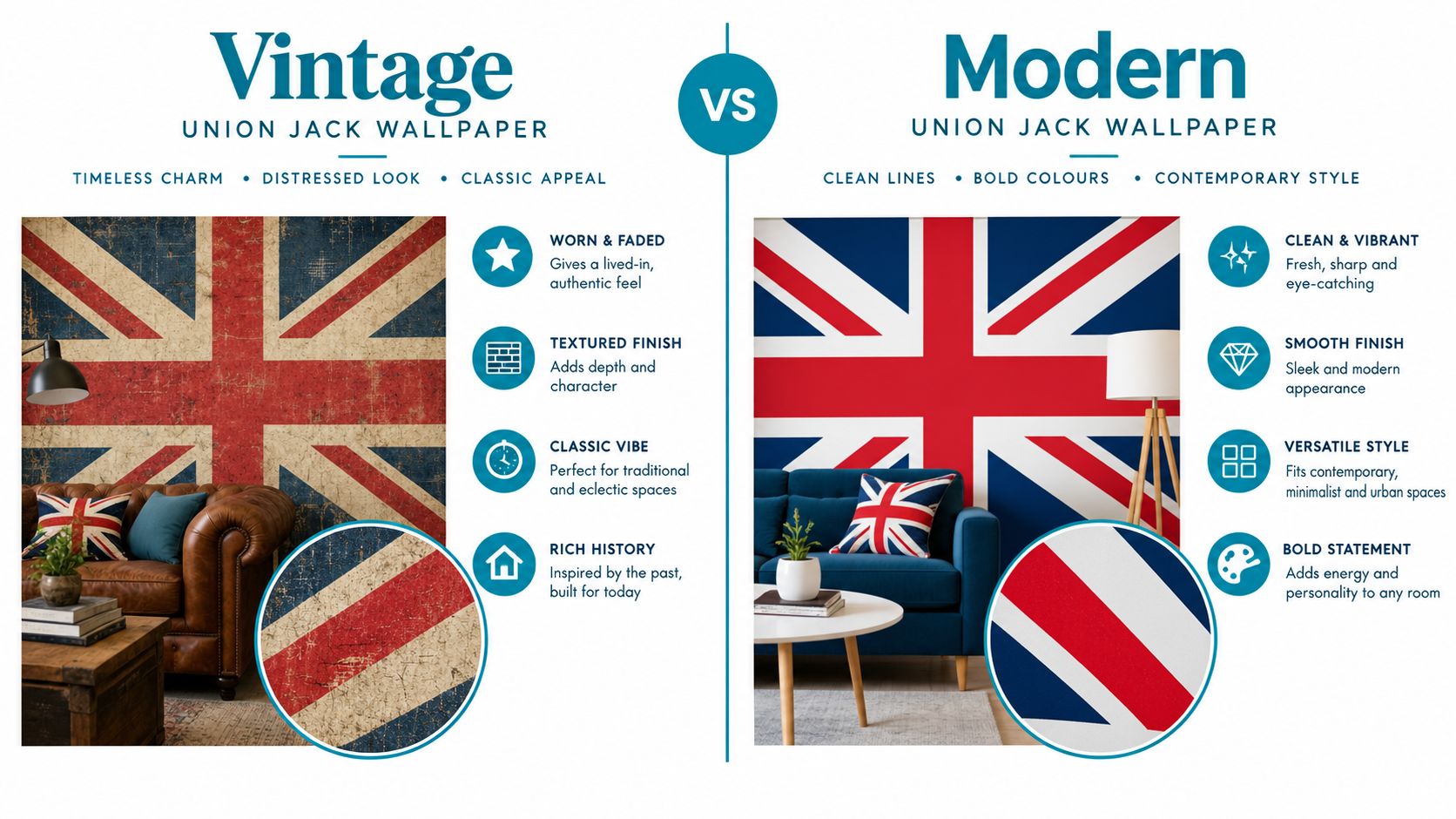
Choosing between vintage and modern wallpaper is less about age than about visual treatment. Both styles can look deliberate, but they create very different moods and demand different surroundings.
Vintage designs
Vintage Union Jack wallpaper usually softens the flag through wear, fading, staining, peeling-paint effects, or a textile-like surface. The red may lean towards brick or burgundy, the blue towards navy or slate, and the white may appear cream rather than brilliant.
This approach works well where the room already has visual history. Think reclaimed timber, painted floorboards, traditional bookcases, aged brass, brown leather, or a deep-painted chimney breast. It can also suit a modern room if you use the contrast intentionally, for example, placing a weathered flag behind a clean-lined console or minimalist desk.
Vintage designs become dated when every other object repeats the same story. Avoid combining distressed wallpaper with multiple Union Jack cushions, flag bunting, retro signs, and themed accessories. One historical reference is usually enough.
Modern designs
Modern interpretations tend to use sharper contrast, larger geometry, cleaner edges, or abstracted flag elements. Some keep the familiar cross structure but enlarge it so the design feels architectural. Others crop the flag, break it into panels, or use unusual colourways that make the reference less literal.
These designs suit contemporary rooms with plain upholstery, pale timber, black metal, glass, or carefully edited accessories. They can be effective behind a media unit, at the head of a bed, or in a creative workspace where a strong visual rhythm feels appropriate.
| Choice | Visual character | Furniture that supports it | Best approach |
|---|---|---|---|
| Vintage | Faded, layered, tactile | Leather, timber, antique finishes | Use as a heritage accent |
| Modern | Crisp, graphic, high contrast | Simple upholstery, metal, pale wood | Give the pattern clear space |
| Muted colourway | Softer and less literal | Natural textiles and painted furniture | Suitable for calmer rooms |
Design test: Order a sample and view it beside your actual flooring, sofa, curtains, and artificial lighting. A pattern that looks balanced on a screen can become much stronger against a white wall.
Materials, Durability, and UK Fire Safety Standards
The printed flag isn't what determines how a wallcovering performs. The substrate, adhesive, protective layer, and wall preparation have a greater effect on cleaning, abrasion, fading, and edge adhesion.
Paper-based wallpaper can give a traditional finish and may be appropriate for a low-contact room. It's less forgiving in busy hallways, children's spaces, rental properties, and rooms where furniture may rub against the wall. Vinyl wallcoverings are generally easier to wipe clean and offer stronger resistance to scratches and impacts. UK wallcovering guidance notes that correctly installed vinyl wallpapers can have lifespans of up to 15 years, depending on conditions and installation quality. This guide to large-format print substrates also explains why cast vinyl with a UV-protective laminate provides a strong balance of colour retention and flexibility.
Match the material to the room
A living room feature wall may only need a durable, cleanable finish. A rental hallway, nursery, or retail interior deserves more attention to surface protection because repeated contact, cleaning, and temperature changes can cause lifting or deterioration.
Ask the supplier about:
- Substrate: Find out whether the print is on paper, non-woven material, vinyl, or a dimensionally stable graphic film.
- Finish: A laminate can help protect against abrasion and cleaning, but it may alter the sheen and tactile quality.
- Adhesive: Confirm that the adhesive suits both the wallpaper and your wall surface.
- Exact product rating: Don't rely on a generic claim made for an entire product family.
Understand the UK fire framework
For UK projects, BS EN 13501-1 is the primary fire-classification framework for surface materials. It uses a main reaction-to-fire class from A1 to F, together with smoke ratings s1, s2, and s3 and flaming-droplet ratings d0, d1, and d2. The exact requirement depends on the building and location.
In practical terms, circulation spaces in dwellings may require at least C-s3,d2, while common circulation spaces in blocks of flats can require B-s3,d2. These requirements are set out in UK government guidance on European fire test and classification standards.
Older references to Class 0 or BS 476 may still appear in UK guidance, but you should ask for certification for the exact SKU, including its base film, ink system, and adhesive. For a domestic feature wall, check the manufacturer's documentation. For shared corridors, rental blocks, hospitality, or commercial interiors, involve the relevant building professional before installation.
For additional context on removable and self-adhesive vinyl applications, see this explanation of vinyl sticker wallpaper.
How to Style Union Jack Wallpaper Without Looking Dated
The easiest way to modernise a Union Jack wall is to control its visual volume. That means deciding how much of the room the pattern should occupy, how intense the colour should be, and whether the flag is being used as a background or as the room's main event.
Use placement to manage impact
A full room can work when the repeat is small, the colours are muted, or the rest of the scheme is deliberately restrained. For most UK homes, though, one feature wall gives you more control. Behind a bed, sofa, desk, or dining banquette, the wallpaper gains a clear purpose and doesn't compete with every sightline.
Hallways are another strong option because they can handle a bolder first impression without requiring the pattern to dominate a room where you spend long periods relaxing. In a child's bedroom, use the design behind the bed or on a reading corner wall, then allow the room to grow with plain bedding and flexible furniture.
Build a balanced colour scheme
You don't need to repeat every flag colour in the accessories. Pick one supporting tone, then let neutrals do the rest.
- With a vintage print: Try oatmeal, tobacco, warm grey, or muted olive in upholstery and textiles.
- With a crisp modern print: Use white, charcoal, pale oak, or one carefully chosen blue.
- With a softened colourway: Add linen, rattan, wool, and painted timber rather than glossy themed accessories.
Scale changes the emotional effect. Small repeats feel busier and more traditional, while oversized graphics can feel architectural but may overwhelm a narrow wall. If the room is compact, request a sample and hold it against the wall at different distances. You're judging the pattern at room scale, not at catalogue scale.
A contemporary Union Jack scheme usually has one patriotic reference, not a complete patriotic collection.
Avoid the theme-room trap
The dated look comes from repetition. Union Jack wallpaper, matching cushions, a flag rug, bunting, framed slogans, and red-white-blue ornaments all compete for attention. If you want to introduce another reference, change the material rather than repeating the exact flag, perhaps with a navy wool throw, a brass lamp, or a vintage map.
A rug can help anchor the wall, but measure the room and furniture first. Guidance on UK Union Jack rug sizing can help you think about proportion without automatically choosing a matching motif.
Measuring, Pattern Repeat, and Installation Planning
A Union Jack wall can look striking in a showroom and awkward at home if its lines stop in the wrong places. Measure first, then treat the pattern repeat and panel dimensions as design decisions, not minor installation details.
Measure the full width and height of every wall you might cover. Note doors, windows, alcoves, sloping ceilings, sockets, and radiators. Keep those openings in your record rather than subtracting them too aggressively, because trimming requires spare material and a supplier's calculator may use the complete wall dimensions when planning panels.
Check the repeat and match
A straight match keeps the design at the same height from one panel to the next. A drop match offsets adjoining strips, creating more waste and making geometric artwork harder to position. Before ordering, ask for the repeat measurement, finished panel width, and the format, whether the design comes as rolls or numbered mural panels.
Study where the Union Jack's diagonals, crossbars, and central intersections will fall. A strong junction behind a door frame, wall light, or television can appear accidental. On a single feature wall, mark the centre line first and work outwards. This gives the most recognisable part of the design a deliberate position, rather than leaving the installer to make that decision at the edge.
For further guidance on composing a focal wall around furniture, read this bedroom feature-wall guidance from Quote My Wall. For additional pattern-alignment context, see this striped circle wallpaper advice.
Prepare the surface properly
Remove loose paint, fill dents, sand rough areas, and leave the wall clean and dry. Dark paint can show through light or semi-opaque paper, while texture may affect adhesion and make straight flag lines appear uneven. Prime or line the wall if the manufacturer recommends it, then allow it to dry fully.
Order a sample before measuring the final quantity. Test its colour, texture, adhesion, and relationship with your furniture in daylight and evening light.
A wall that looks smooth may still have ridges. Shine a torch across it to reveal defects, then mark the centre and key architectural features before mixing paste or opening the packaging. Good preparation makes the finished motif look intentional, which is what keeps a patriotic design contemporary rather than kitsch.
Renter-Friendly Alternatives to Traditional Wallpaper
Traditional paste-the-wall wallpaper isn't the only way to create a Union Jack feature. Peel-and-stick panels, removable wallpaper, wall stickers, and vinyl wraps can deliver the graphic effect with less commitment, particularly in rented homes, nurseries, temporary workspaces, or furniture-upcycling projects.
The right alternative depends on the surface and how long you expect it to remain installed. A large removable panel can create a focal wall, while a smaller vinyl decal may work better on a wardrobe door, desk front, or smooth painted section. A furniture wrap can introduce the motif without covering the building's wall at all.
Choose flexibility with care
Removable products still need a sound surface. Flaking paint, damp, heavy texture, brick, and dusty walls can cause poor adhesion or make removal unpredictable. Test a discreet area first, and keep the packaging and installation instructions in case your landlord asks how the surface will be restored.
Use the removable wallpaper guide for renters to compare temporary approaches before committing. A peel-and-stick product may be repositionable during installation, but that doesn't mean it will remove cleanly from every paint finish.
For a smaller intervention, consider a framed wallpaper panel, a removable decal behind a desk, or a printed board that leans against the wall. These options let you experiment with the motif and move it later without making the entire room depend on one bold pattern.
Choosing the Right Union Jack Wallpaper for Your Home
Make the decision in this order: style, scale, room, substrate, and commitment. Starting with the product image alone encourages impulse buying, especially with such a recognisable pattern.
Choose vintage if you want a layered, historical mood and already have timber, leather, aged finishes, or traditional architecture. Choose modern if your room has clean furniture and needs a crisp graphic focal point. If you're uncertain, a faded or desaturated colourway usually gives you more flexibility than the strongest red, white, and blue version.
Then decide how much wall you can comfortably give to the design. A feature wall is the safest route for most living rooms and bedrooms. A full-room treatment needs a calmer pattern, careful lighting, and confidence that you won't tire of the motif.
Before ordering, check:
- Room conditions: Is the wall dry, smooth, and suitable for the chosen material?
- Maintenance: Can you wipe the surface, and will furniture or children regularly touch it?
- Fire documentation: Does the exact product have the rating required for its location?
- Pattern planning: Have you reviewed the repeat, panel width, and likely cut positions?
- Installation method: Do you want paste-the-wall permanence or a removable alternative?
- Sample appearance: Does it work beside your flooring, furnishings, and evening lighting?
A Union Jack wallpaper doesn't need to dominate your home to make an impression. Treat it as a considered graphic, give it breathing space, and let the rest of the room provide texture rather than competing symbols.
Quote My Wall offers peel-and-stick wallpaper, wall stickers, vinyl furniture wraps, and other customisable décor products that can suit a lower-commitment Union Jack update. Visit Quote My Wall to explore options for a feature wall, removable accent, or related room project.