

Vinyl Sticker Wallpaper: A UK Homeowner's Guide 2026
You're probably staring at a wall that's doing absolutely nothing for the room.
Maybe it's a rental magnolia wall you're not allowed to paint. Maybe it's a nursery that needs personality fast. Maybe it's a tired chest of drawers, a playroom corner, or a hallway that takes daily knocks and already looks older than it should. You want a change, but you don't want paste, mess, or a weekend that turns into a full decorating marathon.
That's where vinyl sticker wallpaper earns its place. It gives you colour, pattern, and character without the commitment that comes with traditional wallpaper. It's also one of those rare decorating options that suits several kinds of homes at once. Renters like it because it feels lower risk. Parents like it because many finishes are wipeable. DIY fans like it because it can go on more than walls.
There is one catch that most guides skip. Some UK walls, especially in older homes, don't behave nicely with non-breathable coverings. If your property runs cold, gets condensation, or has a history of damp, choosing vinyl needs a bit more thought. That doesn't mean you can't use it. It means you need to use it wisely.
The Modern Way to Redecorate Your Space
A room refresh used to mean choosing between paint fumes, wallpaper paste, or putting the job off again. Vinyl sticker wallpaper changed that. It sits in a practical middle ground. You get the visual impact of a proper update, but the process is faster, cleaner, and usually less intimidating for first-time decorators.
In the UK, that shift makes sense. Homes are often compact, many people rent, and plenty of us want a decorating option that doesn't feel permanent. That's one reason vinyl has become such a strong category. In 2025, vinyl wallpaper variants held over 38% of the European wallpaper market, with demand driven by customisable and durable décor choices, according to Market Data Forecast's Europe wallpaper market report.

Why it fits real UK homes
Vinyl sticker wallpaper works well because it solves everyday decorating problems rather than creating new ones.
- For renters: it offers a way to personalise a flat without treating every wall change like a forever decision.
- For parents: it's handy for nurseries, bedrooms, and play areas where wipe-clean surfaces matter.
- For busy households: it helps cover a dull wall, alcove, or furniture panel without emptying the whole room for a major redecoration.
- For upcyclers: it can give wardrobes, drawer fronts, and cupboard panels a fresh look with neat edges and very little drying time.
If you're furnishing a temporary home as well as decorating it, Tanger's Furniture rental solutions offer useful ideas for making a rental feel more settled without overcommitting to pieces or finishes that may not suit your next place.
A good use of vinyl sticker wallpaper is small but visible change. Think one feature wall, the inside of shelves, a wardrobe door, or a child's reading corner.
Why people choose it over a full redo
Traditional decorating often asks for too much all at once. Strip the old covering. Fill the wall. Sand it. Size it. Paste it. Hang it. Clean the paste. Wait for it to dry. Hope the seams behave.
Vinyl sticker wallpaper strips that process back. For many projects, especially decorative panels and feature areas, you clean, measure, peel, smooth, and trim. That's why it appeals to people who want a win this weekend rather than a renovation saga.
Vinyl Sticker vs Traditional Wallpaper
If you're deciding between vinyl sticker wallpaper and traditional wallpaper, the best choice depends on the wall, the room, and how long you want the look to stay.
Traditional wallpaper still has strengths. It can offer tactile finishes, deep texture, and a more classic decorating feel. Vinyl sticker wallpaper wins on convenience. It's usually the easier route for fast updates, rented spaces, furniture projects, and anyone who doesn't fancy wrestling with paste.
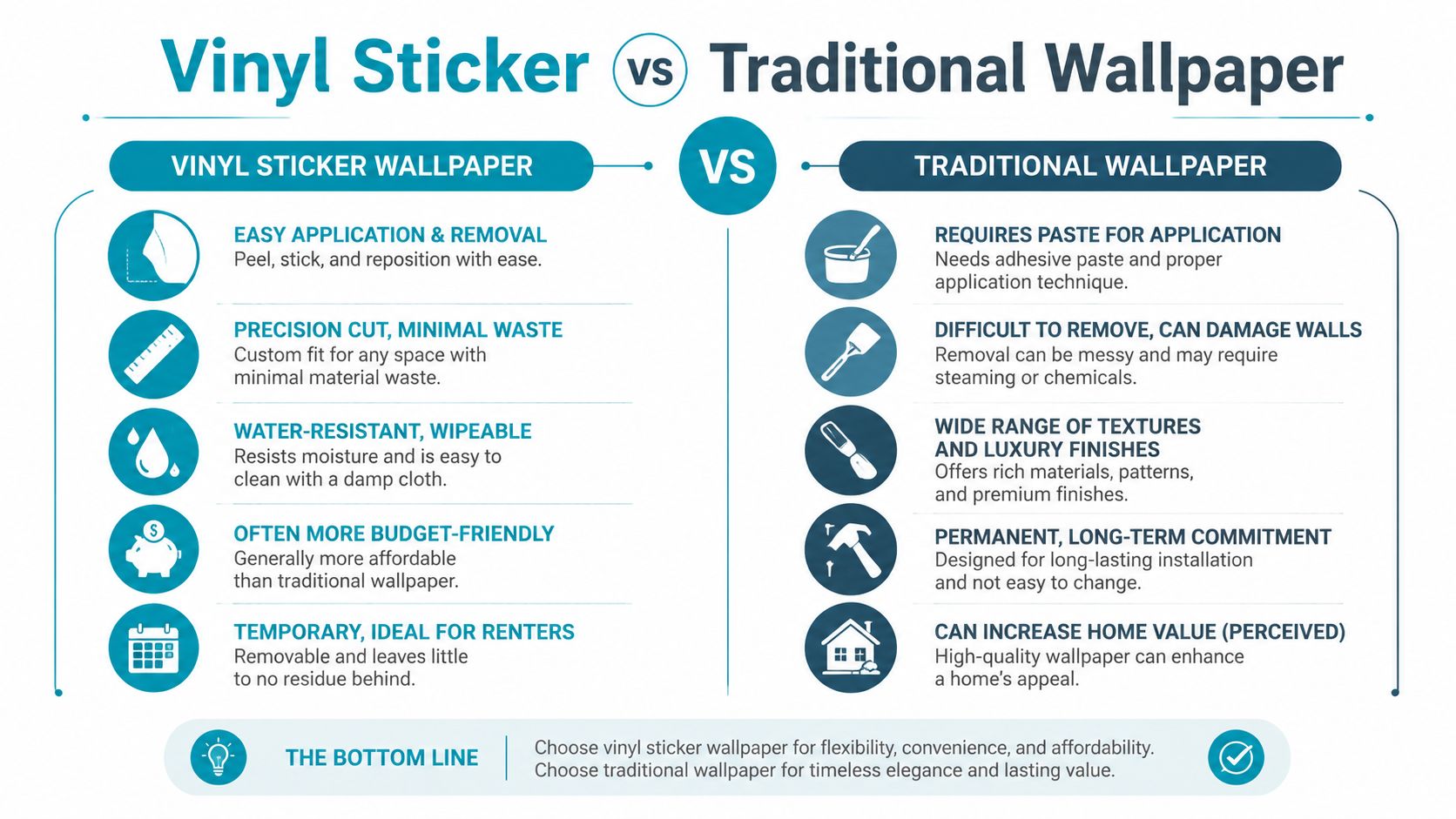
Vinyl Sticker Wallpaper vs Traditional Wallpaper at a Glance
| Feature | Vinyl Sticker Wallpaper | Traditional Wallpaper |
|---|---|---|
| Application | Peel, position, smooth | Paste and hang |
| Mess level | Low | Higher |
| DIY friendliness | Usually easier for beginners | More technique-heavy |
| Best for | Rentals, feature areas, furniture, quick room updates | Whole-room decorating, textured luxury looks |
| Surface feel | Smooth and practical | Can be smooth or richly textured |
| Cleaning | Often wipeable | Varies by material |
| Removal | Often simpler when removed within its intended life | Can be labour-intensive |
| Wall breathability | Lower, because vinyl is non-porous | Varies by wallpaper type |
The breathability issue most guides miss
This matters far more in the UK than many decorating articles admit. Premium vinyl stickers are typically non-breathable, and that can trap moisture on porous or poorly ventilated walls. In older housing, especially where condensation already appears behind furniture or near external walls, that trapped moisture can increase mould risk. Wallpaper from the 70s explains the non-breathable nature of vinyl wallpaper.
That doesn't mean vinyl is “bad”. It means wall condition comes first.
Use extra caution if your home has:
- Cold external walls that already feel cooler than the rest of the room
- Older plaster that takes time to dry after cleaning
- Previous damp or mould marks, even if they've been painted over
- Poor airflow behind beds, wardrobes, or nursery furniture
- Rooms with frequent condensation, such as box rooms and corners near windows
Before applying vinyl sticker wallpaper in an older property, check whether the wall is dry, stable, and free from active condensation. If it isn't, solve the moisture issue first.
Which one suits your project
Choose vinyl sticker wallpaper if you want:
- A weekend project rather than a full decorating job
- A temporary feel for a nursery, rental, or seasonal room update
- A wipeable finish in a busy family area
- A simpler learning curve if you're new to DIY
Choose traditional wallpaper if you want:
- A richly textured finish
- A whole-room heritage look
- A wallcovering that isn't relying on self-adhesive application
- A better fit for walls where breathability is a concern
For a separate practical overview of peel-and-stick styling and setup, this guide to easy and stylish home décor in 2025 gives a useful consumer-friendly angle.
Choosing Your Perfect Vinyl Wallpaper
Not all vinyl sticker wallpaper behaves the same. The pattern might catch your eye first, but the finish, tack, and thickness are what decide whether the job feels easy or annoying.
A good way to think about it is this. Design affects the look. Material affects the experience.
Finish matters more than people expect
The finish changes how the wall looks in daylight and lamplight.
- Matte finish: softer, less reflective, and forgiving on slightly uneven walls. Good for bedrooms, nurseries, and calm living spaces.
- Satin finish: a middle ground with a little sheen. Handy where you want a wipe-clean surface without strong glare.
- Gloss finish: brighter and bolder, often easier to wipe, but it shows wall imperfections more clearly. Better for furniture accents or cleaner-lined spaces than bumpy old plaster.
If your wall gets direct sun, matte often looks more expensive because it doesn't flash light back at you all day.
Tack is really about confidence
“Tack” is how aggressively the adhesive grabs.
Low-tack, repositionable vinyl is easier for beginners. If you're decorating a child's room and want the option to straighten a cloud, rainbow, or name panel without panic, this is the forgiving choice.
Higher-tack products are better for surfaces that get handled more, such as drawers, cupboard doors, or wrapped furniture panels. They're less tolerant of repeated lifting, so your prep and alignment need to be better from the start.
Practical rule: If the project is decorative and temporary, lean lower tack. If the project is high-touch and functional, lean higher tack.
Thickness tells you how the material will handle
Premium UK vinyl sticker wallpaper typically sits around 200 to 250 microns, which balances firmness with enough flexibility to conform to minor wall imperfections, according to Dorotape's wallpaper material datasheet.
That thickness tends to help in three ways:
- It resists tearing better during installation than very flimsy film.
- It smooths more confidently when you're using a squeegee.
- It handles slight surface inconsistency better than ultra-thin material, though it won't hide rough texture.
Think of it like wrapping paper versus cardstock. Too thin, and it creases easily. Too rigid, and it fights every corner.
Match the vinyl to the room
A few quick pairings make life easier:
- Nursery wall or reading nook: matte or satin, repositionable if possible.
- Kitchen cupboard refresh: stronger tack, wipeable finish, careful degreasing first.
- Rental feature wall: low-tack and removable, but only on a sound, dry painted surface.
- Furniture upcycle: slightly firmer vinyl with clean edge trimming and patient surface prep.
The prettiest design is only the right choice if the material suits the surface.
Planning Your Project From Start to Finish
Most problems with vinyl sticker wallpaper start before the backing paper comes off. Crooked placement, lifting corners, trapped dust, visible bumps. Nearly all of them come back to planning.
A calm half-hour with a tape measure and cloth saves a lot of frustration later.
Measure before you browse
Measure the full area first, then measure any interruptions such as windows, sockets, rails, or sloped ceilings. Write everything down. Don't trust memory once you start comparing designs.
For a simple wall section:
- Width × height gives your coverage area.
- If you're applying separate panels, note each panel width so you can visualise joins.
- For furniture, measure front-facing surfaces individually. Drawer fronts, side panels, and top panels are rarely identical.
If your project is in a rental and you want ideas specific to temporary decorating, this removable wallpaper guide for renters is a useful companion read.
Prep the surface like you mean it
Vinyl likes clean, smooth, fully dry surfaces. It doesn't forgive grease, chalky paint, or flaky filler.
Use this checklist before application:
- Dust properly: especially at skirting boards, ceiling lines, and corners.
- Wash away grease: important in kitchens, near radiators, and on furniture.
- Fill chips and cracks: then let repairs dry completely.
- Sand rough spots: even tiny raised bits can show through.
- Check old paint: if it's peeling, soft, or powdery, the vinyl will only stick as well as that weak layer underneath.
- Make sure the wall is dry: this matters doubly in older UK homes.
Damp-prone walls need a different decision process
If a wall has had mould before, stop and investigate first. Vinyl sticker wallpaper can look lovely on a sound wall, but it shouldn't be used as a cover-up for an active moisture problem.
Check for:
- Musty smell
- Cold, clammy patches
- Discolouration behind furniture
- Fresh condensation after a cold night
- Paint that blisters or feels soft
If any of those show up, improve ventilation and fix the underlying issue before decorating. In some homes, the best choice is using vinyl only on internal walls or on furniture rather than on the damp-prone area itself.
A successful install starts with a boring wall. Flat, dry, stable, clean. Boring walls give the best results.
Your Step-by-Step Installation and Removal Guide
Application is easier when you slow down at the start. Most first-timers rush the first panel, then spend the next hour correcting it. The neatest jobs come from gentle positioning and steady smoothing.
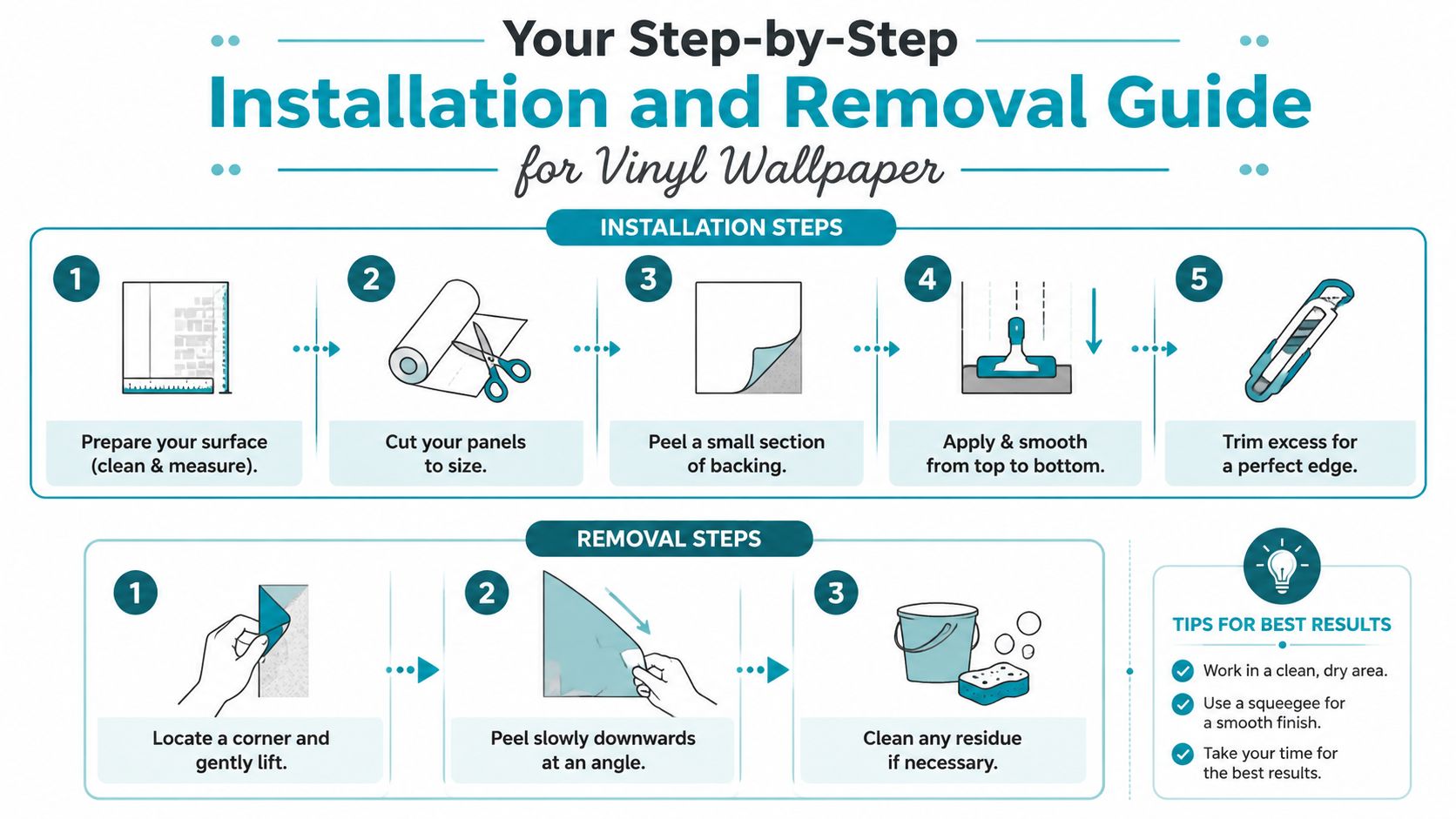
Installing vinyl sticker wallpaper
You'll want a tape measure, pencil, spirit level, squeegee or smoothing tool, sharp craft knife, microfibre cloth, and step stool if needed.
-
Mark a straight starting line
Don't assume the corner is plumb. Use a level and pencil a faint guide line where the first edge will sit. -
Cut and label pieces first
If you're working with multiple panels, trim them to rough size and keep them in order. That avoids confusion when adhesive is exposed. -
Peel only a small section of backing
Start at the top. Peel back a small strip rather than exposing the whole adhesive side at once. -
Position the top edge carefully
Lightly anchor it, check alignment, then begin smoothing downward. -
Use the squeegee from the centre out
Push air outwards in short strokes. Don't press wildly. Firm, even passes work best. -
Keep peeling gradually
As the panel settles, pull more backing away and continue smoothing. For larger pieces, the hinge method helps. Tape the panel in place first, hinge it from the top, and work down in a controlled way. -
Trim the excess with a sharp blade
Replace blunt blades quickly. A dull knife drags the vinyl and leaves ragged edges.
Removal after months or years
It's important to be realistic: Vinyl doesn't always peel off in one dreamy sheet, especially after long use. Over a 3 to 5 year lifespan, PVC vinyl can harden through plasticiser migration and become more brittle, which can lead to shattering or adhesive residue during removal, as outlined in StickerShop's guide to vinyl stickers.
That means gentle removal is the smart approach.
- Lift a corner slowly: use a fingernail or plastic scraper, not a metal blade.
- Pull at an angle: peeling downward and slowly usually gives better control than yanking straight out.
- Apply gentle warmth: a hairdryer on low can soften adhesive and reduce snapping.
- Pause if paint starts lifting: score around problem areas carefully and work more slowly.
- Clean residue patiently: a soft cloth and mild cleaner are safer than aggressive scraping.
If the wall underneath has picked up marks from furniture, shoes, or everyday life, this guide to removing scuff marks from walls is worth keeping handy before you touch up the area.
Common mistakes that cause bubbles or damage
- Starting on a dirty wall
- Peeling all the backing off at once
- Ignoring a crooked first line
- Applying onto fresh paint before it has properly cured
- Forcing old vinyl off when it's brittle
A slow install beats a fast redo every time.
Design Ideas and Creative Uses Beyond Walls
Some of the best vinyl projects don't involve covering an entire room. They focus on awkward, overlooked, or heavily used spots that benefit from colour and pattern.
That wider appeal is easy to understand. The global peel-and-stick wallpaper market generated $1.85 billion in 2025, with vinyl accounting for 48.6% of the share, according to DataIntelo's peel-and-stick wallpaper market report. DIY-friendly decorating has clearly moved well beyond one standard feature wall.
For children's spaces
A nursery is one of the easiest places to use vinyl creatively. One moon-and-stars corner, a name decal above the cot, or a reading nook with soft shapes can change the mood of the room without overfilling it.
Parents often get the best result by using vinyl in zones:
- Bed or cot area: keep the main visual interest here
- Play corner: use wipeable decals lower down where hands reach
- Storage labels and matching motifs: helps the room feel joined up without becoming busy
For rentals and quick refreshes
If your flat feels plain, don't try to “fix” every wall. Choose one area that draws the eye when you walk in. A dining nook, entry wall, or alcove usually has more impact than spreading small touches everywhere.
Furniture can carry a lot of personality too. Drawer fronts, wardrobe panels, side tables, and bookcase backs all take vinyl well when properly cleaned and measured. For extra character, pair a patterned wrap with warm metallic or antique-inspired lighting. Golden Lighting vintage collections are a helpful reference if you want to balance modern vinyl surfaces with softer, more classic fittings.
For upcycling and custom details
Vinyl is brilliant for the pieces you nearly gave away. A chest of drawers with good bones but a tired finish. A basic desk that needs colour. Stair risers that feel anonymous. Even a linen cupboard door can become a small design moment.
For more inspiration around shapes, layouts, and decorative applications, this complete guide to vinyl wall stickers is useful for sparking ideas beyond standard wallpaper rolls.
Small surfaces are where vinyl often looks smartest. A full room can be bold. A well-chosen panel or furniture wrap can look intentional.
Frequently Asked Questions for UK Homes
Can I apply vinyl sticker wallpaper over woodchip or textured walls
Usually, heavily textured walls are a poor match. Vinyl needs contact across the surface to sit neatly and stay put. Light texture may be manageable with firmer material and careful smoothing, but deep woodchip, rough artex, and crumbly old plaster tend to show through and weaken adhesion.
Is vinyl sticker wallpaper suitable for older or listed buildings
Sometimes, but caution matters. Older UK homes often have walls that need to breathe more than modern plasterboard does. If the building has known damp issues, lime plaster, or heritage restrictions, get proper advice before applying anything non-breathable. In these properties, furniture panels or modern internal partitions are often a safer place to use vinyl than original external walls.
Can I use it in a bathroom
It depends on where. Decorative vinyl can work better away from direct water and on surfaces that stay relatively stable and dry between uses. A steamy, poorly ventilated bathroom is not the easiest environment, especially if the wall already collects condensation. Ventilation first, decoration second.
Will it damage paint when I remove it
It can, especially if the paint underneath is weak, old, or poorly bonded to the wall. The longer vinyl stays up, the more careful you should be during removal. A hidden patch test is always worth doing before a larger install.
Is it a good option for care settings or children's rooms
Yes, if you prioritise cleanability, secure adhesion on sound surfaces, and age-appropriate placement. In children's spaces, avoid placing peelable decorative elements where very young children can constantly pick at them. In care settings, choose practical placements that support cleaning routines and legibility.
If you're ready to refresh a nursery, rental, furniture piece, or family room with premium vinyl, Quote My Wall is a strong place to start. They offer wall stickers, vinyl wraps, labels, prints, and personalised options for UK homes, so you can choose something that fits your space rather than forcing your space to fit a trend.