

Vinyl Wraps Cost UK 2026: Furniture & Walls
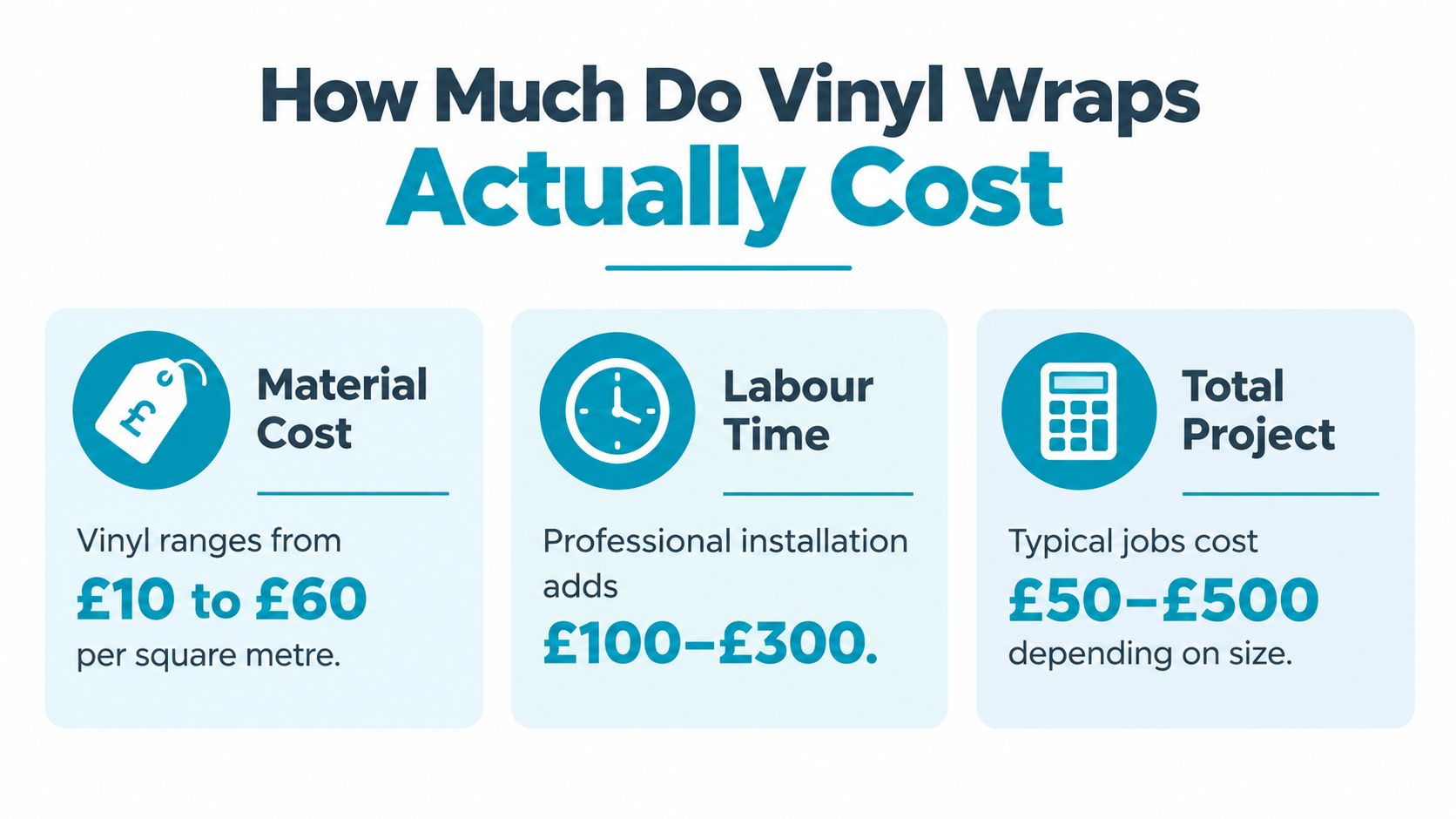
A full kitchen-door vinyl wrap typically costs £150–£450 for materials alone when you do it yourself, or £300–£800 with professional fitting. A single bedside table wrap is usually £25–£75 DIY or £80–£200 fitted.
Those figures are useful starting points, but they don't tell the whole story. The final vinyl wraps cost depends just as much on the condition of the furniture, the preparation it needs, the amount of material wasted and how long the finish remains useful. A cheap roll can become an expensive project if the surface is damaged, the edges are awkward or the wrap needs replacing quickly.
For UK homeowners and renters, wrapping can offer a practical way to refresh furniture, walls, windows and doors without replacing an entire room. The sensible question isn't, “How much is the vinyl?” It's, “How much will this project cost per year of useful improvement?”
How Much Do Vinyl Wraps Actually Cost
A small furniture project can be inexpensive, while a larger professional job can quickly move into four-figure territory. UK vehicle-wrapping guidance places professional wrapping at approximately £895 to more than £3,500, with a small-to-medium car starting at about £1,495 and a large van from around £2,800. That comparison is helpful because it shows how coverage, preparation and fitting labour influence the final bill, rather than suggesting that vinyl has one universal rate. UK vehicle-wrap pricing guidance explains those cost drivers in practical terms.
For furniture, the same principle applies on a smaller scale. A flat bedside table with clean laminate may need little preparation and very little film. An old chest of drawers with peeling paint, rounded corners and removable hardware needs more work before the vinyl can even be applied. A kitchen door also faces more daily contact than a decorative wall panel, so choosing a durable film and finishing the edges properly matters.
What your first estimate should include
A realistic budget normally contains four separate parts:
- Vinyl material: The film, backing paper and any matching finish.
- Preparation: Degreaser, cloths, filler, sanding materials and repairs.
- Installation: Your own time or a fitter's labour.
- Finishing and waste: Trimming, edge work, rework and unused offcuts.
For a straightforward furniture makeover, measuring the surface accurately is the best first step. Guidance for wrapping furniture in the UK can help you assess whether your item is suitable before ordering.
A professional quote should state what it includes. Ask whether the price covers removing handles, taking doors off hinges, repairing chips, wrapping internal edges and correcting installation faults. A headline figure that excludes preparation may look attractive but won't necessarily be the lowest final cost.
The Five Factors That Drive Vinyl Wrap Pricing
Vinyl pricing becomes easier to understand once you separate the project into its main variables. The five factors below explain why two apparently similar jobs can receive very different quotes.
Material grade
Entry-level calendared film is generally less expensive. Cast vinyl, the professional installation grade, costs approximately 15–25% more in material cost than entry-level calendared film, according to UK wrapping guidance from 3M's UK car-wrap pricing information. Cast film is designed to conform more easily around curves and detailed surfaces, which can make it more suitable for shaped furniture edges.
The cheapest material isn't automatically the right choice. A flat drawer front may be forgiving, while a curved cabinet door needs a film that can be heated and stretched without excessive tension. Finish also affects the visual result. Matt, satin, gloss, metallic and textured surfaces can behave differently during fitting and may make imperfections more visible.
Surface area
More coverage usually means more film, more trimming and more installation time. Measure each visible face rather than estimating from the overall size of the furniture. Include side panels and exposed edges if you want a fully finished appearance.
Surface complexity
Handles, grooves, routed profiles, rounded corners, seams and narrow returns all increase the work involved. Patterned film creates another challenge because adjacent panels may need careful alignment. That raises waste, particularly when the design has a directional grain or repeating image.
Preparation requirements
Clean, smooth and stable surfaces are cheaper to wrap than loose veneer, flaking paint or swollen MDF. Degreasing, filling, sanding and priming may be necessary before application. Preparation isn't an optional cosmetic extra. It determines whether the adhesive can form a reliable bond.
Labour and access
DIY removes fitting labour but transfers the cost into your time, tools and risk. Professional installers charge for setup, preparation, application and finishing. London work can cost 20–40% more than equivalent installations in northern England, according to the UK pricing guide linked above, so location also belongs in the initial budget.
| Factor | What It Means | Typical Impact on Cost |
|---|---|---|
| Material grade | The film's flexibility, finish and suitability for the surface | Premium cast film increases material spend |
| Coverage | The total area to be covered | Larger projects need more film and trimming |
| Complexity | Curves, grooves, handles and pattern matching | More labour and greater waste |
| Preparation | Cleaning, repairs, sanding and stabilising | Damaged furniture can need substantial extra work |
| Installation | DIY fitting or professional application | Labour increases the quote but can reduce rework |
Practical rule: Price the surface you need to prepare, not just the roll you need to buy.
DIY versus Professional Installation Costs
DIY is attractive because it gives you control over the timing and avoids a fitting charge. It also exposes every weak point in the furniture. Dust, grease, uneven paint and sharp edges can create bubbles, lifting or visible creases, and correcting a failed panel may require fresh material.
Professional fitting costs more upfront, but the quote may include preparation, specialist tools, controlled working conditions and edge finishing. UK pricing guidance from 3M places a typical professional car wrap at £1,800–£5,000, with materials, preparation and labour included in the estimate. Vehicle work is more extensive than most furniture projects, but the benchmark demonstrates why skilled installation can form a large part of the price.
Choose DIY when
- The faces are flat: Simple drawer fronts and smooth doors are easier to learn on.
- You can remove hardware: Taking off handles and hinges helps you achieve cleaner edges.
- You have time to practise: A sample piece lets you test heat, pressure and repositioning.
- The item has modest replacement value: A first attempt carries less financial risk on an inexpensive piece.
Choose a professional when
- The substrate is difficult: Damaged veneer, swollen board or unstable paint needs assessment first.
- The finish must look flawless: Kitchens, matching furniture runs and visible feature pieces show mistakes quickly.
- The design is complex: Grain alignment, curves and multiple edges increase the chance of rework.
- You need a predictable result: Paying for installation can be sensible when your time is limited.
| Project | DIY Materials Only | Professional Fitted |
|---|---|---|
| Full kitchen-door wrap | £150–£450 | £300–£800 |
| Single bedside table | £25–£75 | £80–£200 |
| Large or complex furniture project | Material-dependent | Quote required after inspection |
The best decision depends on the surface rather than confidence alone. A careful beginner can handle a smooth panel, while an experienced DIYer can still lose money on furniture that needs extensive repair. Ask for a written professional quote and compare its inclusions with the materials and preparation you would need to purchase yourself.
Measuring Your Project Accurately
Measure in metres, then calculate each face separately. The basic formula is:
height × width = surface area
For several panels, calculate each panel and add the results together. Don't rely on the outside dimensions of a wardrobe or cabinet if only some faces will be wrapped. Doors, drawer fronts, side panels and exposed tops may all have different measurements.
Add a waste allowance for trimming, positioning and mistakes. UK wrap-cost guidance recommends recording actual film consumption and accounting separately for preparation, installation, finishing and rework. Offcuts also occur when the film has a directional grain or when a damaged section must be cut around.
A simple measuring sequence
- List every face: Include doors, drawer fronts, sides, tops and visible returns.
- Measure height and width: Record the measurements for each different panel.
- Calculate each area: Multiply the two measurements for every face.
- Add the areas together: This gives your usable coverage requirement.
- Plan for waste: Order additional material where trimming, matching or learning will be involved.
- Check the roll width: A large total area may still be difficult to cut efficiently if the roll is narrow.
For a wall, multiply the wall width by its height, then subtract large openings only if the calculation would otherwise materially overstate the required coverage. For a window frame, measure the faces that will receive film. A frame's perimeter can require more material than a quick glass-width measurement suggests.
| Furniture | Door Height | Door Width | Material per Door |
|---|---|---|---|
| Bedside table | Measure the actual panel | Measure the actual panel | Panel area plus trimming allowance |
| Chest of drawers | Measure each drawer front | Measure each drawer front | Add each drawer separately |
| Wardrobe | Measure each door | Measure each door | Door area plus edge and pattern allowance |
| Kitchen cabinet | Measure every door and drawer | Measure every door and drawer | Total all visible fronts |
The cabinet-wrapping measurement guide is useful when a kitchen contains mixed door and drawer sizes. Ordering too little can be more costly than ordering a sensible surplus because a replacement piece may differ slightly in colour, batch or finish.
Real UK Project Price Examples
The following examples use the headline ranges supplied for common UK projects. Treat them as budgeting guides, not guaranteed quotes. Furniture condition, location, material grade and the amount of preparation can move the final figure.
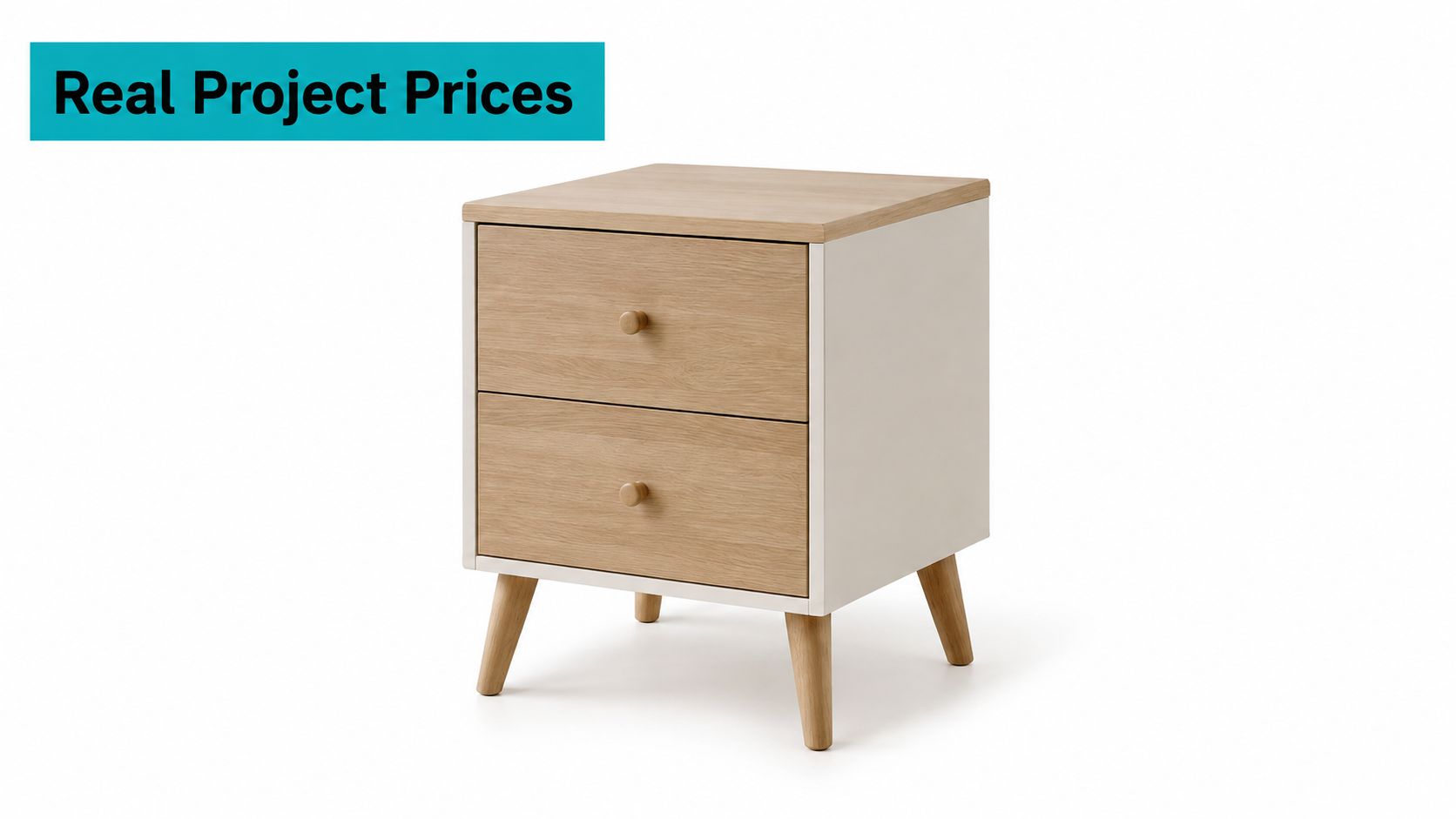
Bedside table
A single bedside table is a manageable first project when its surfaces are smooth and its drawers can be removed. A DIY budget of £25–£75 covers the stated material range, while a fitted job commonly falls at £80–£200. A wood-effect or matt finish can disguise minor visual variation, but it won't hide a loose veneer or deep dent.
The preparation decision matters more than the size. If the table only needs cleaning and light smoothing, DIY may offer good value. If it needs repairs and the wrap must continue around several edges, professional fitting may prevent wasted material.
Kitchen doors
A full kitchen-door wrap typically costs £150–£450 for materials or £300–£800 professionally fitted. The higher end becomes more plausible when doors need removal, degreasing, repairs, edge wrapping or a coordinated grain direction.
Kitchen doors also receive frequent handling, heat and cleaning. A durable film and careful edge finishing deserve more weight than the lowest material price.
Wardrobe
A full wardrobe needs more coverage and often includes tall doors, side panels and awkward top edges. The quote should specify whether the installer is wrapping only the fronts or the complete exterior. Ask for a panel-by-panel measurement rather than accepting a vague “wardrobe price”.
Feature wall
A vinyl feature wall can be simpler than furniture if the wall is smooth, dry and free from flaking paint. Window reveals, sockets, corners and textured surfaces make the installation more demanding. Measure the wall faces and decide whether the design needs matching across adjoining strips before ordering.
These examples show why a single online price rarely answers the question properly. The same item can be cheap to refresh when sound, yet poor value when preparation consumes most of the budget.
The Hidden Costs Most People Overlook
The most common budgeting mistake is to treat vinyl as the entire project. Film is only one component. An old piece may need degreasing, sanding, filler, primer or a stable replacement surface before adhesive can work reliably.
Hardware creates another cost. Removing handles and hinges takes time, while masking around them can leave less polished edges. Drawers and doors are usually easier to wrap when removed, but removal and reinstallation still need to be included in a professional quote.
Waste and rework
Actual usable coverage is smaller than the purchased area because you need to trim around corners, reposition pieces and discard flawed sections. Pattern alignment can make offcuts unavoidable. Guidance on calculating the true profit of a wrap job recommends separating film use from laminate, preparation, installation, finishing, rework and actual labour time. This UK wrap-cost calculation guide offers a useful framework for asking an installer what a quote really includes.
A bubble on a hidden side may be tolerable. A crease across a prominent kitchen door usually means removing the panel and starting again. That can consume both material and time.
Removal and durability
Renters should test a small hidden area before committing. Adhesive may interact differently with laminate, MDF, painted wood and veneer, and removal can expose weak paint or lift a damaged surface. Keep the product details and installation instructions so you can assess the risk before wrapping a deposit-sensitive item.
The sustainability question is also more complicated than “vinyl equals reuse”. UK evidence records approximately 22 million furniture items discarded annually, representing about 670,000 tonnes, while around 17% of discarded furniture is recycled. UK furniture-waste evidence from Hippo highlights why extending an item's useful life matters, but the wrap only helps if the underlying piece remains in use long enough to justify the material and future removal.
A low purchase price isn't low total cost if the substrate needs repairing twice or the finish fails before the furniture has earned another useful period of service.
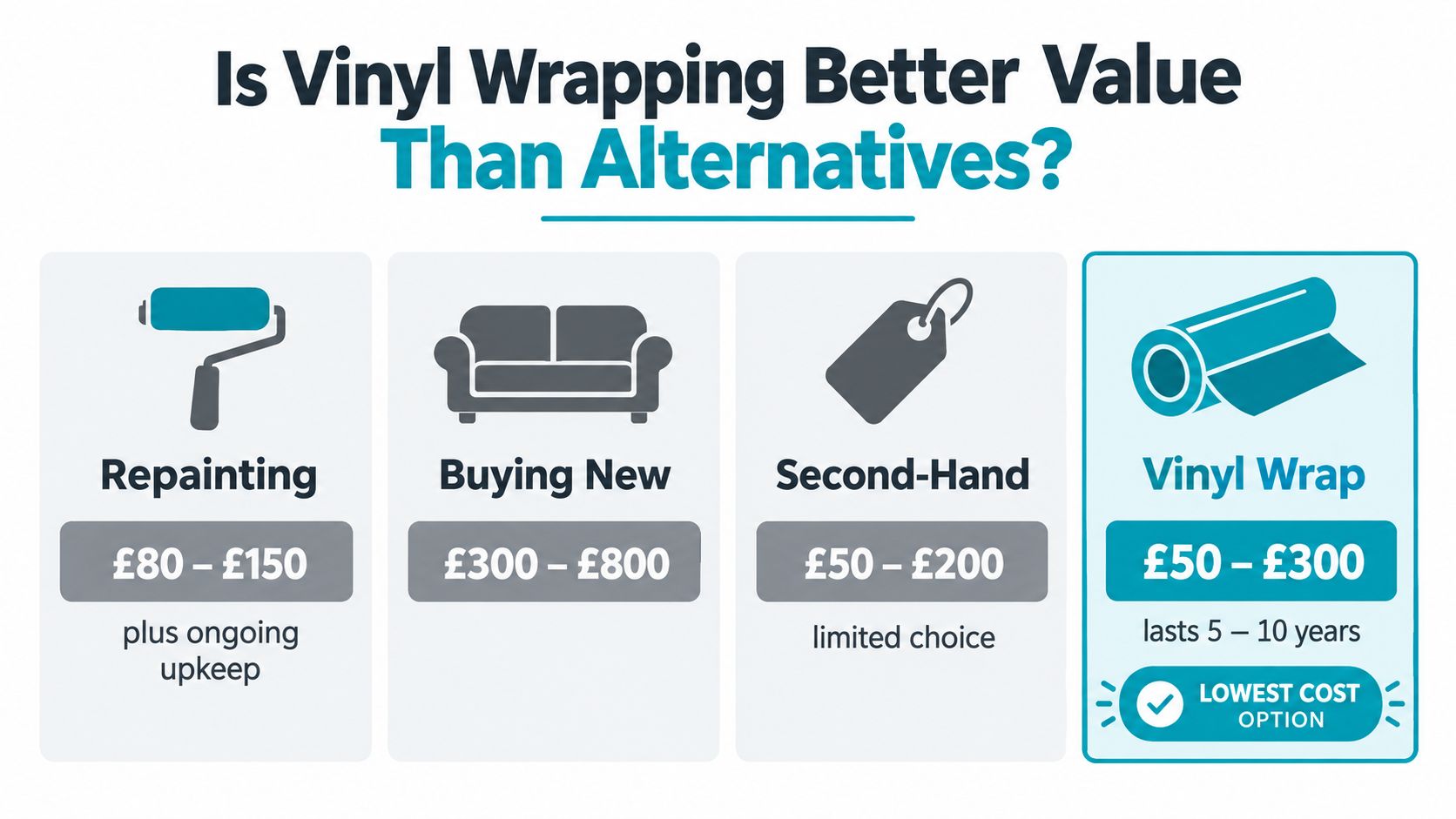
Is Vinyl Wrapping Better Value Than Alternatives
Vinyl wrapping can be excellent value, but it isn't automatically the right answer for every item. Compare the total project, including preparation, tools, labour, future maintenance and the condition of the furniture.
Repainting may suit a piece with detailed mouldings or a surface that won't accept adhesive well. It requires cleaning, preparation and multiple stages of application, while drying time can make the room unusable for longer. Wrapping is often cleaner and faster for smooth panels, but it demands accurate cutting and careful edge work.
Buying new gives you a fresh surface and may provide a longer service life, but it also removes a usable item from your home and adds the purchase cost. Second-hand replacement can be financially attractive when you find a suitable piece in sound condition, though style, dimensions and availability are unpredictable.
The wider reuse picture supports evaluating what you already own. The UK reuse sector reported reusing 2.29 million furniture and electrical items in 2025, supporting 1.35 million households and generating £288.88 million in household savings, according to the Reuse Network Social Impact Report. Those figures don't prove that wrapping every item is cheaper, but they do reinforce the value of keeping suitable furniture in circulation.
Use cost per year of service
Instead of comparing only the upfront price, divide the total project cost by the years you expect the finish to remain useful. The calculation is:
total cost ÷ expected useful years = cost per year of service
The result is only as reliable as your assumptions. A wrap on a lightly used bedroom unit may remain attractive longer than one on a busy kitchen door. A poor surface can shorten both the useful life and the value of the project.
| Option | Upfront Cost | Lifespan | Cost Per Year |
|---|---|---|---|
| Repainting | Materials and preparation vary | Depends on use and surface | Total painting cost divided by useful years |
| Buying new | Purchase and delivery cost vary | Depends on construction and use | Total purchase cost divided by useful years |
| Second-hand | Usually lower purchase cost | Depends on condition | Purchase and repair cost divided by useful years |
| Vinyl wrap | Film, preparation and fitting | Depends on film, substrate and room | Total wrap cost divided by useful years |
For a broader perspective on resilient vinyl surfaces and where vinyl products fit in practical interiors, this overview of vinyl flooring provides useful context, although flooring and furniture wrapping have different installation demands.
A sensible comparison asks whether the item is structurally sound, whether the finish suits the room and whether you can keep using it for long enough to spread the cost. For renters, removability may matter more than appearance. For an upcycler, preparation time may matter more than the roll price.
Your Vinyl Wrap Budgeting Checklist
A reliable budget starts before you choose a colour. Work through the item, the surface and the intended service life in that order.
- Inspect the furniture: Reject or repair loose veneer, swollen board, flaking paint and unstable surfaces before calculating film.
- Measure every face: Record doors, drawer fronts, side panels, tops and exposed returns individually.
- Calculate usable coverage: Multiply height by width for each face and add the results.
- Allow for waste: Include trimming, directional grain, pattern matching and the possibility of rework.
- Choose the film for the room: A decorative wall application has different demands from a frequently handled kitchen door.
- List preparation supplies: Include degreaser, cloths, filler, sanding materials, masking tape and any primer the substrate requires.
- Decide who will fit it: Choose DIY for manageable flat surfaces and professional installation for complex, visible or high-use work.
- Ask for an itemised quote: Check coverage, film type, warranty, preparation, hardware removal, difficult edges, finishing and removal.
- Test removability: If you're renting, apply a small sample in an inconspicuous place and check the surface after removal.
- Calculate cost per year: Divide the complete project cost by the realistic period you expect the finish to remain useful.
The key decision is not whether vinyl is cheap. It's whether the existing item is good enough to deserve a new surface, whether you can prepare it properly and whether the result will remain useful for the time you need. A careful calculation can show that wrapping is the right choice, while a poor substrate may make repainting, repair or second-hand replacement more sensible.
Quote My Wall offers vinyl wraps for furniture and related home décor products, so you can compare suitable designs and plan the material side of a project alongside your measurements. Visit Quote My Wall to browse options, then measure your surfaces and request advice before ordering for a larger makeover.