

Privacy Window Film for Bathroom: A UK Guide
You're standing in the shower, the bathroom window is directly overlooked, and the temporary blind has started to collect damp marks. It blocks the daylight, rattles when the window opens, and never feels quite clean. A privacy window film for bathroom use solves the problem at the glass, without adding fabric, cords, or bulky fittings.
The right film can preserve natural light, provide privacy after dark, and cope with the condensation that makes bathrooms difficult places for ordinary window coverings. But choosing well in the UK involves more than picking a pretty frosted finish. You also need to consider obscuration, glass safety markings, installation conditions, and whether your tenancy allows a permanent adhesive product.
Why Bathroom Privacy Film Is the Smartest Upgrade
A bathroom window creates a design compromise. You want daylight, but you don't want neighbours, pedestrians, or nearby flats looking in. Blinds and curtains solve the visibility problem, yet they can make a small room feel enclosed and introduce textiles into one of the dampest rooms in the home.
Privacy film takes a different approach. It sits directly on the glass and diffuses the view, so the window can still brighten the room without offering a clear sightline. A frosted finish can imitate acid-etched or sandblasted glass, while specialist guidance says it can maintain natural light rather than stopping it altogether. You can see the difference in the intended effect below.
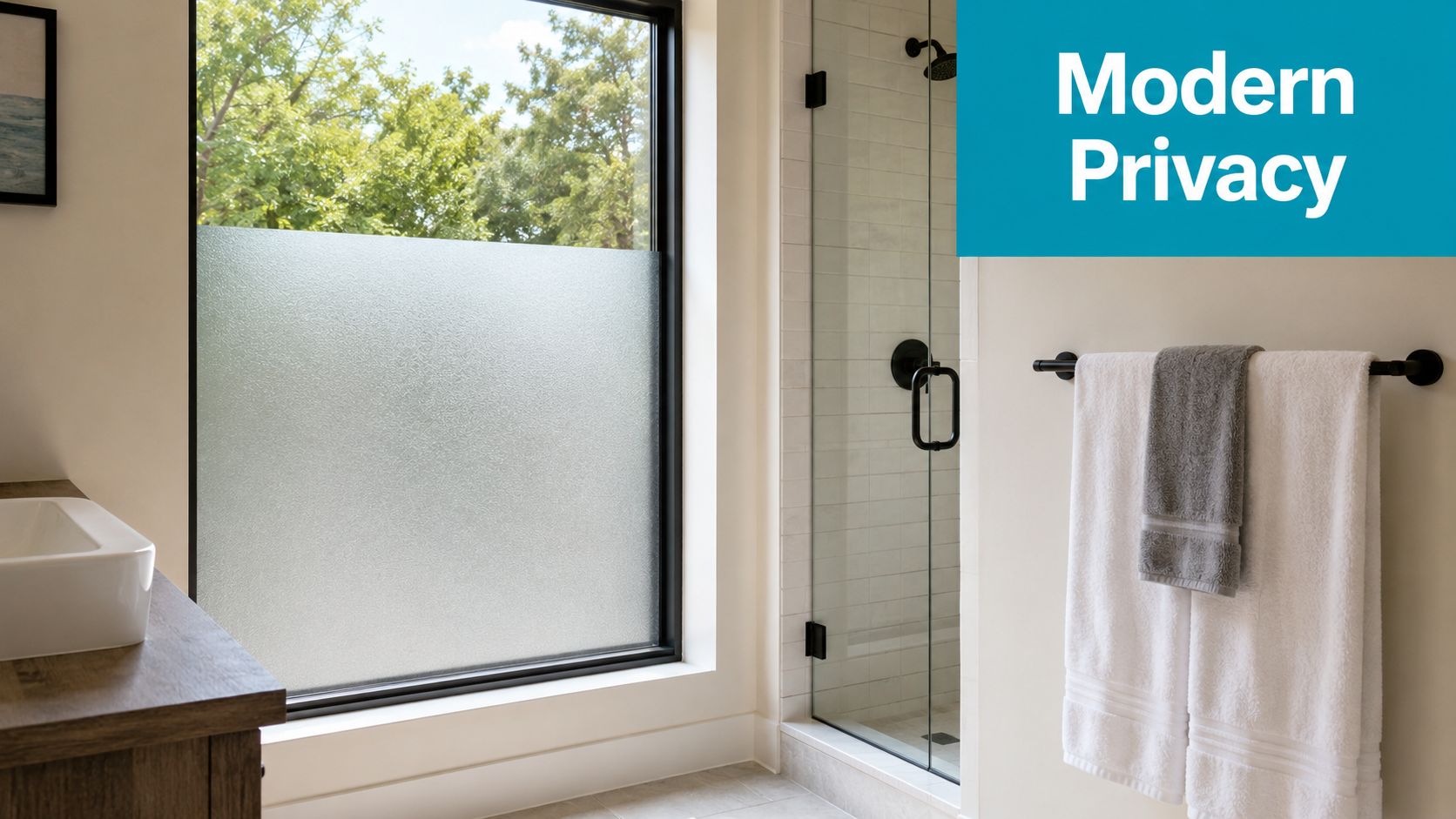
Better light without the awkwardness
A frosted bathroom film is particularly useful where the window is small or faces a neighbouring property. The room stays connected to the outside light, but the glass no longer demands constant adjustment every time someone uses the bathroom.
That matters in a shower room, where a fabric curtain can sit close to steam and splashes. Film doesn't absorb moisture, and it doesn't need to be gathered, dried, laundered, or kept away from the sill. A smooth glass surface is also easier to wipe than a damp textile.
Practical rule: Choose privacy at the glass when the room is humid, overlooked, and dependent on daylight.
The film also gives you a cleaner visual line. There's no rail above the window and no slats competing with tiles, sanitaryware, or a mirror. If you're planning wider changes, ideas for find bathroom upgrades for home value can help you coordinate privacy improvements with the rest of the room rather than treating the window as an afterthought.
Start with the sightline, not the finish
Before ordering, stand outside the bathroom at likely viewing positions. Check the window from the pavement, neighbouring garden, opposite windows, and any higher angle. Then inspect the room at night with the bathroom light on.
A decorative pattern may look private from straight on but reveal outlines from an oblique angle. For practical guidance on choosing a finish, compare the options in this window film privacy guide. The most attractive film is still the wrong choice if it leaves a recognisable silhouette where privacy matters most.
Understanding UK Privacy Levels and Building Regulations
Bathroom privacy should be specified by obscuration, not by the word “frosted” alone. Two frosted-looking films can produce very different results, especially when a person stands close to the glass or an observer views it from an angle.
UK planning and glazing guidance commonly uses Pilkington-style privacy levels from Level 1, the least obscure, to Level 5, the most obscure. Bathroom guidance often treats Level 3 as a minimum, while ground-floor or directly overlooked bathrooms are commonly advised to use Level 4 or Level 5 to prevent discernible silhouettes. The relevant choice depends on the actual sightline, not on whether the window is in a bathroom. These privacy considerations are reflected in UK planning guidance on obscure glazing.
What the levels mean in practice
Think of the scale as a visibility filter:
- Level 1: Lightly obscured. Shapes and movement may remain apparent.
- Level 2: More diffusion, but close observers may still recognise an outline.
- Level 3: A stronger bathroom starting point where the window isn't directly exposed.
- Level 4: Substantial obscuration for vulnerable ground-floor or overlooked glazing.
- Level 5: The strongest privacy choice where you don't want a body outline to be discernible.
Some film suppliers describe opacity on a 0 to 10 scale, rather than using the Pilkington system. One UK example places a matte frosted film at around 8/10, with a rough alignment to 4/5 on the Pilkington privacy guide. That comparison is a useful buying aid, but it isn't a universal conversion. Always check the supplier's own description and, where possible, request a sample.
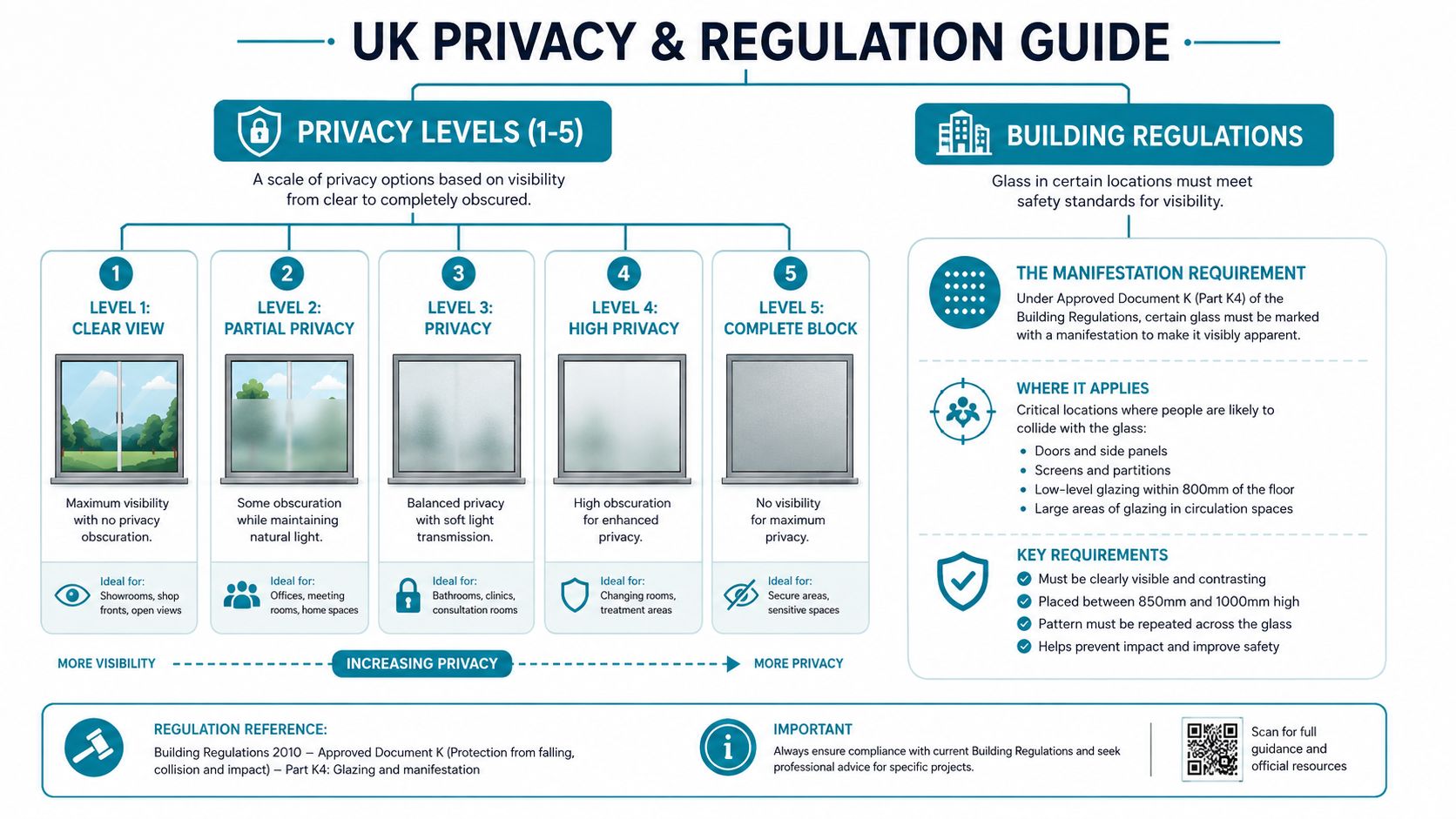
Manifestation is a separate safety issue
Privacy and manifestation aren't the same thing. Manifestation makes large areas of glass visible to people moving through a building, reducing the risk of someone walking into a transparent door, screen, or glazed partition.
UK guidance commonly cites contrasting markings at 850 to 1000 mm and 1400 to 1600 mm above finished floor level for large glazed areas, particularly glass used in doors and full-height screens. The relevant guidance is set out in this UK manifestation reference.
A frosted film can help make otherwise clear glass visible, but don't assume that any decorative film automatically satisfies the needs of your particular installation. If the bathroom contains a full-height glass screen, glazed door, or large internal partition, treat safety marking as a separate design and compliance decision. Use contrasting bands, dots, or another clearly visible treatment where the glazing arrangement requires it.
Design decision: Privacy film controls what people can see. Manifestation helps people see that the glass is there.
Comparing Film Types and Bathroom Alternatives
The best option depends on whether you prioritise reversibility, permanence, or decoration. For most homeowners, a moisture-suitable frosted adhesive film offers the most settled finish. For renters, static cling is usually the safer starting point because it can be removed without relying on a permanent bond.
Bathroom blinds and curtains remain workable in some rooms, especially where the window is well away from the shower. They're less convincing when they sit in a regular cycle of steam, splashes, and limited ventilation. Fabric can hold dampness, while slats and hardware need frequent cleaning around their edges and fixings.
| Feature | Privacy Film | Venetian Blinds | Fabric Curtains |
|---|---|---|---|
| Moisture resistance | Suitable bathroom-grade products are designed to resist condensation and water exposure | Slats can cope better than fabric, but mechanisms and fixings still need care | Fabric can remain damp and may develop marks or unpleasant odours |
| Maintenance | Wipe the smooth surface with a soft cloth and suitable cleaner | Clean individual slats, cords, headrails, and fittings | Remove, wash, dry, and reinstall regularly |
| Light transmission | Frosted and obscured finishes allow daylight through while diffusing views | Open slats admit light, closed slats reduce it | Privacy usually comes with a darker room |
| Privacy at night | A properly selected obscuring film doesn't depend on a day-versus-night reflection effect | Closed blinds provide privacy, but gaps and angles matter | Closed curtains provide privacy if they cover the full window |
| Reversibility | Static cling is the easiest removable route; adhesive film needs more care at removal | Usually involves brackets and fixings | Requires a pole or track and may leave mounting holes |
| Visual effect | Clean, integrated, and available in plain or patterned finishes | More architectural and adjustable | Softer, but visually heavier in a small bathroom |
The hygiene argument is strongest where curtains touch a sill, radiator, or wet wall. A film doesn't create an extra absorbent layer, and it removes the need for a separate covering altogether. UK-facing guidance identifies bathrooms as a common domestic use for frosted film because it provides two-way privacy without adding another damp-room furnishing, as described by domestic frosted film guidance.
Choose the construction for the tenancy
- Static-cling film: Best for tenants, temporary projects, and beginners. It uses pressure rather than a permanent adhesive and works on smooth glass when fitted correctly.
- Adhesive film: Better suited to an owner who wants a settled long-term finish. Removal requires more patience, and residue is a consideration.
- Decorative patterned film: Useful when the bathroom needs a design feature, but check the pattern's actual obscuration before using it on a shower or exposed ground-floor window.
For a broader decorative scheme, you could coordinate the film with bathroom paneling ideas so the window treatment relates to the wall finish rather than looking like an isolated fix. If you're comparing styles and applications, this guide to frosted window film for privacy is a useful reference.
How to Measure and Install Your Film Perfectly
A good film can fail if the glass is greasy, damp, or covered with tiny particles. Bathroom installation needs more preparation than a dry bedroom window because condensation and soap residue can interfere with the edges.
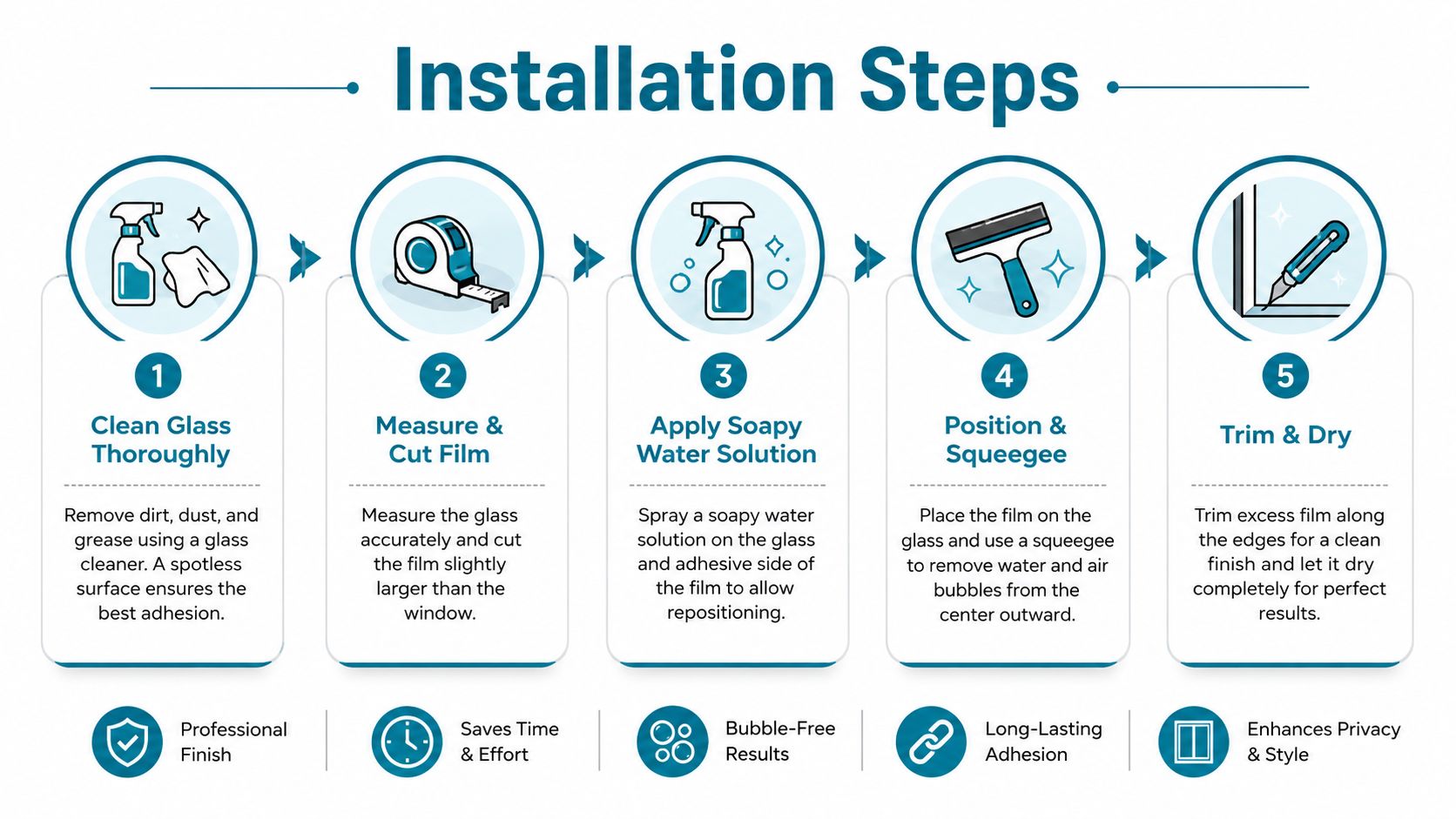
Measure before you cut
- Measure the visible glass. Measure the width and height in several places. Older windows and frames aren't always perfectly square, so use the smallest measurement if the film is intended to sit inside the glazing area.
- Decide on the edge detail. You can cut the film to the glass size, or leave a narrow, even gap around it if the supplier recommends that approach. Follow the product instructions rather than guessing.
- Order enough material for a clean attempt. If the window has a difficult shape, a sill, or an awkward reach, allow for a practice piece. Don't try to make a complicated cut while balancing over a bath.
Use a steel ruler, a sharp snap-off knife, a non-abrasive squeegee, a spray bottle, and lint-free cloths. A blunt blade drags the film and creates ragged corners.
Prepare the glass properly
Clean the pane with a mild glass cleaner first, then remove any remaining residue with a clean scraper suitable for glass. Pay close attention to the perimeter, where silicone, dust, soap film, and dried water marks collect.
Switch off the shower and allow the room to settle. The glass must be clean and dry before you begin, even though you'll use a wet application solution during fitting. UK supplier guidance says bathroom-grade film should resist condensation, and static-cling products are positioned for smooth bathroom glass because normal room-side condensation shouldn't harm them after fitting. You can review that advice in this bathroom privacy film installation guidance.
Apply slowly, then remove the water
- Spray the glass: Apply a light, even layer of soapy water. This lets you slide the film into position.
- Separate the backing: Peel it away carefully. If the film curls, have a second person hold the loose section.
- Position the film: Place it against the wet glass and align the top edge before committing to the rest.
- Squeegee from the centre: Push water and air towards the edges using overlapping strokes. Keep the squeegee flat and use steady pressure.
- Trim the perimeter: Run a sharp blade along a ruler or the frame edge. Wipe away expelled water without lifting the film.
- Let the edges settle: Avoid repeated steaming and unnecessary touching while the film finishes drying.
Static cling is more forgiving because you can lift and reposition it. That doesn't make preparation optional. Dirt trapped beneath the film stays visible, and moisture left at the edge is where lifting can begin.
The Renter's Guide to Legal and Reversible Privacy
A tenant shouldn't treat bathroom film as automatically harmless. The fact that a product is marketed as removable doesn't override a tenancy agreement that restricts alterations, changes to windows, or anything affecting the property's appearance.
Start with the contract. Look for wording about alterations, fixtures, fittings, adhesive products, window coverings, and returning the property to its original condition. If the wording is unclear, ask the landlord or managing agent in writing and keep the response with your tenancy records.
Static cling is the sensible default
For most renters, choose a non-adhesive static-cling film. It can be removed more predictably than a permanent adhesive product, and it avoids bonding a decorative layer directly to the pane. A useful overview of non-adhesive window privacy film can help you understand the removable approach before ordering.
Adhesive film isn't automatically forbidden, but it creates more risk at checkout. Removal may leave residue, expose scratches that were previously unnoticed, or damage a finish if the product or fitting method isn't suitable. A landlord may regard that as an alteration even if the film was inexpensive.
Think about the checkout inspection
Take photographs of the clean window before installation. Keep the packaging, product instructions, and any written permission. When you leave, remove the film carefully, clean residue with a product suitable for the glass, and photograph the restored pane.
Rental rule: If you need privacy quickly but can't obtain clear permission, use a removable product and install it neatly. If the agreement prohibits alterations outright, follow the agreement rather than relying on a product description.
UK housing guidance also recognises privacy as a legitimate concern. Gateshead Council says bedrooms and bathrooms should have glazing that provides sufficient privacy, and it accepts privacy glass or privacy window film as a solution. That doesn't give every tenant automatic permission to install film, but it supports the practical case for discussing a reversible treatment with the landlord instead of accepting an exposed bathroom.
Styling Ideas and Long-Term Maintenance
Privacy film doesn't have to look like an emergency patch. A plain matte finish suits a minimalist bathroom, while a geometric design can echo encaustic tiles, ribbed glass, or brushed metal fittings.

Match the pattern to the room
- Plain frost: The safest choice for a small bathroom or a window that needs strong, consistent obscuration.
- Upper-panel frost: Useful where you want a brighter lower pane, provided the remaining sightline is private.
- Geometric shapes: Works well beside simple metro tiles or a plain painted wall.
- Textured or etched effects: Adds a more architectural appearance without the cost or disruption of replacing the glass.
- Custom bands: Can echo the horizontal lines of panelling or wall tile layouts.
Don't select a sparse pattern solely from a product photograph. Check how much of the body outline it obscures at close range, particularly if the glass faces a path or another home.
Clean it as part of the bathroom routine
Use a soft microfibre cloth and a mild cleaner. Avoid abrasive pads, aggressive scraping, and anything that could scratch the surface or catch an exposed edge. Wipe away soap deposits before they harden, especially along the lower section of a shower-adjacent pane.
Ventilation still matters. Film resists the damp conditions it was designed for, but it can't correct a bathroom that remains saturated for long periods. Run the extractor, open the window when practical, and dry persistent water around the frame.
A cohesive update might pair patterned film with tile stickers or a coordinated vinyl detail, but keep the glass treatment visually quieter if the room already has strong flooring or wall decoration. The aim is a deliberate finish, not several competing patterns.
Final Thoughts on Choosing the Right Film
Choose privacy level first, finish second. A bathroom on the ground floor or facing a close neighbour generally needs stronger obscuration than a high window with no direct sightline. Use the UK privacy guidance as a starting point, then test the glass from outside at night with the bathroom light switched on.
For a humid room, select a product described as suitable for condensation and install it on clean, dry glass. If you're renting, static cling is the safer route, but check the tenancy agreement and ask for written approval whenever the wording leaves room for doubt. Film gives you daylight and a smooth, easy-clean surface, while avoiding the damp textile problem created by curtains.
Don't buy on appearance alone. Order a sample, inspect it from likely viewing angles, and choose a finish that makes the room feel brighter without compromising privacy.
Quote My Wall offers frosted window privacy films and removable window clings designed to let light through while reducing visibility, along with application guidance for DIY fitting. Visit Quote My Wall to explore bathroom-suitable privacy designs and choose a reversible or decorative option for your glass.