
Nursery Wall Art UK: Your 2026 Buying Guide
You're probably staring at a freshly painted room, or a room that still needs painting, wondering how on earth people make nursery walls look calm, stylish and baby-friendly all at once. You want something sweeter than bare magnolia, but you don't want a room full of cartoon animals that feels dated before your baby has even arrived.
That's where nursery wall art in the UK gets interesting. It isn't just about filling blank space. The right wall art can soften a room, give it personality, and create little visual moments your baby can enjoy as their sight and attention develop. The trick is choosing pieces that feel lovely to live with now and still make sense as your child grows.
Creating Your Dream Nursery A Plan for Perfect Walls
Blank nursery walls can make people freeze. They either buy nothing because they're worried about getting it wrong, or they buy too much and end up with a room that feels busy instead of restful.
A better approach is to treat the walls as part of the room's function. Some walls should feel soothing. Some can carry a little more visual interest. Some are ideal for practical art, like wipe-clean decals or a name feature. Once you think in zones, decisions get easier.
The wider market shows just how many families are investing in their interiors. The UK wall art market generated USD 4,140.2 million in 2025 and is projected to reach USD 6,741.2 million by 2033, according to Grand View Research's UK wall art market outlook. Nursery wall art sits inside that broader shift. Parents want rooms that feel intentional, not improvised.
Start with three simple questions
Before you shop, ask yourself:
-
What mood do I want in here?
Calm, airy, cosy, playful, earthy, storybook, modern. -
Which wall should be the focal point?
Usually the wall seen first from the doorway, or the wall near the changing area rather than over the cot. - Do I want something that can grow with my child? If yes, lean towards nature scenes, botanicals, abstract shapes, moons, stars, rainbows, typography, or softly styled animals.
Practical rule: Choose the room feeling first and the theme second. “Warm and restful” is more useful than “jungle”.
Think of wall art as layers
Most beautiful nurseries don't rely on one giant idea. They use a few layers that work together:
- A main feature such as a large print set, mural-style decal, or oversized shape
- A supporting detail like a shelf print, mini gallery wall, or personalised name
- A quiet area where the eye can rest
That balance matters. Babies benefit from visual interest, but parents also need a room that feels peaceful at 2am. Good nursery wall art in the UK should support both.
UK Nursery Trends Finding a Style That Grows With Them
UK parents are moving away from overly themed nursery décor. According to Kid of the Village's nursery trend discussion, 45% of parents prioritise “non-cheesy”, artistically tasteful nursery decor, and there has been a 33% increase in searches for “minimalist natural scenery” and “modern abstract” nursery art over traditional woodland animals.
That doesn't mean nurseries need to look cold or grown-up. It means parents want rooms that feel well designed, with art they won't be desperate to replace in a year.
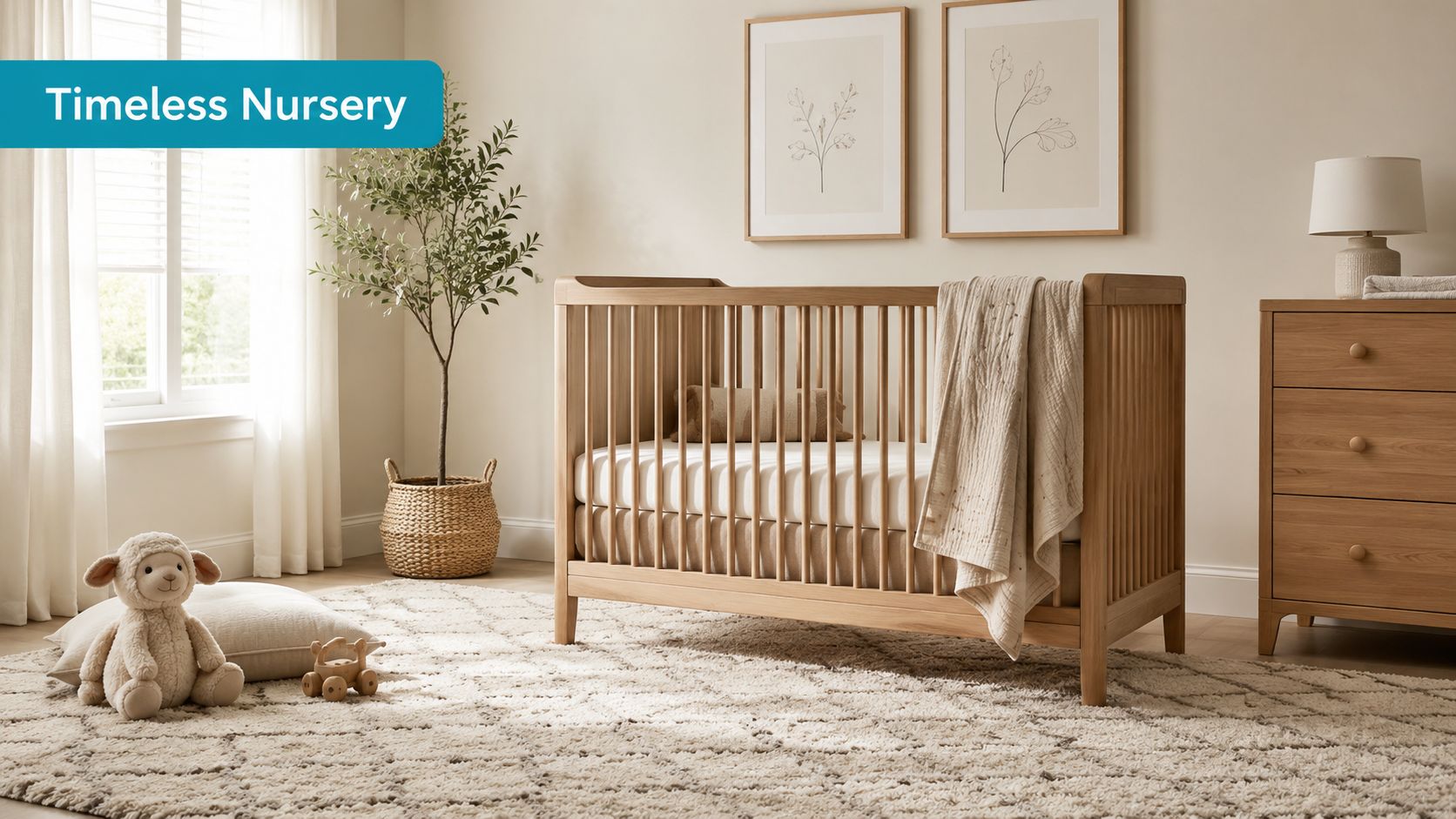
Minimalist landscapes that still feel warm
This is one of the easiest styles to live with. Think rolling hills, soft sunrises, moon phases, beach grasses, cloud studies, or muted mountain scenes. These work beautifully in UK homes because they suit both period properties and newer builds, and they don't fight with practical nursery furniture.
A theme with broad visual scope grows well because it doesn't feel age-locked. A newborn sees large shapes and tonal contrast. A toddler begins to notice details and tell little stories about what they see.
Try this combination:
- One larger wide-format print above a chest of drawers
- Two smaller companion prints nearby
- Natural textures such as oak, cane, wool and linen to make the room feel softer
Modern abstract done gently
Parents often like abstract art but worry it might feel too sharp for a baby's room. The answer is to choose abstract pieces with rounded forms, soft edges and a restrained palette. Curves, arches, circles and hand-painted brush shapes feel much friendlier than very jagged, high-intensity graphics.
This style is especially good if you want a nursery that doesn't scream “baby room”. It can also bridge beautifully into a toddler or child's room later.
If you'd like a few more visual references, these modern nursery decor concepts are useful for seeing how contemporary palettes and softer themes can come together.
Sophisticated doesn't have to mean serious. A room can feel polished and still be playful.
Updated classics that don't feel clichéd
Animals aren't the problem. It's the styling that dates quickly. A safari theme can feel fresh if the art is sketched, tonal or loosely painted. Botanicals can look elegant if the colours are dusty rather than bright. Space themes work well when they focus on moons, stars and orbit lines instead of every wall becoming a cartoon galaxy.
A few strong options:
| Style | What it looks like | Why it lasts |
|---|---|---|
| Modern safari | Muted giraffes, palms, sandy tones | Feels gentle, not loud |
| Botanical nursery | Leaves, seed heads, wildflowers | Calm and easy to update |
| Celestial | Moons, stars, clouds, night skies | Works from baby to school age |
| Rainbow neutral | Arches in clay, oat, sage, rust | Soft shape play without clutter |
Build a theme without overdoing it
One of the biggest mistakes I see is repeating the same motif on every surface. If the wallpaper, bedding, mobile, lamp and art all say the same thing, the room can feel flat and overstated.
Instead, use a “one theme, three expressions” approach:
- Artwork carries the main idea
- Textiles echo the colours
- Accessories add one or two subtle nods
That's enough to make the room feel cohesive. It also gives you room to swap things out later without redoing the whole nursery.
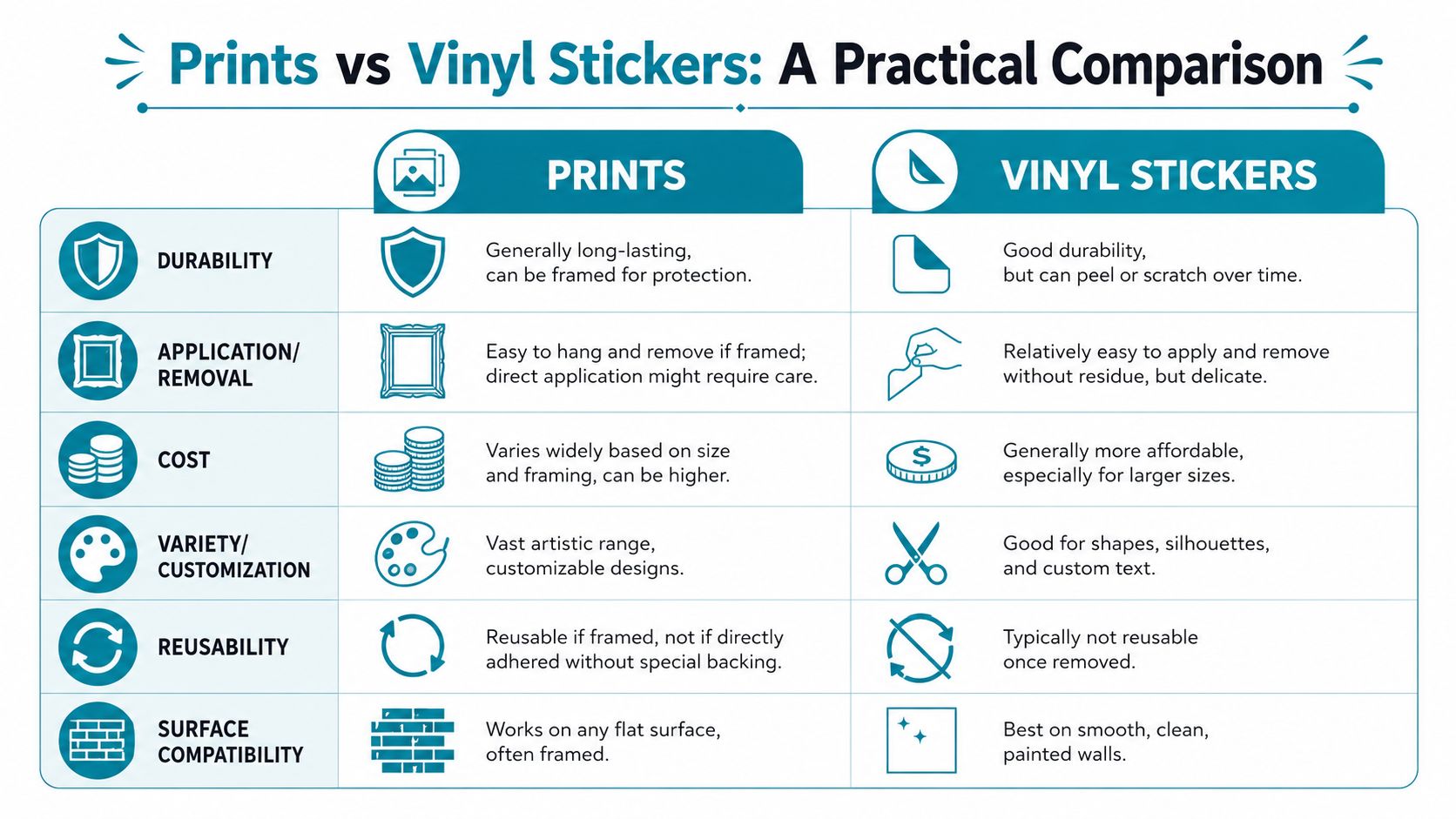
Prints vs Vinyl Stickers A Practical Comparison
Once you know the look you want, the next decision is material. In most nurseries, the choice comes down to prints or vinyl wall stickers. Both can work well. The right one depends on your walls, your budget, how long you plan to stay in the home, and whether you want the art to be more decorative or more flexible.
Where prints shine
Prints feel classic. They're ideal if you like a layered, collected look and want to combine art with shelves, books and keepsakes. Framed prints can also move with you from room to room.
They're especially useful when you want:
- A gallery wall feel with matching or mixed frames
- Artwork you can rehang later in a playroom, hallway or bedroom
- Texture and finish options such as paper, mount boards and frame styles
The downside is practical. Frames can become heavy, glass needs care, and a set of prints often costs more once framing is included. In a nursery, placement matters because anything weighty needs secure fixing and shouldn't sit over sleep or play areas.
Where vinyl stickers make life easier
Vinyl decals are often the simpler option for families who want impact without much hardware. They're handy for renters, awkward wall spaces, and anyone who wants a mural-like look without committing to wallpaper.
The publisher notes that its premium vinyl is designed to last at least 5 years indoors in normal interior use. That sort of lifespan can make vinyl appealing in a nursery, where you want the room to stay tidy through the baby and toddler years.
This guide to vinyl wall art in the UK is useful if you want to compare styles and see where decals make the most sense.
A side-by-side view
| Feature | Prints | Vinyl stickers |
|---|---|---|
| Look | Framed, layered, traditional | Seamless, mural-like, clean |
| Installation | Hooks, nails or strips | Applied directly to wall |
| Flexibility | Easy to move if framed | Better for a fixed design |
| Nursery practicality | Stylish but heavier | Lightweight and wipeable |
| Best for | Collected art lovers | Renters, DIY updates, names, motifs |
If you want one large statement without drilling, vinyl often solves the problem neatly.
My designer shortcut
Use both. A large decal can create shape and softness on one wall, while framed or mounted prints bring detail to another. That mix stops the room looking flat and usually feels more expensive than relying on one format alone.
Designing for Development Sizing and Layout
Many parents feel stuck, as a 2025 UK study found that 78% of parents worry about overstimulating décor, 62% feel confused about how to get it right, and only 14% found adequate guidance on stimulation thresholds for typical UK nursery sizes, according to this UK nursery decor guidance discussion.
The confusion makes sense. Advice often stops at “use soft colours” or “keep it simple”, which sounds nice but doesn't help when you're trying to decide whether to hang three prints, one decal, or nothing over a chest of drawers.
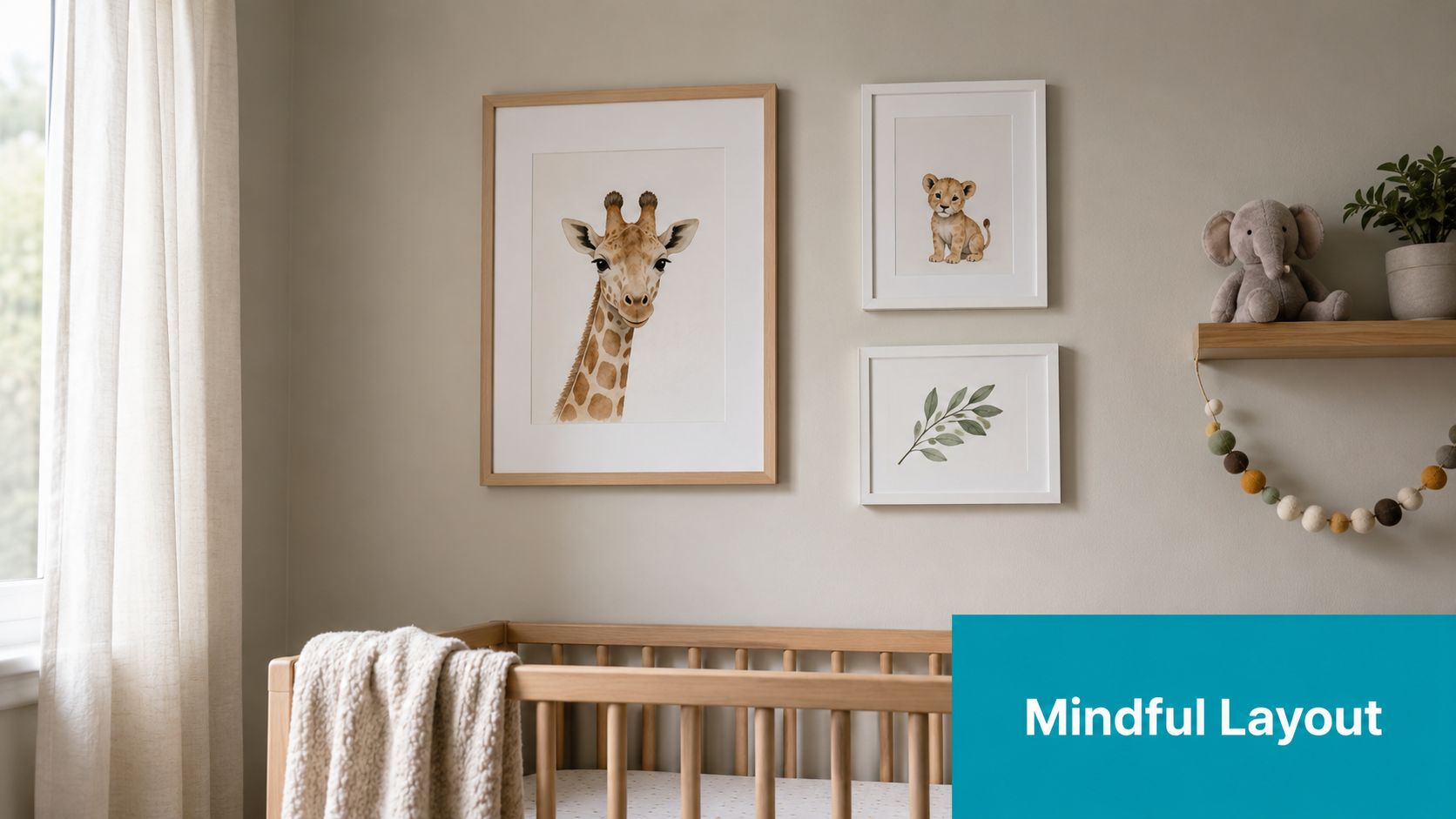
Use the room in zones
A nursery doesn't need the same energy everywhere. Divide it mentally into activity areas.
- Sleep zone near the cot should feel visually quieter
- Care zone near the changing table can hold a little more interest
- Play or reading corner can take the most personality
That one shift solves a lot. Parents often assume every wall needs equal treatment. It doesn't.
What babies usually respond to well
Young babies tend to notice clear shape, contrast and repetition more easily than fussy detail. That doesn't mean black-and-white everything. It means the art should have a readable structure.
Good examples include:
- Simple animal silhouettes
- Large moons, suns or arches
- Layered forms with clear edges
- Botanical forms with distinct outlines
Poorer choices for a main baby-viewing area include very dense gallery walls, tiny intricate illustrations placed too far away, or art with lots of competing colours and patterns.
Keep the busiest artwork where your baby is awake and alert, not where you're hoping they'll settle.
A practical layout that works in many UK nurseries
For many UK homes, the nursery is a modest room rather than a huge dedicated suite. In that kind of space, scale matters more than quantity.
A balanced arrangement often looks like this:
-
One focal wall only
Pick the wall opposite the doorway, or the wall above a dresser. -
One main feature
Use either a medium group of prints or one larger wall sticker design. -
One supporting area
Add a smaller detail elsewhere, such as a name decal, shelf print or mini pair of artworks. -
Leave one wall mostly open
Empty space helps the room breathe.
Placement rules that save mistakes
Here are the rules I give clients most often:
- Don't place heavy framed art above the cot. Even if fixed securely, it's not the best spot for either safety or sleep.
- Do place engaging art near the changing station. It gives your baby something interesting to look at during nappy changes.
- Hang nursery prints lower than standard adult art if they're meant for your child to notice later. Just keep safety in mind.
- Match the artwork width to the furniture below it. Art that's too narrow can look lost. Art that's much wider can feel top-heavy.
If you want extra help thinking through sightlines and placement, these artwork lighting and layout secrets offer useful general design ideas you can adapt for a nursery.
Colour without overload
Soft colour doesn't have to mean beige only. Sage, clay, dusky blue, oat, muted terracotta, blush and olive can all work well. The key is control. Repeat a few colours across the room rather than adding a new shade in every object.
For nursery wall art in the UK, I often suggest this simple filter: if the art is detailed, keep the palette calmer. If the palette is bolder, keep the shapes simpler.
Safety First Choosing Materials and Installing Securely
Nursery art should be charming, but safety always gets the final say. This matters with both prints and decals, because babies become toddlers quickly, and toddlers are determined little testers of every corner, frame and peeling edge.
Material checks worth doing
Start with the product description rather than the photograph. You're looking for practical information, not just a pretty mock-up.
Check for:
- Non-toxic materials where the seller states this clearly
- Suitable inks or finishes intended for interior home use
- Smooth, well-cut edges on decals so corners don't lift easily
- Wipeable surfaces if the art will sit near a changing area
If a listing is vague about material, ask before buying. In a nursery, “looks nice” isn't enough.
Safe placement matters as much as safe materials
Frames, shelves and hanging decorations need extra care in a child's room. Avoid placing heavy items over the cot, over a feeding chair where you'll sit holding your baby, or over a play mat area.
A safer setup usually includes:
- Lightweight wall décor close to baby-level zones
- Heavier framed pieces on side walls away from climbing furniture
- No trailing cords or ribbons within reach
A beautiful nursery should still work when you're tired. Choose pieces that don't create one more thing to worry about.
Applying decals neatly
Poorly applied wall stickers are more likely to peel. That's irritating visually, and it can become a picking temptation later on.
A careful install usually means:
- Clean the wall first so dust doesn't sit under the adhesive.
- Make sure fresh paint has properly cured before applying anything.
- Use a level or masking guide if the design needs straight alignment.
- Press from the centre outwards to reduce bubbles.
- Check all edges after a day or two and smooth any lifting corners.
If you want a more detailed walkthrough, this guide on how to apply wall stickers is a handy practical reference.
Making It Personal with Custom Nursery Art
The nicest nurseries usually have one detail that feels specific to that family. Not expensive. Not elaborate. Just personal.
That might be your baby's name in a soft script above a chest of drawers. It might be a meaningful phrase by the reading chair. It might be wall art that nods to a place you love, a language you speak at home, or a colour palette that already runs through the rest of your house.
Why personalised art works so well
Personalised pieces anchor the room. They make the nursery feel designed for a real child, not styled for a catalogue photo.
They're also useful in a practical way. A custom name decal or personalised wall feature often becomes the visual centre of the room, which means you can keep everything else more pared back.
Good personalised options include:
- Name decals over drawers or on a feature wall
- Initials paired with stars, moons, florals or animals
- Short family phrases with gentle meaning
- Custom colour choices to match your scheme
Keep the wording simple
Long quotes can dominate a nursery wall quickly. Shorter usually feels calmer and more timeless. One name, one phrase, one focal spot. That's often enough.
If you want to explore ideas, personalised nursery wall art options can help you picture what custom pieces look like in real rooms. One provider in this space is Quote My Wall, which offers nursery wall stickers and personalised designs alongside prints and labels, so it's one route if you want a coordinated look.
There's another benefit parents often realise later. Personal touches can evolve. A name decal can stay while you swap the cot for a bed, or a neutral personalised design can move from nursery to child's bedroom without looking out of place.
Your Nursery Wall Art Questions Answered
Is vinyl or framed art better if I'm renting
Vinyl is often easier for renters if the wall finish is suitable and your tenancy rules allow removable décor. Lightweight prints can also work well with removable hanging strips, but always check weight limits and test carefully in an inconspicuous area first.
How much wall art should a nursery have
Less than generally assumed. One focal wall and one secondary detail are usually enough. If the room already has patterned curtains, textured storage, colourful books and toys, the walls can stay simpler.
Can I put art above the cot
I wouldn't place heavy framed pieces above the cot. A quieter wall treatment is usually the safer and more restful option there. If you want interest in that area, consider something lightweight and visually soft, placed with care.
How do I keep nursery wall art looking fresh
Dust frames and ledges gently, wipe suitable decals with a soft cloth, and deal with peeling corners early rather than waiting. It also helps to rotate a small print or shelf accessory now and then. The room will feel updated without needing a full redesign.
If you're ready to turn blank walls into something calm, stylish and personal, Quote My Wall is a practical place to browse nursery wall stickers, prints and custom options for UK homes. It's especially useful if you want a design that feels easy to install, easy to live with, and suited to your room rather than copied from a showroom.