
Name Labels That Actually Stay Put Through the Wash
UK survey reporting found that 75% of primary-school children lose one or two uniform items each year. Name labels can help return identifiable clothing to its owner, but the useful questions are which items to label first, whether the label suits the garment's wash routine, and where it should go.
A label that stays attached but fades until the name can't be read hasn't done its job. The same goes for a clearly printed label placed where laundry staff can't find it. A practical approach starts with the clothing most likely to go missing, then matches the label type and placement to how each item is used.
What Name Labels Are and Why They Matter
A name label puts an owner's identifying details on clothing or belongings so someone else can sort them and return them. That simple job matters in a school, where children wear similar jumpers, and at home, where uniform gets mixed into family laundry. It matters in care homes too, where staff need to match garments to residents during laundry sorting.
The scale of the school problem is clear: a UK survey reported that 98% of primary schools store lost property, and approximately two-thirds rated their lost-property problem as medium or severe. Only 3% said that 75–100% of school uniform and kit was labelled. In the same survey, 88% of schools identified name labels as the best way to reduce lost property. (UK primary-school lost-property survey results)
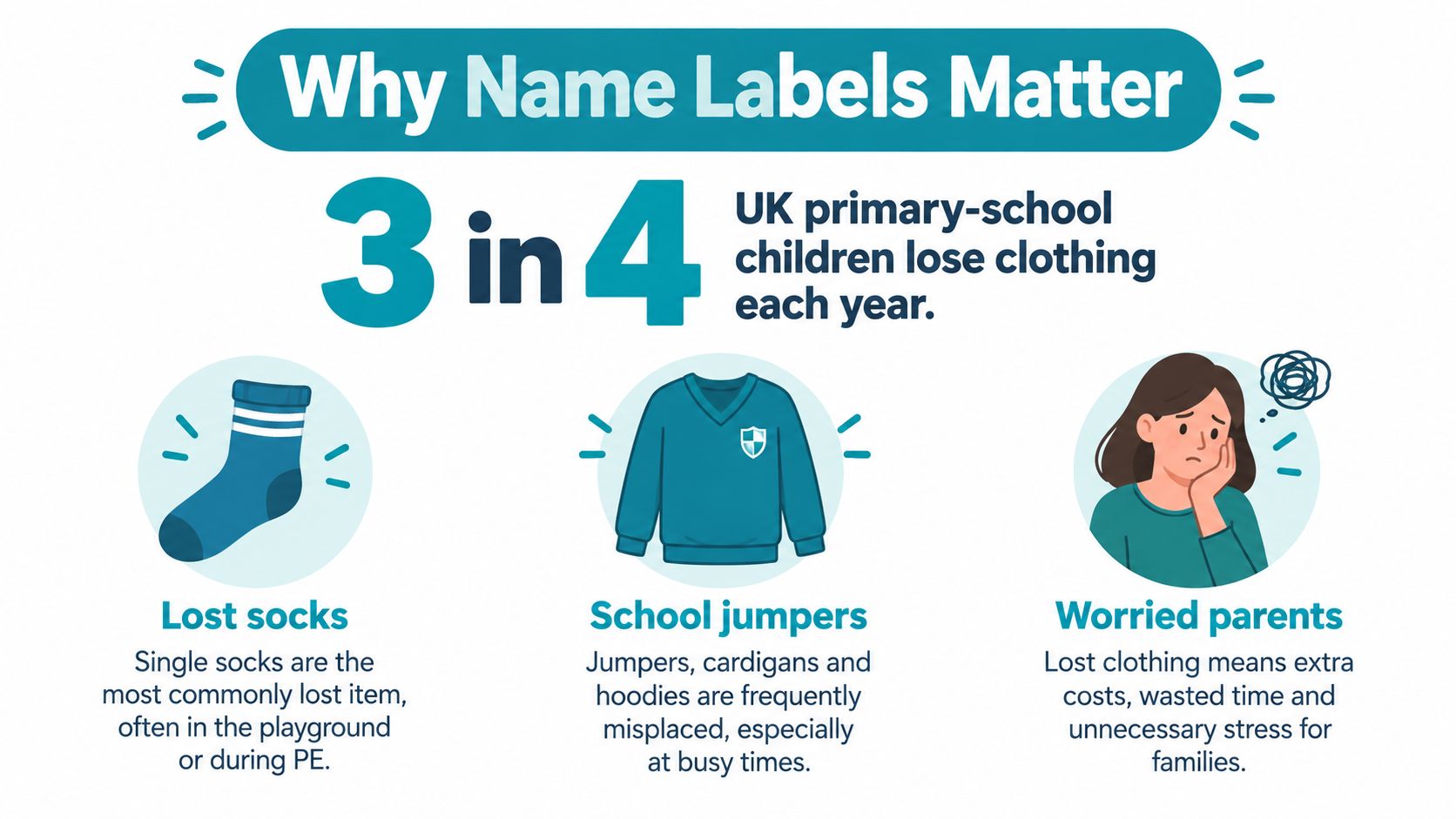
Labels do three everyday jobs. They help a school identify who owns a cardigan; they help a household sort clothing after washing; and they give care-home staff a consistent identifier to look for when handling residents' laundry. None of those jobs requires a complicated system, but each depends on the name being readable and the label being placed where someone can find it.
Labelling is best treated as a priority exercise, not a demand to mark every possession at once. A frequently removed school jumper presents a different risk from a rarely used garment, and an expensive coat may be more costly to replace than a basic item. Start with the pieces that are most likely to be taken off, mixed up or expensive to replace, then build from there.
One distinction often gets missed: labels reduce avoidable loss, not every kind of replacement. They can help an item find its way home when it's misplaced, but they can't prevent a child from outgrowing it or damaging it. Thinking about labels this way keeps the job manageable and helps you choose a format for the actual garment, not just the most convenient pack.
The Three Main Types of Name Labels
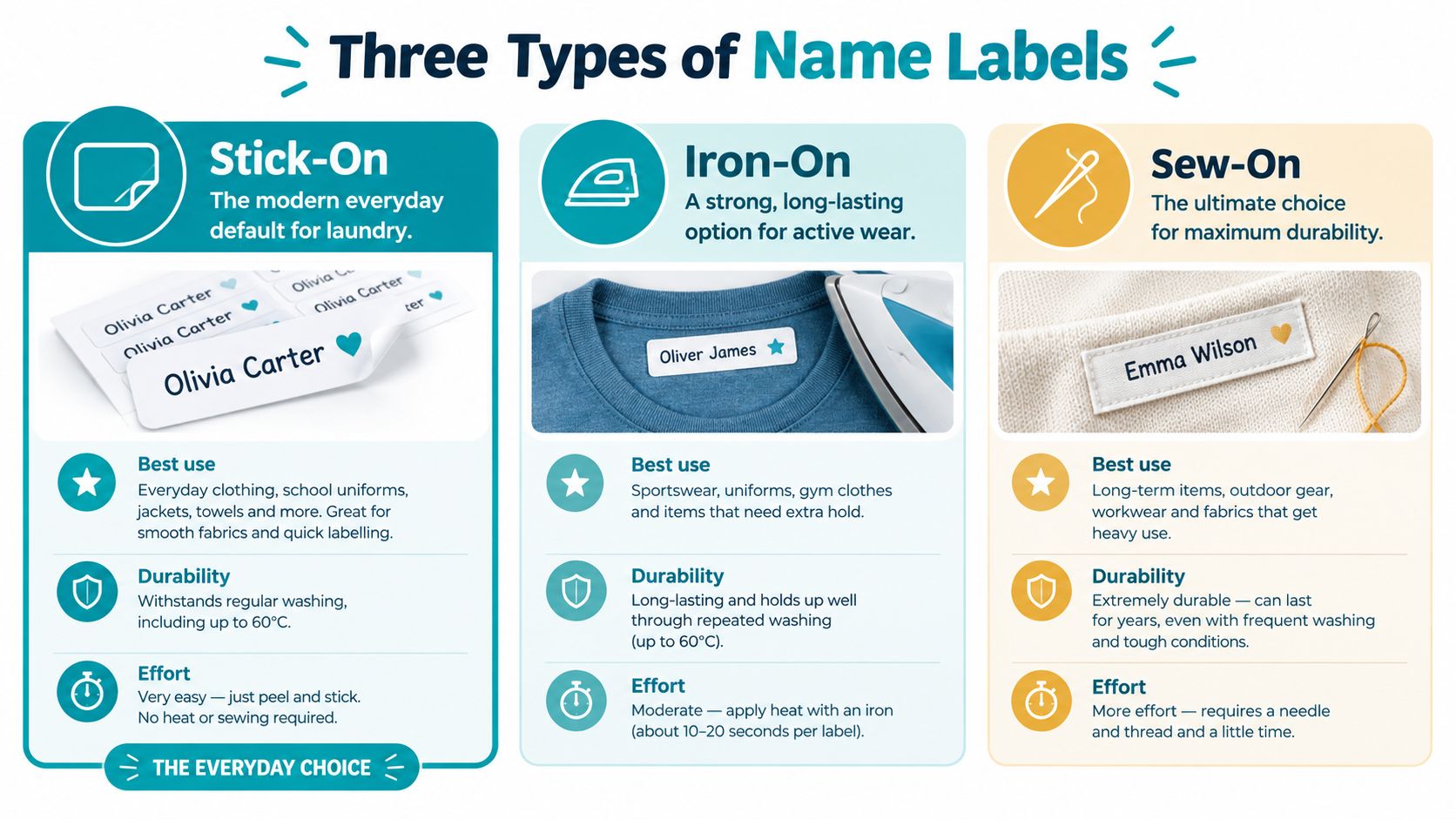
The right format depends on how much effort you're willing to spend and how the item will be worn and washed. Stick-on labels are the easy option, iron-on labels need heat to attach, and sew-on labels take the most work but can suit garments that are kept and handed down. The table gives a broad comparison. Actual durability depends on the product and care conditions, so don't treat a label type as a guarantee.
| Type | Application | Best for | Skill needed | Durability |
|---|---|---|---|---|
| Stick-on | Press onto a suitable, smooth care label | Everyday schoolwear and items where quick application matters | Low | Depends on adhesion, print legibility and care routine |
| Iron-on | Apply with an iron, following the product instructions | Garments needing a more fixed application | Some care with heat and positioning | Depends on the product and garment care |
| Sew-on | Stitch securely to the garment | Coats, scarves and clothing likely to be reused | Basic sewing | Can be a practical choice for long-term wear, but stitching and garment care matter |
Stick-on labels suit busy households because they need no sewing or ironing. They're easiest to apply to a smooth, flat care label, and they can be useful when a child's kit includes many small items. Don't confuse easy application with universal suitability: check that the label is intended for the surface and wash conditions.
Iron-on labels take longer to apply and need care around heat-sensitive fabrics. They may make sense for a uniform item that gets hard wear, provided the manufacturer's instructions suit the garment. For a closer look at how this format works, see this guide to iron-on clothing name tags.
Sew-on labels are the traditional choice for garments that are kept for a long time or passed between siblings. They require a needle and thread, and the result depends on secure stitching, but they avoid relying on a stick-on adhesive. Choose the format that fits the item and your routine. You don't need to use one type for everything.
Materials, Finishes and What Survives the Wash
A label's material affects how it stands up to water, detergent, heat and rubbing. The word washable is not enough on its own. For a school jumper, check that the label is designed for the garment's usual washing and drying routine. For a coat or delicate item, follow the fabric's care instructions too.
UKFT guidance explains that textile care information covers washing, bleaching, ironing, dry-cleaning and tumble drying. The EN 23758/ISO 3758 framework it references says care information should remain legible throughout a textile's useful life. Label materials should also withstand the indicated treatment at least as well as the garment, with care symbols reflecting the most severe process it can tolerate without significant loss of serviceability. (UKFT guidance on textile labelling and care)
The same checks help when choosing a name label. Consider the wash temperature, detergent, agitation and drying method it will face. Adhesion and print legibility are separate checks: a label may stay stuck while its name fades or blurs. Claims such as microwave-safe or dishwasher-safe don't automatically show that a product will withstand repeated textile washing.
Materials such as vinyl or polyester film, woven fabric and printed paper respond differently to heat, water and friction. Check the maker's care instructions for specific guidance, then test the label in the way you'll use it. For example, wash the labelled garment once on a full cycle at your usual temperature, then check that the label remains attached and the name readable before putting it into regular rotation. See this guide to choosing material for name labels for more on material options.
Finish affects how easily someone can read the name. High-contrast text on a clear, white or coloured background is generally easier to read than pale text against a similar shade. Check the finished label against the garment's care information too, and make sure it does not cover legally required details. A label that works on one item may not suit another fabric or laundry routine.
How to Apply Stick-On Labels Correctly
A careful application starts with the surface, not the label. Use a clean, smooth, dry care label and check that it has no visible residue or loose fibres. A flat care label gives the adhesive a more even surface than a textured seam or the garment fabric itself.
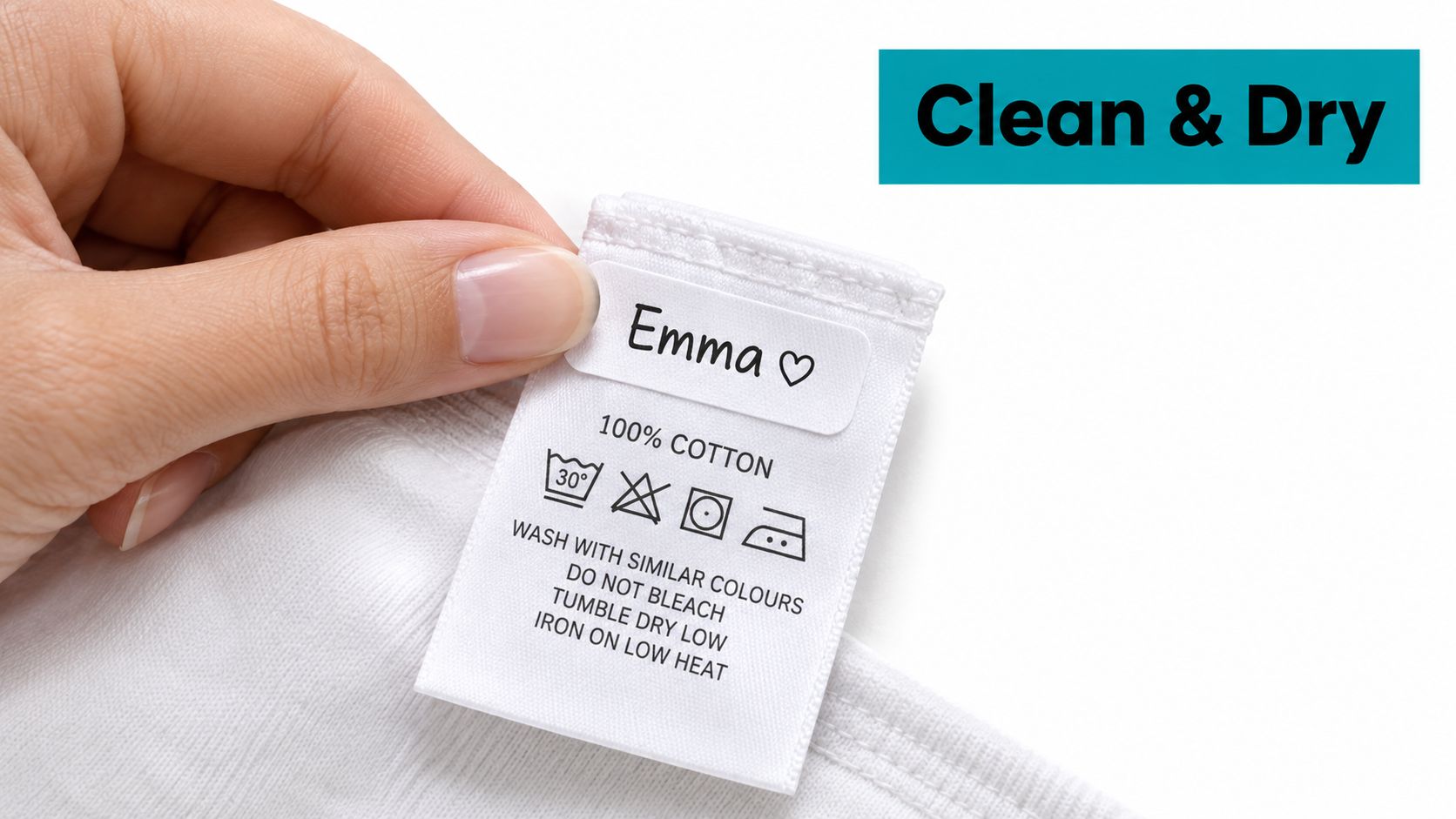
Work through the application without rushing:
- Choose the spot. Use the care label if the product instructions say it's suitable. Avoid placing a sticker over garment care information.
- Prepare the surface. Make sure it's dry, smooth and free of lint or residue. Don't stick the label onto damp fabric.
- Handle the label by its edge. This keeps the adhesive surface clean.
- Press it down firmly. Smooth across the full label, paying attention to the corners.
- Follow the product's waiting instructions. If the label maker specifies a settling period before washing, allow it. Don't put it straight into the laundry unless the instructions say that's fine.
The brand strip at the back of a neck can seem like an obvious place, but it's often a poor choice for children's clothing. It may be uncomfortable against the skin, and it can be less suitable for adhesion than a smooth care label. Keep the name where it can be read without turning a soft garment into an irritating one.
If a corner starts to lift, don't leave it to catch on other clothes. Check that the surface is dry and free of residue, then press the corner down again if the product guidance allows. If it won't lie flat or the print has become unreadable, replace the label rather than assuming it'll survive another wash. The exact waiting time and application pressure vary by product, so follow the label maker's own instructions rather than using a fixed routine for every brand.
Best Uses for Name Labels Across Ages and Settings
64% of lost school uniform in a UK estimate was made up of cardigans, jumpers and fleeces, around 2.4 million items under the estimate's stated assumptions. These easy-to-remove layers are sensible first choices when deciding what to label. (UK reporting on school-uniform loss and replacement costs)
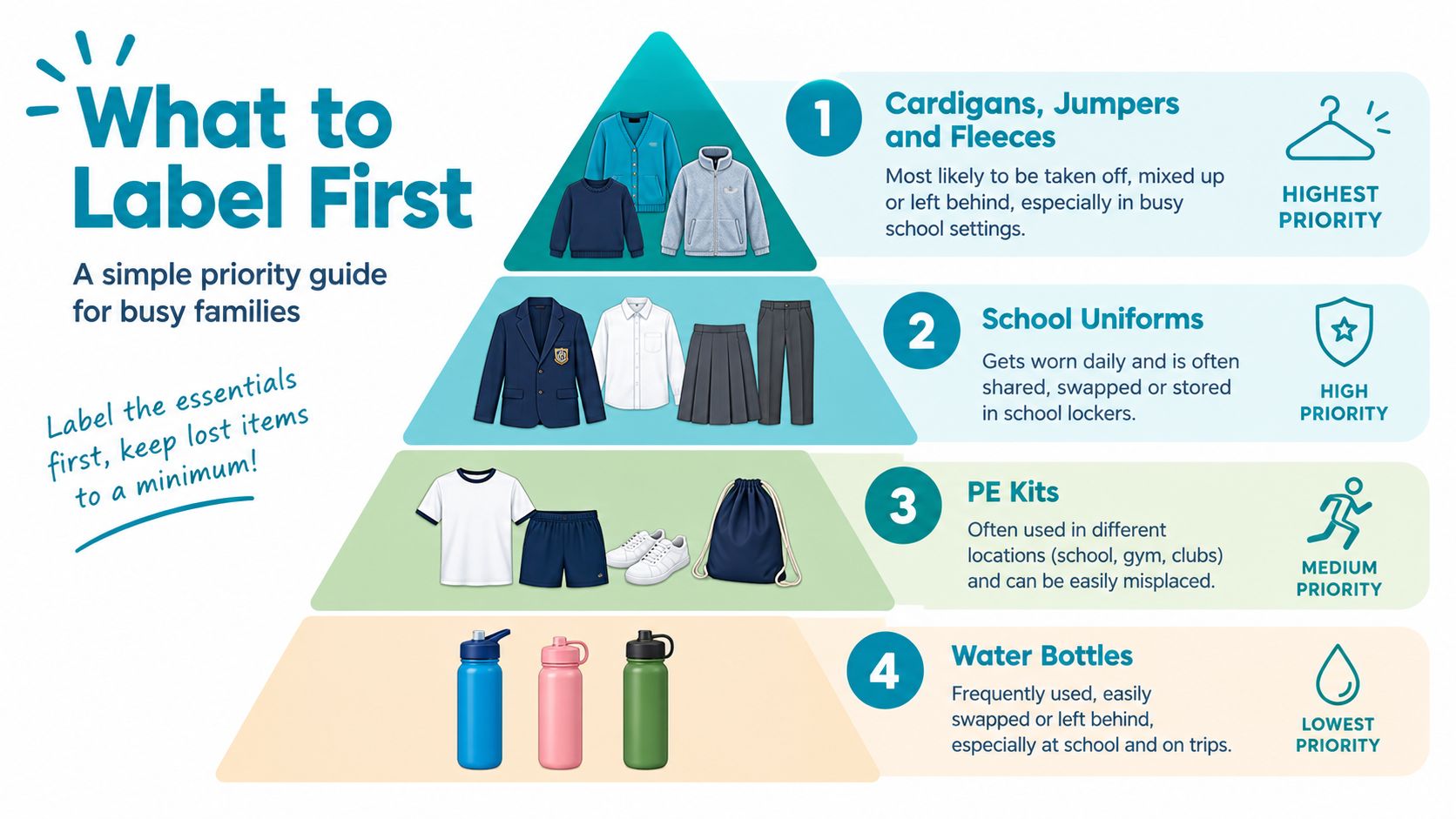
Once those are covered, consider items that cost more or are harder to replace, such as a blazer, coat or PE kit. The Children's Society reported average annual uniform costs of £315 for primary-school pupils and £337 for secondary-school pupils. Where schools required at least two items from specialist suppliers, the primary-school average rose to £375; secondary-school costs were £75 higher than the broader average. (The Children's Society report on school-uniform costs)
Give labels a consistent, easy-to-find position so staff can identify clothing without checking every seam. UK primary schools surveyed identified name labels as a practical way to reduce lost property, as noted earlier. For a child starting nursery, this guide to how to ease nursery anxiety offers preparation ideas beyond labelling belongings.
Care homes face a different problem: laundry often follows shared processes, and staff may overlook a label tucked into an obscure seam. Agree a clear placement with the care team, so the identifier is easy to find and read after washing. This guide to clothing labels for nursing homes explores what staff need from labels in that setting.
For residents with dementia or limited ability to recognise their belongings, identification also supports dignity. Use the identifier agreed with the home, whether that is a name, surname and initial, or a code chosen to protect privacy. Keep a family inventory of labelled items and check it with staff from time to time. A shared system works like a key everyone has been given: the label helps only if the people handling the laundry know how to read it.
Ordering Considerations and Personalisation Tips
A useful order starts with a list of what needs labelling, not a guess at how many stickers might be needed. Put the frequently removed and costly items first, then add smaller belongings if the same label format is appropriate. Think about replacements and hand-me-downs too, but don't buy more than you can use before the details change.
Size should match the item and the available label area. A small label may fit a sock or glove, while a larger one can be easier to read on a coat or bedding. Check the dimensions against the care label before ordering; a large sticker is no use if it covers garment information or won't lie flat.
For the printed text, choose the identifier that will help the person handling the item. A full name can work for school clothing, while a first name or surname and initial may be more suitable where privacy matters. Care homes should agree any coded system with staff, so a family member's shorthand doesn't leave laundry workers guessing.
Readability first: Choose strong contrast and simple lettering. A decorative font that looks attractive on screen may become difficult to read when printed small.
Before you order, check that the product instructions match the garment's care conditions. If you're comparing materials or formats, make sure the label is intended for clothing rather than assuming that a claim about another use transfers to laundry. Quote My Wall offers personalised stick-on and iron-on clothing labels, including options for schoolwear and care-home belongings, so you can compare formats against the items you need to identify.
September can be a busy time for school preparations, so leave enough time to choose a design and have labels ready before uniform is in daily use. If the name or identifier needs to change later, a smaller, targeted reorder may be more practical than ordering a large quantity with details you might not keep using. A short item list, a readable design and a clear idea of the wash routine make the purchase far more straightforward.
Caring for Your Labels and Knowing Their Limits
Check labels at every half-term, alongside pockets, cuffs and missing buttons. Washing, drying and friction can weaken the bond or fade the name. Look for lifted edges, then read the whole identifier. Replace labels that are loose or unclear, and remove old names before passing clothing on.
A label works like a return address: it gives someone a way to reunite an item with its owner.
That help has limits. UK reporting on school-uniform loss and replacement costs found that 53% of parents replaced school shoes because their child had outgrown them, while 63% replaced school items that were ruined or broken. Labels cannot solve either problem. Prioritise checking coats, blazers and other belongings that could still be returned and used; an unreadable name leaves even a sound garment difficult to identify.
In care homes, include label checks when clean laundry is put away. Agree a consistent, discreet position with staff so they can find names without searching each garment. Where someone has dementia, check whether they recognise the identifier themselves, rather than assuming a laundry code helps them.
Choose the fixing method according to the garment's likely use. A coat or blazer kept for hand-me-downs may justify an iron-on or sew-on label if its fabric and care instructions allow it. Stick-on labels can suit everyday items. Whatever the format, inspect both the attachment and the printed name.
Frequently Asked Questions About Name Labels
Will stick-on name labels survive the washing machine?
Check the label's own washing and drying instructions before choosing it. Durability depends on the adhesive, the surface and the treatment the garment receives.
UKFT guidance on textile labelling and care explains that care information should remain legible throughout a garment's useful life. That is a useful distinction: a readable care tag does not guarantee that an added name sticker will withstand the same wash.
What's the practical difference between iron-on and stick-on labels?
Stick-on labels attach with pressure; iron-on labels need heat. The fixing method must suit both the garment and the label instructions. For example, check whether a jumper can tolerate the required ironing before choosing an iron-on label.
Choose by compatibility, rather than convenience alone.
Are clothing labels suitable for sensitive skin?
A care tag can act as a buffer between the label and the wearer's skin, provided the product is suitable for that surface. Check whether the finished tag rubs or feels stiff. Stop using the label if it causes irritation.
For care-home clothing, comfort and dignity matter alongside identification. A familiar name may be more useful to someone with dementia than a code intended for laundry staff.
How do I remove residue if a label comes off?
Follow the garment's care instructions and the label maker's removal advice. Test any suggested cleaning method on a hidden area first. Avoid scraping, solvents or heat unless the fabric guidance allows them.
Quote My Wall offers personalised stick-on and iron-on labels for schoolwear, care-home clothing and other belongings. Compare the formats with your garments' care requirements, starting with usable items that could be returned if lost.