

A Complete Guide to Clothing Labels for Nursing Homes
Losing clothing in a nursing home isn't just a minor hassle. For residents, it can be deeply distressing, and for staff, it's a logistical nightmare that never seems to end. This is where dependable clothing labels for nursing homes come in, proving they're a cornerstone of dignified, efficient care, not just an afterthought. Modern stick-on labels offer a simple, solid solution to bring back order and make sure personal belongings always find their way home.
Why Effective Clothing Labels Are a Must-Have for Care Homes
Picture the chaos of a lost baggage claim at a busy airport. That's pretty much a daily reality for many care home laundry rooms. All the clothes are bundled together, washed in industrial machines at searing temperatures, and then someone has the painstaking job of sorting it all out. Without a clear, permanent way to tell what belongs to whom, it's almost guaranteed that a resident's favourite cardigan or comfy pyjamas will go astray, causing real emotional upset.
This is exactly why a systematic approach to labelling is so critical. It turns the laundry room guessing game into a smooth, reliable process. When every single item is clearly marked with a durable, easy-to-read name tag, staff can sort clothes quickly and, more importantly, accurately. This one simple change makes a huge difference, slashing the time wasted hunting for lost items and letting caregivers get back to what they do best—caring for residents.
More Than Just a Name Tag
A great labelling system does so much more than just prevent loss; it’s about upholding the dignity and identity of each person. For many residents, their personal clothing is one of their last tangible links to their life and who they are outside the care home. Losing these items can feel like losing a piece of themselves. This is especially true for residents living with dementia, who often find immense comfort in familiar things.
A reliable label is a small tool that solves a huge operational and emotional problem. It builds trust with families, empowers staff to work more efficiently, and, most importantly, protects the personal property and emotional well-being of the people in your care.
When families are looking at the move into a care facility, it’s often the practical details that weigh heavily on their minds. Knowing that a home has a solid system for looking after personal belongings brings an incredible sense of relief. When families ask "when is it time for assisted living?", showing this level of organised, compassionate care can be a real deciding factor. It's a clear signal of a commitment to detail and a deep respect for residents as individuals.
Ultimately, a good labelling system helps create a smoother, more organised, and more humane environment for everyone involved.
Comparing Different Types of Clothing Labels
Choosing the right clothing labels for a nursing home isn't just an administrative task—it's about making a choice that prevents daily mix-ups and frustration. Not all labels are created equal, and the punishing environment of a commercial laundry will quickly expose any weaknesses. High temperatures, powerful detergents, and constant tumbling can make a poor-quality label unreadable or cause it to fall off entirely.
Think of it like choosing tyres for a car. You wouldn't put standard road tyres on a vehicle meant for rugged, off-road terrain. The same logic applies here; you need a label engineered specifically for the job. Let’s break down the main contenders.
The Old Guard: Sew-In and Iron-On Labels
For generations, sew-in and iron-on labels were pretty much the only options available. Sew-in labels are undeniably permanent, but they're also incredibly time-consuming to apply. For a care home with hundreds, if not thousands, of garments to track, sewing a label into every single item is just not feasible. It’s an inefficient use of precious staff time.
Iron-on labels seemed like a step up, offering a much faster application. You simply use a hot iron to bond them to the fabric. On the surface, it looks like a secure attachment, but their performance in a nursing home laundry is often a real let-down.
The intense heat and aggressive tumbling in commercial dryers can cause the adhesive on many iron-on labels to weaken over time. This leads to them peeling, cracking, or falling off entirely, sending the garment right back to the anonymous lost-property pile.
Even worse, the ink on many write-on versions just can't stand up to industrial washing. A so-called 'permanent' marker might survive a few cycles, but it almost always fades, bleeds, or washes out completely, making the label useless. You can get a much clearer picture of how modern solutions stack up by reading about the benefits of stick-on labels versus iron-on tags.
The Modern Solution: Stick-On Vinyl Labels
This brings us to what is, by far, the most practical and reliable choice for care homes today: high-tack stick-on vinyl labels. Don't confuse these with the paper stickers you’d find in a craft shop. These are purpose-built products, engineered from a tough vinyl material that shrugs off water, heat, and friction.
The real secret, though, is in the adhesive. It’s an ultra-high-tack formula designed to create a powerful, lasting bond with the synthetic material of a garment’s care tag. When you press it firmly onto that smooth, silky surface, the label essentially fuses with the tag, making it incredibly difficult to remove.
A Head-to-Head Comparison
To make the choice crystal clear, it helps to see how these options compare on the points that matter most in a busy care home.
Comparison of Nursing Home Clothing Label Types
This table breaks down the pros and cons of each common label type, helping you see at a glance which one is the best fit for your needs.
| Label Type | Durability Rating | Application Time | Best For | Potential Downsides |
|---|---|---|---|---|
| Sew-In Labels | Excellent | Very High (5-10 mins/item) | Garments without care tags, heirloom items. | Extremely time-consuming, requires sewing skills. |
| Iron-On Labels | Fair to Good | Moderate (1-2 mins/item) | Socks, underwear, tagless items. | Can peel, crack, or fade in industrial washes. |
| Stick-On Vinyl | Excellent | Very Low (5-10 secs/item) | All garments with a synthetic care tag. | Less effective on stretchy or textured fabric directly. |
As you can see, stick-on vinyl labels hit the sweet spot, offering top-tier durability with an application time that’s practically instant. This efficiency is a massive advantage in a busy care environment. Staff can label an entire wardrobe for a new resident in minutes, not hours, freeing them up to focus on what truly matters—caring for residents.
The performance of these modern labels speaks for itself. They are specifically designed to be:
- Fully Washable: They have no problem withstanding repeated cycles in high-temperature industrial washing machines.
- Tumble Dryer Safe: The material and adhesive won’t melt, curl, or degrade, even under intense heat.
- Fade-Resistant: Professionally printed text stays sharp and easy to read for the entire life of the garment.
Ultimately, clinging to a traditional labelling system can create workflow bottlenecks and distress for residents and their families. By choosing a solution that was engineered for the unique challenges of a nursing home, you ensure reliability, save huge amounts of time, and provide peace of mind for everyone involved.
How Good Labelling Affects Daily Operations and CQC Ratings
Having a solid system with proper clothing labels for nursing homes isn't just a neat little organisational trick. Think of it as the quiet engine room of your daily operations – a crucial part of keeping things running smoothly and meeting your regulatory duties. When a single unlabelled jumper goes astray in the laundry, it sets off a chain reaction. It starts small, but that simple mix-up quickly snowballs into wasted staff time, unnecessary replacement costs, and upset residents. It all paints a picture of a disorganised home, which is the last thing you want an inspector to see.
This goes far deeper than logistics; it's a fundamental part of providing good care. Losing an item of clothing can be upsetting for anyone, but for a resident living with dementia, a familiar cardigan or a favourite shirt can be a massive source of comfort and identity. When these personal belongings disappear, it can cause real emotional distress. We need to stop seeing labelling as a tedious chore and start treating it as a strategic tool that shows a real commitment to person-centred care.
The Real Price of One Lost Sock
It’s surprisingly easy to overlook just how much lost clothing can drain a home's resources. Every time something goes missing, it kicks off a whole series of time-consuming and expensive tasks. Staff have to drop what they're doing – be it care duties or medication rounds – to hunt through laundry rooms, rifle through other residents' wardrobes, and answer calls from worried family members. That lost time really adds up.
Just think about the knock-on effects:
- Wasted Staff Hours: Every minute spent searching for a lost cardigan is a minute not spent with a resident who needs support.
- Financial Drain: More often than not, the home ends up footing the bill to replace lost items. Over a year, this can become a significant and completely avoidable expense.
- Reputation Damage: When clothing goes missing again and again, it eats away at the trust families have placed in you to care for their loved ones' belongings.
This constant cycle of losing and replacing things creates a persistent drag on your operations, affecting both efficiency and staff morale.
From Laundry Headaches to CQC Compliance
A well-oiled labelling system speaks volumes to regulatory bodies like the Care Quality Commission (CQC). When inspectors visit, they're looking for signs of a well-led, safe, and responsive service. A chaotic laundry room and a long list of complaints about lost property can be a red flag, hinting at bigger problems under the surface.
On the flip side, a system where every single garment is clearly labelled and always finds its way back to the right room shows you're in control. It proves that the home is taking proactive steps to protect residents' property and dignity, which is a massive part of providing safe and effective care.
A clear, consistent labelling process isn't just about keeping track of jumpers. It's tangible proof of your home's attention to detail, respect for residents, and operational competence—all things the CQC loves to see.
The scale of laundry in UK nursing homes makes this an incredibly important area to get right. Picture a typical 80-resident home. If each person has about 100 items of clothing, the home is responsible for a staggering 8,000 garments. That means around 245 items are going through the wash every single day. Even with basic pen marks, sorting errors can still happen 3-7% of the time. That works out to roughly seven items ending up in the wrong place daily. Over a year, that’s over 1,800 potential complaints – a figure that really shows the size of the problem. You can dig into more data on residential care laundry challenges to see the full picture.
By bringing in a reliable system with durable clothing labels, you tackle this high-risk area head-on. You turn a potential compliance nightmare into a shining example of best practice. It’s a proactive step that not only makes daily life easier but also puts you in a much stronger position when the regulators come knocking.
How to Choose the Best Clothing Labels for Your Facility
Picking the right clothing labels for a nursing home isn't all that different from choosing the right tyres for a lorry; you need something that can handle the long, hard road ahead. A care home laundry is a tough environment, so durability, clarity, and simple application should be top of your list. This guide will walk you through what really matters when you're making a choice that needs to last.
The first thing to look at is the material the label is made from. You'll want to go for labels made from premium vinyl. It’s waterproof and tough enough to handle the constant rubbing and tumbling inside a dryer. Unlike flimsy paper labels that turn to pulp, a quality vinyl label won't tear, fade, or fall apart after a few washes. Think of it as your first line of defence against the laundry room's daily battle.
Next up is the adhesive, and honestly, this might be the most important part. Standard sticky labels just won't cut it against the heat and harsh chemicals of an industrial washing machine. You need to look for labels that use an ultra high-tack adhesive specifically made for fabric care tags. This isn't just sticky; it creates a permanent chemical bond with the silky material of a garment's care tag, locking it in place for good.
Key Features to Demand
When you're comparing different brands, don't let price be your only guide. A cheap label that comes off in its second wash will cost you far more in time and lost clothing. Instead, have a non-negotiable checklist of features to guarantee the labels can perform under pressure.
Make sure any label you consider has these features:
- Wash-Safe Certification: It must be officially rated for hot washes (up to 90°C) and industrial-strength tumble drying.
- Microwave and Dishwasher Safe: This might sound odd for clothing, but it’s a brilliant sign of a label's overall toughness and heat resistance.
- Permanent Bond: The label should be designed to fuse with the garment's existing care tag, not just sit on the surface.
- Clear, Fade-Resistant Print: The ink needs to be waterproof and tough enough to stay readable, no matter how many times it's washed.
These features are your guarantee that the label will stay put and stay clear for the life of the garment, which is the whole point, after all.
The Power of Customisation
Beyond just being tough, the design of the label itself can be a massive help to your staff. With a bit of thought, a simple name tag can become a key part of your daily workflow. For example, always choose clear, bold fonts. Staff sorting piles of laundry need to be able to read a name at a glance, so avoid fussy or script-style fonts that are easy to misread.
The right label does more than just identify; it organises. Simple design choices like colour-coding can streamline your entire sorting process, saving valuable staff time and reducing errors.
Think about giving each floor or wing its own colour. A resident on the ground floor could have labels with a blue border, while someone on the first floor gets a green one. This simple visual cue lets laundry staff sort clothes by destination before they even read a single name. It's a small change that can drastically speed things up and cut down on mistakes.
The flowchart below paints a clear picture of the choice facilities face when deciding whether to put a proper labelling system in place.
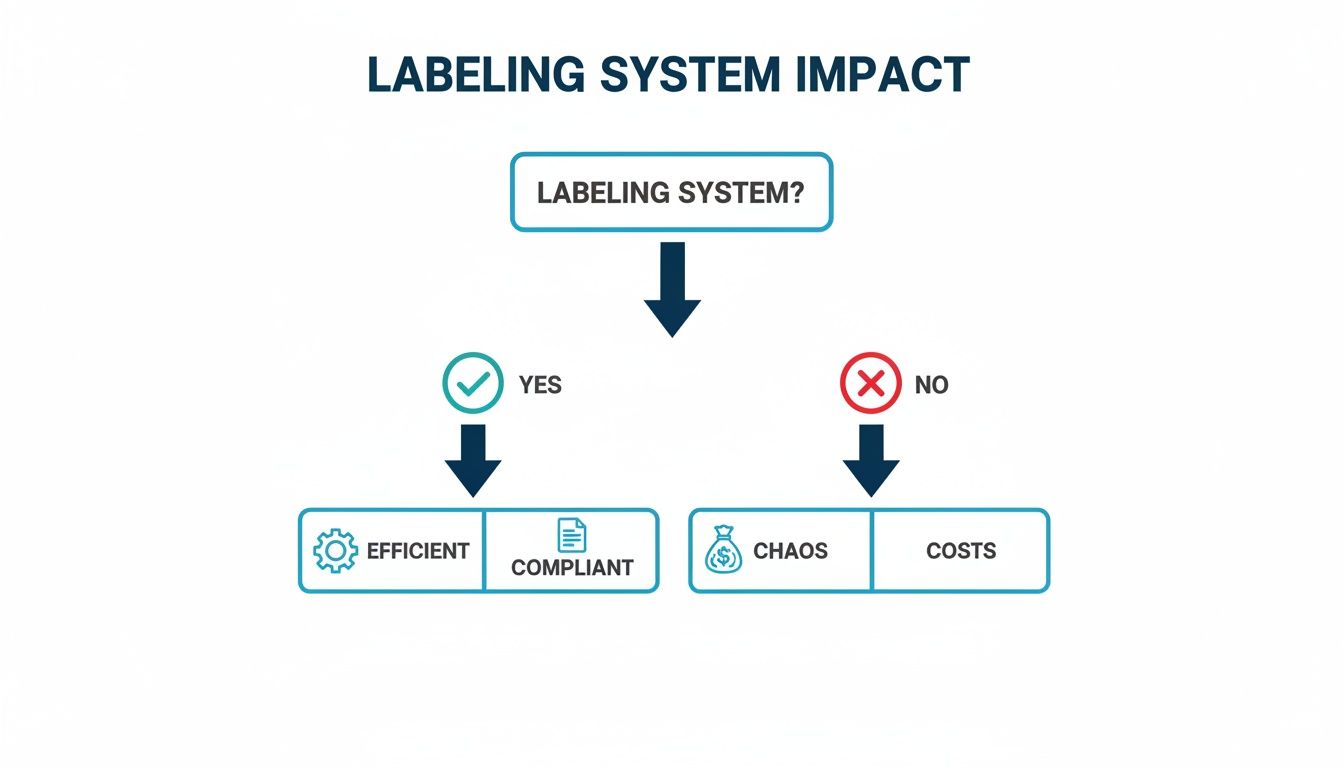
As you can see, a good system leads to efficiency and compliance, whereas ignoring it leads straight to chaos and higher costs.
Finally, make sure your chosen labels meet the right standards. While adding detailed washing instructions isn't your job, there are UK textile regulations to be aware of. The key takeaway is that any tag you add to an item in a care setting must be permanent and stay readable for life. This lines up perfectly with what you need anyway: a secure, durable label. You can learn more about how UK textile regulations impact care labels to ensure you're covered. By choosing high-quality, compliant labels, you’re not just making things easier for your team—you’re also protecting the dignity of your residents.
A Practical Guide to Applying and Maintaining Stick-On Labels
Even the best clothing labels for nursing homes are no match for a sloppy application. A top-quality label is only as good as its bond, and getting that permanent stick is a simple but crucial process. Think of it like a pilot's pre-flight check; a few key steps on the ground ensure a smooth journey through countless laundry cycles.
This guide will walk you through clear, practical instructions to get it right every time, from preparing the surface to finding the perfect placement. Following these steps means your labels stay put and stay readable, protecting residents' belongings and saving staff the headache of sorting through a mountain of anonymous clothes.
The Five Steps to a Perfect Application
Applying a stick-on label takes just a few seconds, but skipping a step can seriously compromise how well it performs. For a bond that can handle industrial washers and dryers, consistency is everything.
- Prepare the Surface: The label needs to go on the garment’s existing silky care or brand tag. These synthetic tags offer the ideal smooth surface for the adhesive to grab onto. Just make sure the care tag is completely clean and dry before you start.
- Peel and Position: Gently peel the label from its backing paper, trying not to touch the sticky side too much. Place it flat onto the care tag, smoothing it out to avoid any creases or air bubbles.
- Apply Firm Pressure: This is the most important step, so don’t rush it. Use your thumb to press down firmly across the whole label for a good few seconds. This pressure activates the high-tack adhesive, creating a powerful, permanent bond with the fibres of the care tag.
- Cure the Adhesive: Once it’s on, the adhesive needs time to cure and fully set. It’s absolutely essential to wait at least 24 hours before washing the garment. Chucking it in the wash too soon will weaken the bond before it’s had a chance to properly form.
- Check the Bond: After that first wash, give the label a quick once-over to make sure it’s still firmly attached. A correctly applied label will look like it has fused right into the care tag itself.
Why the Care Tag is the Ideal Spot
Choosing where to put the label is just as important as how you apply it. We specifically recommend the garment's care tag because its smooth, non-porous surface is exactly what the label’s adhesive was designed for. Trying to stick labels directly onto fabrics like cotton or wool just doesn't work as well; the textured surface stops the adhesive from making full contact.
It's interesting, really, how important these little tags have become. A 2025 UK survey found that 82% of consumers find care labels useful for looking after their clothes, a number that's been on the rise. It shows we're all starting to care a bit more about making our clothes last, which all starts with proper identification and care. You can find more details in the UKFT report on the Ginetex survey.
By sticking your name labels exclusively to these care tags, you're using a feature that’s already on the garment to guarantee the best possible performance and comfort for the resident.
Simple Maintenance for Lasting Legibility
Good quality vinyl labels don't need much looking after, but a few simple habits will keep them in top condition for the life of the garment. When you're folding laundry, just give the label a quick glance. If you ever see an edge starting to lift (which is rare if it was applied properly), you can usually fix it by just applying firm pressure again.
Also, try to avoid using harsh bleaching agents directly on the labels, as they can cause the print to fade over time. By following these simple application and care tips, you’ll get the most value out of your labels and ensure your system stays reliable. If you want to dive a bit deeper, have a look at our guide to machine washable labels for even more tips.
Securing Resident Dignity Through Better Clothing Management
When it comes down to it, this whole process is about so much more than just labels. It's really about upholding dignity, showing respect, and giving everyone—residents, families, and staff—a little more peace of mind. Investing in a top-notch system with quality clothing labels for nursing homes is a small step, but one that pays off in a big way. It turns what can be a chaotic, stressful daily task into a smooth, reliable part of the routine.
The constant headache of lost clothing doesn't have to be an unavoidable part of life in a care home. It's a problem that modern, durable stick-on labels are perfectly made to solve. By making sure every single personal item is clearly and permanently marked, you're protecting residents from the upset of losing their familiar belongings—things that are often cherished links to who they are and the life they've lived.
A Commitment to Person-Centred Care
Protecting personal items like this is a powerful, visible sign of your home's dedication to person-centred care. It sends a clear message to families that you see and value the individual, and that you pay attention to the little details that genuinely make a difference in a resident's day-to-day life. This is what compassionate care looks like in practice. You can find out more about the importance of name labels in care homes in our related article.
Helping residents hold onto their identity through their own clothes is a cornerstone of maintaining their dignity. It also fits into the bigger picture of helping people age well and stay independent for as long as possible. You can explore additional resources for aging in place to see how small details like labelling contribute to a higher standard of care.
Adopting a proven solution isn't just an operational upgrade; it's a fundamental enhancement to the quality of life for every member of your community, reinforcing trust and demonstrating a deep commitment to compassionate care.
It’s time to solve one of the most persistent frustrations in residential care for good. By choosing durable, custom-printed stick-on labels, you can finally put an end to lost property, lighten the load on your staff, and most importantly, secure the comfort and dignity of the people entrusted to your care.
Got Questions? We've Got Answers
When it comes to labelling clothes for a care home, a few questions always pop up. Let's walk through the most common ones so you can feel completely confident about the system you're putting in place.
Just How Long Do These Stick-On Labels Actually Last?
You might be surprised. Top-quality vinyl stick-on labels are built tough, specifically for the harsh reality of industrial laundry machines. When you stick one properly onto that silky care tag inside a garment, it’s there for the long haul. We're talking years – they often outlive the clothes they're stuck to.
Think of it as a permanent solution. The super-strong adhesive and durable vinyl mean the label won't peel, fade, or crack, even after hundreds of trips through a hot wash and tumble dryer. You can truly "label it and forget it," knowing that a resident's name will stay clear and easy to read.
Are They Safe for Someone with Sensitive Skin?
Absolutely, as long as you apply them correctly. The golden rule is to always stick the label onto the garment’s existing care tag or brand label. Never stick it directly onto the fabric that will be touching the skin.
This simple placement trick ensures there’s no contact at all, completely side-stepping any risk of irritation. The label materials themselves are inert, but sticking them to the care tag is the professional standard for a reason—it guarantees both a rock-solid bond and total comfort for the resident.
Should I Buy Pre-Printed Labels or Just Write on Blank Ones?
For a busy care home, there's really no contest: professionally printed labels are the only way to go. You can technically write on blank labels with a "permanent" marker, but that ink almost always gives up the ghost in an industrial washer. It fades, bleeds, or disappears completely, landing you right back where you started with lost clothes and sorting mix-ups.
Custom-printed labels keep the name crisp, bold, and perfectly readable for the entire life of the garment. It’s a small investment that pays off big by eliminating confusion and making sure clothes always find their way back to the right room.
What if I Need to Remove a Label?
Good stick-on labels are designed to be permanent—that's what makes them so reliable. But sometimes, you need to get one off, maybe to donate an item of clothing. If you find yourself in that spot, there's a technique you can try.
Carefully warm the label with a hairdryer for a few seconds to soften the glue. This should make it possible to slowly peel it away from the care tag. If there's any sticky gunk left behind, a cloth with a bit of isopropyl alcohol usually does the trick. Just be sure to test it on a hidden spot first to be safe.
At Quote My Wall, we specialise in ultra-durable, custom-printed stick-on labels made for the unique demands of care homes. Make sure every jumper and sock is accounted for by checking out our labelling solutions.