

Iron On Clothing Name Tags A UK Comparison Guide
At the heart of it, the difference is straightforward. Iron-on clothing name tags are your permanent, wash-proof solution, built to last on things like school uniforms and care home clothing. Stick-on labels, on the other hand, are all about convenience—a no-heat, no-fuss option perfect for delicate items or temporary labelling. The best choice really boils down to whether you need ultimate durability or quick, versatile application.
Choosing Between Iron-On and Stick-On Name Tags
Picking the right label can be a real game-changer, saving you the headache of lost property in busy places like schools or care homes. It’s not just a matter of preference; it’s about matching the label to the fabric, how the item is used, and how it’s going to be washed. To make it easier, let's look at the four things that really matter: durability, how easy they are to apply, fabric suitability, and whether you can get them off again.
For years, iron-on labels have been the go-to for UK schools trying to cut down on lost property. You see a massive drop in misplaced jumpers and P.E. kits when they're properly labelled, which is why they’re so often recommended for primary school kids. These tags are designed to handle the rough and tumble of UK laundry habits, staying put through 40-60°C washes and tumble drying.
Key Differences at a Glance
To help you decide, let’s get straight to the main distinctions. Each type shines in different situations, so your needs will point you to the clear winner. Essentially, you're choosing between the permanent, fused bond of an iron-on tag and the flexible, damage-free nature of a stick-on one.
| Feature | Iron-On Clothing Name Tags | Stick-On Name Labels |
|---|---|---|
| Best For | School uniforms, care home clothing, cotton & polyester | Delicate fabrics, temporary use, non-fabric items |
| Application | Needs a hot iron and a bit of pressure | Just peel and stick onto the garment's care tag |
| Durability | Permanent; designed to last the life of the garment | Very durable, but may peel after many, many washes |
| Removal | Tricky. Needs heat again and can leave residue | Peels off cleanly from care tags without a trace |
This decision tree gives you a quick visual guide for choosing based on the fabric.
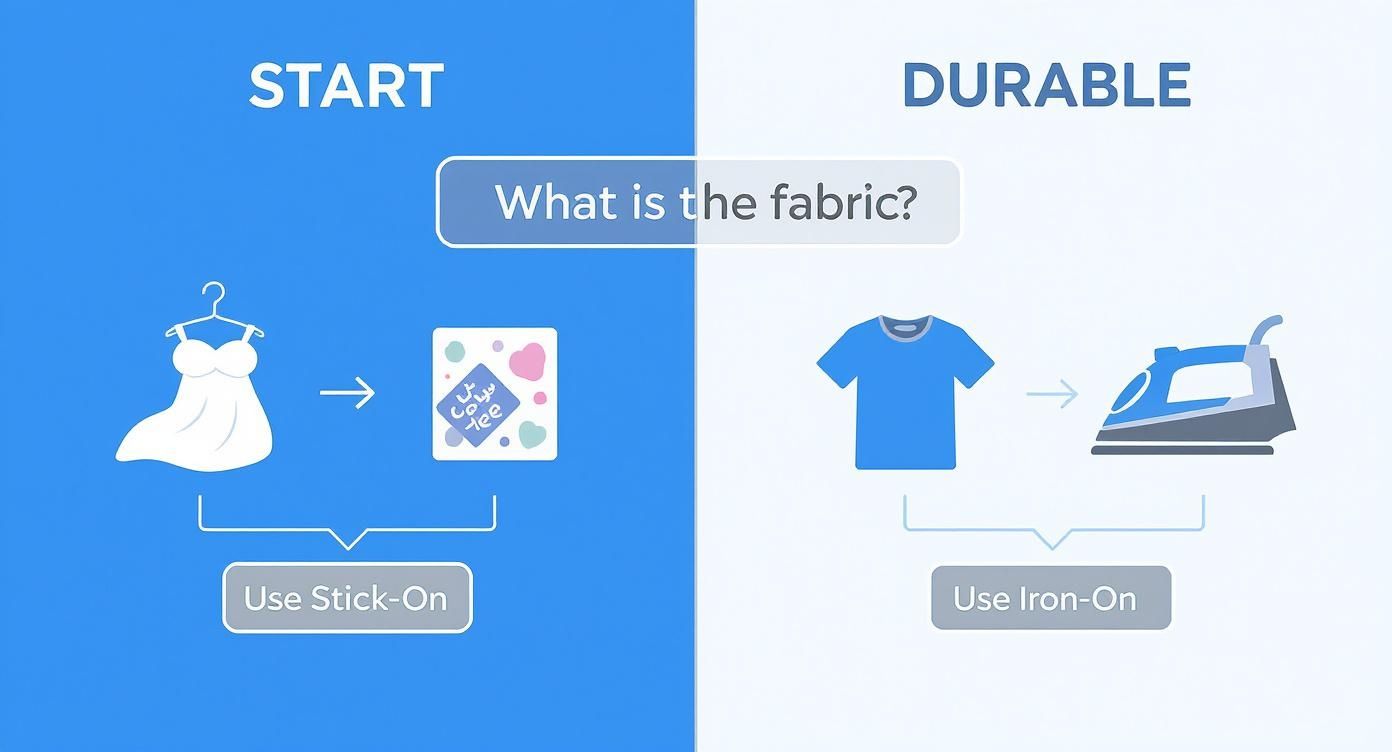
The infographic highlights a really important point: tough fabrics like cotton and polyester can take the heat, making iron-on tags a fantastic choice. But for more delicate materials, you need the gentler touch of a stick-on label. While iron-on tags offer that set-and-forget permanence, it's well worth exploring the benefits of stick-on clothing labels in our detailed comparison.
How They Go On (And Come Off): A Practical Comparison
This is where the rubber meets the road, or in this case, the label meets the fabric. The real difference between these two types of name tags comes down to how you apply and remove them. It's the classic trade-off: a bit more effort up front for a permanent solution, versus a quick-and-easy fix. Understanding this dynamic is everything when it comes to picking the right label for the job.
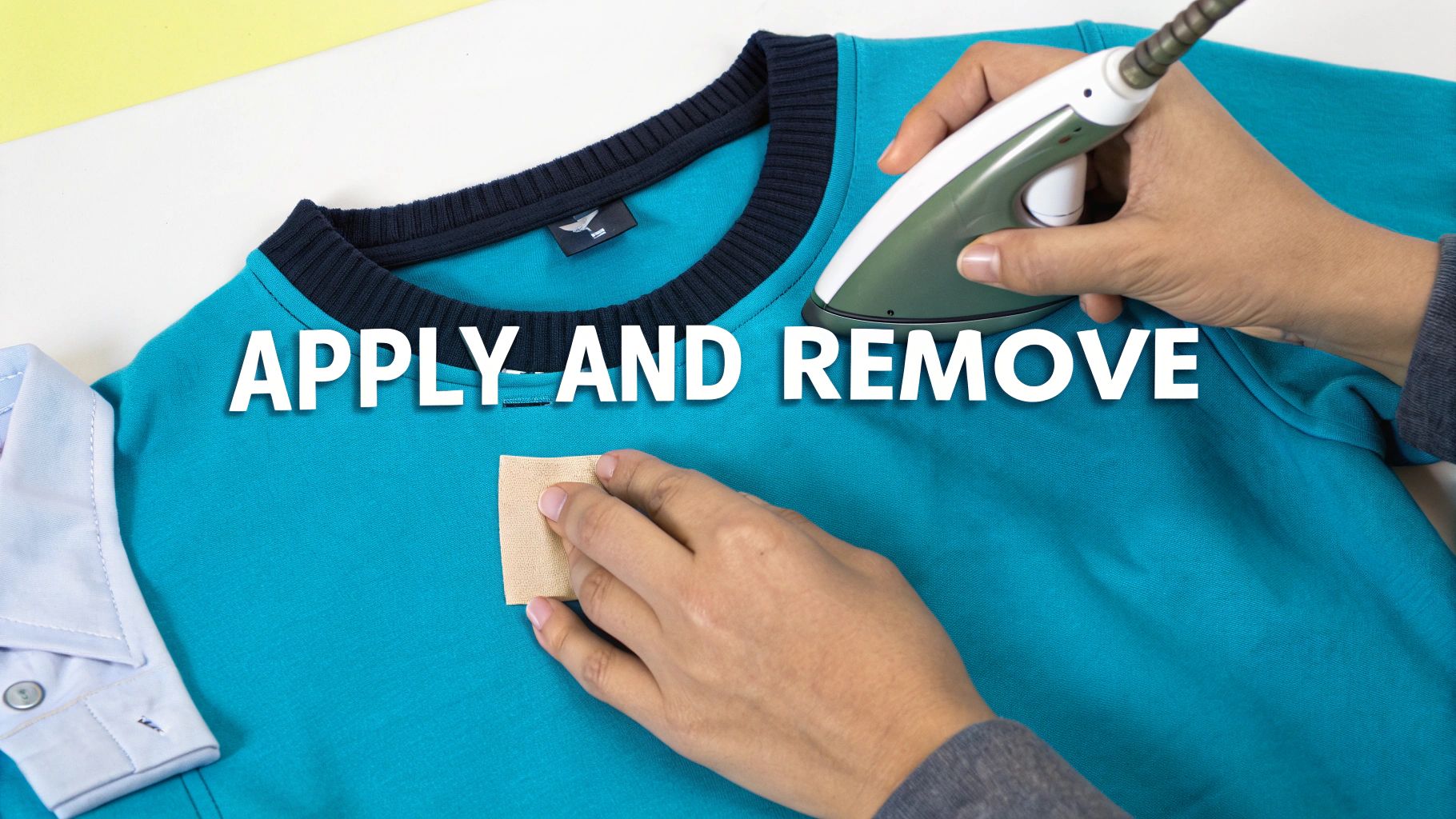
Stick-on labels are simplicity itself. You just peel one off the sheet and press it firmly onto the garment's care or brand tag. It takes seconds. This makes them an absolute lifesaver when you're faced with a mountain of school uniforms the night before term starts. The trick is remembering where they stick best—they're designed for those smooth, silky care labels, not for the texture of the main fabric.
The Application Process: A Step-by-Step Look
Applying iron on clothing name tags is a more hands-on process, but it’s this method that creates an incredibly strong, permanent bond with the fabric. To get it right, you need to nail three things: heat, pressure, and time. This process literally melts the label’s adhesive into the fibres of the clothing.
Applying an Iron-On Clothing Name Tag
- Prep Your Station: Get your iron nice and hot – usually the cotton setting is perfect. Crucially, make sure the steam is switched off. Any moisture will mess with the adhesive and stop it from bonding properly.
- Get Positioned: Lay the garment out on a hard, flat surface. A kitchen table or a sturdy countertop is much better than an ironing board, which is too soft and padded to allow for firm pressure. Place the label where you want it, with the text facing up.
- Heat and Pressure: Cover the label with the little sheet of parchment paper that comes with it. Now, press the hot iron down flat and hard for 10-15 seconds. The key is to apply firm, even pressure. Don't wiggle the iron around.
- The Cool Down: Let everything cool down completely before you even think about peeling off the parchment paper. This is a vital step, as it gives the adhesive time to cure and set properly into the fabric.
Getting the application just right is the secret to making these labels last. The principles are the same whether you're using a home iron or more professional gear, where mastering heat press settings for DTF transfers is key to a perfect finish.
Crucial Tip: From my experience, the number one reason iron-on labels fail is not enough heat or pressure. If the iron isn't hot enough, or you don't press down firmly, you'll get a weak bond and the edges will start to lift after a few washes.
Getting Them Off Again
What happens when you want to pass clothes on or sell them? This is a huge factor, and the two labels couldn't be more different.
Stick-on labels are a breeze to remove. Because they're stuck to the care tag, you can usually just get a fingernail under the edge and peel them off cleanly. No sticky mess, no damage to the garment.
Removing iron on clothing name tags, on the other hand, means you have to reverse the process you started with.
- Reheat the Label: Put the parchment paper back over the old label and press it with a hot, dry iron for a few seconds. This will soften the adhesive again.
- Peel it While It's Warm: As soon as you lift the iron, carefully use a pair of tweezers to grab a corner and peel the label away. Just be careful—it will be hot to the touch.
- Tackle any Residue: Occasionally, you might see a faint outline of adhesive left behind. A neat trick is to place the parchment paper over the area and press with the iron again. The sticky residue should lift off onto the paper.
The sheer ease of removing stick-on labels makes them a brilliant choice for short-term use or for labelling expensive items you want to keep in pristine condition. If you want to dive deeper into heat-applied products, our guide on iron-on clothing decals has even more tips. Ultimately, your choice will likely come down to how much time you're willing to spend on application and potential removal.
How Do They Really Hold Up? A Look at Durability in the Real World
When you take the time to label an item of clothing, you expect that label to stay put. After all, what’s the point otherwise? The real test isn’t how it looks when you first apply it, but how it fares after being thrown in the washing machine and tumble dryer week after week. This is where you see the fundamental differences between iron-on and stick-on labels.
An iron-on clothing name tag works by literally becoming part of the fabric. The heat from the iron melts a special thermal adhesive, which then fuses directly into the clothing's fibres. Done correctly, this creates a permanent bond that’s as tough as the garment itself, designed to survive countless hot washes and tumble dries without fading or peeling.
Stick-on labels, on the other hand, use a seriously strong, pressure-sensitive adhesive. They don’t fuse with the fabric but form a powerful bond with a smooth surface—ideally, the silky care tag inside the clothing. Modern adhesives are surprisingly tenacious and can easily handle dozens of normal wash cycles, but their staying power is tied to the surface they stick to, not the garment's main fabric.
Performance in the Wash Cycle
The laundry basket is the ultimate proving ground. The combination of heat, water, and constant tumbling quickly separates the truly durable labels from the ones that give up after a few spins.
Iron-on labels have a long and proven track record here. Back in the 1970s, advancements in thermal plastics made them incredibly resilient, capable of handling the punishing industrial washes common in settings like care homes and NHS facilities, where temperatures can hit 95°C for sanitation.
Stick-on labels are more than a match for typical domestic washing, holding on tight through 40-60°C cycles. They're perfectly reliable for the weekly school uniform wash. However, the extreme heat of a sanitising or industrial wash can weaken the adhesive over time, making them a less suitable choice for environments with such demanding cleaning needs.
Expert Insight: For items that take a real beating, like a child's PE kit or a care home resident's jumpers, the direct-to-fabric bond of an iron-on label offers genuine peace of mind. You apply it once and can forget about it, confident it will last as long as the garment does.
Fabric Compatibility and Adhesion
The type of material you’re labelling is a huge factor in how well a label performs over the long haul. In fact, it's probably the most critical point to consider.
Iron-on clothing name tags are at their best on absorbent, natural fibres that can take the heat.
- Cotton & Polycotton Blends: This is their sweet spot. The adhesive melts right into the weave, creating a bond that's almost impossible to shift.
- Polyester: Works very well, as long as you're careful with the iron temperature to avoid melting the fabric itself.
- Wool & Delicates: Definitely not suitable. The intense heat needed for a proper bond will scorch, melt, or permanently damage materials like wool, silk, and many synthetics.
This is where stick-on labels shine, offering far more flexibility for those heat-sensitive items. Since they stick to the care tag, the main fabric is never exposed to the iron.
- Delicate Synthetics (Nylon, Lycra): Perfect for swimwear and sports kits where an iron would cause damage.
- Waterproof Jackets: An ideal solution. An iron would completely destroy the waterproof membrane of outerwear.
- Knitwear: By sticking to the care label, you avoid stretching or distorting the delicate structure of woolly jumpers.
It's a crucial distinction. An iron-on label might be tougher in a hot wash, but that durability is useless if the application process ruins the very item you’re trying to label. To learn more, you can check out the performance of different machine washable labels in our detailed guide.
Durability Comparison: Iron On vs Stick On Labels
To really break it down, here’s a side-by-side look at how each label type performs under different conditions you're likely to encounter.
| Durability Factor | Iron On Clothing Name Tags | Stick On Name Labels (on care tag) |
|---|---|---|
| High-Temp Washes (95°C) | Excellent. Built to handle industrial laundry for sanitation. | Fair. Might start to lose its grip after many high-heat cycles. |
| Standard Washes (40-60°C) | Excellent. Will easily last the lifetime of the garment. | Very Good. Lasts through dozens of washes without peeling. |
| Tumble Drying | Excellent. Completely unfazed by the heat and friction. | Good. Stands up well, but prolonged extreme heat can affect glue. |
| Fabric Friction | Excellent. The fused bond stops it from fraying or lifting. | Good. Edges can lift if they're subject to constant, direct rubbing. |
| Legibility Over Time | Excellent. The print is infused into the label, so it won't fade. | Very Good. Quality printing stays crisp and clear for a long time. |
So, what’s the verdict? It really does come down to what you’re labelling. For the everyday workhorses—school trousers, cotton shirts, and care home basics—the sheer permanence of iron-on clothing name tags is unbeatable. But for everything else, from delicate woollens to pricey waterproofs, the clever, fabric-safe durability of a stick-on label is simply the smarter, safer choice.
Iron-On vs. Stick-On: Which Label Should You Choose?
Picking the right name label isn't just a matter of preference. It's about knowing what you’re labelling, how it will be used, and how often it’ll end up in the wash. The best choice for a school blazer that gets thrown in the laundry every week is worlds apart from the right one for a delicate silk scarf or a temporary tag for a weekend away.
Getting this right from the start saves a lot of headaches and lost property down the line. It really comes down to a trade-off: do you need bomb-proof permanence, or do you need a quick, damage-free solution that works on almost anything? Let’s break down the real-world situations where each type of label really shines.
The Case for Iron-On Clothing Name Tags
Think of iron-on clothing name tags as your go-to for long-term, heavy-duty labelling. They are built for garments that face a relentless cycle of wear, tear, and washing. Their real strength is the permanent bond they create, melting directly into the fabric’s fibres. This makes them the undisputed champion for institutional settings.
School Uniforms: The Ultimate Test
School uniforms are the perfect battleground for name labels. We're talking blazers, jumpers, trousers, and PE kits worn day in, day out and washed constantly. You need a label that can take the punishment without you ever having to think about it again.
- Durability: A properly applied iron-on label essentially becomes part of the clothing. It won’t peel, crack, or fade, even after dozens of washes at standard UK temperatures.
- Consistency: For parents facing a mountain of new school clothes, the "apply once and forget" nature of iron-on tags is a massive time-saver.
- Security: Because they are so difficult to get off, there’s less chance of labels being picked off or swapped in the chaos of the changing rooms.
Care Home Clothing: Industrial Strength Needs
In a care home, clothes are often laundered using industrial processes with incredibly high temperatures—sometimes up to 95°C—to guarantee sanitation. This is far beyond what most standard adhesives can handle.
Key Insight: For care homes, durability isn't just a nice-to-have; it's essential for hygiene and preventing residents' items from going missing. The tough, heat-fused bond of an iron-on label is really the only reliable choice for surviving these harsh conditions.
These labels are specifically engineered to withstand that kind of thermal and mechanical stress, ensuring names stay clear and attached. This is vital for maintaining residents' dignity and helping the laundry service run smoothly.
When Stick-On Labels Are the Smarter Choice
While iron-on labels are unbeatable for sheer permanence, they’re not a one-size-fits-all solution. There are plenty of times when using a hot iron is simply impractical or would ruin the very item you’re trying to protect. This is where the brilliant flexibility of stick-on labels, like the ones from Quote My Wall, comes into its own.
Delicate and Heat-Sensitive Fabrics
Lots of modern clothes are made from materials that would be destroyed by the heat needed for an iron-on tag. The perfect workaround is to pop a stick-on label onto the smooth, silky care tag inside the garment instead.
Think about items like these:
- Waterproof Jackets: An iron would melt the waterproof membrane in a second.
- Silk or Satin Items: These beautiful fabrics would scorch under direct heat.
- Wool Knitwear: The heat could easily damage the natural fibres and warp the shape.
- Nylon Sportswear: Things like football kits or swimwear can melt very easily.
Temporary Labelling Needs
Not every label needs to be for life. Stick-on labels are fantastic for short-term situations where you need to identify something and then remove the label later without leaving a mark.
- School Trips or Camps: Quickly label a sleeping bag, sun hat, or special event T-shirt for just a few days.
- Hand-Me-Downs: If you plan to pass clothes on to a younger sibling or a friend, a stick-on label peels off cleanly, leaving the item ready for its next life.
Beyond the Wardrobe: Labelling Everything Else
Perhaps the biggest advantage of stick-on labels is just how versatile they are. Because they don’t need heat, you can use them on so much more than just clothes. They are the ideal choice for labelling all the other bits and pieces that go to school or on a trip—lunch boxes, water bottles, sports gear, and backpacks. This makes them a fantastic, multi-purpose solution for keeping all of a child’s belongings organised.
Making the Right Choice: Which Label is Best for You?
Choosing between clothing labels really boils down to three things: how permanent you need it to be, how much time you have, and what kind of fabric you’re working with. There’s no single “best” label out there—just the one that’s best for your situation. Let's pull everything together to help you pick the right one with confidence.
The thinking here is pretty simple. If you need a permanent, set-and-forget solution for sturdy clothes that will get a lot of wear and tear, iron on clothing name tags are hands-down the winner. But if you’re labelling a mix of items—delicate fabrics, lunch boxes, or things you might want to pass on later—then a good quality stick-on label offers far more flexibility.
A Clear Framework for Your Decision
To make this as easy as possible, let's just run through a few common scenarios. Think about your specific needs and see which description fits best. This way, you’ll end up with a label that doesn’t just work, but actually excels at the job.
Consider the life of the garment. A school blazer has to last the whole year, but a party dress might only be worn once or twice. That lifecycle is your biggest clue.
Go for Iron On Clothing Name Tags When…
- Durability is Everything: For school uniforms, PE kits, and care home clothing that goes through punishing industrial washes, you need the fused, permanent bond that only an iron-on label can provide.
- The Fabric Can Take the Heat: You're mainly labelling cotton, polyester, or polycotton blends that won’t be ruined by a hot iron.
- You're in it for the Long Haul: These items are being labelled for good. You have no plans to remove the names later, making them perfect for ensuring a child’s kit stays theirs for years to come.
Choose Stick-On Name Labels When…
- You’re Dealing with Delicates: You need to label wool, silk, nylon, or waterproof gear where a hot iron would be a disaster.
- You Need a Quick and Easy Fix: You've got a mountain of stuff to label and don't want the hassle of dragging out the ironing board.
- You’re Labelling More Than Just Clothes: The job includes lunch boxes, water bottles, shoes, and other random bits and bobs. A versatile sticker is the only real multi-purpose solution.
- The Items Might Be Passed On: You're hoping to hand the clothes down one day, so being able to remove the label without leaving a mark is a huge plus.
The final decision really hinges on practicality. An iron-on label is a fantastic, robust product, but its greatest strength—its permanence—becomes a weakness if you apply it to the wrong material. Always put the safety of the garment first.
The Verdict for Different Lifestyles
The UK market for clothing labels is definitely growing, driven by the need for reliable ways to identify belongings. This is especially true for schools and healthcare, where the performance and sheer staying power of iron on clothing name tags are highly valued. You can see more on these trends in the brand clothing label industry analysis.
This just goes to show that for many people, the permanence of an iron-on label is exactly what they’re looking for.
For busy parents getting kids ready for school, the smartest move is often a hybrid approach. Use iron on clothing name tags for the core uniform—the blazers, trousers, skirts, and cotton polo shirts that can handle the heat. For everything else, grab a pack of versatile stick-on labels, like the ones from Quote My Wall. They're perfect for the delicate PE kit, the nylon rain jacket, the lunchbox, and the book bag.
This two-pronged strategy really does give you the best of both worlds. You get the unbeatable toughness of iron-on labels where it counts most, and the quick, safe, and flexible application of stick-on labels for everything else. It means every single item is accounted for without risking damage to expensive or heat-sensitive belongings—a complete, stress-free solution.
Got a Few More Questions? Let's Get Them Answered
Even with all the facts laid out, you might still be wondering about a few specific details. That's completely normal. Getting the small things right is what makes the difference between a label that sticks for good and one that drives you mad.
Here, we'll tackle the most common questions we get asked about both iron-on and stick-on clothing labels. We'll cover how long they really last in the real world, what to do if one starts to misbehave, and the all-important question of which fabrics they work with. Think of this as the final check before you start labelling with total confidence.
How Long Do Iron-On Clothing Name Tags Really Last?
When an iron-on clothing name tag is applied correctly, it’s there for the life of the garment. I'm not exaggerating – it’s a permanent solution. The secret, and I can't stress this enough, is all in the application. You need a hot iron (no steam!), firm, even pressure, and you have to give the adhesive a moment to properly cure and bond with the fabric's fibres.
On the right materials like cotton, polyester, or polycotton blends, these labels will happily survive hundreds of washes at the usual UK temperatures of 40-60°C. They're even built tough enough for the industrial-level laundering you find in care homes, where temperatures can hit 95°C for sterilisation.
A Word of Advice: In my experience, almost every single case of an iron-on label peeling away can be traced back to how it was first put on. The usual culprits are not enough heat, not enough pressure, or trying to iron on a soft surface like an ironing board that just soaks up all your effort.
If you see a label starting to lift, don't panic. It hasn’t failed; it just needs a little more convincing to create that permanent bond.
What Should I Do If My Name Tag Starts to Peel Off?
It's frustrating to see a label's edge start to curl up, but thankfully, it's usually a quick fix. For an iron-on clothing name tag, the solution is simply to reapply heat to wake up that thermal adhesive and secure the bond once and for all.
Here’s the best way to sort out a peeling iron-on label:
- Prep the Area: Make sure the garment is clean and completely dry. Any lingering dirt, dampness, or fabric softener residue will get in the way of a good stick.
- Protect the Label: Grab the parchment paper that came with your labels and place it over the troublesome tag.
- Re-apply Heat & Pressure: With a hot, dry iron (no steam!), press down firmly for 10-15 seconds. Really focus your pressure on the bits that have started to lift.
- Let It Cool: Leave the garment to cool down completely before you test the bond. This gives the reactivated adhesive time to set properly.
Now, if a stick-on label is peeling from a care tag, you can try pressing it down firmly again. But since their adhesive isn't heat-activated, a simple press is less of a permanent fix. They have a finite (though very long!) lifespan and are designed to be replaced after many, many washes. That easy-peasy replacement is actually part of their appeal for temporary use or on delicate items.
Can I Use Iron-On Labels on Wool or Nylon?
This is a crucial one, and the answer is a hard no. You should never use iron-on clothing name tags on heat-sensitive fabrics. That includes materials like wool, nylon, silk, velvet, or anything with a waterproof coating. The high heat needed to get the label to stick will almost certainly damage, scorch, or even melt these fabrics.
This is precisely the situation where stick-on labels are the hero. By applying the sticker directly to the garment’s smooth satin care tag, the hot iron never has to touch the delicate material itself. It’s a simple workaround that keeps the garment in perfect condition.
Always, always check the care instructions on your clothing before you plug in the iron. If it says "cool iron only" or shows the little crossed-out iron symbol, an iron-on label is definitely not the right choice.
In these cases, a good quality stick-on label isn't just a good option; it's the only safe and effective one. It’s the best way to protect your investment in expensive or delicate clothing while still making sure everything is clearly named.
For a versatile, damage-free labelling solution that works on everything from delicate fabrics to lunch boxes and water bottles, consider the ultra high-tack washable labels from Quote My Wall. They provide the durability you need without the risks of using a hot iron. Explore our range of personalised stick-on name labels at https://www.quotemywall.co.uk.