

Custom Vinyl Stickers for Windows: A Complete UK Guide
A Saturday morning project can start with a simple frustration. You're standing in a chilly conservatory with a coffee in hand, looking through a clear pane at a shared courtyard, wondering whether you need a decorative design, more privacy, or something that stops visitors walking into the glass.
Those are three different jobs. A window sticker can change the appearance of a room, control what passers-by can see, or make a glazed area visible for safety. The material may look similar, but the correct vinyl, adhesive, finish and installation method depend on which job matters most.
What Custom Vinyl Stickers for Windows Actually Are
Custom vinyl stickers for windows are precision-cut or printed graphics made with pressure-sensitive adhesive. They arrive on a backing liner and are applied to clean glass. A cut decal may contain lettering, a logo, shapes or a simple pattern. A printed graphic carries colour, photographs or detailed artwork over a larger area.
The practical distinction is between a self-adhesive vinyl decal and window film. A small logo on a shop door is usually a decal. Frosted privacy coverage, a gradient, reeded effect or one-way vision treatment is generally classed as film because it changes sightlines across more of the pane. Personalised vinyl stickers for UK homes and businesses can suit smaller, purpose-led graphics where full-pane coverage is unnecessary.
Static-cling products form a separate category. They grip through surface tension rather than permanent adhesive, so this guide to static-cling film is useful when temporary positioning matters more than long-term edge hold.
The three roles that are easy to confuse
Decoration covers lettering, motifs, children's designs, branding and colour blocks. The purpose is visual impact, while the view and daylight remain largely available.
Privacy interrupts a direct sightline. Frosted, etched-effect, reeded and gradient films can obscure faces or room contents while keeping a room lighter than an opaque covering. Lustalux on window-covering trends notes the preference for privacy finishes that retain a natural feel rather than making rooms appear closed in.
Safety manifestation makes glass visible. A large door or partition may need a contrasting pattern or band so people recognise the obstruction before walking into it. A decorative sticker may contribute, but it should not be assumed to satisfy a building requirement. The property owner or responsible person must check the rules for the setting.
Most window graphics use thin polymeric calendered PVC, chosen for flat or gently curved glass. It can be cut, printed, laminated or layered with white ink. Specify the role first, then choose the artwork, finish and adhesive.
Main Types and How They Perform on Glass
A clear logo, a frosted bathroom panel and a perforated shopfront graphic don't behave in the same way. Each finish makes a different compromise between privacy, daylight, visibility, cleaning and appearance.
The privacy and light descriptions below are practical comparisons rather than laboratory ratings. Light transmission varies with the exact product, colour, print coverage, glass and installation position, so a supplier should provide a sample when the result matters.
| Finish | Privacy (1-5) | Light Transmission | Typical UK Use |
|---|---|---|---|
| Clear or transparent vinyl | 1 | High where the glass remains uncovered | Logos, lettering, small motifs and internal branding |
| Frosted or etched-effect film | 4 | High to moderate, depending on coverage and pattern | Bathrooms, overlooked lounges, meeting rooms and partitions |
| Opaque or coloured vinyl | 5 | Low through covered areas | Shopfront branding, colour blocks, playrooms and full privacy |
| One-way vision, perforated film | 3 during suitable daylight conditions | Moderate through perforations | Retail windows and ground-floor commercial spaces |
Clear vinyl keeps the window open
Clear vinyl works when the glass itself should remain the dominant feature. A cut logo or short message can be read from outside without turning the whole pane into a graphic surface. Printed clear vinyl needs careful colour planning because the glass behind the design affects the result, particularly when the image has pale tones.
White ink can be layered beneath a clear print to strengthen colour and improve contrast. Without that underbase, some artwork may look muted against changing daylight.
Frosted film balances privacy and daylight
Frosted film is usually the most forgiving choice for a domestic privacy problem. It breaks direct sightlines while allowing the room to retain a brighter, more open character than full opaque coverage. A full panel gives stronger privacy, while a band, gradient or patterned section can protect the most exposed part of the window without covering everything.
That makes it suitable for street-facing terraced homes, bathrooms, nurseries and office meeting rooms. The finish also hides fingerprints more effectively than a high-gloss surface.
Opaque and one-way finishes need more caution
Opaque vinyl gives the strongest visual block, but it also removes the view wherever it's applied. It's effective for bold branding, coloured shapes or a child's playroom design, though it can make a small room feel darker.
One-way vision is often misunderstood. It can provide daytime privacy when the exterior is brighter than the interior, but the effect reduces or reverses after the lights come on inside. It's better suited to retail and commercial windows than to a bedroom where privacy is expected at night.
Practical rule: Choose clear vinyl for decoration, frosted film for privacy with daylight, opaque vinyl for a solid visual block, and perforated film only when you understand its changing day and night performance.
Measuring, Designing and Ordering Your Stickers
Measure the actual visible glazed area, not just the frame. Take the width and height in several places because older windows, timber frames and replacement units aren't always perfectly square. Record whether the pane is flat, gently curved, textured, tinted or already covered with another film.
Many modern uPVC installations use familiar module dimensions, including 600mm, 900mm and 1200mm widths, but never order from a nominal window size alone. The rubber glazing seal needs room to move, and a sticker pushed tightly into the bead can catch dirt or lift at the edge. Leaving a 2mm to 5mm gap from the seal is a sensible production allowance for many applications.
Build the artwork around the material
Use AI, EPS or SVG files for logos and lettering. Vector artwork stays sharp when the decal is enlarged. Use a 300dpi raster file for photographic work at its final output size, and keep important text and faces inside a safe area away from the cut line.
Add 3mm bleed where the background runs to the edge. Bleed gives the cutter a small tolerance and prevents an unwanted sliver of glass showing along a trimmed edge. A proof should show the finished size, bleed, crop marks, orientation and whether the graphic is viewed from inside or outside.
Clear vinyl often benefits from a white ink underlayer. It helps colours remain visible on transparent glass, especially where the background changes. On frosted stock, a white underbase may add little because the material already changes the visual ground beneath the print.
Ask the printer the right ordering questions
UK print shops commonly quote from one combined width and height, so prepare a clear dimension schedule for multiple panes. Ask whether the artwork will arrive as one piece, tiled sections or individual decals, and confirm how the design should be read from each side.
For repeat work, clarify whether setup is charged per design or per order. Larger runs may be priced differently from a single bespoke panel, but the exact threshold and fee depend on the supplier.
Before production, request a PDF visual proof at 1:1 scale. Check spelling, logo proportions, colour references, transparent areas, white ink, bleed and the intended face of application. A proof is much cheaper to correct than a finished sticker made to the wrong orientation.
For broader print and finishing options, this overview of custom sticker printing in the UK can help you compare the design route with ready-made formats.
Why the Right Vinyl Matters for Windows
The wider UK window-film market is expanding, although published estimates use different baselines. One Grand View Research UK window-film outlook records USD 715.0 million in revenue in 2022 and projects USD 1,147.3 million by 2030, an implied 6.1% CAGR. A separate Market Research Future estimate places the market at USD 111.2 million in 2024, with a projection from USD 113.91 million in 2025 to USD 145.0 million by 2035 at a 2.4% CAGR, while another estimate gives USD 88.96 million in 2024 and USD 167.16 million by 2035.
The figures don't align, so they shouldn't be merged into one precise market size. They do point to sustained demand for applied graphics and films used for decoration, privacy, retrofits and branding. That makes material selection more important, not less, because buyers are choosing among products designed for very different service conditions.
Calendered and cast vinyl
Monomeric calendered vinyl is generally an economical option for flat indoor glass and short-term graphics. Its construction is less suited to demanding outdoor exposure or complex curves. Polymeric calendered vinyl is more stable and is a strong general-purpose choice for flat or slightly curved window graphics.
Cast vinyl is thinner and more conformable, making it useful where the surface or design demands a premium material. The expected service life depends on the specific product, exposure, ink system, laminate and cleaning routine. Don't accept a lifespan promise without checking whether it applies indoors or outdoors.
A UK datasheet for Metamark MD5 positions a high-performance polymeric self-adhesive vinyl for window graphics and retail signage. It reports glass adhesion of 15 N/25 mm after 20 minutes and 20 N/25 mm after 24 hours, showing why the bond should be allowed to develop before the sticker is stressed or cleaned. The UK Metamark technical data is particularly relevant when edge grip matters.
| Vinyl Type | Typical Lifespan | Adhesive Strength | Best For |
|---|---|---|---|
| Monomeric calendered | Shorter indoor or temporary use | General-purpose hold | Flat indoor decoration and changeable promotions |
| Polymeric calendered | Longer-term general use | Stronger, more stable glass adhesion | Window graphics, retail signage and privacy applications |
| Cast vinyl | Premium long-term applications | Product-specific, usually selected for demanding work | Complex curves, refined graphics and exposed installations |
These lifespan descriptions are comparative, not guarantees. Solvent-based acrylic adhesives are commonly preferred for clean glass because they wet out and anchor reliably. Low-tack removable adhesive is safer for rented homes or temporary promotions, but it may provide less long-term resistance at vulnerable edges.
Ink and laminate matter too. A polyester film with pressure-sensitive acrylic adhesive and a hard coat can block 98–99% of UV, while related 3M products sold through a UK distributor report 77% total solar energy rejected, 78% glare reduction and 99% UV blocking on 6mm glass. Another product reports 82% solar energy rejected, 81% glare reduction and 99% UV blocking on clear polycarbonate. The technical window-film data also makes clear that the result depends on the construction, glass and glazing arrangement.
Fitting and Removing Window Stickers Without Damage
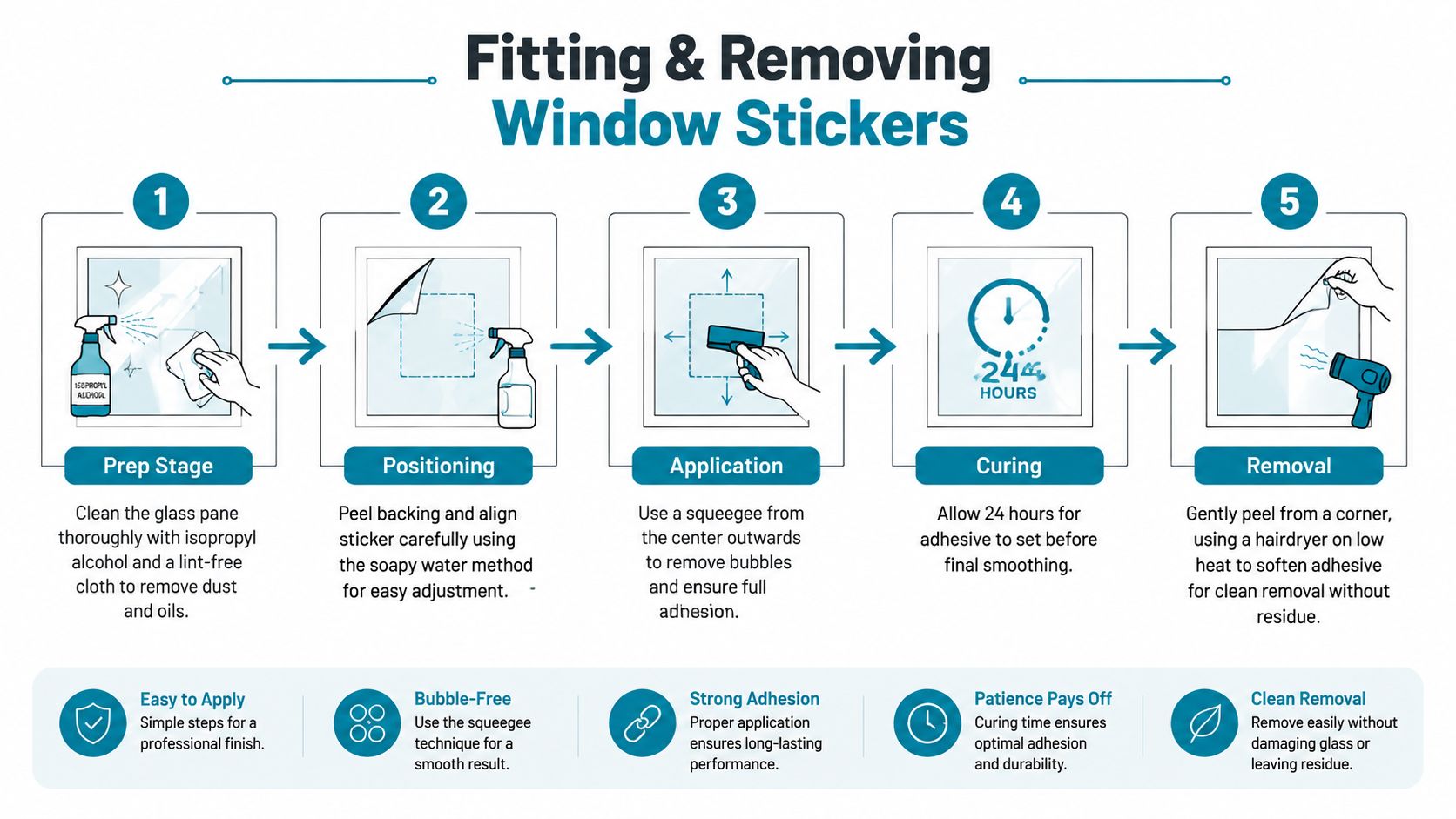
Good fitting is mostly preparation. Dust, silicone residue, fingerprints and household-cleaner film can prevent the adhesive from making a continuous bond, even when the vinyl itself is suitable.
A reliable fitting routine
- Prepare the pane. Clean the glass with isopropyl alcohol and a lint-free cloth. Avoid leaving detergent or polish behind. Check the room is within the manufacturer's recommended temperature range, commonly around 10°C to 25°C for installation. Lay a rolled sticker flat for about an hour first so it can relax.
- Position before committing. Hold the design against the glass with its backing still attached. Check the gap from the seals, the reading direction and the sightline from outside. For a large graphic, use masking tape along the top edge and add a vertical hinge through the centre.
- Use a controlled wet application. Lightly mist the glass with clean soapy water. Peel back part of the liner, place the exposed section and adjust it while the surface is wet. Work in manageable sections rather than trying to control a large sheet all at once.
- Squeegee from the centre. Use a felt-edged or plastic squeegee at roughly 45 degrees, moving from the centre outwards with overlapping strokes. The aim is to push water and air towards the edges without stretching the vinyl.
- Seal the perimeter. Once the graphic is positioned, run a soft roller or protected fingernail around the edges. Pay particular attention to corners and areas near the glazing bead. Leave the application undisturbed while the adhesive cures.
- Wait before cleaning. Allow 24 hours before washing the window or putting mechanical pressure on the edges. The Metamark data cited earlier shows why early disturbance can produce a weaker hold than the bond achieved after dwell time.
Fixing bubbles, corners and residue
Small bubbles often settle as the adhesive bonds, but a stubborn bubble can be pierced with a fine pin. Press the air towards the pinhole, then smooth the area with a squeegee. Don't lift the whole decal to chase one bubble, because repeated peeling can introduce dust and distort the edge.
For removal, warm the vinyl gently with a hairdryer. The surface should become flexible, not hot enough to damage seals, frames or the film beneath. Peel from a corner at a shallow angle, pulling steadily rather than sharply.
If adhesive remains, test a citrus-based remover on a small area first. White vinegar can help with light residue, followed by clean water and a microfibre cloth. Avoid abrasive pads, blades and aggressive solvents that can scratch glass or affect adjacent coatings.
UK Rules Most Buyers Forget
A window sticker isn't automatically just decoration. Its role changes when it sits on a vehicle windscreen, marks a glass door, protects visual privacy in a workplace or forms part of a building's accessibility approach.
Glazed doors and partitions
UK building guidance treats visibility as a safety issue in glazed areas where people might walk into the glass. Approved Document M and the relevant UK guidance should be checked for the specific building and project, particularly where a decal is intended to act as manifestation rather than decoration.
The practical fitting principle is clear. A large glass door or partition needs a contrasting, visible marker that people can recognise as they approach. A decorative logo may help, but a sparse clear design can disappear against reflections, while an attractive frosted band can provide a more reliable visual interruption. Building owners, landlords, facilities managers and the person commissioning the alteration should establish who is responsible before installation.
Vehicle windscreens
Vehicle glazing has a separate set of restrictions. UK guidance says items placed on windscreens must not block the driver's view, so a design that looks harmless on a rear side window may be unsuitable within the swept or forward viewing area. The driver and vehicle operator carry the practical responsibility for keeping visibility clear.
For a focused discussion of placement, removal and legal tips for vehicle decals, vehicle owners should check the applicable rules before ordering.
Rental homes and offices
Tenants should read the tenancy agreement and ask the landlord or agent before applying adhesive film. Removable material may still need to be taken off at check-out, and damage to seals, coatings or glass can become a dispute.
In offices, frosted or opaque film can support visual privacy where meeting rooms or screens contain personal information. It's not a substitute for an organisation's wider data-protection controls, but it can reduce casual viewing of confidential conversations and documents. The organisation controlling the workspace should decide the coverage and document the reason, rather than leaving the choice to an individual installer.
Real UK Setups That Work
The same pane can need a completely different specification depending on who uses the room and what happens outside it. These examples show why a product choice should follow the setting, not the appearance in an online photograph.
An overlooked south-facing terrace
A ground-floor lounge facing a shared path needs privacy at seated and standing eye level, but full opaque coverage would waste the strongest source of daylight. A patterned or gradient frosted film across the vulnerable section is usually more predictable than one-way vision in a domestic setting, because evening lighting can defeat the one-way effect.
A matte frosted finish reduces reflections and gives the room a softer appearance. The exact height should follow the sightline from the path and the furniture arrangement, with the upper glass left open where possible.
A nursery with a visible pane
A nursery window needs cheerful decoration, but a low-contrast design can be difficult to see against changing outdoor light. A coloured cut-vinyl motif can add identity, while a clearly visible band or pattern can help distinguish a large pane from an open doorway.
The school, nursery operator or building manager should select the manifestation approach. Avoid covering the entire window just to make it noticeable, because children still benefit from daylight and a view.
A care-home corridor partition
A corridor partition beside a resident's room has a dignity requirement as well as a safety one. Full frosted coverage around the waist and direct viewing zone can stop passers-by seeing into the room while leaving upper glass lighter.
A matte finish is easier to live with under corridor lighting than a glossy printed panel. The responsible operator should check the building's accessibility and safeguarding requirements before treating the film as an informal privacy upgrade.
A small shopfront
A local business may need opening hours, a logo and a strong colour cue without blocking the display. Cut opaque lettering applied to clear glass gives crisp edges and lets the window remain part of the shopfront. A small frosted panel can add separation near a counter or consultation area.
| Scenario | Location | Sticker Type | Typical Size | Finish |
|---|---|---|---|---|
| Overlooked terrace | Ground-floor lounge | Frosted or gradient film | Sightline-led section | Matte |
| Nursery | External window or internal partition | Coloured decal with visible manifestation | Pattern or band sized to the pane | Matte or satin |
| Care home | Corridor glass partition | Privacy frosted film | Waist and viewing zone | Matte frosted |
| Small business | Shopfront glazing | Cut opaque logo and lettering | Logo and text sized to viewing distance | Gloss or matte clear application |
The dimensions should be measured directly from the pane rather than copied from a generic template. Reflections, furniture, corridor traffic and the direction of approach all affect whether a design works.
Buyer Checklist, Care and Common Questions
Before paying for production, ask for more than a colour preview. The material and adhesive determine whether the graphic stays neat, removes cleanly and remains suitable for the building or vehicle where it will be used.
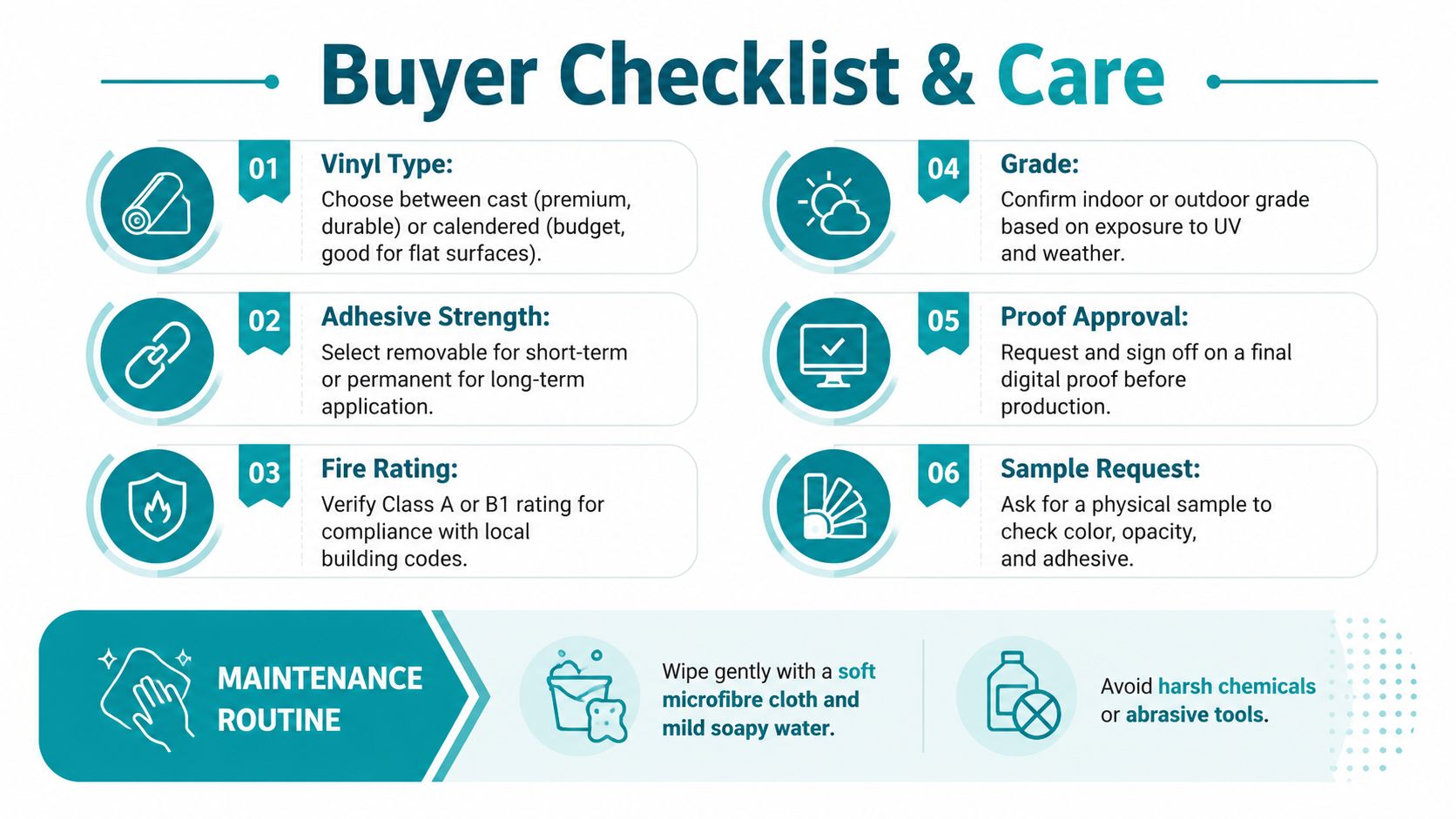
- Choose the vinyl: Select monomeric for simpler indoor work, polymeric for stronger general-purpose window graphics, or cast where conformity and premium finish justify it.
- Confirm the adhesive: Use removable low-tack adhesive for temporary work or rented homes, and stronger permanent adhesive where long-term edge hold matters.
- Check the grade: Confirm whether the stock is intended for indoor or outdoor exposure, and ask about UV stability, laminate and cleaning limits.
- Ask about safety: For public buildings, care settings, schools and offices, request the relevant fire, accessibility or manifestation information rather than assuming a decorative product covers every requirement.
- Approve the proof: Check dimensions, spelling, orientation, bleed, transparent areas and white ink before production.
- Request a sample: A physical sample reveals the actual opacity, colour, surface texture and adhesive behaviour on your glass.
Cleaning and upkeep
Wipe the finished sticker with a soft microfibre cloth and mild soapy water. Avoid abrasive tools, aggressive solvents and ammonia-based glass cleaners unless the vinyl manufacturer specifically approves them. Inspect the edges about every six months, particularly on sunny panes or near seals, and press a small lifted corner back down with a clean squeegee before dirt gets underneath.
Common UK questions
How long does a quality sticker last? Indoor life is generally longer and more predictable than outdoor life because sunlight, rain, frost and temperature changes accelerate wear. The product datasheet, ink, laminate, orientation and cleaning routine matter more than a generic promise.
Do tenants need landlord permission? Often, yes in practical terms. Check the tenancy agreement and get written approval before applying adhesive film, especially if the design could affect glazing, seals or the condition expected at check-out.
Will a window sticker block Wi-Fi or 5G? Ordinary decorative vinyl and frosted films don't normally act as a meaningful signal barrier. Specialised metallised solar-control films are a different product category, so ask the supplier about construction if wireless performance is critical.
Will removal leave marks? Properly selected vinyl can usually be removed from sound glass without permanent damage, but aged adhesive, heat exposure, poor-quality film and existing coatings can leave residue. Warm the film, peel slowly and test any remover before using it across the pane.
Quote My Wall offers window decals, privacy films and custom sticker options for glass, including frosted and clear styles for decorative or privacy-led projects. If you've measured the pane and know whether you need branding, privacy or a visible safety pattern, visit Quote My Wall to explore suitable window products and request a design route.