

Personalised Vinyl Stickers UK: The Complete Buying Guide
You've found the perfect design, but now you're wondering whether it will stick to the nursery wall, survive a child's lunch box, or come off a rented flat without taking paint with it. UK buyers often start by comparing colours and fonts, then discover that surface type, outdoor exposure, adhesive strength and finish matter far more than the artwork alone.
Personalised vinyl stickers can be an excellent solution for home décor, organisation, children's belongings, furniture projects and small-business branding. They're not a universal substitute for paint, wallpaper, fabric labels or permanent signage, though. The right choice depends on where the sticker will go and how hard that surface will work.
Why Personalised Vinyl Stickers Have Become a UK Staple
A renter in Manchester might want a name decal for a child's bedroom, a parent in Bristol might be labelling school equipment, and a small business in Leeds might need branded packaging without committing to a large print run. All three buyers are looking at the same basic product, but they need very different performance from it.
The appeal is practical. A sticker can refresh a plain wall, identify storage boxes, personalise furniture or add branding without the mess of redecorating or the expense of replacing an otherwise useful item. For renters, the possibility of a reversible update is often more important than a dramatic decorative effect.
The UK market also sits within a mature label-printing industry. The UK label printer market is projected across 2021 to 2031, with revenues tracked across retail, manufacturing, logistics and healthcare end users, according to 6Wresearch's UK label printer market overview. That context matters because personalised vinyl stickers are part of a wider print ecosystem built around speed, accuracy and customisation, not merely novelty décor.
What buyers are really deciding
The first question isn't “Which design should I choose?” It's “What must this sticker withstand?”
- A wall decal needs a finish and adhesive suited to a smooth painted surface.
- A bottle or lunch box label needs reliable adhesion and resistance to regular handling.
- Outdoor branding needs protection from sunlight, rain and cleaning.
- A furniture wrap or decorative panel needs accurate sizing and careful installation.
- A rental-friendly product must be tested cautiously before full application.
That's why generic product galleries aren't enough. A design that looks superb online can fail on a dusty wall, a textured cupboard or a damp bathroom surface.
Practical rule: Choose the sticker for the surface and conditions first, then choose the appearance.
The rest of your decision comes down to material, size, artwork, installation and expected lifespan. Get those decisions right and personalised vinyl stickers are a flexible, affordable decorating and labelling tool. Ignore them and even a high-quality print can peel, fade or leave you disappointed.
Understanding Vinyl Materials and What They Mean for Your Project
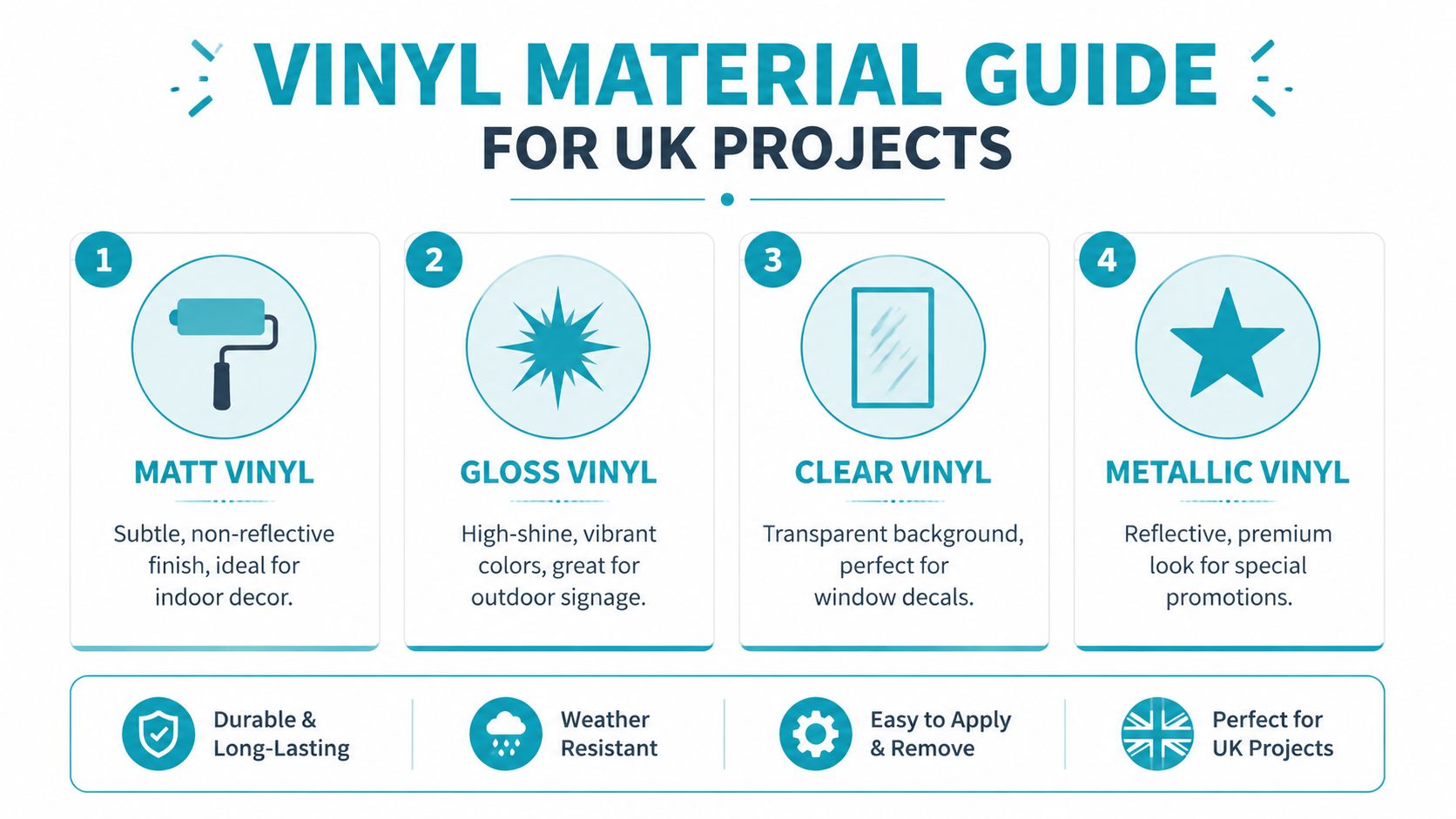
Material choice controls both appearance and performance. UK suppliers commonly offer matt, gloss, clear, metallic and textured finishes, with each one solving a different problem. Don't select a finish only because it looks attractive on a product page.
Comparing the main finishes
Matt vinyl has a muted, non-reflective appearance. It's usually the safest choice for indoor wall art, furniture details and labels where glare would make text difficult to read. Its outdoor rating is typically about 1 year, according to Edge Stickers' vinyl durability guidance, so it's not my first choice for exposed exterior signage.
Gloss vinyl reflects more light and generally makes printed colours appear punchier. It suits windows, product branding and outdoor applications better than matt in many cases. Its commonly stated outdoor rating is around 4 years, although sunlight, abrasion and cleaning still affect real-world results.
Clear vinyl works when you want the background surface to remain visible, particularly on glass, jars and windows. It's useful for understated logos and decorative window graphics, but pale artwork can lose contrast against a busy or bright background.
Metallic vinyl gives a reflective, premium effect for accents, celebration décor and promotional details. It can look excellent in small doses, but it may reduce readability when used behind fine text or intricate artwork.
Textured finishes add tactile interest and can suit decorative projects, although the texture may affect small details and fine lettering. If you're interested in how surface texture changes a printed result, this plastisol texture guide gives useful visual context, even though plastisol is a different print application.
| Material type | Best for | Outdoor lifespan | Key limitation |
|---|---|---|---|
| Matt vinyl | Indoor décor, furniture, readable labels | About 1 year | Lower outdoor rating |
| Gloss vinyl | Outdoor signs, bright branding, windows | Around 4 years | Glare can affect readability |
| Clear vinyl | Glass, jars, window decals | Depends on print and protection | Low-contrast artwork may disappear |
| Metallic vinyl | Premium accents and promotions | Depends on product specification | Fine text can be harder to read |
| Textured vinyl | Decorative, tactile applications | Depends on product specification | Detail may look less crisp |
For stronger outdoor performance, UV-cured inks can retain colour fastness for 3–5 years, while a UV-protective overlaminate can extend that to 5–7 years, as the Edge Stickers guidance explains. Don't pay for lamination unless the sticker faces prolonged sunlight, weather or frequent cleaning.
For wall-specific decisions, the ultimate guide to vinyl for wall art is a useful companion because wall paint, finish and removal expectations matter as much as the vinyl itself.
Getting the Size Right Without Costly Mistakes
A sticker that's too small looks lost. One that's too large can dominate a room, collide with handles or fold around a corner. Measure the actual application area, not the object's general dimensions.
Start by cleaning the surface and identifying the usable flat space. For a wall, measure between skirting boards, sockets, shelves and corners. For a cupboard door, measure inside the recessed area if the design shouldn't cross the frame. For a bottle or laptop, measure the flattest panel rather than the full circumference.

A reliable measuring process
- Measure width and height separately. Don't assume the surface is square. Record the smallest usable measurement if the area tapers or includes curves.
- Mark the intended position with low-tack masking tape. Create a temporary rectangle matching the sticker dimensions. Stand back and view it from the normal distance.
- Check the design's proportions. A long name, quote or logo may need more width than expected. Ask whether the supplier measures the full sheet or the visible artwork.
- Account for edges and curves. Vinyl adheres most predictably to smooth, flat areas. A sticker forced across a sharp edge may lift prematurely.
- Measure labels individually. Pens, lunch boxes, books and bottles need different proportions. A long narrow label may suit a pen, while a wider format is easier to read on a storage box.
For curved items, place a strip of paper over the area, mark the edges, then flatten the paper and measure it. This gives you a better approximation than measuring the object from end to end.
Avoid these ordering errors
Don't measure over skirting, hinges or handles unless the design is specifically intended to wrap around them. Don't rely on a phone photograph for scale, and don't approve artwork before checking the preview at its final dimensions.
Large decals also need a practical installation plan. If you can't comfortably position the piece without stretching or folding it, ask whether it can be supplied in sections. A slightly smaller, accurately applied design will look better than an oversized one with creases.
Real-World Applications Where Vinyl Stickers Work Best
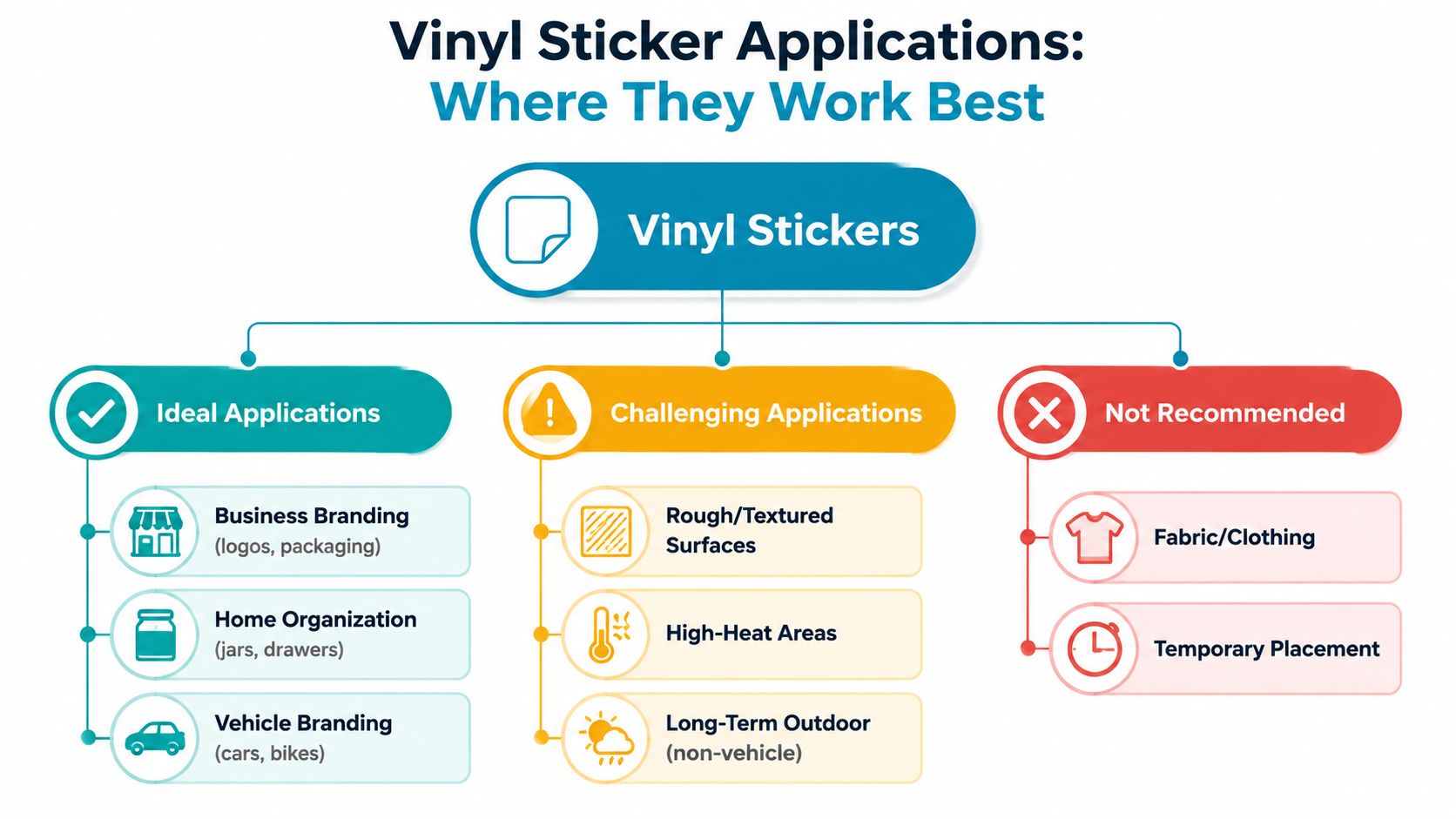
Vinyl performs best on flat, non-porous surfaces. Suitable examples include glass, aluminium, polyethylene, painted walls, furniture and plastic, while HelloPrint's UK vinyl sticker guidance warns that vinyl isn't suitable for every surface.
That distinction separates successful projects from peeling edges and wasted orders.
Where vinyl is a strong choice
Rental décor is one of the most useful applications. A simple name, constellation, botanical motif or nursery graphic can change a room without wallpapering. Use a smooth, clean wall, avoid freshly painted surfaces, and test a small hidden area first. Removal depends on the paint, age of the finish and adhesive, so “removable” should never mean “guaranteed damage-free”.
Home organisation is straightforward on jars, drawers, plastic boxes and cupboards. Matt vinyl usually makes small labels easier to read, while clear vinyl can keep a minimal look on glass containers.
Children's belongings benefit from durable labels on hard items such as bottles, lunch boxes, pencil cases, books and bags. Clothing needs a dedicated fabric label rather than a standard hard-surface sticker.
Furniture upcycling works well on smooth, prepared panels. Vinyl can update a drawer front or add a repeat pattern without replacing the furniture, but damaged veneer, loose paint and heavy texture need repair first.
Business branding suits packaging, product containers, windows, laptops and event materials. Choose the finish according to handling and visibility, not only brand colour.
Where problems start
Bathrooms combine humidity, condensation and regular cleaning. A well-prepared smooth tile, glass panel or mirror may work, but porous grout, rough plaster and areas constantly exposed to water are poor candidates.
High-heat surfaces near cookers, radiators or appliances require a product specifically rated for that environment. Standard decorative vinyl isn't a sensible choice where heat can soften adhesive or distort the material.
Fabric and clothing are different again. Vinyl intended for glass, plastic or painted furniture won't reliably flex, wash and tumble dry like a purpose-made clothing label. Use an iron-on or washable stick-on textile label for uniforms, care-home garments and nursery clothing.
Best use case: A smooth, clean, non-porous surface that needs attractive personalisation without permanent printing.
If the surface is rough, dusty, oily, porous, constantly wet or exposed to heat, choose another method or ask the supplier for a sample before committing.
Design and Customisation Options That Actually Matter
A personalised design succeeds when people can read it, recognise it and see it clearly against the surface. Decorative extras come second.
Start with the viewing distance. A wall quote can use larger, simpler lettering, while a small name label needs a clean font with strong contrast. Avoid thin strokes, tightly packed script and excessive detail when the finished sticker will be small.
Prepare artwork for print
Use vector artwork for logos, lettering and simple illustrations whenever possible. Vector files preserve clean edges as the design is resized. If you're supplying a raster image, use the highest-quality original available and check that it doesn't look soft at the final size.
Give the supplier clear information about:
- The finished dimensions, including whether those dimensions cover the sticker or only the artwork.
- The cut shape, such as a rectangle, circle or contour-cut outline.
- The background treatment, especially for clear vinyl.
- The colour references, including brand colours or PMS references where relevant.
- The intended surface, so the supplier can advise on material and adhesive.
Colour matching has limits. Vinyl printing uses CMYK, and PMS colours can be closely matched, but Avery's vinyl guidance notes that neon shades and certain greens can be difficult to reproduce accurately. If a precise colour is central to your brand, request a proof or sample and judge it under the lighting where it will be used.
Choose contrast over decoration
A dark design on a clear sticker may look strong on a white window but disappear against foliage or a dark vehicle. Metallic backgrounds can add distinction, yet they may compete with small text.
For children's items, prioritise quick recognition. A bold name and simple icon will usually work better than a crowded illustration. For small-business packaging, keep the logo clear and leave enough breathing space around it.
Review the proof at actual size, not only zoomed in on a screen. Check spelling, punctuation, orientation and the position of every important element before approval.
Your Complete Ordering Checklist and What to Expect
A smooth order starts with a precise brief. Suppliers can recommend the right product far more effectively when you tell them where the sticker will go, how large it needs to be and what conditions it will face.
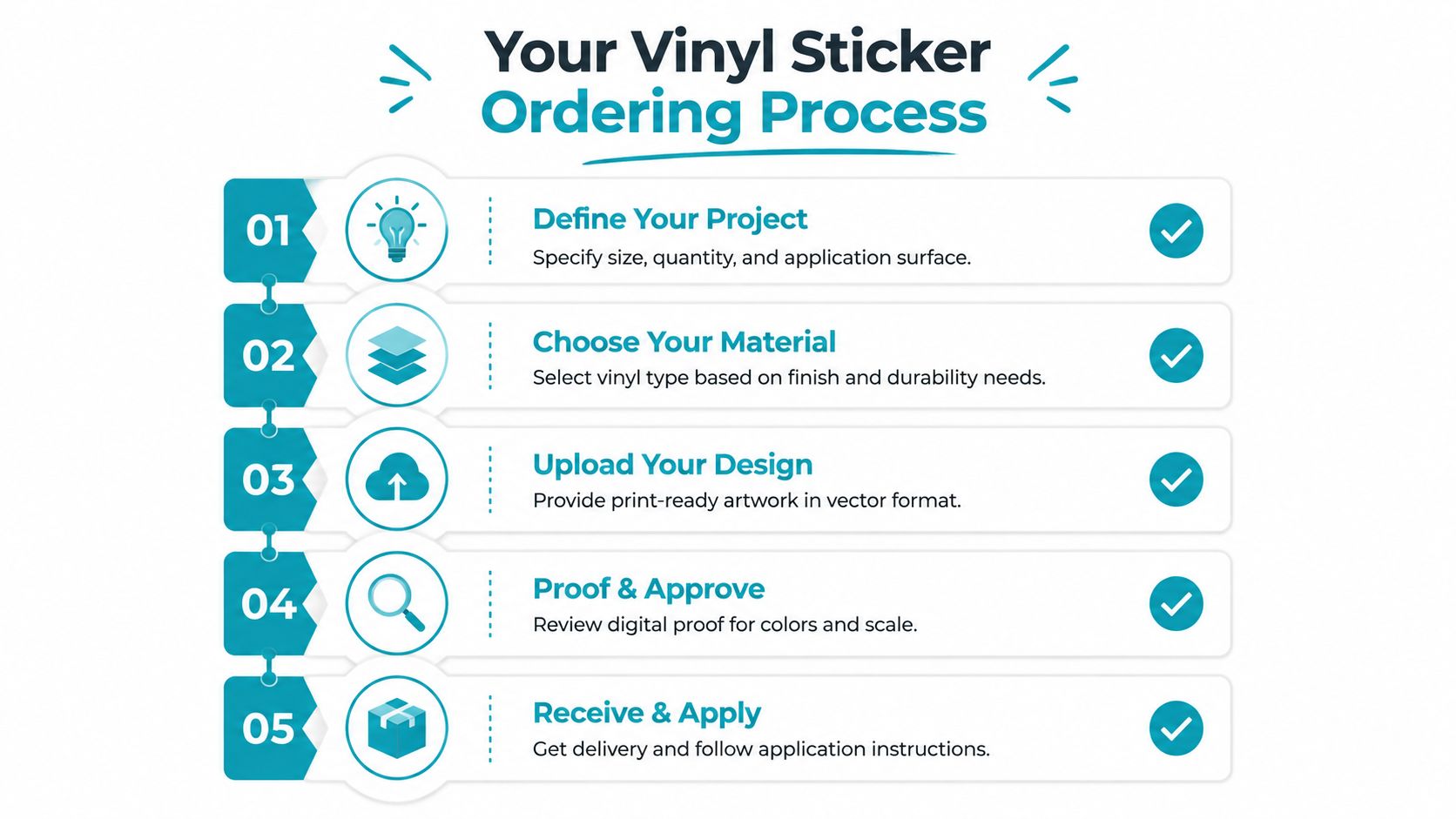
Write the brief before comparing suppliers
Include the following:
- Application surface. Say “painted plaster wall”, “plastic lunch box”, “shop window” or “powder-coated aluminium”, not just “indoor use”.
- Finished size. State width and height, then confirm whether the design must fit around edges or curves.
- Quantity. One wall decal, a small batch of labels and a larger packaging run may have different production methods.
- Finish and colour. Specify matt, gloss, clear, metallic or textured vinyl, then ask whether your artwork suits it.
- Exposure. Mention sunlight, rain, washing, handling, cleaning chemicals or humidity.
- Removal expectations. This is essential for rented homes, temporary displays and event signage.
Suppliers may structure prices around size, quantity, cut complexity, material and finishing. Don't compare a basic matt indoor sticker with a laminated outdoor graphic as though they're interchangeable. A lower price can reflect a simpler material or less protective finishing rather than better value.
Questions worth asking
Ask whether you'll receive a digital proof, whether the supplier can provide a material sample, how the product should be applied, and what the stated durability refers to. “Waterproof” may describe the face material, ink or adhesive, so clarify the complete construction.
UK suppliers advertise options including 48-hour express manufacturing, free UK and EU delivery, and materials such as waterproof polypropylene, gloss, matt, clear, metallic and textured finishes, as reported by LabelMarket's UK supplier information. Treat express production as a supplier-specific service, not a universal promise.
For a wider look at the process, Quote My Wall's guide to custom sticker printing in the UK can help you organise the artwork and application brief before ordering.
Finally, check delivery timing, packaging, replacement policy for printing errors and whether the supplier's durability advice matches your surface. Keep the approved proof and order details until the stickers have arrived and been checked.
Installation and Care Instructions for Long-Lasting Results
Most vinyl failures start before the sticker touches the surface. Dust, grease, moisture, fresh paint and rushed positioning cause more trouble than the printed material itself.
Clean hard surfaces with a suitable non-oily cleaner and allow them to dry completely. For glass and plastic, remove fingerprints and residue. For painted walls, dust carefully and avoid aggressive cleaning that could weaken the paint. Never apply a large decal over flaking paint, wallpaper seams or loose furniture coating.
Apply small stickers carefully
For a small label, hold it by the edges, align one side, then smooth it across with a clean card or felt squeegee. Work from the centre towards the edges to push air out rather than trapping it underneath.
For a larger wall decal, use masking tape to create a hinge along the top edge. Position the design, lift the lower section, peel away the backing gradually and smooth the vinyl down in controlled passes. Don't pull the material sideways, as stretching can distort lettering and create tension at the edges.
Curved surfaces need patience. Apply the centre first, then work towards the sides, using gentle pressure. Sharp compound curves are poor candidates for ordinary flat vinyl, especially if the sticker must remain wrinkle-free.
For detailed application guidance, follow Quote My Wall's instructions on how to apply vinyl stickers.
Cleaning and maintenance
Use a soft cloth and mild cleaning solution. Avoid abrasive pads, aggressive solvents and repeated scrubbing across exposed edges. Outdoor stickers should be checked periodically for lifting corners, especially after cold weather or strong sunlight.
Indoor wall decals generally need little maintenance beyond dusting. Labels on bottles, boxes and furniture face more handling, so smooth application and sealed edges matter.
Removal without unnecessary damage
Warm the sticker gently with a hairdryer, keep the heat moving and lift a corner slowly. Pull back across the surface rather than sharply away from it. If resistance is high, stop and warm the area again.
Paint condition matters. A sticker may remove cleanly from one wall but lift weak paint from another. Test first in an inconspicuous area, particularly in a rented property. Remove adhesive residue with a surface-safe method, and don't use harsh chemicals on delicate finishes.
Common Questions About Personalised Vinyl Stickers Answered
Can I apply vinyl to a freshly painted wall?
Wait until the paint has fully cured according to the paint manufacturer's guidance, not merely until it feels dry. Test the sticker on a hidden area first. Fresh or fragile paint can bond poorly, and removal may lift the coating.
Will vinyl work in a bathroom?
It can work on smooth glass, tiles or other suitable non-porous surfaces, but constant condensation, grout lines and harsh cleaning reduce reliability. Keep decorative vinyl away from areas that stay wet and choose a product designed for the expected exposure.
Are personalised vinyl stickers waterproof?
Some vinyl constructions are waterproof, but that doesn't mean every sticker is suitable for immersion, dishwashers, food contact or continual outdoor exposure. Confirm the material, ink, adhesive and intended use together. A label on the outside of a bottle is a different requirement from a product placed near its drinking spout.
Can renters remove them safely?
Often, but no supplier can remove the risk created by weak paint, dusty surfaces or unsuitable adhesive. Test first, warm the vinyl during removal and lift it slowly. For rental walls, choose a modest design and avoid applying stickers over damaged paint.
When should I choose an alternative?
Choose paint for broad, permanent colour changes. Choose wallpaper for full-room pattern and fabric labels for clothing. Use printed boards, etched signage or another permanent method when the message must withstand severe exposure or long-term commercial handling.
The best personalised vinyl stickers UK projects are deliberately matched to their environment. They're excellent for smooth surfaces, controlled decoration, clear labelling and flexible branding. They're a poor shortcut for every rough, hot, wet or fabric application.
For custom wall stickers, furniture vinyl, window graphics and personalised labels, Quote My Wall offers design-led self-adhesive vinyl products for home, nursery and small-business projects. Visit the shop with your measurements, surface details and preferred finish ready, then choose a product that fits the job rather than forcing the job to fit the sticker.