
Personalised Gifts UK for Him: The 2026 Buyer Guide
You've got a birthday, anniversary or Father's Day date circled on the calendar, and the man you're buying for insists he “doesn't need anything”. After an hour browsing generic gifts for men, you're no closer to a decision. Most of the products look forgettable, the personalisation feels forced, and the delivery date is suddenly more important than the gift itself.
The answer isn't to search harder. It's to search by occasion first, then choose a useful object and add personal meaning with a name, date, message, photograph or design. This approach works particularly well for personalised gifts UK for him, because the event gives you a clear guide to tone, timing and practicality.
Why Occasion-Led Gifting Works Best for Men
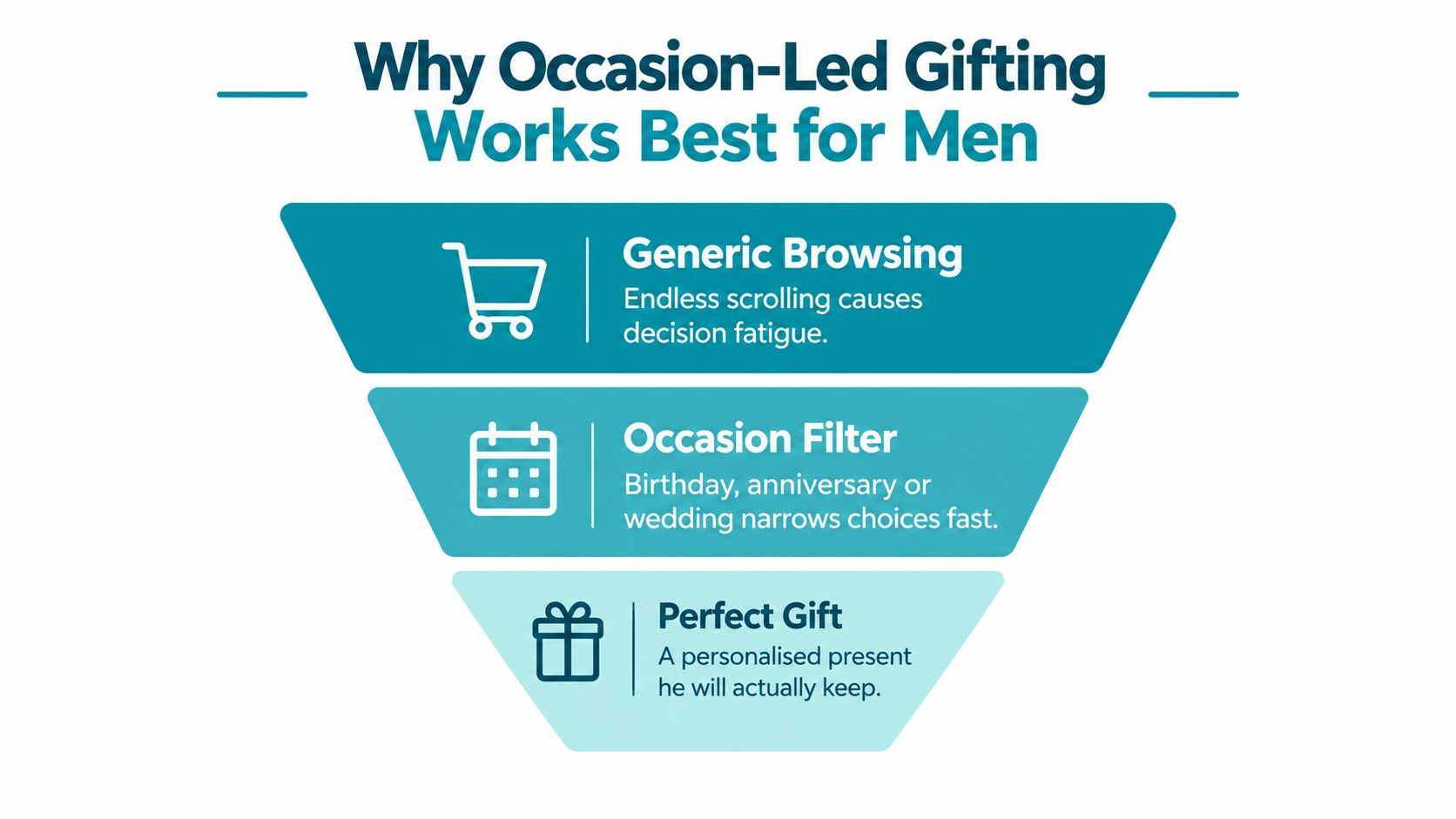
A generic catalogue asks the wrong opening question: “What product should I buy?” Start with “What is he celebrating, and what should the gift say?” A first Father's Day needs a different emotional register from a retirement, wedding or milestone anniversary. Once the occasion is clear, the range becomes manageable.
UK men's gifting behaviour supports this approach. YouGov reports that the occasion is the leading purchase factor for 65% of UK men, followed by closeness to the recipient at 52% and budget at 43%. Personalised gifts were selected by 18% of men, compared with 28% of women. These figures suggest that personalisation shouldn't be presented as decoration alone. It should solve the occasion, such as a date for an anniversary, a name for Father's Day or a shared message for a birthday. YouGov's UK gifting research provides the useful commercial context.
Use the occasion as your first filter
A birthday usually suits something linked to his interests or daily routine. An anniversary calls for a shared memory, date or place. A wedding gift should feel appropriate to the couple and their home, while retirement gifts benefit from a personal reference to his work, hobby or next chapter.
Use this simple sequence:
- Name the event. Birthday, anniversary, Father's Day, wedding, Christmas or retirement.
- Define the relationship. Partner, husband, dad, brother, friend or colleague.
- Choose the role of the gift. Something he'll use, display, wear or keep as a record.
- Add one meaningful detail. A date, location, initials, short message or hobby reference.
- Check the deadline before falling in love with the design.
That final check matters because personalised products are often ordered for fixed-date occasions. The UK personalised-gifts market was estimated at approximately £1.43 billion in 2024, equivalent to US$1.88 billion, and forecasts indicate it could reach US$3.27 billion by 2032, with a projected compound annual growth rate of 7.1%. The figures come from UK gifting market coverage by MRM. They show that customised presents have moved well beyond a niche seasonal purchase.
Practical rule: If you can't explain why the gift belongs to this particular occasion, keep searching.
The best occasion-led choice combines utility and evidence of thought. An engraved bottle opener can mark a wedding or milestone birthday. A custom print can commemorate where a couple met. A vinyl decal can personalise a home office without adding clutter. The event gives the product its meaning, and the personal detail makes it his.
Choosing Between Novelty Items and Lasting Keepsakes
A novelty gift earns a laugh at the unwrapping stage. A keepsake earns its place in his home. That distinction matters more than the product category itself, because a personalised object can still be badly chosen if the recipient has no reason to use or display it.
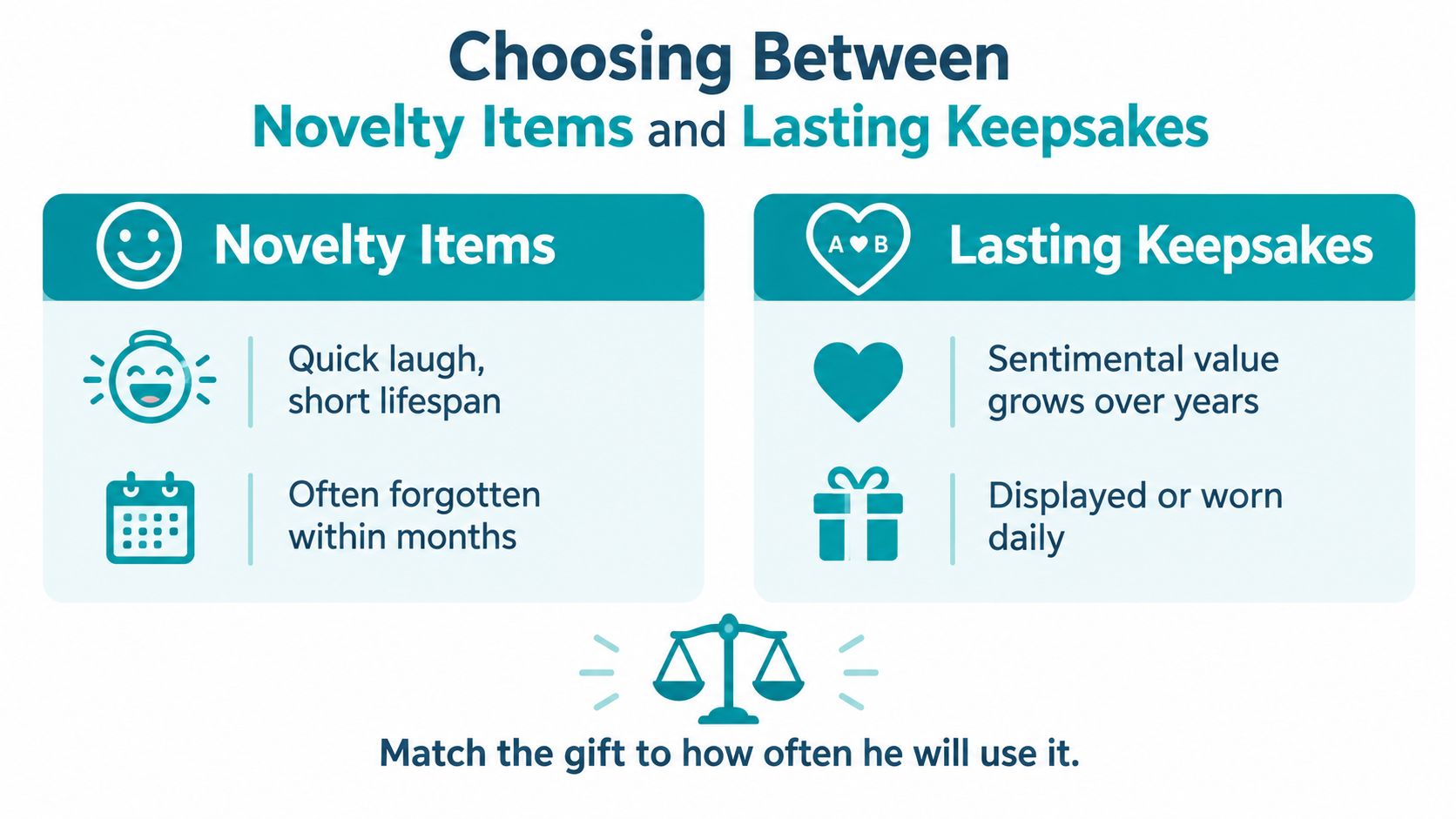
Consider the difference between a novelty pint glass with a generic joke and a well-made bottle opener engraved with a date. Both relate to drinking, but only one necessarily reflects a relationship or event. The stronger choice has a job, a place in the home and a personal detail that remains relevant after the occasion has passed.
Match the object to his habits
Start by observing what he already uses. Does he keep a tidy desk, work on furniture, host friends, travel for work, cook regularly or collect records? His existing habits tell you more than a broad “gifts for men” category.
| If he values | Consider | Personalisation that works |
|---|---|---|
| Practical home accessories | Engraved bottle opener or storage item | Initials, date or short phrase |
| Shared memories | Framed print or acrylic sign | Coordinates, venue or anniversary date |
| Music and interiors | Vinyl art or a designed wall print | Favourite lyric, album reference or name |
| DIY and upcycling | Furniture vinyl wrap | Pattern, monogram or understated motif |
| Sentimental objects | Compact keepsake | Message with a private reference |
A good personalised gift should pass three tests:
- It has a natural home. He shouldn't need to reorganise a room to accommodate it.
- It has a repeat use. Practicality gives the object a chance to become part of his routine.
- The message sounds like him. Avoid long declarations if he prefers understated design.
For a closer look at the thinking behind a practical engraved present, see this guide to an engraved gift for him. The principle is simple: choose a sound base product first, then make the personalisation precise.
When a novelty is the right choice
Novelty isn't automatically poor gifting. It works when the recipient enjoys humour, the joke is specific to your relationship and the object still has some practical value. A playful design on a useful mug or a humorous bottle opener has a better chance than a large decorative item built around a joke nobody will repeat.
Lasting value doesn't mean the gift must be serious. It means the personal detail should outlive the first reaction. A small reference to an in-joke, favourite place or shared achievement can be more effective than printing his name in oversized lettering.
The best keepsake is rarely the most elaborate one. It's the object he can use without having to explain why he owns it.
Designing Custom Vinyl and Prints for His Space
Personalised wall art succeeds or fails on restraint. A meaningful message can look cheap if the typeface is difficult to read, the colours fight the room or the design fills every available centimetre. Treat the piece as interior décor first and a personalised gift second.

Build the design around the room
Begin with the wall, furniture and lighting rather than the wording. A home office may suit black, charcoal, navy or muted green. A kitchen can handle stronger contrast, while a bedroom usually benefits from quieter typography and more negative space.
Use this design order:
- Choose the visual subject. Coordinates, a line from a song, a family name, a map detail or a hobby.
- Limit the message. Short wording looks more intentional and remains easier to read from across the room.
- Select one primary typeface. A clean sans serif suits modern interiors. A restrained serif can work for heritage, travel or literary themes.
- Create breathing room. Leave clear space around the text so the design doesn't feel crowded.
- Check contrast. Dark lettering on a pale wall and light lettering on a dark surface are dependable starting points.
- Scale it to the viewing distance. A print above a desk can carry finer detail than a statement piece viewed from the other side of a room.
Custom vinyl works particularly well when you want to update an existing object rather than add another one. A furniture wrap can refresh a cabinet, side table or desk. A wall decal can mark a home gym, office or music corner without the permanence of painted lettering. The design should follow the surface, with simple shapes and clean spacing around edges, handles and joins.
Choose the material for the job
A print suits artwork, typography and photographic treatment. Vinyl suits lettering, decals, furniture surfaces and designs that need a clean cut edge. For a rental property, removable wall décor may be more suitable than a permanent fixture, but always check the surface and application guidance before installation.
Quote My Wall offers personalised wall stickers, vinyl furniture wraps, window films, prints and custom gifts such as bottle openers, baubles and acrylic wedding signs. Use a supplier's preview carefully, especially where the design includes dates, names or unusual spelling.
A masculine look doesn't require dark colours or industrial graphics. It can come from clear hierarchy, controlled colour and a subject that means something. A coordinate print of where you met may feel more refined than a large romantic slogan. A discreet vinyl design on a record cabinet may say more about him than a generic “best dad” sign.
Navigating Price Brackets and Perceived Value
Personalisation changes how a buyer judges a gift. A standard object competes on material, brand and function. Add a name, date or short message, and the recipient also sees the time and intention behind the choice.
Roland DG's UK consumer research found that shoppers expected to spend more than £750 million on personalised gifts during the festive period, with buyers spending over £40 per personalised item on average. The same research found that shoppers were willing to pay an average 7% premium for a gift containing a name, message or image. The Roland DG survey gives useful evidence for retailers and buyers alike.
Spend first on the base item
A low-cost customisation can feel valuable when the underlying object is useful and well finished. An engraved bottle opener, a sturdy mug, a compact sign or a carefully printed design doesn't need excessive decoration. The quality of the surface, the clarity of the lettering and the accuracy of the preview carry more weight than adding multiple personal details.
Think in three practical bands:
- Entry-level gifts: Add a name, initials or date to a small useful object. This works for stocking fillers, Secret Santa exchanges and modest birthday gifts.
- Mid-range keepsakes: Choose a better material or larger format, then use a restrained message. An acrylic sign, framed print or durable home accessory can carry more emotional weight without becoming extravagant.
- Statement pieces: Spend on scale, finish and design control. A large wall print or furniture wrap should fit the recipient's room and taste, not contain more text.
The mistake is spending the budget on personalisation while ignoring the object itself. A long message won't rescue a flimsy product. Conversely, a high-quality base item can feel generic if the personal detail has no connection to the recipient.
Make the premium feel intentional
The survey also found that 21% of respondents considered personalised gifts more thoughtful, while 20% valued their uniqueness and difference from ordinary off-the-shelf products. Those findings support a clear recommendation: sell the meaning at the point of selection, but don't oversell the decoration.
Younger adults aged 18 to 34 were willing to spend about £30 more than people aged over 55 on personalised gifts over the following year, according to the same Roland DG research. That makes personalisation especially relevant for partners, friends and milestone gifts, although the right design still matters more than age.
For shoppers comparing ideas without a large budget, this guide to affordable anniversary gifts for him offers useful inspiration around practical presents. The best value usually comes from combining a reliable object with one precise personal detail.
Managing UK Lead Times and Ordering Deadlines
A beautiful custom gift that arrives after the occasion is a failed purchase. Bespoke orders need time for personalisation, proofing, production, dispatch and delivery, so treat the delivery date as part of the design decision.
UK shoppers also carry real uncertainty around returns. UK ecommerce data indicates that 69% of shoppers returned an item to an online retailer in 2025, while research cited in UK retail coverage found that 58% of consumers had returned a Christmas gift at some point. These figures appear in DHL's UK ecommerce report. For personalised goods, the key issue is that products made to the customer's specifications are generally excluded from the normal cooling-off return right. Faulty or misdescribed goods remain a separate matter.
Use this ordering checklist
1. Confirm the production window. Read the product page for making time, dispatch information and delivery options. Don't confuse dispatch with arrival.
2. Check the personalisation field twice. Copy the spelling exactly as you want it printed or engraved. Check apostrophes, capital letters, dates, initials and punctuation.
3. Review the proof. If the supplier provides a digital proof, inspect the wording, line breaks, alignment, colours and proportions. A proof is your chance to catch a mistake before production.
4. Add a holiday buffer. Christmas, Father's Day and popular birthday periods create heavier demand. Order earlier than you would for a standard stocked item, particularly if the gift is travelling to another address.
5. Choose express delivery only when production allows it. Faster postage won't help if the item is still being made. Ask whether an express service affects dispatch or only the courier stage.
6. Plan for damage. Photograph the parcel and product promptly if it arrives damaged, then contact the seller using the process shown in the order terms.
7. Keep a fallback gift in mind. If you've missed the cutoff, choose a non-personalised item that can arrive on time, then add a handwritten message or plan a customised present for a later date.
Spelling check: Read the final personalisation aloud, then compare it with the recipient's name, the event date and your order confirmation.
Last-minute buyers can also consult this practical Smokey Rebel delivery guide for ideas about urgent UK gifting. Use any next-day option only after confirming that the product itself is ready to leave the seller.
The safest approach is to order when the occasion is still comfortably ahead, not when the countdown has become the main feature of the purchase. Personalised gifts can't usually be returned because the recipient dislikes the wording or you change your mind, so the buyer must take responsibility for the details before production.
Care Instructions for Long-Lasting Custom Gifts
A personalised present becomes memorable through use. The recipient sees it on the wall, reaches for it during a gathering or carries it through ordinary routines. Good aftercare protects both the material and the meaning attached to it.
Take a custom wall decal given to a partner who has created a home office. The design looks sharp when installed, but dust, harsh cleaning products and rough handling around the edges can shorten its life. Clean the surrounding surface with a soft, dry or lightly damp cloth, avoid abrasive products and don't scrub directly across lettering or cut edges.
Vinyl and printed décor
Apply gentle care rather than repeated correction. Dust vinyl with a soft microfibre cloth. If the surface needs more attention, use a lightly damp cloth and dry it afterwards. Avoid soaking the decal, directing steam at it or applying solvent-based cleaners unless the product instructions specifically permit them.
For prints, keep moisture away from the paper and frame joints. Strong direct sunlight can affect colours over time, so position the artwork with the room's light in mind. A print intended for a kitchen, bathroom or other humid setting needs suitable framing and protection rather than ordinary paper left exposed.
Quote My Wall states that its interior wall art is designed to last at least five years, while exterior vinyl is designed to last at least three years, as described in its product information. For further guidance on what affects durability, read how long wall stickers last.
Engraved items and clothing labels
Wipe engraved metal with a soft cloth and dry it fully after cleaning. Don't use aggressive scouring pads, which can mark the surface around the engraving and make the item look tired before its time. Acrylic signs need a soft cloth and mild cleaning approach because rough paper towels or abrasive products can create fine scratches.
Stick-on clothing labels need firm application to clean, dry fabric. Press the label securely, follow the supplier's washing guidance and avoid testing adhesion immediately after application. Quote My Wall describes its clothing labels as washable, microwave-safe, tumble-dryer-safe and dishwasher-safe, but care instructions still matter because fabric type, heat and detergent affect the result.
For gifts that include wearable accessories, maintenance should match the material. Someone learning about maintaining nylon straps with Nothing But Bands will find the same useful principle applies: clean gently, dry thoroughly and follow the maker's care advice instead of relying on guesswork.
Write the care instructions on a small insert card and place it with the gift. That small addition tells him the object was chosen for long-term use, not just for the moment he opened it.
Choose a personalised present around the occasion, then make the design useful enough to earn a permanent place in his home. Browse the vinyl décor, prints and custom gift options at Quote My Wall, and order with enough time to proof the details properly before the date arrives.