
Name Labels Clothes: A Practical UK Buying and Care Guide
Your child walks through the door wearing the right polo shirt and the wrong jumper. The PE bag is missing. The coat was “definitely left by the classroom door”. If you're a parent in the UK, you already know how this goes. The same thing happens in care settings too, just with cardigans, nightwear, slippers and knitwear moving through a much bigger laundry cycle.
That's why I'm blunt about name labels clothes. They're not a cute extra. They're an identification tool that saves hassle, reduces avoidable replacement buying, and makes sorting easier when ten similar navy jumpers or five near-identical fleeces are in one pile. The key question is whether to label. It's which label type fits your actual use, and whether you need maximum hold, easier removal, or a balance of both.
Why Name Labels for Clothes Matter More Than Parents Realise
A child comes home with the wrong jumper, the PE bag is missing, and the coat that was “left by the classroom door” never turns up. Parents in the UK know this pattern well. The same thing happens in care settings too, only with cardigans, nightwear, slippers and knitwear moving through a much bigger laundry cycle.
That is why I am blunt about name labels clothes. They are not a nice extra. They are a practical identification tool that cuts avoidable replacement buying and makes sorting faster when half a dozen near-identical jumpers are in one pile.
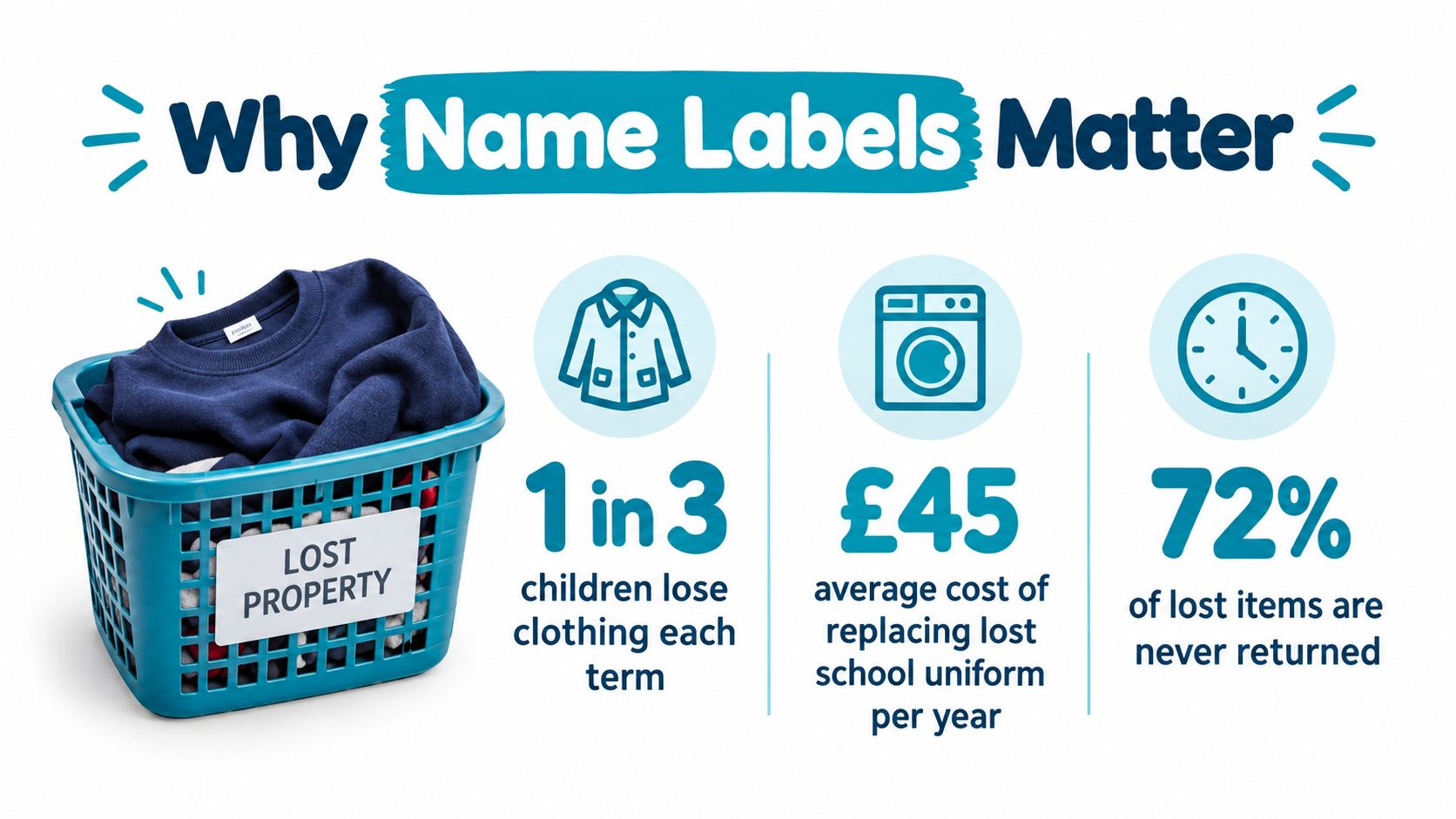
The cost pressure is real. Research cited by The Children's Society found families spent up to £337 per year for each secondary-school child and up to £315 per year for each primary-school child on uniform, and 75% of primary-school children lose an average of one or two uniform items annually (i news reporting The Children's Society figures). If clothes keep disappearing, labels pay for themselves quickly because they keep ownership attached to items that all look the same.
Here is the problem in a single image:
The same mess happens in care homes
School uniform is only half the story. In UK care homes with on-site laundering, clothing or personal belongings have been lost or misplaced in 81% of homes, and 1 in 10 said it happened frequently. Another survey found half of care-home managers saw misplaced or lost personal items as a significant source of difficulty for residents, staff and the organisation.
That is why label choice matters for sustainability as well as convenience. If a label keeps a cardigan, nightdress or pair of slippers in circulation longer, that is one less item bought again and one less item sent to waste early. In a laundry-heavy setting, adhesion strength is not just about durability. It decides whether the label still does its job after repeated washing, sorting and handling, or whether the garment becomes another replace-and-repeat expense.
Practical rule: If a garment leaves the house or goes through shared laundry, it should be labelled.
What matters when choosing a label
Parents and care-home teams usually only need to compare three formats:
- Stick-on labels, usually applied to the care label.
- Iron-on labels, which bond to fabric with heat.
- Sew-on labels, which are stitched in and stay put until unpicked.
Each has a place. I am opinionated about this because people often buy the wrong format for the job, then blame labels in general. The problem is usually fit, not labels. The right choice depends on the garment, the wash routine and whether you will want to remove the label later without damaging the clothing.
Comparing Stick-On, Iron-On and Sew-On Labels
If you want the short version, stick-on is fastest, iron-on is more committed, and sew-on is old-school reliable but slow. The best one depends on the garment, the wash routine, and whether you want to remove it later without a fight.
How each type behaves in real life
Think of stick-on labels as a high-tack personalised label that works best on the smooth manufacturer care tag. They're ideal when you want a quick application with no iron and no sewing basket. For busy parents, that matters. For care staff and families labelling a full wardrobe, it matters even more.
Iron-on labels behave more like a fused patch. They're useful when there's no suitable care tag, or when you want a more permanent bond directly on fabric. They take longer to apply properly, and removal is not the strong point.
Sew-on labels are the stitched-in option. They suit people who want a traditional approach or who are dealing with tricky garments where adhesive may be less convenient. The trade-off is obvious. They take the most time and effort.
| Criterion | Stick-On | Iron-On | Sew-On |
|---|---|---|---|
| Application time | Fastest, peel and press | Moderate, needs heat and care | Slowest, requires sewing |
| Durability in routine washing | Strong when applied to a smooth care tag | Strong when properly fused | Strong if stitching holds |
| Best fabric situation | Garments with suitable care labels | Items without usable tags | Delicates or garments where stitching is preferred |
| Comfort against skin | Usually fine on care labels | Depends on placement and finish | Depends on stitching and thread choice |
| Removal for hand-me-downs | Usually easier | Least flexible | Removable, but only by unpicking |
| Best for | Schoolwear, nursery kit, fast bulk labelling | Tagless items, more permanent marking | Long-term garments, specialist use |
My honest recommendation
For most families, stick-on wins on convenience. If the garment has a suitable care label, it's the option that people use consistently. A label you apply tonight is more useful than a “better” label still sitting in a drawer next week. If you want a practical example of that no-iron approach, this guide on stick-on name labels as an alternative to iron-on labels explains the appeal clearly.
Use this simple match-up:
- Nursery and primary school clothing: stick-on first.
- Tagless items or awkward fabrics: consider iron-on.
- Long-stay care garments or specialist textiles: sew-on can still make sense, especially where staff want something visibly fixed in place.
The best label isn't the one with the strongest sales copy. It's the one that fits the garment and the person who'll actually apply it.
How to Apply Stick-On Labels So They Actually Stay Put
Most stick-on label failures are user error. That sounds harsh, but it's true. People press a label onto fluff, over a seam, onto a textured fleece patch, or onto a care tag coated in detergent residue, then wonder why the corners lift.
UK textile-label guidance says labels should be durable, legible, visible and accessible, and it also makes clear that poor surface preparation, plus application over lint, fabric softener, seams or heavily textured fabric, weakens adhesion by reducing contact area (UK textile labelling guidance on durability and application conditions). That's the standard I'd use for any stick-on clothing label.
Where to put the label
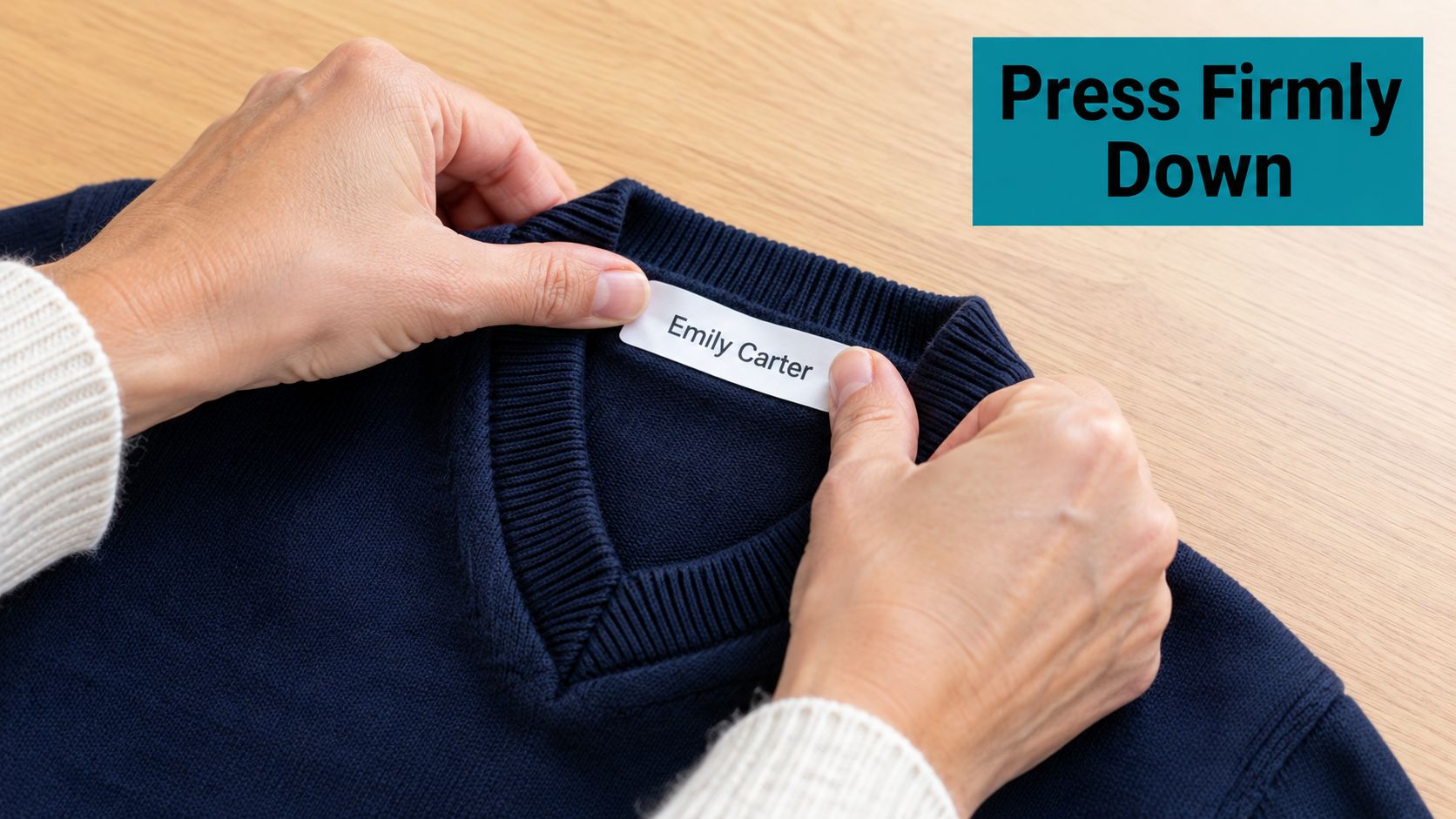
The best placement is usually the smooth care label already sewn into the garment. It gives the adhesive a stable, low-texture surface. That's far better than ribbed collars, brushed fleece linings, chunky knitwear or anything with stretch.
Good placements include:
- Care-label fabric: best default choice for school and care clothing.
- Flat inner seam area: useful when there's no practical care tag.
- Smooth inner garment surface: acceptable only if the fabric is stable and low-texture.
Bad placements are easy to spot. Avoid seams, fluffy surfaces, ribbing, linty fabric, and damp material.
A simple application routine that works
Follow the same routine every time:
- Check the surface. It must be clean, fully dry and free from lint or softener residue.
- Choose a flat spot. The more texture and movement, the worse the bond.
- Press firmly. Don't just pat it on. Use solid pressure across the full label, especially the edges.
- Leave it alone. Don't rush it straight into the wash pile if you can avoid it.
Shop-floor advice: Smooth tags beat soft fabric. Adhesive loves contact area. It hates fluff.
Test one item before doing the whole pile
If you're labelling a new school wardrobe or a resident's full clothing set, don't bulk-apply blindly. Label one representative garment, wash and dry it using the programme you use, then inspect for three things:
- Edge lift
- Print legibility
- Any shift or movement
That small test tells you far more than product packaging does. A label that still reads clearly but starts peeling is not good enough. In a school or laundry workflow, it needs to stay attached and readable.
Washing, Tumble Drying, Microwave and Dishwasher Safety Explained
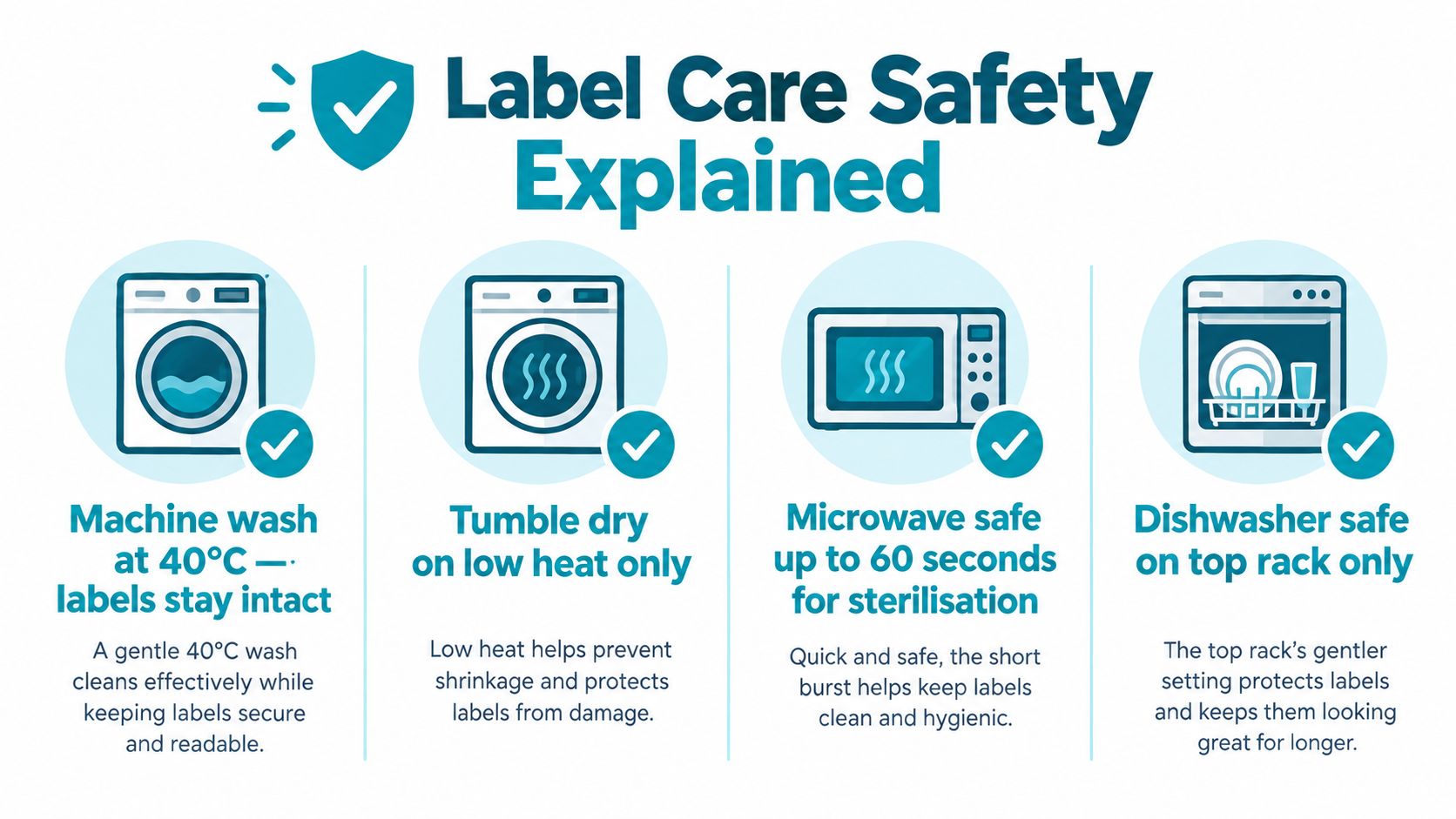
“Washable” is one of those words sellers throw around too casually. In real life, a clothing label gets hit by detergent, water, agitation, rubbing against other garments, wet-to-dry cycling and, sometimes, tumble-dryer heat. That's the actual test. Not whether it looked fine five minutes after application.
For clothes, the harshest parts are usually mechanical agitation and drying cycles. The wash softens and stresses the adhesive. The tumble dryer adds heat and movement. If a label was applied badly, those two stages expose it fast. If it was applied properly on a suitable care tag, that same routine is far less dramatic.
What these claims usually mean in practice
I'd treat each claim like this:
- Machine washable means the label should stay readable and attached through normal laundry when applied to the right surface.
- Tumble dryer safe matters most after washing, because edge lift often shows up there first.
- Microwave safe is relevant for labelled food containers, bib boxes or accessories, not school jumpers.
- Dishwasher safe is mainly for lunch gear, bottles and hard items, not fabric.
That last pair matters because families often buy label packs for more than clothing. If you're also naming lunch kit, cups or snack containers, it's sensible to check separate guidance on dishwasher-safe name labels rather than assuming one adhesive behaves identically on every surface.
My practical view on heat and mixed-use labelling
Heat isn't automatically the enemy. Moderate heat can help a well-bonded adhesive settle. Excess heat, poor placement, and repeated friction are troublemakers. That's why smooth tags outperform fuzzy linings every time.
This matters if you're labelling school outfits that include specialist fabrics too. If a child wears uniform pieces in wool or tartan, it's worth checking the garment construction before choosing placement. For example, if you browse Kilts4Less tartan skirts, you'll see the kind of structured garment where inner labels and lining areas matter more than just sticking something anywhere convenient.
What I'd actually do at home
Keep it simple:
- Wash labelled garments inside out when practical.
- Use your normal programme, not an unrealistically gentle one just to protect the label.
- Avoid sticking labels onto areas that flex heavily in the dryer.
- If you're labelling non-clothing items too, treat hard surfaces and textiles as separate jobs.
A premium stick-on label can handle a lot, but “safe” never means “ignore the application basics”.
Reuse, Second-Hand Uniforms and the Adhesion Trade-Off
This is the bit most label guides get wrong. They act as if the strongest possible bond is always the goal. It isn't. If you use school swaps, sibling hand-me-downs or donate uniform, reusability matters almost as much as durability.
The UK government says schools in England should prioritise affordability, durability and value for money, and make second-hand uniforms accessible. It also reported average uniform costs of £343 for primary pupils and £442 for secondary pupils in April 2025 proposals about reducing costs (UK school uniform guidance and 2025 cost figures). That should change how parents think about labels. A label that grips brilliantly but damages resale or donation potential isn't always the smart buy.
Stronger isn't always better
I'd split garments into two camps.
First, there are high-turnover items. PE tops, generic trousers, supermarket polo shirts, cardigans that pass down easily. For these, a label that stays put during use but can be removed cleanly later is often the best choice.
Second, there are school-specific pieces. Branded blazers, logo jumpers, house sports kit. These may only circulate within one school community, so strong identification during active use matters more.
Maximum adhesion is a durability feature. It is not automatically a sustainability feature.
A simple decision framework for parents
Ask these questions before you buy:
- Will this garment be handed down? If yes, avoid treating permanence as the only virtue.
- Is it branded or generic? Branded items usually have a narrower resale path.
- Does the label need to move later? If yes, prioritise cleaner removal and sensible placement.
- Will residue matter? On resale or donation items, yes, it will.
Placement affects reuse too
Where you place the label changes the future usefulness of the garment. A clearly positioned label on the care tag is usually kinder to second-hand circulation than anything that permanently marks the main fabric. That's especially true for blazers, coats and knitwear that need to look tidy for the next wearer.
My view is straightforward. If you only shop new and keep clothing within one child's wardrobe, a tougher bond may suit you. If you actively use second-hand uniform channels, balance hold with removability. That's the smarter, cheaper and less wasteful choice.
Buying Considerations for UK Customers
When you compare packs of name labels clothes, don't get distracted by colours and cute icons first. Start with the practical stuff. What surface is this label designed for, how clear are the instructions, and does the pack make sense for the volume you need to label?
The legal point matters too. Under the Textile Products (Labelling and Fibre Composition) Regulations 2012, textile products must carry compliant fibre information and related labelling, so your personalised name label should not cover fibre content, safety information or manufacturer details (UK textile labelling rules and fibre-composition guidance). In plain English, don't plaster a name label over the information label as if the original details don't matter. Use the care-label area sensibly, or another spot that leaves statutory information visible.
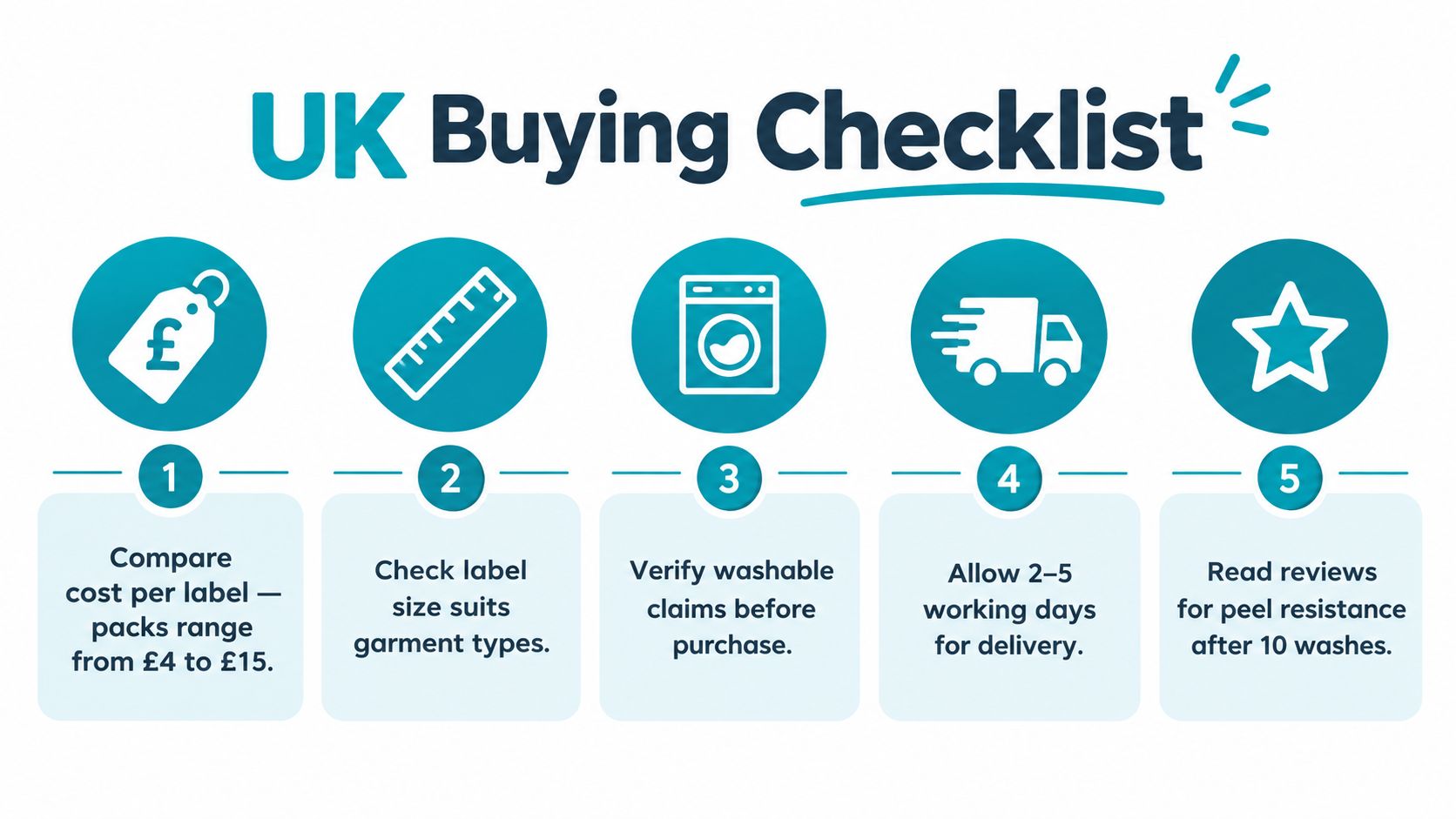
The checklist I'd use before ordering
- Check the intended surface: If the seller doesn't clearly say the label is for garment care tags or specific fabric use, move on.
- Read the application instructions: No proper instructions usually means trouble later.
- Look at print clarity: High contrast and easy reading matter more than decorative fonts.
- Match pack size to your job: A nursery starter pack and a full boarding-school wardrobe are not the same thing.
- Think about reorders: If you'll need the same design again for siblings or replacements, keep it simple.
Red flags I wouldn't ignore
Some warning signs are obvious:
- Vague washable claims with no explanation of where the label should be applied.
- No UK contact details or customer support path.
- No mention of care labels, seams or surface prep.
- No clarity on removal or residue, especially if you use second-hand uniforms.
If you want a straightforward stick-on option designed for clothing care labels, Quote My Wall offers personalised clothing labels in different shapes and pack styles for school and care use. That's useful if you already know you want the no-iron route and don't need to overcomplicate the purchase.
My buying rule
Buy for the laundry routine and garment type, not the packaging. A plain, readable label with clear instructions beats a fancy design with muddled claims every time.
Care Home Use Cases, Privacy and Laundry Workflow
Care-home clothing labels need a different standard of thinking. Parents usually want a jumper back from lost property. Care homes need garments to move through a repeatable system of wearing, laundering, sorting and returning, often handled by staff who do not know every resident's wardrobe by sight.
That matters because misplaced clothing is a real operational problem. A survey of UK care homes with on-site laundering found clothing and personal belongings were often lost or misplaced, and some homes said it happened frequently (care-home laundry loss survey findings). Laundry volume is part of the same issue. Residents' personal clothing is one more stream staff have to sort, match and send back correctly, so labels are about ownership and workflow, not just neatness.
Don't put more information on the label than needed
I do not like full-name-everywhere labelling in care settings unless there is a clear reason. Privacy and dignity matter. The better approach is information minimisation.
Use combinations such as:
- Initials plus room number
- Abbreviated identifier agreed by staff and family
- High-contrast text that staff can read quickly
- Discreet placement inside seams or care-label areas
If a family is weighing different support settings for an older relative, practical details like laundry and clothing management are easy to miss. The guide to Stoke care options for elderly gives useful background because it helps frame the difference between support models before you even get to clothing systems.
A four-step framework that helps staff
- Identify the resident and risk level. Everyday knitwear and continence-wear do not behave the same in laundry.
- Choose discreet placement. Inside seams and care-label zones usually work best.
- Keep a written inventory. Labels help, but a simple clothing list closes the loop.
- Test on representative garments. Try one knit, one delicate, one frequently sanitised item before bulk application.
For care teams wanting a broader look at why this matters operationally, the importance of name labels in care homes is worth reading alongside your internal laundry process.
In a care home, the right label does not just identify a jumper. It supports dignity, reduces sorting errors and gives staff one less preventable problem.
What good care-home labelling looks like
It should be readable, discreet, and consistent. If the label gives away too much personal detail to anyone handling the garment, it is too much. If staff cannot read it quickly in a laundry workflow, it is too little. Good care-home labelling sits in the middle.
Common Misconceptions and Quick Answers
People still assume stick-on labels always fail and iron-on labels always win. That's too simplistic. A well-applied stick-on label on the right care tag can be the most sensible choice in the house, while a badly applied iron-on can still be a nuisance.
Quick answers:
- Do stick-on labels last? Yes, if you apply them to the right surface and press them properly.
- Are they suitable for care homes? They can be, if you test them on the actual garments and laundry routine first.
- What if an edge starts lifting? Replace it early. Don't wait for a half-attached label to disappear in the next wash.
- What about hand-me-downs? Removable label options often make more sense than permanent ones.
If you need clothing labels for school uniform or care-home garments, Quote My Wall offers personalised stick-on options designed for care labels, including formats that suit quick bulk labelling. If you'd rather stop replacing missing jumpers and start labelling properly, it's a practical place to begin.