

Dishwasher Safe Name Labels: A Complete Guide
“Dishwasher safe” is one of the most overconfident labels in the name-label market. Many parents read it as a guarantee that a sticker will survive every bottle, lunchbox and wash programme indefinitely. In practice, dishwasher safe name labels are only as reliable as the surface, temperature and adhesive system they meet.
A label can stay firmly attached to a smooth glass jar yet lift from a textured plastic lunchbox. A product may tolerate an ordinary domestic cycle but struggle on a hotter programme with aggressive detergent. Application matters too. Grease, moisture, ridges and rushed washing can defeat a well-made label before the adhesive has properly bonded.
The useful question isn't just, “Is this dishwasher safe?” Ask instead, “Is it dishwasher safe for my item, my machine and the way I'll use it?” That compatibility-first approach will save you from replacing names halfway through term.
Why Dishwasher Safe Does Not Mean Indestructible
A dishwasher attacks labels from several directions at once. Hot water softens some adhesive systems, detergent works at the bond and steam finds any imperfect edge. Repeated heating and cooling can gradually turn a small weakness into curling, peeling or fading.
UK guidance identifies typical domestic dishwasher exposure at about 55–65°C, and explains that repeated thermal cycling can weaken adhesive bonds over time (UK guidance on waterproof sticker materials). That doesn't mean every cycle will damage a good label. It means the label needs a face material and adhesive designed for that environment.
The surface is often the real problem
Smooth, clean, dry plastic, glass and metal give an adhesive a continuous area to grip. Textured plastic creates tiny contact gaps. Greasy surfaces leave a film between the adhesive and the item. Silicone-heavy materials can be especially difficult because many standard adhesives struggle to form a dependable bond.
That explains the familiar frustration of a label surviving perfectly on a glass storage jar but peeling from a ribbed lunchbox after very little use. The product hasn't necessarily contradicted its claim. The application surface has changed the result.
Temperature changes the odds
A gentler cycle places less stress on the label than a hotter programme. UK-facing guidance specifically warns that top-shelf placement and avoiding high-temperature settings such as “pots and pans” can affect performance (stick-in label guidance from Labels4School). Treat a dishwasher claim as conditional unless the product page gives clear temperature or cycle information.
Look for these questions before buying:
- Which materials are specified? Smooth plastic, glass and stainless steel are more useful than a vague “all surfaces” promise.
- What is excluded? Honest brands mention textured or silicone-heavy items.
- Is the adhesive permanent? “Waterproof” describes resistance to water, not necessarily bond strength.
- Is there test evidence? Wash testing is more persuasive than a broad durability adjective.
Practical rule: Buy for the surface you own, not the strongest claim printed on the packet.
The UK has had formal dishwasher labelling rules since the Energy Information (Dishwashers) Regulations 1999 came into force on 8 July 1999, requiring detailed information about energy, cleaning, drying, capacity, water use and, where applicable, noise (UK dishwasher labelling background). That long standards-driven history makes precision in product information familiar to UK buyers. Name-label sellers should apply the same discipline to durability claims.
Materials and Adhesive Technology Behind Durable Labels
The face stock is the label's outer body. The adhesive is the part doing the holding. If either is poorly matched to dishwasher exposure, the name may remain readable while the label itself lifts, or the label may stay attached while the print fades.
For UK use, independent guidance favours polypropylene, or PP, and polyester, or PET, for dishwasher exposure. Both are non-porous face-stock options that resist water penetration better than absorbent paper. The same guidance identifies vinyl as more vulnerable to degradation under repeated machine-wash conditions and links failure to edge lift and fading (material guidance for repeated exposure).
PP, PET and vinyl in everyday use
Polypropylene is a practical choice for lunchboxes, tubs and bottles because it is light, moisture-resistant and suitable for smooth hard surfaces. It works well when paired with an adhesive formulated to tolerate heat and detergent.
Polyester is usually the more durable-feeling option. It offers a strong, stable face stock for labels that need to remain crisp and legible while the item is repeatedly washed. For care settings or frequently handled containers, PET is a sensible specification to seek.
Vinyl isn't automatically unsuitable. The problem is treating all vinyl as equal. Thin or poorly protected vinyl may soften, degrade or lose its print more readily in repeated machine-wash conditions. If a product lists vinyl without explaining its adhesive, protective layer or testing, I wouldn't assume it will cope with demanding use.
A good label normally combines three elements:
- Non-porous face stock, so water and detergent don't soak into the material.
- Permanent adhesive, formulated for heat and detergent resistance.
- Protected print, often through a clear laminate or similarly resistant top layer.
The adhesive must also match the surface. A powerful adhesive can still fail on grease, texture or silicone because it can't make enough consistent contact.
Test language matters
Recent UK product pages increasingly refer to independent wash testing to BS EN ISO 6330, wash claims at 40°C, steriliser compatibility and exclusions for textured surfaces (recent UK school-label guidance). Those details are useful because they tell you what was tested and what wasn't.
Don't confuse a laundry test with a dishwasher test. The environments differ, so a label tested for clothing shouldn't automatically be trusted on a lunchbox. For clothing-care decisions, a resource explaining laundry symbols and care labels can help you interpret the garment's own instructions.
For a closer look at how face stock affects label behaviour, use Quote My Wall's guide to choosing the right material for name labels. The sensible specification is clear: non-porous material, permanent adhesive and evidence that matches your intended washing conditions.
Common Use Cases for UK Families and Care Settings
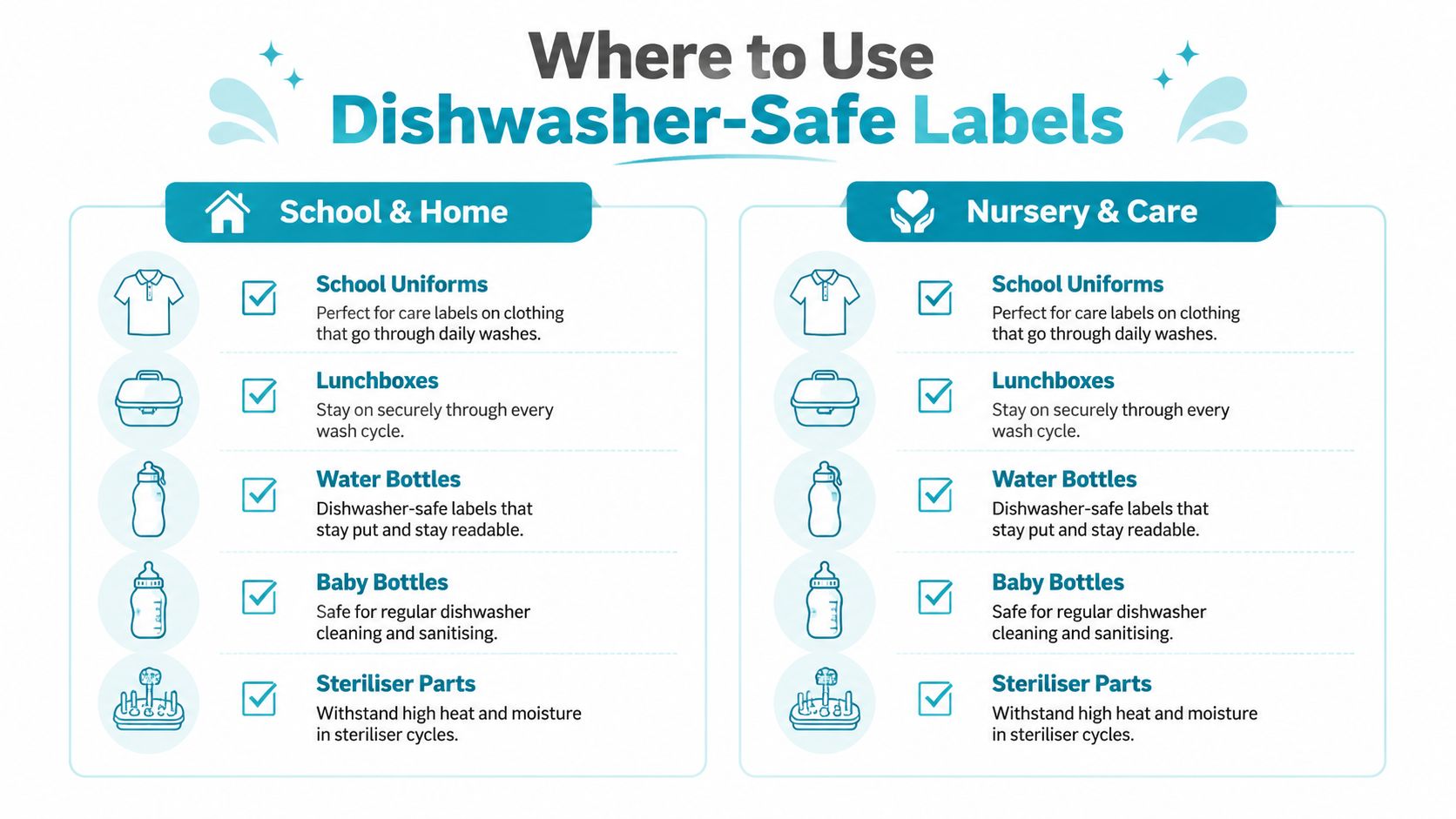
The right label depends on both the object and the washing method. A lunchbox needs a hard-surface dishwasher label. A school jumper needs a fabric label. A steriliser component needs a product explicitly described for that environment, not merely a sticker advertised as waterproof.
Start with the surface. Smooth plastic, coated metal, glass and hard acrylic are usually the easiest places to apply a name label because the adhesive can contact a broad, even area. Textured plastic, flexible silicone and sharply curved surfaces deserve caution. A label may appear firmly attached at first and still develop an edge problem once heat and moisture work on it.
A practical compatibility check
- Lunchboxes and food containers: Choose a non-porous label for a smooth lid or side panel. Avoid ribs, recessed lettering and textured grips.
- Water bottles: Use the smooth central body, away from seams, ridges and screw threads. The label should sit flat without stretching around a sharp curve.
- Baby bottles and steriliser parts: Check the product's stated steriliser and heat compatibility. Bottle plastics and accessories vary, so don't transfer a claim from one item to another.
- Glasses and cutlery: Smooth glass and metal can provide excellent adhesion, but place the label where it won't rub constantly against other items.
- School clothing: Use a washable clothing label, not a hard-surface dishwasher label, and follow the garment's care instructions.
- Care-home laundry: Select labels designed for fabric and confirm that the supplier's testing reflects the laundry process used by the home.
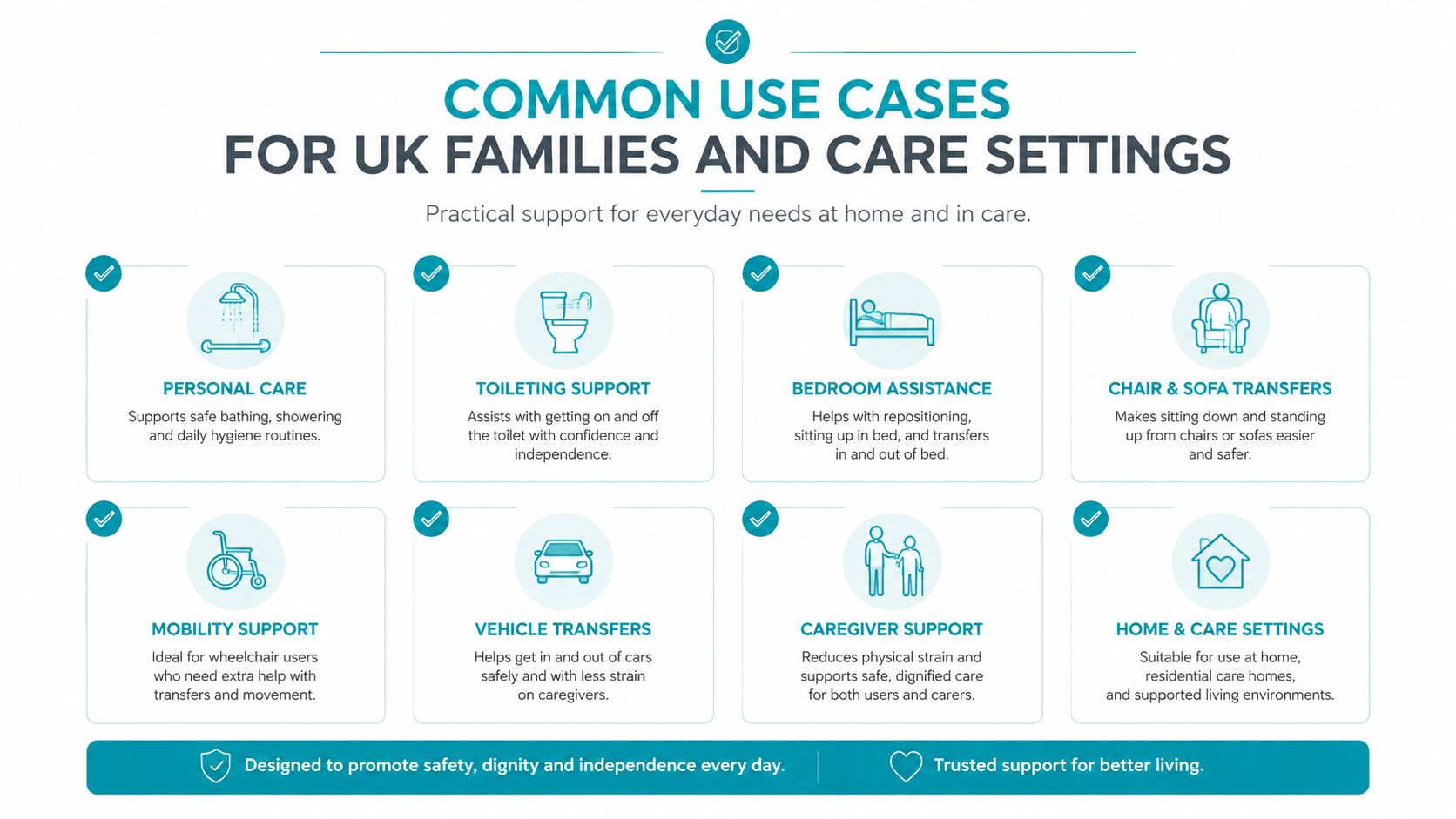
Care homes need a separate standard of judgement. Household dishwasher exposure isn't a substitute for industrial laundry evidence, especially when garments face hotter washing, pressing or commercial drying. Managers should ask what was tested, on which fabric, and under which care process rather than accepting “washable” as a complete answer.
For equipment used in a care environment, broader commercial dishwasher compliance tips offer useful context around matching equipment claims to operational conditions. The same principle applies to labels: compatibility beats general reassurance.
Quote My Wall's guidance on the importance of name labels in care homes is relevant when the priority is keeping clothing identifiable through shared handling and regular laundering. For families, the simplest rule is equally effective. Label the surface with the product designed for that surface.
How Dishwasher Safe Labels Compare to Alternatives
Stick-on dishwasher labels are convenient, but they aren't a universal replacement for fabric labels or a marker. The best system is usually mixed. Use a hard-surface label on containers and a laundry-specific method on clothing.
| Labelling Method | Best Surfaces | Durability | Application Speed | Cost Per Label |
|---|---|---|---|---|
| Dishwasher-safe stick-on label | Smooth plastic, glass, metal and hard containers | Strong when the surface and wash conditions match | Very quick | Usually moderate |
| Iron-on transfer | Fabric and care-tag areas | Good when applied correctly to suitable fabric | Moderate, requires heat and care | Usually moderate |
| Sew-in fabric label | Clothing, uniforms and textiles | Very durable and secure | Slowest, requires sewing | Often higher in time and effort |
| Permanent marker | Temporary marking on fabric or hard items | Limited, prone to fading or blurring | Fastest | Low at application |
Stick-ons win on convenience
For lunchboxes and water bottles, a dishwasher-safe stick-on label is the obvious choice. It needs no sewing, ironing or specialist equipment, and it can carry a clear name and design. The weakness appears when the item is textured, greasy, flexible or exposed to a more severe cycle than the product was designed to handle.
Iron-on transfers suit uniform labels because heat bonds them to fabric. They aren't useful on a rigid lunchbox. They also need careful placement and application, and the garment's care instructions still matter.
Fabric methods win on permanence
Sew-in labels take more effort but make sense for care-home wardrobes, hand-me-downs and items that will be washed repeatedly. They remain mechanically secured rather than relying only on a pressure-sensitive adhesive. The trade-off is obvious, you need time, thread and access to the garment.
Permanent marker is a short-term fix. It works when you need to identify something immediately, but handwriting can fade, blur or become difficult to read. It also looks untidy on shared items and may not withstand regular washing.
A dishwasher label is the right tool for a smooth container. It isn't the right tool for every belonging in a school bag.
Choose based on the surface first, then the washing process, then how easily you'll need to replace or remove the name. Paying for an advanced label won't solve a basic compatibility mistake.
Application Tips and Care Instructions for Maximum Lifespan
Application is where many “failed” labels lose the battle. Adhesive needs a clean, dry surface and firm contact. If you apply a label over grease, condensation, dust or a moulded ridge, water has an easy route beneath the edge.
Apply it properly
- Choose a flat area. Avoid seams, grooves, raised logos and sharp curves. A smooth side panel is usually safer than a textured lid.
- Clean thoroughly. Remove food residue and grease. Let the item dry fully before touching the label backing.
- Position once. Align the label carefully, because repeated lifting can weaken the adhesive edge.
- Press from the centre outwards. Use a clean finger or a firm flat edge to push out trapped air.
- Seal the perimeter. Run around every edge with firm pressure, paying particular attention to corners.
- Leave it alone. UK guidance recommends waiting 2–3 days before washing so the bond can develop (UK stick-on label application guidance).
That waiting period is inconvenient, but it matters more than rushing an item into the next dishwasher load. A label that feels stuck isn't necessarily fully bonded.
Use the machine sensibly
Place labelled containers on the top shelf where possible, and keep the label away from direct contact with heating elements. Avoid the harshest high-temperature settings unless the product specifically supports them. A normal or eco programme can be a more sensible choice for items carrying labels, provided it still meets your cleaning needs.
Don't scrub at the label with an abrasive scourer. If the print remains intact but one corner starts lifting, remove and replace the label rather than allowing detergent and water to work underneath. On clothing, follow the garment's washing, tumble-drying and ironing instructions. Don't assume a label's dishwasher claim automatically covers a microwave, steriliser or tumble dryer.
For microwave use, check the supplier's own safety statement and keep labels containing metallic elements out of the appliance. For steriliser parts, look for explicit compatibility rather than relying on “waterproof”.
The cheapest way to extend label life is simple: prepare the surface, apply pressure, allow the adhesive to cure and choose a sensible wash cycle.
Buying Checklist and How to Choose the Right Label
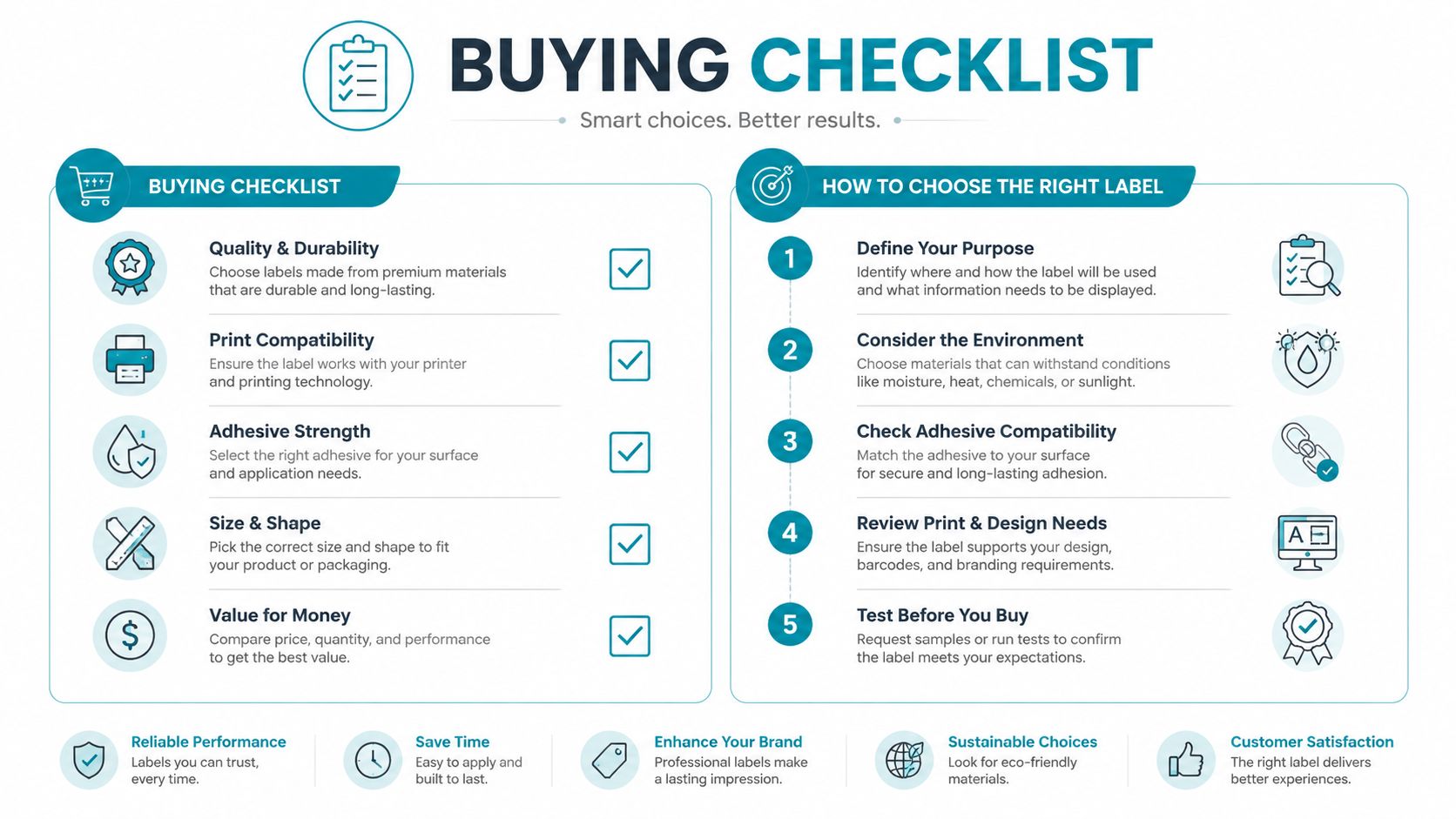
A good product page should answer practical questions without forcing you to interpret marketing language. If it only says “waterproof” or “dishwasher safe” and gives no material, surface or test detail, treat that as incomplete information.
Six checks before you buy
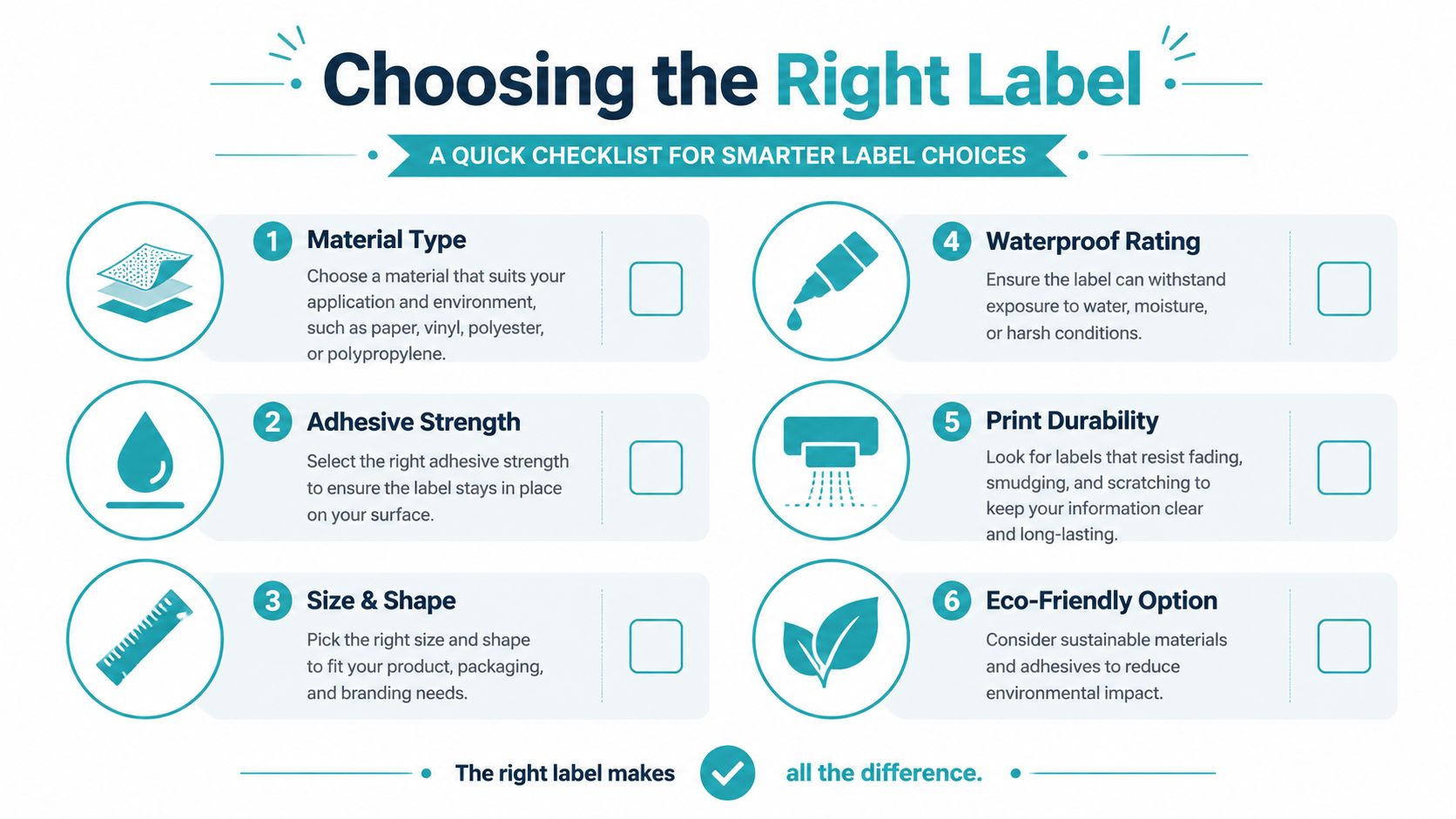
Material type: Look for PP or PET when the label is intended for repeated dishwasher exposure. The face stock should be non-porous and suitable for the item you're marking.
Adhesive strength: Seek a permanent adhesive formulated for heat and detergent resistance. A strong face material can't compensate for glue that softens or loses contact.
Surface exclusions: Check whether the supplier names textured plastic, silicone, rubber, curved surfaces or seams as unsuitable. Exclusions show that the seller has considered real-world failure points.
Test evidence: Independent testing is valuable when it matches your use. Recent UK product information refers to testing to BS EN ISO 6330 and claims involving 60 washes at 40°C, but a laundry test shouldn't be treated as proof of dishwasher performance (UK school-label testing context).
Print protection: A laminate or protected print layer helps preserve legibility. If the product doesn't explain how the name is protected, ask before ordering.
Care instructions: Look for placement advice, curing time, shelf guidance and temperature limits. A supplier that explains how a product can fail is more useful than one promising universal permanence.
When a premium label earns its place
For a short-lived item or a smooth container used gently, a basic label may be sufficient. For a school year, shared nursery equipment or care-home clothing, verified durability and honest application limits are more valuable than the lowest purchase price. The comparison is not pack price. It's how often you need to replace the label and how disruptive a failure becomes.
I'd choose tested longevity over an impressive waterproofing phrase. Recent UK commerce guidance also points towards broader use across school clothing, bottles, lunchboxes, steriliser-safe items and care-home garments, while highlighting temperature limits and surface exclusions (UK label market guidance).
Quote My Wall offers stick-on name labels in the UK for washable clothing and everyday labelled items. Assess them by the same checklist as any other option: material, adhesive, intended surface and care instructions.
Frequently Asked Questions About Dishwasher Safe Labels
Are dishwasher-safe labels also microwave safe?
Not automatically. Dishwasher performance doesn't prove microwave suitability because the heat and appliance conditions differ. Use a product only if the supplier explicitly states microwave safety, and avoid labels containing metallic elements.
Can I use one on a steriliser part?
Only when the product description specifically includes steriliser compatibility. Steriliser components may use plastics or silicone that behave differently from a smooth lunchbox. If the surface is textured, flexible or heavily curved, expect a higher risk of edge lift.
How long will a label last?
There's no honest universal lifespan. A well-made label on a smooth, clean surface may remain useful through repeated washing, while the same label can fail sooner on texture, grease, silicone or a severe high-temperature programme. Treat any stated wash rating as a test condition, not a promise for every household.
What should I do if an edge starts peeling?
Remove the label if dirt or water has already reached the adhesive. Pressing a failing edge back down rarely restores the original bond. Clean and dry the surface, then apply a replacement in a flatter position.
Will eco detergent damage the adhesive?
Detergent formulas vary, so don't assume a low-temperature or eco programme makes every product safe. Gentler settings may reduce thermal stress, but the label still needs detergent-resistant adhesive and correct application.
Are dishwasher labels suitable for clothes?
Use a label designed for fabric and follow the garment's care instructions. A hard-surface dishwasher label isn't a substitute for a washable clothing label, even if both products are described as waterproof.
Quote My Wall offers washable stick-on clothing labels for school uniforms and care-home garments, along with labels for items such as bottles, lunchboxes, glasses and cutlery. Visit Quote My Wall to choose a label matched to your surface, then apply it carefully and give the adhesive time to cure before washing.