

Stick on Name Labels UK: The Complete Buyer's Guide for 2026
Monday morning turns up the same mess again. A jumper has vanished, the PE kit is in the wrong bag, and someone at school is holding a coat that definitely isn't yours. In a care home, the stakes feel different but the problem looks the same, clothes get mixed up, staff waste time sorting them, and residents can end up distressed by items that should have been easy to identify.
Stick-on name labels cut straight through that chaos. They're quick, they don't need an iron or a needle, and when they're applied properly, they save you from relabelling the same items over and over. For UK families, nurseries, and care teams, that convenience matters because the laundry never stops.
Why Every UK Parent and Carer Needs Stick On Name Labels
A school week can chew through clothes faster than one might expect. One lost jumper becomes two, then a PE top, then a coat that never makes it back home. If you've ever stood in a school hall staring at a table full of unmarked navy sweatshirts, you already know the answer. The item wasn't lost because it disappeared, it was lost because nobody could tell whose it was.
That's why stick-on name labels earn their place in a UK household. They're the fastest way to mark the basics, and they're especially useful when you're dealing with a long list of items that all look nearly identical. You peel, stick, press, and move on with your day.
The same logic applies in care settings, only the consequences land harder. In a care home, a mislabeled cardigan or pair of trousers can cause confusion, extra laundry work, and unnecessary upset for residents who rely on routine and familiar belongings. For people living with dementia, a wrong item isn't just inconvenient, it can be disorienting.
Practical rule: if an item will be washed often, packed in a hurry, and handled by multiple people, it needs a label that works without fuss.
That is the appeal here. Not novelty. Not gimmick. Just a simple system that makes it easier for school staff, nursery workers, and care teams to put the right item back with the right person.
The UK Self-Adhesive Label Market at a Glance
The market behind stick-on name labels is bigger than many parents assume, and that matters when you are choosing what will survive school bags, nursery laundry, and care home wash cycles. The UK self-adhesive labels market is estimated at USD 1.99 billion in 2026, rising to USD 2.39 billion by 2031 at a 3.72% CAGR, according to Mordor Intelligence's UK self-adhesive labels market report. That scale shows these products sit inside a mature labelling system, not a novelty corner of the market.
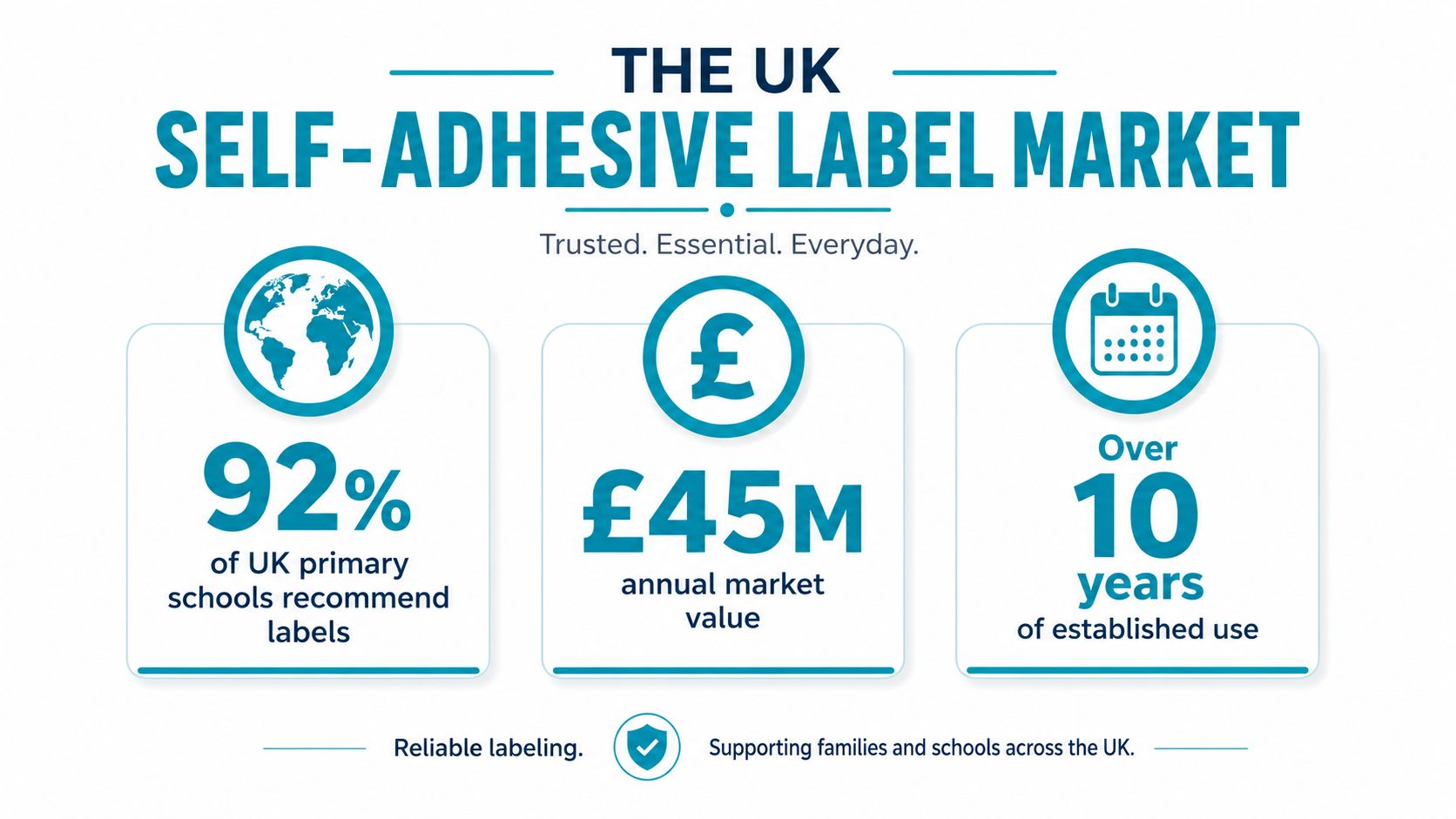
The wider UK label market backs that up. Food and beverage uses accounted for 40.67% of UK self-adhesive label demand in 2025, while the pharmaceutical segment is forecast to grow at 4.26% CAGR through 2031 because of serialization and Braille requirements, as covered in the same market reporting. That mix matters for buyers of clothing labels because it shows the adhesive-label sector is shaped by durability, traceability, and compliance, not just neat printing.
Independent market data points in the same direction. IndexBox reports that UK consumption of self-adhesive printed labels reached 166K tons in 2024, production totalled 157K tons, and market revenue hit USD 2.3 billion. It also says the average export price was USD 19,743 per ton in 2024, more than double the average import price of USD 9,835 per ton. That price gap points to a market with clear tiers, where higher-value output sits alongside mass domestic demand.
For parents, carers, and school buyers, the takeaway is straightforward. Stick-on labels are part of a serious UK labelling infrastructure with volume, supply-chain depth, and steady demand behind them.
How Stick-On Labels Bond to Clothing
Stick-on clothing labels work because they are built for the care-label-only adhesion model. The label is meant to bond to a smooth wash-care tag, not straight onto fabric. A care label behaves more like a stable plastic or satin surface, while cloth moves, stretches, and traps moisture in ways that weaken adhesive contact.
What Makes One Label Last
The tag matters more than the shirt.
A label sticks properly when the surface is clean and dry, much like a plaster on dry skin holds better than one put on damp skin. Put it on a textured, wet, or oily surface and it lifts sooner. That is why stick-on labels belong on the garment's care tag rather than on the fibres themselves.
That difference is the gap between a label that survives a school term and one that starts peeling after a hard wash cycle. Independent UK product specs from Labels4Kids say the adhesive is validated for smooth, low-energy substrates, and that labels should be pressed onto a fully dry care tag and then left to cure for 24 to 72 hours before water or heat exposure. The same source says one UK supplier reports independent testing to BS EN ISO 6330 for 30 washes at 40°C.
Press firmly, then leave it alone. The adhesive does not reach full strength the moment you stick it down.
What keeps one label in place is not the print. It is the way the adhesive meets the tag.
- Surface cleanliness, because detergent residue and fabric softener get in the way of wet-out.
- Cure time, because the adhesive needs time to settle into the tag's surface.
- Substrate chemistry, because some tag materials bond more easily than others.
That is why the face material matters less than people think. A fancy print does not rescue a badly applied label. A plain label on the right tag, applied properly, usually outlasts a prettier one slapped onto the wrong surface.
This comparison of stick-on clothing labels and iron-on options makes the point clearly. If you want labels to survive real use in schools, nurseries, or care homes, treat the care tag like the working surface it is. That is where the bond happens, and that is where most failures start.
Stick On vs Iron On vs Sew In Labels Compared
A school uniform bag at 7.45am tells you everything you need to know. You need labels that go on quickly, survive repeated washing, and still make sense after a child, a carer, or a laundry machine has done its worst. The right choice depends on the fabric, the wash routine, and whether the item needs to stay identifiable for months or just for a short stretch of use.
| Criteria | Stick On Labels | Iron On Labels | Sew In Labels |
|---|---|---|---|
| Application speed | Fastest, no tools | Slower, needs an iron and patience | Slowest, needs sewing |
| Durability through washing | Strong on care tags when applied correctly | Strong on suitable fabrics, less reliable on rough surfaces | Very secure once sewn |
| Fabric compatibility | Best on care labels and smooth surfaces | Better on heat-tolerant fabrics | Broad, but intrusive |
| Visibility and aesthetics | Clean and discreet on tags | Can be visible depending on placement | Can be visible, especially on seams |
| Resale impact | May leave residue if removed | Usually cleaner than stick-on | Most permanent |
The practical choice is straightforward. For school uniforms, nursery kit, and care home clothing in volume, stick-on labels are the quickest option and the least disruptive to apply. For rougher textiles or items that need a firmer bond to the garment itself, iron-on labels are the better fit. For garments that will be altered, kept for a long time, or need a permanent mark, sew-in labels do the job, but they demand more time and effort.
That lines up with the guidance in Quote My Wall's guide on the benefits of stick-on clothing labels compared to iron-on clothing label tags. The point is simple. Match the label to the laundry routine, not to the marketing claim.
Best practice: use the least fiddly label that still survives the wash cycle the item actually faces.
For a lot of UK parents and carers, that means stick-on labels for fast turnaround items, iron-on labels for tougher fabrics, and sew-in labels only when you are happy to spend the extra time. The same logic applies to partners sourcing uniform patch types and backings, where the backing has to suit the fabric and the way the item will be washed.
Real-World Use Cases Across Schools Nurseries and Care Homes
School uniforms are the most obvious use case, but they're not the only one. A child's week might include a blazer, PE kit, jumper, coat, lunch bag, wellies, and after-school club kit, all of which get tossed into different bags by different hands. The labels that survive that kind of life are the ones that stay legible, stay put, and don't add another job to your evening.
Schools need volume and speed
For school clothes, I'd prioritise clear personalisation, quick application, and consistency across every item. Younger children need obvious labels that staff can spot fast, while older pupils usually need something more discreet on the care tag so the uniform still looks neat. If a label takes too long to apply, it won't get used properly, and then it doesn't matter how good it looked online.
Nurseries punish weak labels
Nursery clothing gets a harder life than people realise. Bibs, vests, soft toys, and small garments are washed often, packed and unpacked constantly, and sometimes sterilised or run through hotter cycles than parents expect. The labels that do best are the ones with strong adhesion and simple, readable print, because nursery staff are usually sorting items in a hurry.
Care homes need clarity, not fuss
In care homes, especially where dementia care is involved, you want labels that are easy to read and hard to miss. A clean, high-contrast label on the care tag helps staff return items quickly and reduces mix-ups that can unsettle residents. For teams comparing label approaches with broader uniform identification options, uniform patch types and backings can be useful background reading, but clothing labels usually make more sense for the inside of garments.
If you're sorting out personalised options, Quote My Wall's personalised clothes tags are worth a look because the same basic principle applies across all three settings. The label has to be readable, durable, and quick to apply. Anything else is just decoration.
Application Steps and Washing Care Instructions
A label usually fails for plain, avoidable reasons. The care tag was still damp, fabric softener went on too soon, or the label was pressed down badly and washed before the adhesive had time to set. Most peeling problems come from rushing the job, not from the label itself.
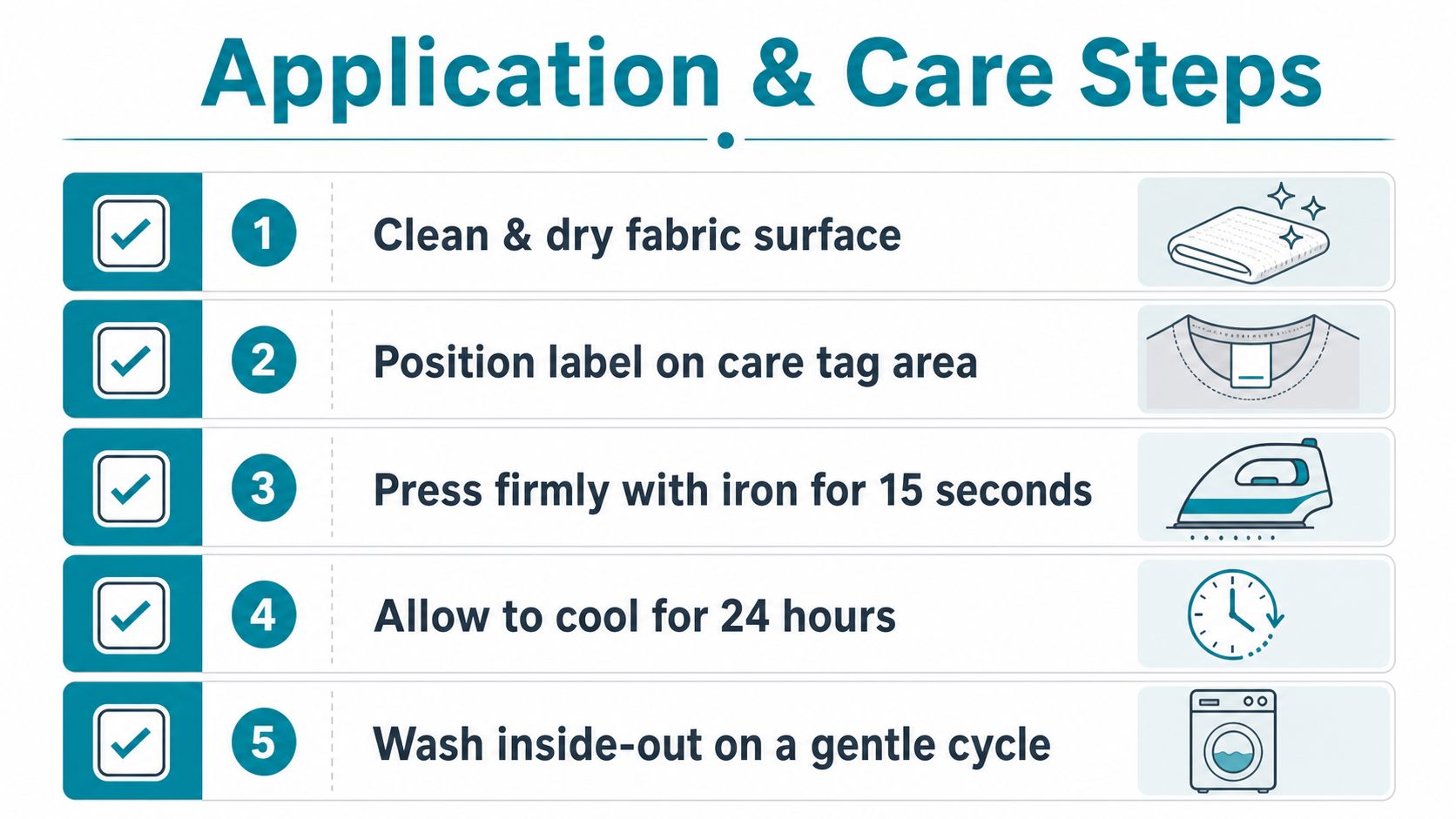
The Application Checklist That Works
- Start with a clean, dry care tag. Any moisture, lotion, or detergent residue weakens the bond straight away.
- Position the label squarely. A crooked label is irritating every time you sort the wash.
- Press it down firmly. Use steady pressure across the whole surface, not just the middle.
- Leave it to cure. Wait 24 to 72 hours before washing, as noted in the Labels4Kids product guidance.
- Treat the first few washes gently. Turn items inside out where possible and avoid rough handling while the adhesive settles.
A calm, careful application matters more than any marketing claim. If the label has not bonded properly at the start, school laundry, nursery bags, and care-home washing routines will expose the mistake fast.
The mistakes that shorten label life
- Applying to a damp tag: The adhesive never gets a proper grip.
- Using fabric softener too early: It can leave residue that interferes with the bond.
- Washing before curing: You interrupt the adhesive before it sets.
- Sticking labels onto the wrong surface: Textured or silicone-rich areas are poor for adhesion.
If you want the wash-care details set out more plainly, Quote My Wall's guide to machine-washable labels is useful reading. The practical lesson is simple, prepare the tag properly, give the adhesive time, and do not shortcut the process just because the item needs to go back into use quickly.
Why Quote My Wall Labels Stand Out for UK Buyers
Quote My Wall's stick-on clothing labels fit the use case I've been describing because they're built for the exact kind of laundry abuse UK families and care teams deal with. The brand's labels are positioned as ultra-high-tack, fully washable, and safe for the microwave, tumble dryer, and dishwasher, which covers the everyday mess of school bags, nursery spares, and care-home laundry routines.
That combination matters because most buyers don't need a label that sounds impressive. They need one that survives repeated handling without turning into another task. If you're labelling a stack of school jumpers or a resident's full clothing set, quick application and wash resilience are the features that save time.
Quote My Wall also gives you a practical route for personalised ordering, which is the part people often get wrong. Personalisation isn't just about making the label look nice. It helps staff and relatives identify items quickly, which is the whole point in busy settings where clothes get sorted under pressure.
I'd still keep the decision use-case-first. If you need labels for smooth care tags, daily school use, and repeated laundering, a high-tack stick-on option is the right tool. If the item is textured, exposed, or meant to be permanently sewn in, use a different format.
Frequently Asked Questions About Stick On Name Labels
Can stick-on labels be removed without damaging clothing?
Usually, the label comes off the care tag rather than the garment itself, which is exactly why tag placement matters. If you're planning to resell items or hand them down, test a label on one item first and avoid applying it anywhere except the care label.
What if the garment doesn't have a care tag?
That's where stick-on labels are the wrong choice. Use an alternative format that suits the fabric directly, because the adhesion model relies on a smooth tag surface.
Do they work on waterproof or coated fabrics?
Not reliably on the outer coating itself. These labels are meant for the garment's care tag, not slick technical shells or silicone-rich surfaces.
Can schools or care homes order them in bulk?
Yes, and that's usually the sensible route if you're labelling a lot of identical items. Bulk ordering keeps the design consistent across a whole set of clothes, which saves time later when staff are sorting laundry or parents are replacing lost items.
If you're buying now, keep it simple. Match the label type to the laundry reality, not the marketing copy, and choose a supplier that treats the care tag as the sticking point.
If you're ready to sort out school uniforms, nursery clothes, or care home garments without wasting time on labels that peel early, visit Quote My Wall and look at their stick-on clothing labels. Pick the format that fits your laundry routine, order once, and stop relabelling the same pile every half term.