
Clothing Name Labels: A Practical Buyer's and Usage Guide
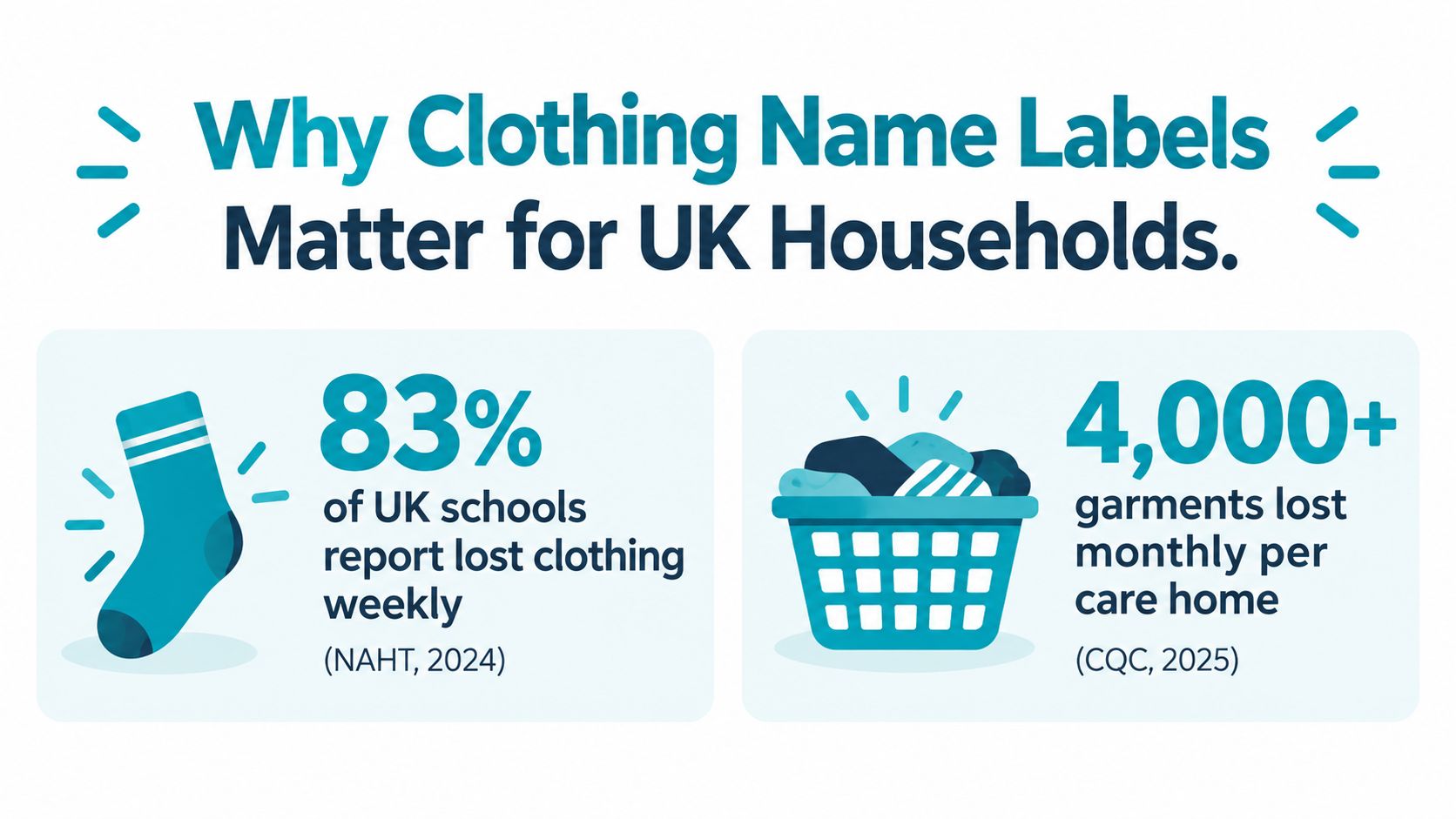
Two-thirds of UK primary schools rate their lost-property problem as medium or severe, yet only 3% say most school uniform and kit is labelled. Almost 90% identify name labels as the best way to reduce the problem, according to a UK primary-school survey reported by Stikins. That gap says something important: clothing name labels aren't a decorative extra. They're a small piece of household and laundry organisation that many families know they need, but don't apply consistently.
The same problem appears in care homes. A survey of managers found that 81% had experienced clothing or other items being lost or misplaced on their premises, while 10% said it happened frequently. Half said misplaced personal items created significant trouble for managers, residents and staff, as reported by The Carer.
I've labelled enough school jumpers, PE kits, nursery cardigans and care-home wardrobes to know that adhesion is only part of the answer. The label has to be readable during sorting, placed where someone can find it quickly, and chosen with future hand-me-downs and privacy in mind.
Why Clothing Name Labels Matter for UK Households
A clothing name label is a small identifier attached to a garment so that a teacher, nursery worker, laundry assistant or family member can connect it with its owner. That owner might be a Year 2 pupil, a toddler with a spare outfit at nursery, or a care-home resident whose clothes are washed alongside other residents' belongings.
The practical value is simple. An unlabelled navy jumper looks like every other unlabelled navy jumper. A clearly marked jumper can move from a lost-property box or laundry trolley back to the right person without guesswork.
The problem is bigger than a missing jumper
Schools often store lost property rather than disposing of it immediately. The survey cited above found that 98% of schools store lost property, which creates a continuing demand for staff time and storage space. It also found that 90% considered top layers, including jumpers, sweaters, cardigans and sweatshirts, among the three items most likely to remain unclaimed, while coats were identified by 41%. These figures come from a commercial labelling company's industry survey, not official government statistics, but they still describe a familiar operational problem.
Care homes face a less visible version of the same issue. Garments pass through washing, drying, folding and sorting, sometimes handled by staff who don't know every resident personally. Without an identifier, a similar-looking cardigan or pair of trousers becomes an investigation rather than a straightforward return.
What a useful label must do
A good label needs four qualities:
- Readable: The name must remain clear after normal wear and washing.
- Secure: It must stay attached through handling, laundering and drying.
- Findable: Staff and children should know where to look.
- Appropriate: The wording should respect privacy and the garment's future use.
That last point matters. A full child's name printed prominently on a coat may make identification easy, but it also displays personal information in public. A surname, initial or family-approved code can sometimes do the job with less exposure.
The UK textile-labelling framework also matters. Government guidance on textile labelling says required textile information must remain available and clear. A name label supplements fibre-content information, it doesn't replace it. Apply it to a clean, dry, smooth care-label or fabric area, and give the adhesive time to bond before washing.
The best mindset is to treat labels as part of a clothing workflow. Schools need faster returns and less overflowing lost property. Care homes need reliable sorting. Families need fewer replacement purchases and a more organised route for passing clothes on.
Types of Clothing Name Labels and How They Compare
There isn't one universally correct label. The right format depends on the garment, the available application surface, the wearer's sensitivity to texture, and whether you want the label to be permanent.
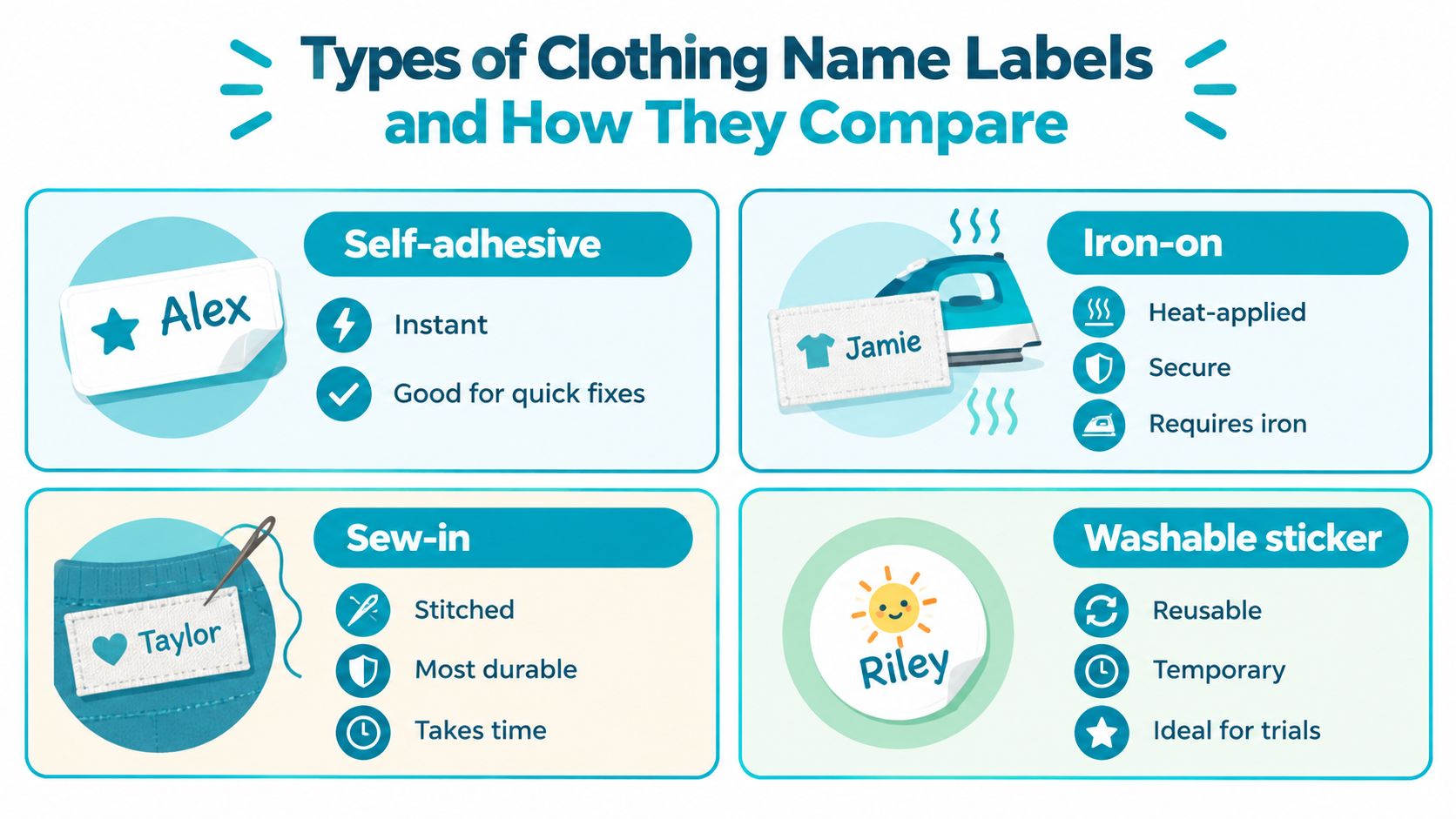
Stick-on labels are the quickest option. They work particularly well on the smooth woven care label inside a garment, where the adhesive has a stable surface. They're useful for jackets, fleeces, synthetic PE kit and clothing that may later be passed to another child. The weakness is application discipline. Pressing a self-adhesive label onto stretchy or fluffy fabric usually gives it a poor chance of staying put.
Iron-on labels use heat to bond to suitable fabric. They're a strong choice for cotton uniforms and garments without a smooth care tag, but they require an iron, a heat-safe surface and careful pressure. They aren't appropriate for every technical or water-resistant material, and a poorly applied edge can lift.
Sew-in labels are dependable when stitched securely, particularly for long-term care-home wardrobes or handmade garments. They take more time and can create a raised edge or uncomfortable seam, so placement matters for children or adults with sensory sensitivities.
Printed care-tag replacements can look tidy, but removing legally required textile information is a mistake. Use a separate identification label unless the replacement is designed to preserve all required garment information.
Write-on laundry markers are useful for urgent labelling, especially inside socks or on a small fabric area, but handwriting can fade, blur or become difficult to read. They're a backup, not my first choice for a full wardrobe.
Picture icons help in nursery settings when a child can't read their name yet. For older children, a discreet initial or surname may feel more acceptable than a colourful character.
Clothing Name Label Formats at a Glance
| Format | Application | Durability | Best for |
|---|---|---|---|
| Stick-on | Peel and press onto a smooth care label | Good when correctly applied | Fast labelling, outerwear, PE kit and hand-me-downs |
| Iron-on | Apply heat with an iron | Strong on suitable fabrics | Cotton uniforms and fabric without a usable care tag |
| Sew-in | Stitch through the label and garment | Very strong when well stitched | Long-term wardrobes and demanding laundry routines |
| Printed care-tag replacement | Replace or supplement an existing tag | Depends on construction | Neat identification where garment information remains intact |
| Write-on marker | Write directly on a suitable fabric area | Temporary to moderate | Emergency additions and small items |
My practical recommendation is to use stick-on labels for speed and flexibility, iron-on labels where the fabric welcomes heat, and sew-in labels only when you're prepared to spend the extra time. For babies and eczema-prone children, keep labels away from direct skin contact and check the finished garment before regular wear.
How to Apply Stick-On Clothing Name Labels So They Last
Most failures begin before the first wash. The label is stuck to the wrong surface, applied over lint or moisture, or washed before the adhesive has bonded properly.
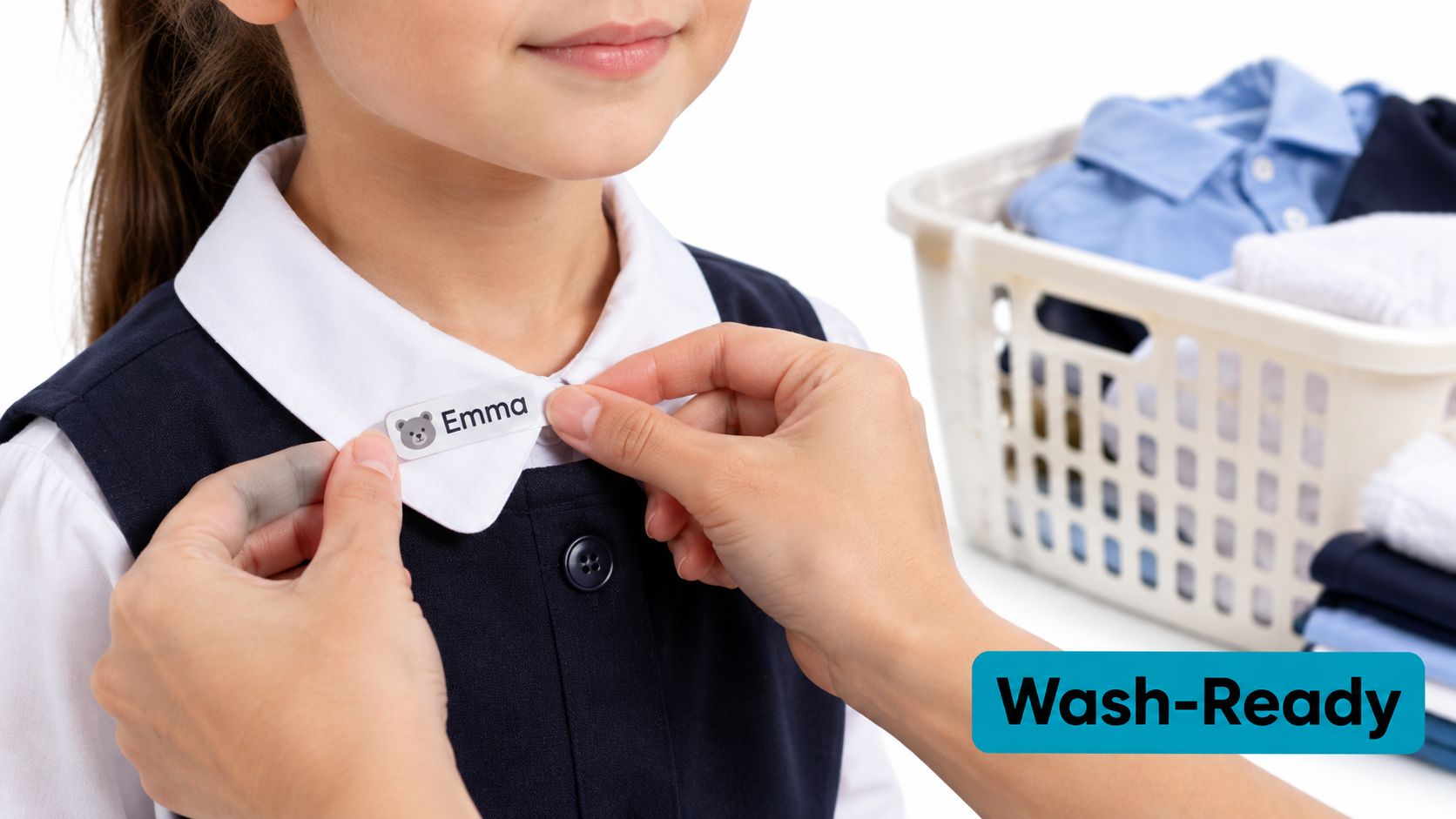
Start with the care label. The smooth, woven tag inside the back neck or waistband is usually flatter and more stable than the garment itself. It also keeps the label away from the skin, which is helpful for children who dislike scratchy textures.
A reliable application routine
- Choose the surface carefully. Use a flat, smooth care label or another suitable fabric area. Avoid seams, ribbing, fluffy fleece and heavily textured fabric.
- Clean the area. The surface must be dry and free from lint, detergent film and fabric-conditioner residue. A clean, dry surface gives the adhesive proper contact.
- Peel without touching the adhesive. Fingerprints and fibres can reduce contact at the edges.
- Position the label fully within the tag. Don't allow corners to extend onto the garment if the label is designed for a care-tag surface.
- Press from the centre outwards. Use firm, even pressure, then run a fingernail around the edges.
- Leave it alone before washing. The adhesive needs a bonding period. I leave newly labelled items for 24 to 72 hours before washing, following the product's instructions.
Deal with difficult garments by changing the method
Stretchy PE shirts can distort while you apply the label, so use the flattest available care tag and support the fabric underneath. On thick towels, socks and garments without a smooth tag, check whether the product is suitable for direct fabric application. If it isn't, choose an iron-on or sew-in format instead.
Don't label an entire kit and hope for the best. Apply one label to one representative garment, wash it according to its normal routine, and inspect the edges. That small test can prevent a whole batch of disappointing applications.
Practical rule: A washable label is only as reliable as the surface preparation, pressure and curing time behind it.
For coats and jackets, prioritise a visible inside collar or care-tag position. If the garment has a pocket, a second identifier can help, but only use multiple labels if the product instructions and your privacy preferences support it.
Labelling School and Nursery Uniforms That Actually Come Home
Start with the garments most likely to leave the child's body during the day. The school survey found that 90% of schools ranked top layers among the items most likely to remain unclaimed, with coats identified by 41%. That makes jumpers, cardigans, hoodies, sweatshirts and coats the first items I'd label, not the last.
The survey also found that almost 90% of schools saw name labels as the best way to reduce lost property, while only 3% said most uniform and kit was labelled. The practical lesson is clear: families don't need a complicated system. They need to label the items that travel, come off, and get left behind.
Prioritise the school wardrobe
- Outer layers: Label jumpers, cardigans, hoodies, fleeces, coats and waterproofs first. Choose a placement that staff can find quickly inside the collar or on the care label.
- PE clothing: Mark T-shirts, shorts, leggings, sweatshirts and bags. PE kit moves between classrooms, changing areas and home laundry.
- Small loose items: Add labels to hats, gloves, scarves, bibs and spare clothing. These pieces disappear easily because they aren't always returned to the same bag.
- Shoes and plimsolls: Use a product intended for the shoe's interior, or follow the manufacturer's placement guidance. Don't assume a clothing label belongs on every material.
- Nursery comfort items: Label blankets, comforters and spare outfits discreetly. A picture icon can help a pre-reader recognise their belongings.
The full wardrobe doesn't need identical wording. A child's first name and surname may suit classroom clothing, while a surname or family code may be better for a coat displayed in a public cloakroom. For siblings, a removable label makes more sense where clothes are likely to be handed down.
Keep a simple inventory on your phone or inside the uniform drawer. When a new garment arrives, label it before it enters the school bag. The personalised name-label guidance from Quote My Wall can help you think through designs and school-use placements, but the essential rule is your own routine: label the high-risk items first, then fill the gaps.
Using Clothing Name Labels in Care Homes and Shared Laundry
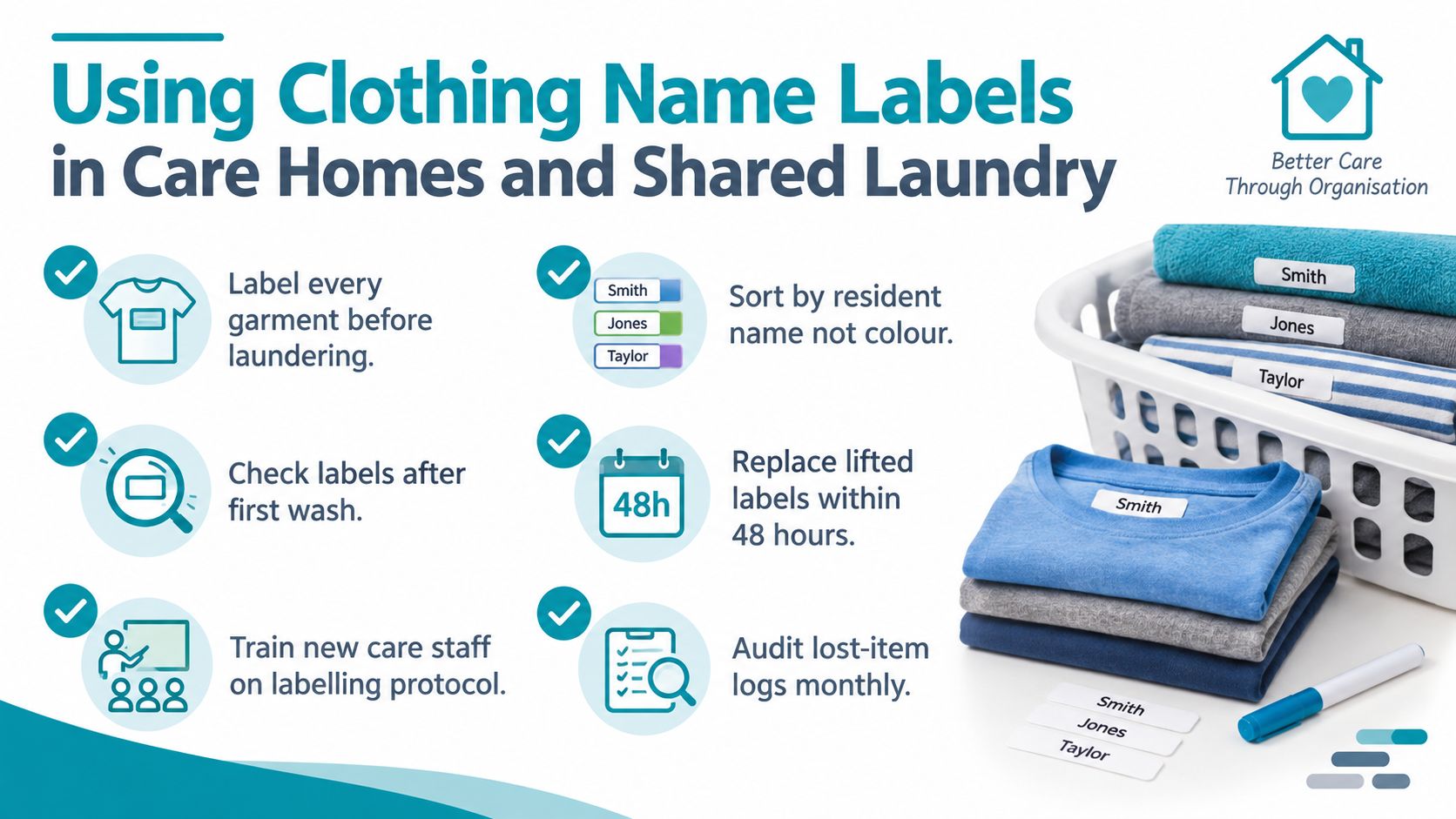
Care-home labelling needs to support the laundry process, not merely identify a resident in theory. Clothes may be collected from rooms, mixed with other loads, washed, dried, folded and returned by different members of staff. A label that's technically durable but hidden in a seam still slows sorting.
The survey of care-home managers cited earlier found that 81% had experienced items being lost or misplaced within their premises, and 10% described it as frequent. That makes clear placement and quick reading as important as adhesive strength.
Agree the system before you order
Ask the home how it wants garments marked. Some facilities may prefer a surname and room number, while others may request initials, a resident code or a specific colour convention. Don't invent a code that staff aren't expecting.
Place labels where a sorter naturally looks:
- Tops and dresses: Inside the back neck or on the care label.
- Trousers and skirts: At the back waistband or on an accessible care tag.
- Socks: Near the top where the label can be seen without turning the whole sock inside out.
- Cardigans and coats: Inside the collar or another consistent, flat position.
- Adaptive clothing: Avoid closures, access panels and areas that rub against the resident's skin.
Use large enough lettering for fast recognition, but keep the wording concise. “Smith, Room 12” may be more useful during a laundry round than a long first name, address or unnecessary personal detail.
Build the label into the handover routine
Label clothing before it enters the home's laundry system. Ask staff to check a new label after its first wash, and agree who replaces it if an edge lifts. A small lost-item log can reveal whether the problem is a weak label, an inconsistent position or a sorting-stage oversight.
Sanitation still matters alongside identification. For broader background on washing and hygiene practices, consult this laundry sanitation guide from BacteriaFAQ.com, then follow the care home's own temperature, detergent and infection-control procedures.
Families should also ask whether the home supplies labels or expects relatives to provide them. The guide to clothing labels for nursing homes is useful when preparing a wardrobe, but the home's actual laundry workflow takes priority.
Customisation, Privacy and Sustainable Reuse of Labelled Clothing
The label wording determines what happens when the garment leaves your household. A full name makes school returns straightforward, but it can also expose a child's identity to everyone handling a coat or bag. For visible outerwear, I prefer the minimum information that the school can use reliably.
Possible formats include:
- First name and surname: Easy for school staff, but the most revealing.
- Surname and initial: More discreet while still identifying a family.
- Surname only: Suitable where staff already know the child or resident.
- Surname and room number: Practical for care-home sorting, provided the home approves it.
- Family code or icon: Useful for young children and hand-me-down systems.
Ask the school or care home what it expects before ordering a large batch. A label that's private but unfamiliar to staff won't solve the sorting problem.
Design for the garment's next owner
The most sustainable label isn't necessarily the one advertised as lasting the longest. It's the one that helps the garment stay in use, return to its owner, move to a sibling, or reach a donation point in usable condition.
UK textile policy discussions report that councils spend about £73 million each year removing textiles from household waste, with a projection that this could rise to £200 million by 2035. The same discussion reports that more than 70% of UK adults support a formal textile extended-producer-responsibility scheme. These figures come from a policy discussion rather than an official government dataset, but they reinforce a useful household principle: avoid replacing clothing just because its owner can't be identified.
Stick-on labels are helpful for hand-me-downs because they can be replaced or covered when ownership changes, subject to the product's instructions. Don't layer a new label over a loose old one. Remove the old identifier if possible, clean the surface, and apply the new one to a stable area.
The guide to stick-on labels and sustainability offers further ideas about combining personalisation with reuse. Keep the design legible rather than oversized, and avoid printing information the next owner shouldn't inherit.
Ordering Custom Labels: What to Decide Before You Buy
Order from a wardrobe list rather than guesswork. Count the garments that leave the house, include PE kit and spare clothing, then allow for new purchases and replacements. The right quantity depends on your child's routine or the resident's wardrobe, so a checklist gives a better answer than a generic pack size.
Set these details before buying:
- Wording: Decide between a full name, surname, initials, room number or an approved code.
- Legibility: Use a clear font with strong contrast. Decorative lettering that looks attractive on screen may be difficult to read in a busy laundry room.
- Size: Make the label large enough for quick identification, while keeping it small enough to fit fully on the care label or chosen application area.
- Design: A simple icon suits a nursery child. An older pupil may prefer a restrained colour and initial.
- Testing: Apply one label first and wash it according to the garment's normal care instructions.
- Timing: Allow enough time for application and bonding before the clothing is needed.
For families choosing self-adhesive labels, Quote My Wall clothing labels are fully washable, microwave, tumble dryer and dishwasher safe. The company says they use the same premium vinyl quality as its wall stickers, vinyl wraps and custom prints, as stated on the Quote My Wall website. That makes them a practical fit for school uniforms, PE clothing and care-home garments, where labels face regular handling and need to remain readable.
Choose a stick-on label when the garment has a smooth care tag, particularly with coats, fleeces, synthetic sportswear and clothing likely to be passed on. Choose an iron-on or sew-in label when there is no suitable surface, or when the manufacturer's instructions make self-adhesive application unsuitable.
Check the label against the whole clothing workflow. It should be visible to the person sorting laundry, comfortable for the wearer and easy to replace when ownership changes. Clear wording also helps reduce lost-property confusion and prevents a usable garment being discarded just because nobody can identify it.
Quote My Wall offers personalised, washable stick-on clothing labels for school uniforms, children's clothing and care-home wardrobes. Create a readable design, apply it to the right surface and use Quote My Wall to order labels that fit your household's laundry and hand-me-down routine.