

Bedroom Wall Stickers for Adults: A Style Guide for 2026
Most advice about bedroom wall stickers for adults is too soft. It tells you to pick a design you like, smooth it on, and enjoy an instant bedroom update. That's how people end up with lifting corners, damaged paint, and decals that look cheap within weeks.
The decision isn't just style. It's compatibility. Paint age, wall texture, adhesive tack, finish sheen, and placement matter more than the mock-up photo on the product page. Get those right and a sticker can look deliberate and stay put for years. Get them wrong and even a good design will fight the room.
The Case for Adult Bedroom Wall Stickers
Adult bedrooms are awkward spaces to update. Paint feels like too much work for one wall. Wallpaper asks for more commitment than you want. Framed art can look scattered unless you invest time in layout, drilling, and matching frames.
That's why bedroom wall stickers for adults make sense. They sit in the middle ground. You can change the mood of a room quickly, add scale where a single frame would feel mean, and avoid turning a simple bedroom refresh into a full decorating project.
A strong UK demand signal sits behind that. Shelter and B&Q found that 77% of private renters in England wanted to make small improvements to their homes, equal to 6.6 million adults, and 72% said they would feel happier if they could decorate as they wished in the reported Shelter and B&Q research. The same coverage says 50% wanted to put personal items on the walls and 51% wanted to paint, which tells you the urge isn't niche. People want walls that feel like theirs.
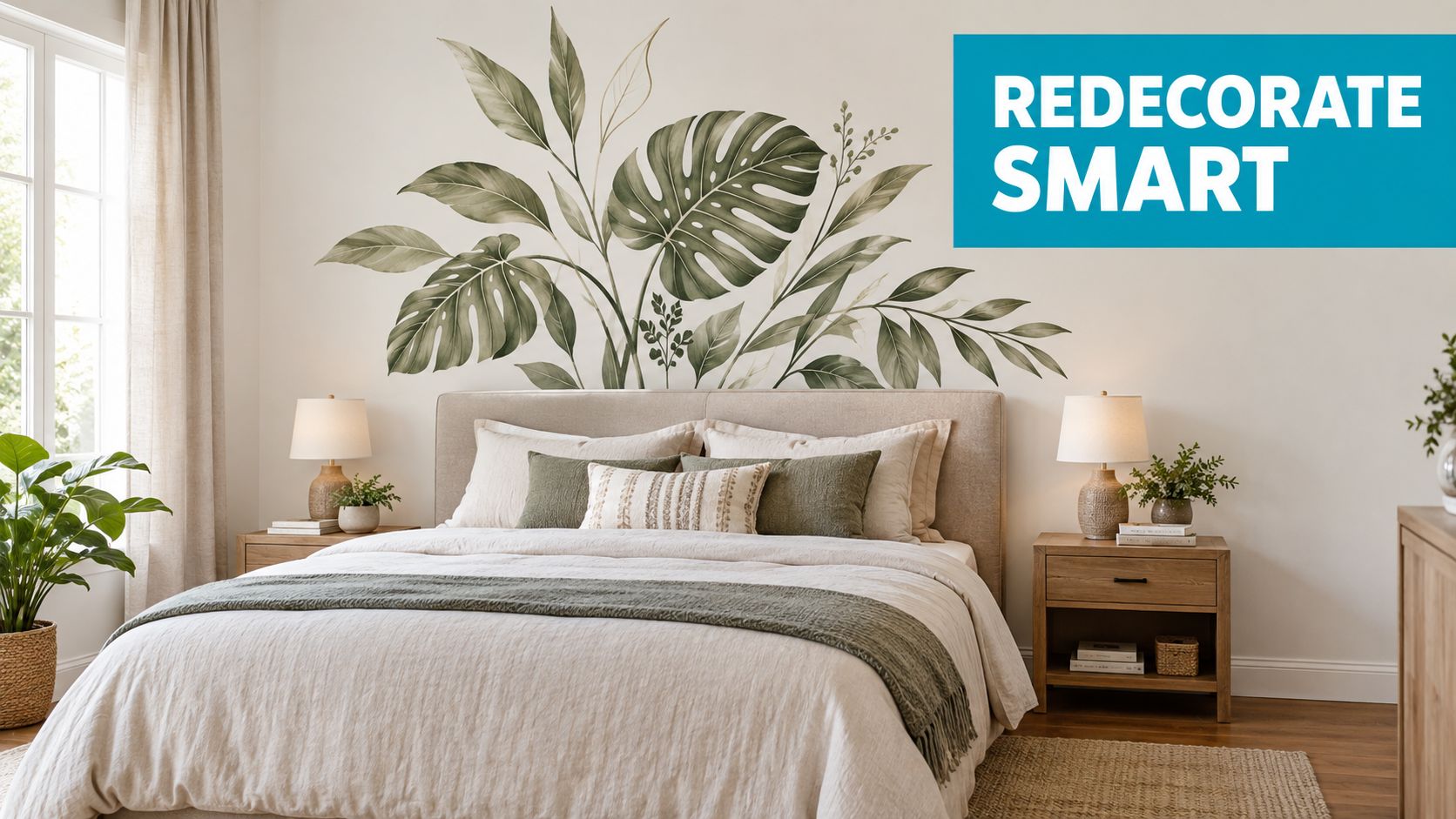
Why stickers beat many low-effort alternatives
A bedroom needs atmosphere more than decoration for decoration's sake. Stickers do that well because they can cover visual dead space without making the room feel busier.
- They create scale fast. A large botanical stem, abstract line set, or shaped arch behind a bedside zone can anchor the bed properly.
- They avoid hardware. No nails, no rawl plugs, no awkward landlord conversation.
- They suit temporary decorating. If your taste changes, or the room layout shifts, you're not stuck with a permanent wall finish.
Practical rule: In bedrooms, wall stickers work best when they replace a decorating problem, not when they're added as an afterthought.
There's also a wider wall-decorating context worth noting. UK wallpaper market coverage reported the market reached $645 million in 2024, up 38% from the previous year, with continued growth projected through 2035 in this market summary. That doesn't prove stickers and wallpaper behave the same way. It does show sustained appetite for wall-based decoration, especially from people who want a visible room change.
Where they go wrong
Adults usually regret wall stickers for one of three reasons:
- The design looks childish or novelty-led
- The scale is timid
- The wall surface was never suitable
The first two are style mistakes. The third is the one that wastes money.
Choosing the Right Design Style
The fastest way to make a bedroom wall sticker look cheap is to choose it as a “sticker” instead of as wall art. Adults don't need novelty motifs floating around the room. They need something that feels integrated with the bed, textiles, lighting, and wall colour.
Current UK wall-art trend coverage points towards minimalist, neutral, earthy, botanical, abstract, and text-based styles, with shades such as terracotta, clay, sand, deep navy, and forest green appearing strongly in 2025 coverage from PosterScape's trend roundup. Those styles work because they read as part of the room, not an add-on.
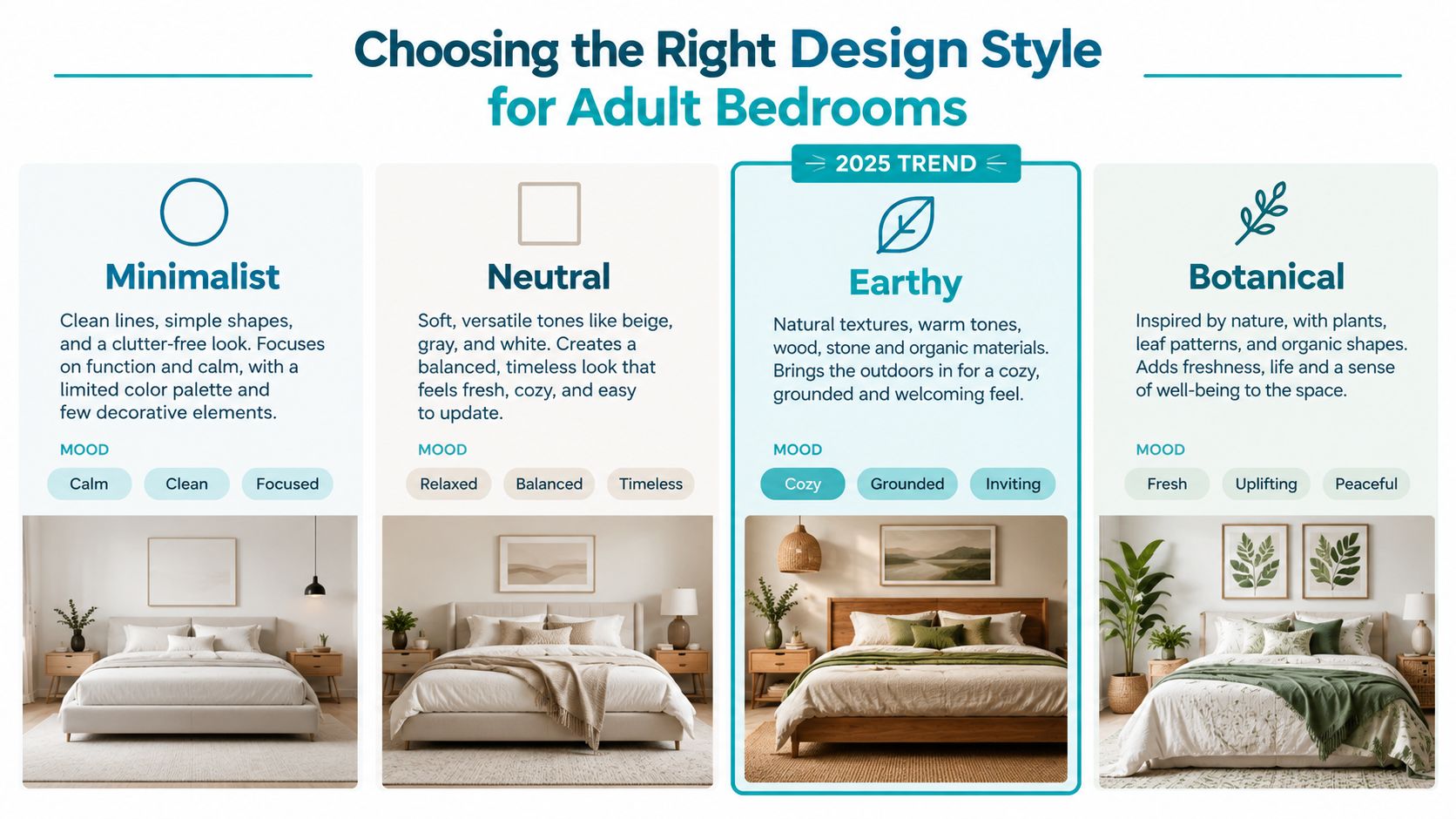
Three adult styles that hold up
Minimalist graphic work suits smaller bedrooms and cleaner schemes. Think line drawings, arches, slim geometric forms, or restrained text. These designs leave space around themselves, which matters when a room already has bedside lamps, plugs, switches, and headboard bulk.
Earthy abstract forms are the strongest option when you want warmth without fuss. Clay, sand, terracotta, and muted olive sit easily with oak, walnut, boucle, linen, and off-white bedding. They also hide the “applied decal” look better than shiny black silhouettes or overly crisp novelty graphics.
Botanical shapes work when they're simplified. A large branch, stem, or leaf composition can soften the hard lines of a bed and chest without pushing the room into cottagecore or spare-room territory.
Adult bedroom wall stickers should feel borrowed from art direction, not from children's décor categories.
What dates quickly
Some designs age badly because they announce a trend too loudly. That includes obvious slogan walls, faux-inspirational script, and motif clusters that try to fill empty space by multiplying small shapes.
A better benchmark is the wider move towards quiet luxury interior design. Even if you don't follow that look closely, the principle helps. Choose restraint, texture, and tonal depth over visual noise.
For bedrooms that suit wording, a text-based decal can still work. It just needs care. If you're considering that route, these bedroom wall quote ideas for different styles are useful for seeing how typography changes the mood from romantic to modern to understated.
A quick filter before you buy
Ask these questions before you commit:
- Would this still look good if it were printed on paper and framed? If not, the design may be relying on novelty.
- Does the colour echo anything already in the room? Bedding, curtains, upholstery, rug, or wood tone.
- Is the shape helping the architecture? Over a headboard, beside a wardrobe, or in an awkward alcove.
- Does it need to be this literal? Less obvious designs often feel more expensive.
The best adult decals don't shout “sticker”. They read as a styling decision.
Understanding Materials and Finishes
Material is where many bedroom purchases go wrong. People spend ages choosing the artwork, then treat the substrate as a footnote. It isn't. The film, adhesive, and finish decide whether the piece looks refined, smells harsh, reflects too much light, or starts curling at the edges.
A useful UK retail reference notes that PVC-free wall stickers are available, and that common compatible surfaces include painted plasterboard, finished wood, tiles, smooth metal, plastic, and sealed concrete in Vistaprint's wall sticker guidance. For bedrooms, that matters because people spend long periods in that room. If low odour and lower material exposure matter to you, PVC-free is the sensible shortlist.
PVC vinyl versus PVC-free film
This isn't a moral choice. It's a trade-off.
Standard PVC vinyl is common, durable, and familiar across decorative applications. It can be the right pick when you need a stronger, more durable film and you're less concerned about material composition.
PVC-free options make more sense when bedroom air quality and odour are higher priorities. In practice, they suit people decorating sleeping spaces, guest rooms, or rooms that don't get a lot of daytime ventilation.
For a broader look at film types and how they're used in decorative applications, this guide to vinyl for wall art is a helpful starting point.
Matte, gloss, and the finish problem
Finish changes the whole result, especially in bedrooms where lighting is usually layered and soft.
| Finish | What it looks like | Where it works | Where it disappoints |
|---|---|---|---|
| Matte | Softer, flatter, more design-led | Calm bedrooms, neutral palettes, textured textiles | Can look dull on very dark walls if the design lacks contrast |
| Gloss | Sharper and more reflective | Utility spaces, playful rooms, bolder graphic styles | Often looks synthetic under bedside lamps or warm ceiling light |
| Textured-look or specialty finish | More character, less “sticker” feel | Feature applications where you want depth | Can feel forced if the wall already has visual texture |
Gloss is the one I'd reject most often for adult bedrooms. It catches lamplight and reminds you the piece is surface-applied. Matte usually blends better with painted walls and doesn't fight with linen, wood, or upholstered headboards.
If you want the decal to look expensive, start by avoiding a finish that throws light back at you.
Match material to the room, not the trend
Bedrooms reward quiet surfaces. That usually means:
- Low-odour preference for rooms with limited ventilation
- Matte finish over gloss in most adult schemes
- Smooth substrate compatibility over decorative ambition
- Realistic expectations about removability and reuse
People often chase the boldest look on screen. In a bedroom, the better result usually comes from the calmer material choice.
Sizing and Placement Strategies
Most disappointing bedroom wall stickers are too small. They float above the bed like an apology, or they're broken into too many pieces and start reading as clutter. Scale should relate to furniture, not to the empty wall in isolation.
Start with the room's visual anchor. In most bedrooms, that's the bed. The wall treatment should either support that anchor or intentionally balance another bulky element such as wardrobes or a chimney breast.
Use the furniture line
A decal above a bed should usually relate to the width of the headboard or the sleeping zone, not stretch into random dead space. If it's much narrower than the bed, it can look accidental. If it sprawls too far, it loses tension.
For side walls, think in vertical blocks. A rising botanical shape near a bedside table, a column of abstract forms beside a tall chest, or a text piece above a reading chair all work because they answer a real gap in the room.
Leave negative space on purpose
People panic and try to “finish” the whole wall. Don't. Bedrooms need quiet.
- Above the bed. Use one dominant composition rather than several small motifs.
- Beside wardrobes. Let the wardrobe stay dominant and use decals as a softener, not a rival.
- In alcoves. Narrow, taller designs usually beat wide ones.
- On a feature wall. Restraint matters more because the paint colour is already doing work.
| Surface | Best For | Tip |
|---|---|---|
| Above the headboard | One large focal decal or a balanced multi-part set | Keep the design visually centred to the bed, not the wall |
| Narrow side wall | Vertical botanicals or slim abstract shapes | Use height to add elegance without crowding |
| Wardrobe-adjacent wall | Simple geometric or tonal forms | Echo the wardrobe finish or hardware colour |
| Alcove | Text-based or stacked forms | Let the alcove frame the design instead of overfilling it |
Plan the layout before peeling
Tape paper templates to the wall first. Brown paper, printer paper, or cut newspaper shapes are enough. This catches two common mistakes early: placing the design too high, and choosing a layout that fights lamp height or socket positions.
A bedroom should feel composed when you walk in and calm when you lie down. Placement affects both.
Installation and Removal Best Practices
The room either rewards you or punishes you. A well-chosen decal on the wrong wall won't perform well, and a decent wall can still be ruined by rushed removal.
UK guidance from StickerScape says decals are cleanly removable from normal painted walls, but removability depends on paint quality and surface preparation, and a smooth, flat, correctly prepared painted plasterboard wall gives the most reliable adhesion in their FAQ guidance. The same guidance also notes that removable vinyl decals are not reusable once removed.
What a good wall actually looks like
The ideal wall is boring. That's good news.
It should be painted, fully cured, dry, smooth, and free from dust or chalkiness. Fresh matt emulsion can be risky if it hasn't cured properly. Textured walls, flaky paint, and dusty surfaces are where edge lift starts.
Independent UK renter décor guidance is even more direct. It recommends testing a hidden area first, cleaning and fully drying the wall, waiting about a month after painting, and removing slowly with low heat at a shallow angle in this renter-focused guide to peel-off wall decals.
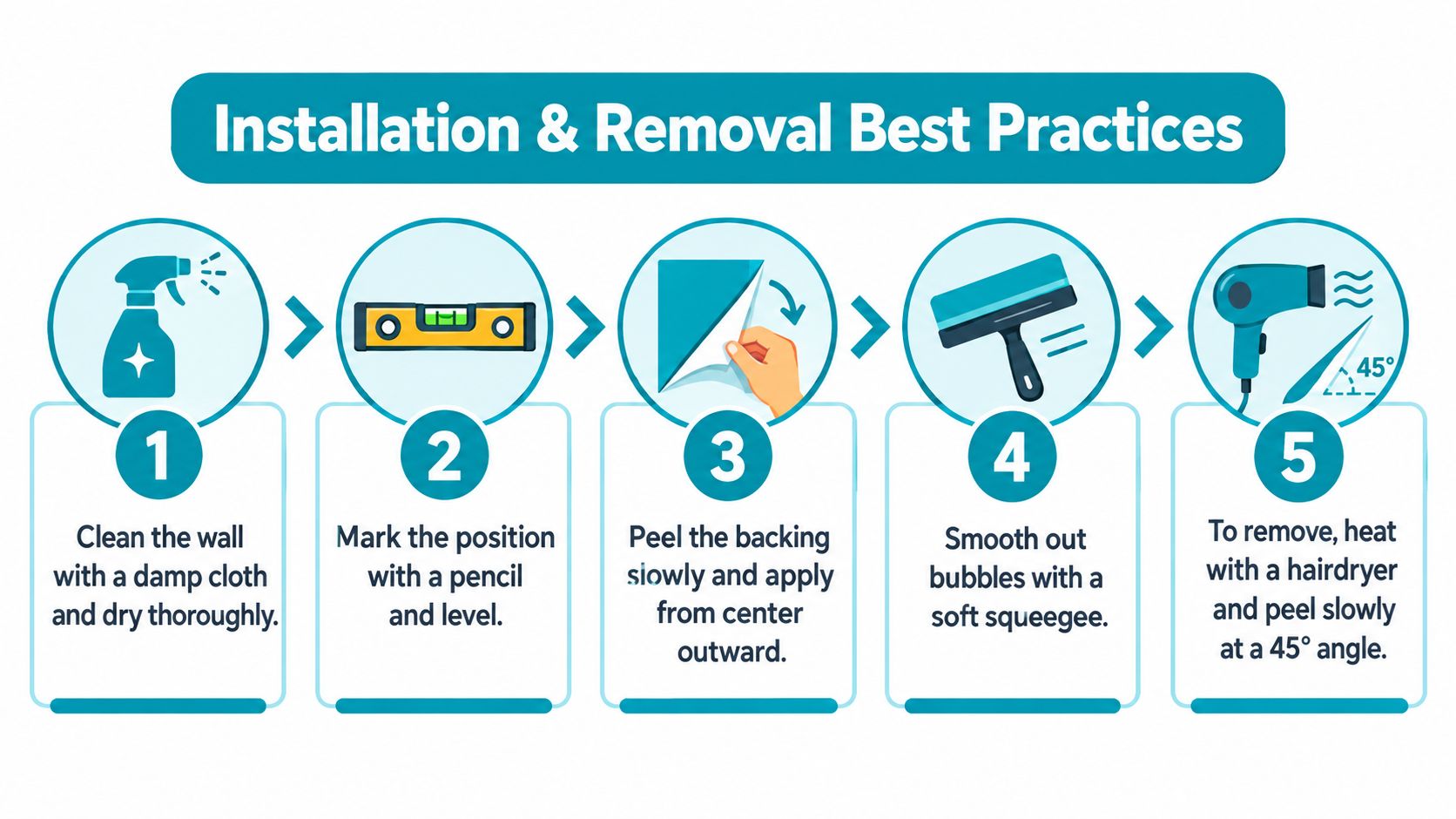
Installation that avoids most failures
The sequence matters more than people think.
-
Clean first
Wipe the wall so dust and residue don't sit under the adhesive. Then let it dry properly. -
Mark position lightly
Use a pencil and a level. Bedrooms make asymmetry obvious because the bed creates such a strong centreline. -
Apply from the centre outward
Don't peel off everything at once if the design is large. Control the film as you go so it doesn't fold onto itself. -
Smooth gently
Use a soft squeegee or cloth. Press firmly enough for contact, not so aggressively that you stretch delicate sections.
A decal that keeps lifting at the edges usually points to the wall, not the artwork.
For extra help on technique, this step-by-step guide on how to remove wall stickers is worth keeping for move-out day as well as installation day.
Removal without taking paint with it
Removal is where renters get nervous, rightly. The safest method is patient, low-heat peeling.
Warm the decal gently with a hairdryer. Don't blast one spot for ages. Start at a corner, peel slowly, and keep the angle shallow so you're coaxing the adhesive away instead of yanking paint upward.
If the wall resists, stop and add a little more warmth. Fast peeling is what causes most damage. That, and removing from poor-quality paint that was never properly bonded to the wall in the first place.
Coordinating with Your Décor and Brand Options
A good decal doesn't sit on the wall alone. It has to negotiate with bedding, timber tone, curtain fabric, lampshades, and whatever metal finish you've already committed to. That's why the smartest styling move is usually to match the sticker to soft furnishings first, then check it against the wall colour.
If your room already has oat, sand, rust, olive, or charcoal in the textiles, pull from that palette. If the room is cooler, deep navy or a restrained black graphic can work. What usually fails is introducing a completely unrelated accent just because it looked dramatic online.

Build the wall from what's already there
Here's the approach that tends to hold up best:
- Start with the bed textile palette. Duvet cover, throw, cushions, upholstered headboard.
- Repeat one room material. Oak, walnut, black metal, brushed brass, rattan, linen.
- Choose one visual role. Calm backdrop, focal feature, or soft connector between furniture pieces.
- Stop before the wall feels busy. Bedrooms benefit from editing.
You can also mix formats. A decal doesn't have to do all the work. In some rooms, pairing a restrained decal with framed canvas wall decor creates better layering than forcing one giant wall graphic to carry the entire scheme.
When customisation makes more sense
Off-the-shelf designs work well when the room is straightforward. But odd alcoves, sloped ceilings, awkward bed widths, or a very specific colour story often need something more.
That's where it helps to know what's available from specialist suppliers. Quote My Wall offers a huge range of designs across vinyl and print products, including personalised wall stickers and furniture upcycling projects, with premium quality vinyl ensuring wall art lasts at least 5 years interior. That combination matters if you want a decal to coordinate with a bedroom and also carry into bedside furniture or other surfaces.
The most convincing bedrooms repeat a mood across surfaces. They don't treat the wall as a separate project.
The final edit
Before buying, look at the room at night, not just in daylight. Bedrooms are used under lamplight, and that changes both colour and finish. A decal that feels subtle by day can suddenly feel too harsh after dark.
The best adult bedroom walls aren't the most decorated ones. They're the ones where every element agrees with the others.
If you want bedroom wall stickers that feel considered rather than improvised, it helps to browse a range that includes adult styles, personalised options, and coordinating vinyl products. Quote My Wall offers wall stickers, bedroom quotes, and related décor options that make it easier to match the decal to the room instead of forcing the room to suit the decal.