
Animal Stickers for Walls: A Complete UK Buying Guide
You've got the wall picked out, the nursery paint is dry, and the boxes are still half-open in the corner. Or maybe you're a renter trying to make a blank bedroom feel less temporary without risking a deposit dispute. That's exactly where animal stickers for walls earn their keep, if you choose them as a proper product instead of treating them like a cute impulse buy.
The common mistake is judging them by the design first. That's backwards. In UK homes, the key questions are whether the wall is ready, whether the adhesive suits the finish, how much area the set covers, and whether the sticker will come off cleanly later. With the UK private rented sector accounting for 4.6 million households in 2023, about 19% of all households according to the Office for National Statistics data summarised in this market report, removable décor isn't a niche idea, it's a practical one. The same source notes that around 42% of private renters had lived in their home for less than 2 years, which tells you why flexible wall décor matters, not just on mood boards.
Why Animal Wall Stickers Have Become a UK Décor Staple
The typical buyer doesn't start with a design brief. They stand in a room that feels unfinished, look at a plain wall, and want a fast fix that won't create a bigger job later. A parent often wants a nursery that feels calm before the cot arrives. A renter wants personality without repainting a whole flat. A landlord wants a room to look cared for without triggering awkward repair questions.
That is why animal wall stickers have moved from novelty to normal. They give you shape, colour and theme without the commitment of papering or the prep burden of painting. They also suit the way many UK households live, especially where tenancies are short or rooms change purpose quickly. The housing profile in the earlier section makes the point already, removable wall décor fits homes that need to adapt.
The people buying them are usually solving one of four problems
- Rental softness: They need a wall to look finished without leaving visible damage.
- Nursery timing: They want a room ready before furniture arrives, not after a decorating project drags on.
- Budget pressure: They want a room to feel redesigned without paying for full redecorating.
- Low-commitment styling: They like change and don't want to be stuck with one look for years.
That mix is why the category works across nurseries, children's bedrooms, guest rooms and short-let spaces. It's also why you should treat the product as a tool. The design matters, but the substrate, adhesive and layout matter more.
Practical rule: if you're buying for a rental or a child's room, the sticker has to earn its place by being easy to remove later. Cute is not enough.
If you're still deciding whether this category suits your room, ask one question first. Do you need a finish that feels permanent, or do you need something that can move with your life? If it's the second one, animal stickers for walls are usually the right starting point.
What Animal Wall Stickers Are Actually Made Of
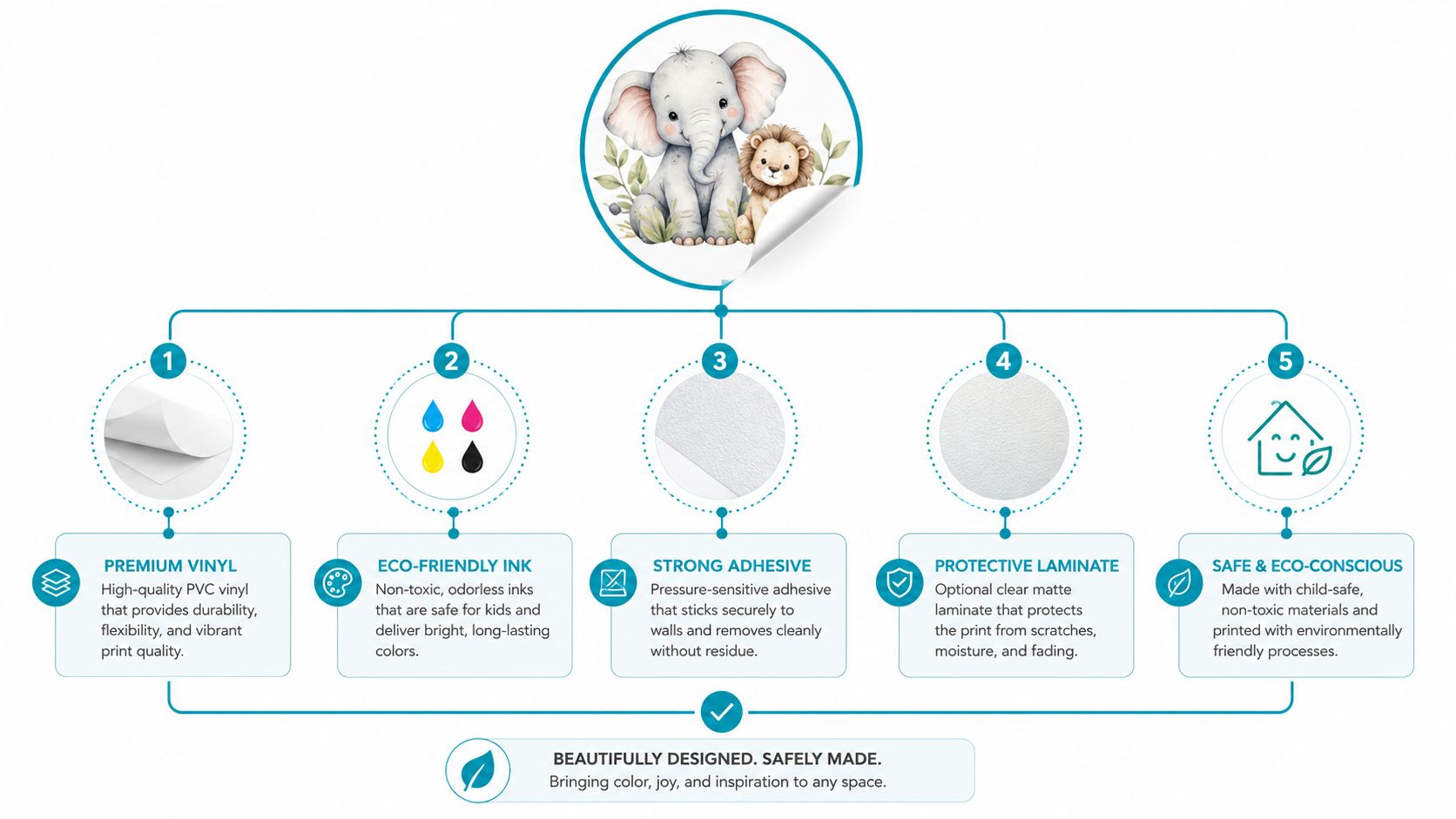
The front of the pack tells you the theme. The back tells you whether the thing will behave on your wall. A proper animal wall sticker is usually a layered product, not just a printed picture. The common stack is PVC or PVC-free vinyl, an acrylic adhesive, and printed inks that carry the colour and line detail.
What actually matters on the spec sheet
Start with the substrate. A good nursery decal listing should tell you whether it's vinyl, whether it's removable, and whether the adhesive is low-tack enough for indoor decoration. Some technical sheets for decorative vinyl specify about 0.1 mm film thickness and a service life near 5 years indoors, which is a useful benchmark when you want a realistic idea of durability in a child's room or a rental property. That kind of spec is more useful than a pretty product photo, because it tells you whether the material has enough structure to handle day-to-day life.
The next question is resistance. For domestic use, water resistance and washable surfaces matter because children touch walls, radiators warm rooms unevenly, and cleaning happens around the sticker whether you plan for it or not. Premium decals are commonly built to cope with humidity swings and light cleaning, but the result still depends on wall prep and the finish underneath.
What to ask before you buy
Ask for material disclosure. If a seller won't say whether the sticker is PVC, PVC-free, removable, or permanent, assume the product is vague for a reason.
Parents should also ask sharper safety questions. If the listing makes claims about low-VOC, phthalate-free, or reduced emissions, read the wording closely and look for actual product information rather than marketing fluff. The same applies to pet households, because lower odour and cleaner material disclosure make a difference in bedrooms, playrooms and treatment spaces.
If you're comparing two similar designs, pick the one that tells you the most about its build. A premium-looking safari scene is not automatically better than a simpler woodland set if the second one has a clearer material spec, removable adhesive and sensible indoor durability.
Product detail cheat sheet
| Feature | What to look for | Why it matters |
|---|---|---|
| Film material | PVC or PVC-free vinyl | Predicts flexibility and durability |
| Adhesive | Acrylic, removable if needed | Affects residue and wall lift risk |
| Finish | Matte or printed surface description | Influences glare and room feel |
| Thickness | Specified film thickness where available | Helps judge handling and longevity |
| Indoor life | A stated indoor service life benchmark | Sets realistic expectations |
The best decals are boring in the technical sense and lively in the visual sense. That's the balance to chase.
Choosing the Right Design, Size and Finish for Each Room
The right design depends on the wall in front of you, not just the animal you like. A safari set that looks brilliant in a tall nursery can feel cramped above a low bed. A woodland scene can calm a bedroom, but the same motif may disappear on a busy wall next to shelves. Size and finish decide whether the design reads as intentional or just pasted on.
The most useful coverage numbers are straight from product guidance. A standard nursery set can cover about 4–5 m², while larger sets may cover roughly 8.6 m² according to independent product guidance linked in the brief. That means you should measure wall area, not count individual stickers and hope for the best. If the wall is taller, wider or interrupted by furniture, the visual coverage changes fast.
Room by room, this is what works
Nurseries usually benefit from soft shapes, gentle colours and motifs that sit low enough to work around a cot, dresser or feeding chair. Children's bedrooms can take bolder jungle or farm themes, especially if the room needs a focal point above the bed. Hallways need tighter compositions, smaller animals and better spacing, because too much detail in a narrow run starts to look cluttered.
Living rooms and home offices are trickier. I'd only use animal wall stickers there if the space already has a relaxed, family-forward style. A tasteful monochrome set or a clean-line woodland composition can work, but loud cartoon graphics usually don't. Bathrooms are possible in principle, but only if the product and wall finish can handle moisture, and even then I'd keep them away from direct splash zones.
For a different decorative approach that uses calm structure rather than bright character, the styling bonsai indoors guide from Leaves & Soul is a good companion read. The point is the same, scale and placement matter more than impulse buying.
Animal wall sticker sizing by room
| Room | Typical coverage | Recommended finish | Best motifs |
|---|---|---|---|
| Nursery | About 4–5 m² | Matte | Woodland, safari, farm |
| Child's bedroom | About 4–5 m², sometimes larger | Matte or subtle sheen | Jungle, sea creatures, mixed animals |
| Hallway | Smaller, spaced clusters | Matte | Birds, rabbits, foxes |
| Home office | Light accent coverage | Matte | Minimal woodland, line-drawn animals |
| Bathroom | Limited use only | Water-resistant surface | Small coastal or woodland accents |
Finish matters because of light. Matte hides glare and looks calmer under bright daylight. Glossy or glittery finishes grab attention fast, which can be fun in a playroom but too loud in a room that already gets strong sun. Chalkboard-style or black-line motifs can work in structured spaces, but only if the room has enough plain wall around them.
My rule is simple. If the room is small or already busy, go smaller and quieter. If the room is large and plain, use fewer, larger motifs so the wall looks designed instead of scattered.
Preparing Your Walls and Applying Stickers Like a Pro
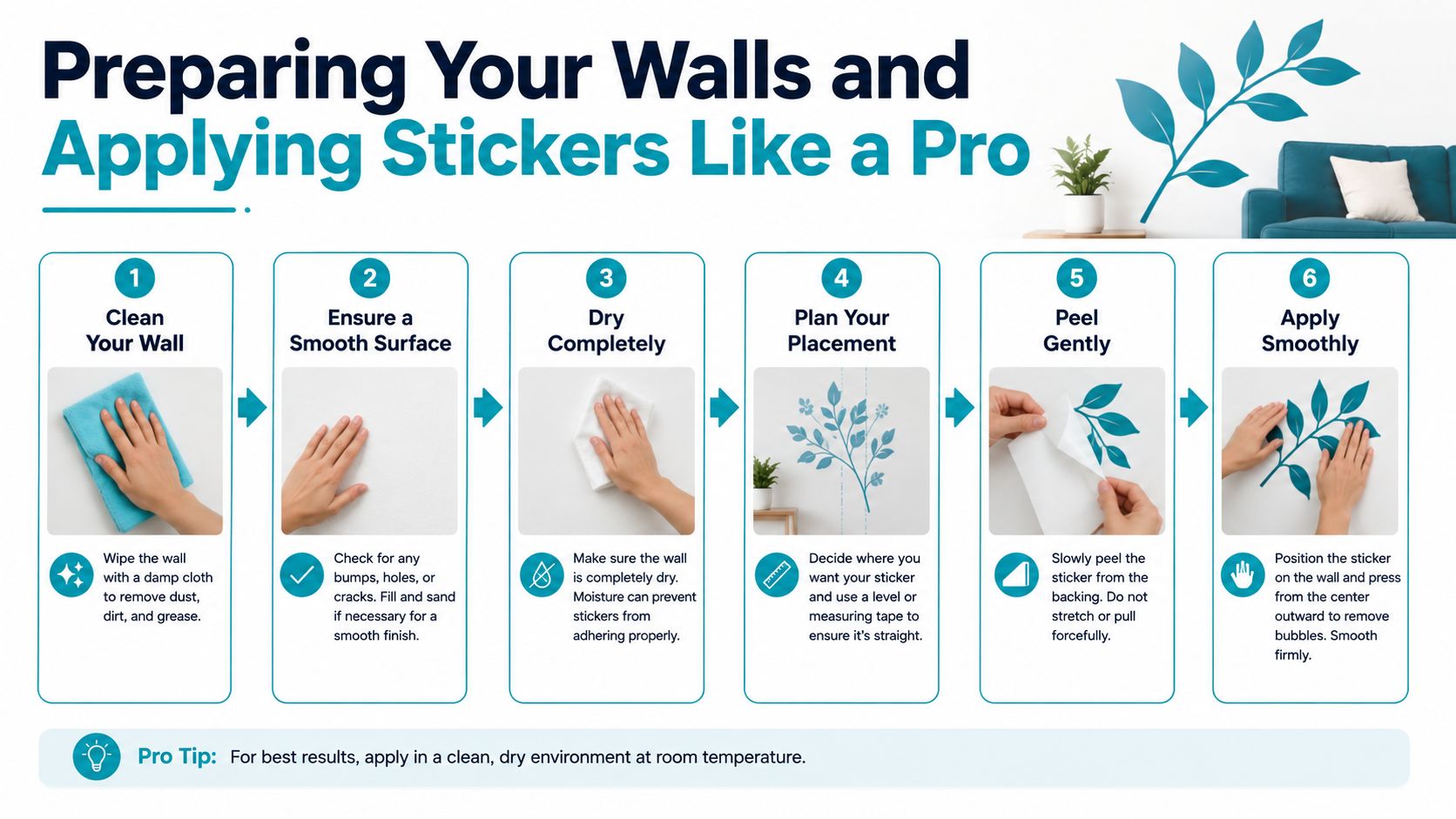
Fresh paint is where many people waste a good set of decals. The adhesive may be sound and the design may be perfect, but if the wall isn't ready, the sticker won't stay put. For animal wall stickers, the surface is the product interface, and you have to treat it that way.
The most important rule is the cure time. Manufacturers commonly advise waiting about 28–30 days after repainting before applying removable decals, because the paint needs to finish curing before low-tack adhesive can bond properly. If you rush it, the sticker can slide, edge-lift, or stick too aggressively to paint that hasn't fully stabilised. That's not a quality failure in the sticker, it's an installation failure.
Prep the wall before you touch the backing paper
The wall should be dry, dust-free, grease-free and free of silicone or latex contamination. Those residues sit on the boundary layer and reduce effective contact, which is why an apparently smooth wall can still fail at the edges. If the room has been freshly decorated, stop and check the finish. Removable decals are typically specified for smooth, flat, non-textured painted surfaces, not satin, eggshell, washable or textured finishes.
Here's the part people skip. Rub your hand over the wall. If it feels slightly tacky, chalky, dusty or uneven, fix that first. A lint roller helps with fine dust, but it won't rescue a poor finish. If the wall has visible texture, I'd generally steer away from decals and use framed art or another format instead.
Apply in sections, not all at once
Dry-fit the sticker first. Hold it against the wall, check the height, and use light pencil marks if needed. Then work from the centre or hinge point outward, pressing with a squeegee in firm, even strokes. Warm hands help the adhesive relax, and room temperature matters more than people think. Cold vinyl is stiff and less forgiving.
Use the hinge method on large sets. Tape the top edge in place, peel a section of backing, then smooth it down gradually. You get better alignment and fewer trapped bubbles.
If the design has multiple animal pieces, don't rush the spacing. The human eye notices crooked repetition before it notices the sticker itself. For a practical application walkthrough, the how to apply wall stickers guide from Quote My Wall is a useful reference.
Removal, Repositioning, Cleaning and Long-Term Care
A sticker is only a good purchase if it comes off in the same spirit it went on. That matters in rentals and in children's rooms, where wall design changes faster than most expect. If you want the best result, think about removal before you apply the first animal.
Start at a corner and peel slowly at a low angle. Don't yank upward. If the adhesive feels stubborn, warm the surface gently with a hairdryer so the vinyl softens and releases more cleanly. A heat gun can work, but it's easy to overdo it, so keep the heat moving and stay conservative. If the sticker has been on for years, expect a slower peel and test one edge first.
Keep the finish clean while it's up
Vinyl should be cleaned gently, not scrubbed. Use a soft dry cloth first, then a lightly damp cloth if needed. Harsh chemicals can damage print inks or weaken the adhesive at the edges. If a piece starts to lift, press it back down promptly rather than leaving a loose corner to collect dust.
The long-term problem is edge-lift. Once a corner starts to curl, dirt gets under it and the failure spreads. Keep an eye on radiator heat, bathroom steam and repeated touching at child height, because all three can shorten the life of a decal even when the sticker itself is good quality.
For renters, the key point is damage control. Peel slowly, warm the adhesive, and stop if paint starts to come with it. That is the whole game. To see the basic logic of removable formats laid out more broadly, the removable wall stickers UK guide is a handy companion.
Store the extras properly
- Keep spare motifs flat: Put leftover pieces back on the original backing paper if you can.
- Use a clean sleeve: A document folder or flat envelope stops dust from settling on the adhesive.
- Label by room: Nursery, playroom or hallway pieces are easier to reuse when you know the scale.
- Avoid loft heat: High temperature and humidity can deform vinyl before you ever use it again.
That storage habit saves money later. It also lets you repurpose animal motifs into another room instead of buying a whole new set.
Animal Wall Stickers Compared With Wallpaper, Paint and Framed Art
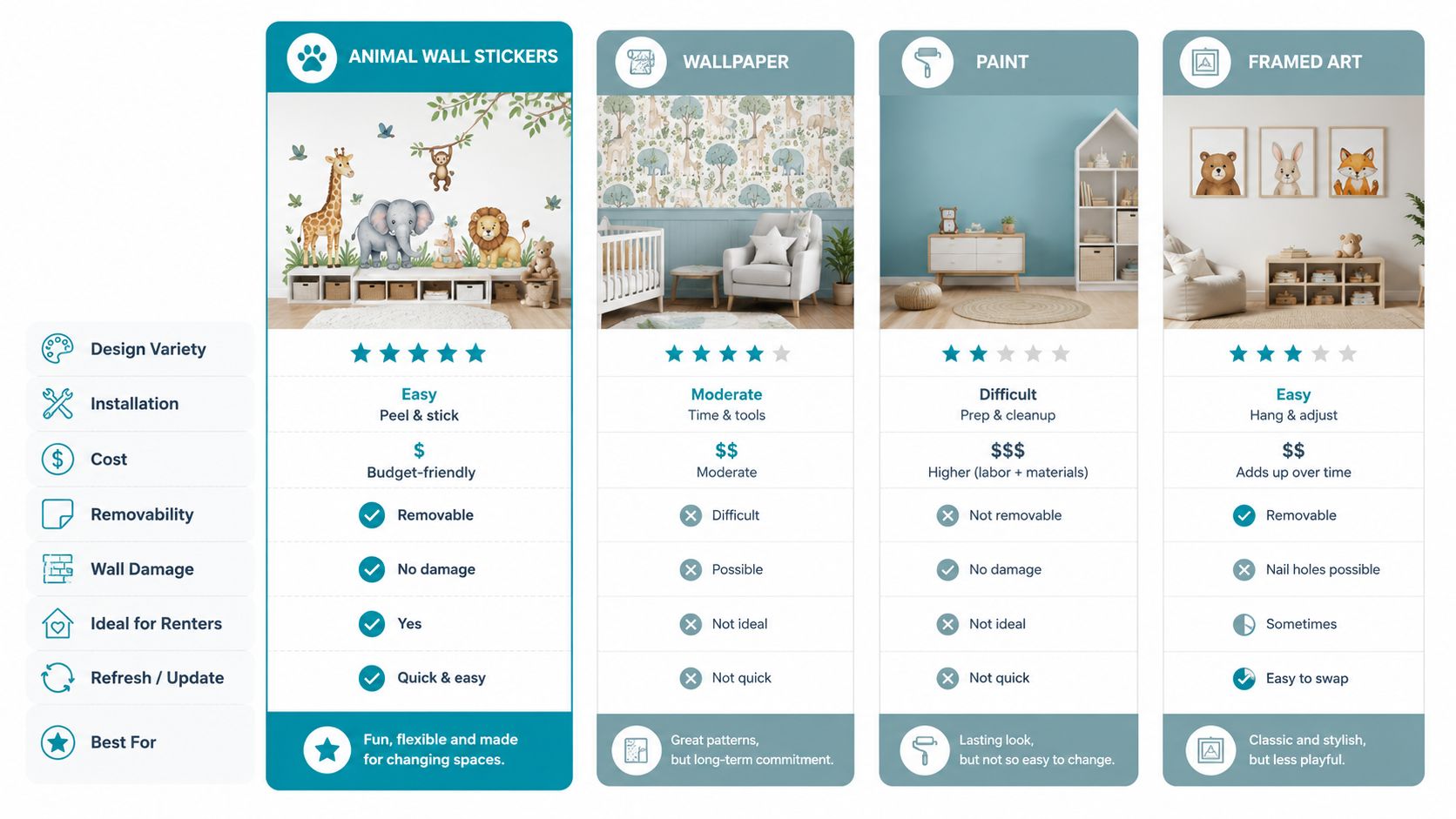
Wallpaper, paint and framed art all solve different problems, and pretending they're interchangeable only leads to disappointment. Animal wall stickers sit in the middle of the range, they're more flexible than wallpaper, less committal than paint, and easier to change than framed art arrangements. That makes them especially strong in rooms that need quick personality without a full redecoration.
The durability benchmark from earlier matters here. A well-made indoor decal can have a useful service life, but it still depends on adhesion and wall prep. Wallpaper and paint can outlast stickers in the right setting, yet both ask for more commitment and more disruption. Framed art is the cleanest removal option of all, but it doesn't give you the same mural effect on the wall surface.
Where each option wins
Wallpaper suits a room you want to commit to for years. It gives depth and pattern density that stickers can't fully mimic. Paint is still the best option when you need a total colour reset, especially if the room has awkward repairs or uneven patches. Framed art wins if you want flexibility with almost no wall risk.
Animal stickers win when you need a better compromise. They're ideal for renters, nurseries and rooms that change use often. They also keep disruption low, which matters when you don't want drying times, paste mess or extra labour.
A simple decision rule
- Choose stickers if you want reversible style, easy installation and lower commitment.
- Choose paint if the room needs a full refresh and you're ready for a proper decorating job.
- Choose wallpaper if you want a permanent visual statement and you own the space or have permission.
- Choose framed art if you want zero wall adhesion risk and easy reshuffling.
If you like faith-based room styling and want an example of how wall presentation can carry a strong theme without repainting, the faith-filled home decorating guide from Little Venture Co. shows how framed visuals can shape a room differently from vinyl.
My verdict is blunt. If you rent, or if the room is for a child who will outgrow the current theme, stickers are usually the smartest first move. If you're designing a long-term adult space, use them only when you want the room to stay light, playful and changeable.
Personalised Stickers, Custom Designs and Upcycling Ideas
The standard catalogue is only the starting point. Once you treat vinyl as a custom material, animal motifs start doing much more than sitting on a bedroom wall. I've seen a simple fox become the basis for a whole nursery palette, with matching initials, a name decal and a few supporting leaves around the cot. That works because the sticker becomes part of the room plan instead of a lone decoration.
Personalised name-and-animal decals are especially useful for siblings sharing a room. Each child gets a clear visual anchor without turning the space into a noisy collage. It also helps when beds, wardrobes and toy storage need to be visually divided. A family can keep the same animal style but vary the colours or sizes so each child has a distinct zone.
The smart ways to extend the idea
One of the best uses is furniture wrapping. A jungle motif can move from the wall onto a wardrobe door or bookshelf, which gives a tired piece of furniture a second life. The same approach works for drawers, toy chests and nursery organisers. It's cleaner than buying all new furniture and more coherent than scattering random decorative pieces around the room.
There are also off-wall uses that make sense in daily life. Smaller cut vinyl pieces can dress laptops, water bottles, school supplies and gift wrap without creating waste from a whole new product category. For small businesses and event planners, custom animal graphics work on temporary displays, props and branded décor when the visual needs to feel friendly rather than corporate.
If you want a commission rather than a template, start with the animal, colour palette and intended surface. A bespoke design is worth it when the room has awkward dimensions, when the motif needs to match a specific nursery theme, or when the design has to tie in with furniture wraps. For more practical detail on custom options, the personalised wall stickers UK guide is the right place to look.
The best custom jobs are simple, not overloaded. One strong animal motif, one supporting accent and one clear placement plan usually beat a crowded design with too many competing elements.
Your Animal Wall Sticker Buying Checklist
Before you order, run the wall and the product through the same checklist. Most bad installs fail at the prep stage, not the design stage. If the room passes, the sticker has a fair chance of looking polished. If it doesn't, you're better off waiting or choosing another format.
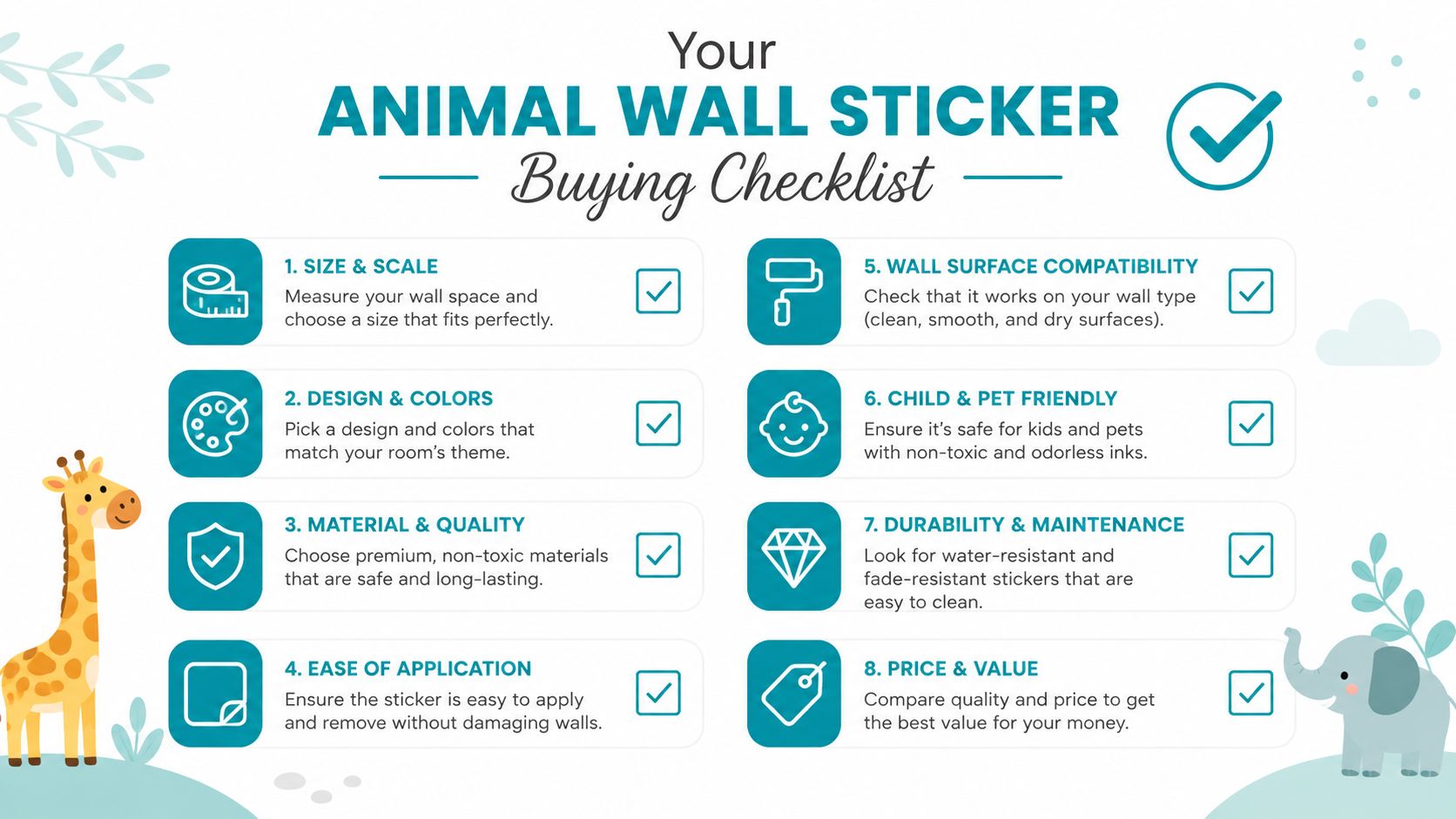
Quick buying check
- Is the paint fully cured? Wait about 28–30 days after repainting before applying vinyl.
- Is the wall smooth and flat? Textured, satin or eggshell finishes are a bad bet.
- Is the surface clean? Dust, grease and residues reduce adhesion fast.
- Do you know the material? Look for PVC or PVC-free vinyl, plus removable adhesive if you're renting.
- Is the coverage realistic? Compare the wall area in m² with the stated set coverage.
- Does the layout suit the room? Decide on the centre point, spacing and which animals should lead the eye.
- Will the finish work with the light? Matte is usually safer in bright rooms.
- Do you know how you'll remove it later? If the answer is no, stop and ask before you buy.
If anything is vague, ask the seller one blunt question. What is the adhesive type, what surface is it designed for, and how should it be removed without lifting paint? If they can't answer clearly, move on.
If you want animal wall stickers that are designed for real UK homes, not just glossy mood boards, take a look at Quote My Wall. You'll find vinyl wall stickers, personalised options and furniture wraps that make it easier to choose a design that fits your wall, your tenancy and your room's finish.