

Wall Art with Quotes: A Practical Guide for Every Room
You've moved into a rented flat, unpacked the boxes, and the walls are still bare magnolia. You want the room to feel like yours, but painting may not be allowed, and drilling a row of holes could create an awkward conversation with your landlord. Wall art with quotes offers a simple middle ground: a phrase can add personality, define the mood of a room and, in the right format, be changed without committing to permanent decoration.
The best choice isn't only about finding words you like. You'll also need to consider the wall surface, the room's purpose, the size of the furniture, the fixing method and how easily the artwork can be removed. UK décor spending supports this kind of regular interior refresh. One 2026 estimate placed the UK home décor market at £1.82 billion, up from £1.74 billion in 2025, with the category including wall art alongside clocks, mirrors, vases and other decorative accessories (UK home décor market estimate).
Why Quote Wall Art Works in Modern UK Homes
A blank wall can make a furnished room feel unfinished. A sofa, rug and lamp may all be in place, yet the space still lacks the small personal signal that tells visitors who lives there. A carefully chosen quote changes that quickly because language carries meaning before the viewer has studied the colour, frame or layout.
A phrase above a desk can create a purposeful working mood. In a hallway, a family saying can make the entrance feel warmer. In a bedroom, quieter wording can support the room's restful character. The quote becomes a visual reminder of something familiar, rather like a note you've chosen to keep in sight rather than a decoration selected only to fill space.
Three practical advantages
Personalisation without a major project is the first benefit. A removable decal or small framed print can bring character to a rented flat without repainting the whole room. This matters in UK homes where neutral walls are common and rooms often need to serve several purposes.
Easy changes are useful when your taste, household or tenancy changes. A playful nursery phrase may no longer suit the room after a redecoration, while a motivational office quote may feel wrong when the room becomes a guest bedroom. A replaceable format lets the wall evolve with the space.
Room-specific meaning is more useful than matching a phrase to a colour chart. Choose words according to what happens in the room. Encouraging language can suit a study, a gentle affirmation may work in a bedroom, and a welcoming family phrase can belong in a shared living area.
The wider UK wall art market also points towards strong demand for decorative wall products. It was estimated at USD 4,140.2 million in 2025 and is projected to reach USD 6,741.2 million by 2033, with a projected 6.4% CAGR from 2026 to 2033 (UK wall art market outlook). Wallpapers, stickers and wall coverings were identified as both the largest revenue-generating type in 2025 and the fastest-growing type segment over the forecast period. Quote decals fit directly into that category, so removable lettering belongs to a substantial part of the market rather than being a minor novelty.
For inspiration that focuses specifically on local styling, explore this guide to wall art quotes in the UK. Then make your decision in order: choose the format, select the phrase and font, match the design to the room, measure before ordering, and check the installation and care requirements.
Choosing the Right Format for Your Space
Different quote products behave differently on a wall. Vinyl is closer to a giant, carefully applied post-it note, while a framed print behaves like an enlarged photograph. The right choice depends on whether you want a temporary update, a substantial focal point or a material that can tolerate the room's daily conditions.
| Format | Typical UK Cost | Install Difficulty | Best Room Match |
|---|---|---|---|
| Vinyl wall decal | Budget to mid-range | Easy with careful smoothing | Nurseries, bedrooms and rented rooms |
| Self-adhesive lettering | Budget to mid-range | Easy to moderate | Offices, hallways and small alcoves |
| Framed quote print | Mid-range | Moderate, due to hooks and weight | Living rooms, bedrooms and gallery walls |
| Canvas quote art | Mid-range | Moderate | Home offices and larger living spaces |
| Wooden word sign | Mid-range to premium | Moderate to difficult, depending on weight | Kitchens, hallways and traditional interiors |
| Printed wall sticker | Budget | Easy | Playrooms, utility areas and short-term styling |
Costs vary by size, material, personalisation and finish, so treat these as broad buying bands rather than fixed prices. A small printed sticker may cost less than a custom wooden sign, while a large framed design requires both the artwork and suitable wall hardware.
Match material to the room
Vinyl decals suit people who want a light, flexible finish. They're especially useful in a nursery, where the design may need to change as the child grows. Self-adhesive lettering creates a clean, direct message without the visual weight of a frame.
Framed prints feel more like permanent furniture. They're a sensible living-room choice when you want the artwork to stay in place through several décor changes. They also work well in a gallery wall, where the quote acts as one element among photographs, illustrations and abstract pieces.
Canvas and wood add texture. Canvas can give a home office a polished appearance, while a wooden word sign works well where natural materials already appear in shelves, flooring or furniture. These formats usually need more dependable fixings and deserve greater care during installation.
For broader thinking about how artwork can define one wall without overwhelming the room, this feature wall artwork guide offers useful context on composition and placement.
Practical rule: If you're renting, don't judge removability by the product name alone. Check the adhesive type, the recommended surface and the removal instructions before buying.
Cheap lettering can curl at the edges, particularly when the wall is dusty, textured or poorly prepared. Thin paper prints may look fine online but can crease during framing or lose colour when placed in strong sunlight. Read the material description, request a sample or proof where possible, and make sure the finish suits the room rather than choosing only by price.
Picking a Phrase and Font That Actually Look Right
Start with the wall, not the quote. A long sentence squeezed into a narrow alcove will look cramped, while a short phrase floating on a very wide wall may feel accidental. Measure the available width and select wording that leaves comfortable space around it.
Take “Be the change” as a simple example. In a living-room alcove, write the phrase on paper at the proposed size, cut around it and fix the template to the wall with painter's tape. Sit on the sofa, stand in the doorway and view it from the side. If the words disappear at normal viewing distance, increase the scale. If they compete with shelves or lamps, reduce the size or move the placement.
Let the room choose the type style
A sans-serif font has clean, simple letter shapes. It suits modern, minimalist rooms and remains easy to read from across the space. A script font feels softer and more personal, which can work in bedrooms and nurseries, but very elaborate lettering becomes difficult to read when reduced.
A serif font has small finishing strokes on the letters. It can complement traditional furniture, period properties and formal living rooms. Consider the existing shapes in the space. If your room already has ornate frames and classic furniture, an ultra-modern geometric font may look disconnected.
Capitalisation also changes the volume of the message. Full capitals feel louder and more assertive. Lowercase script tends to feel gentler. Letter spacing affects whether a phrase breathes or bunches together, while line height matters when the wording is split across two or more lines.
Use these three checks before committing:
- Say it aloud: Choose a phrase that still feels natural when you hear yourself say it.
- Match the mood: Pair calm wording with restful rooms and energetic language with work or activity areas.
- Order a size guide: A life-size paper template is more reliable than judging a product photo on a phone.
If you're buying or licensing a custom typeface, this practical advice on what to consider when buying a font can help you assess readability, licensing and long-term suitability. For phrase ideas designed for adhesive applications, browse quotes for wall decals, then test your preferred wording at full scale before ordering.
Styling Quote Art by Room
The same phrase can feel completely different depending on where it appears. A bold statement above a desk may create focus, but above a cot it could feel too stimulating. Room function, furniture height, sightlines and lighting should guide the final placement.
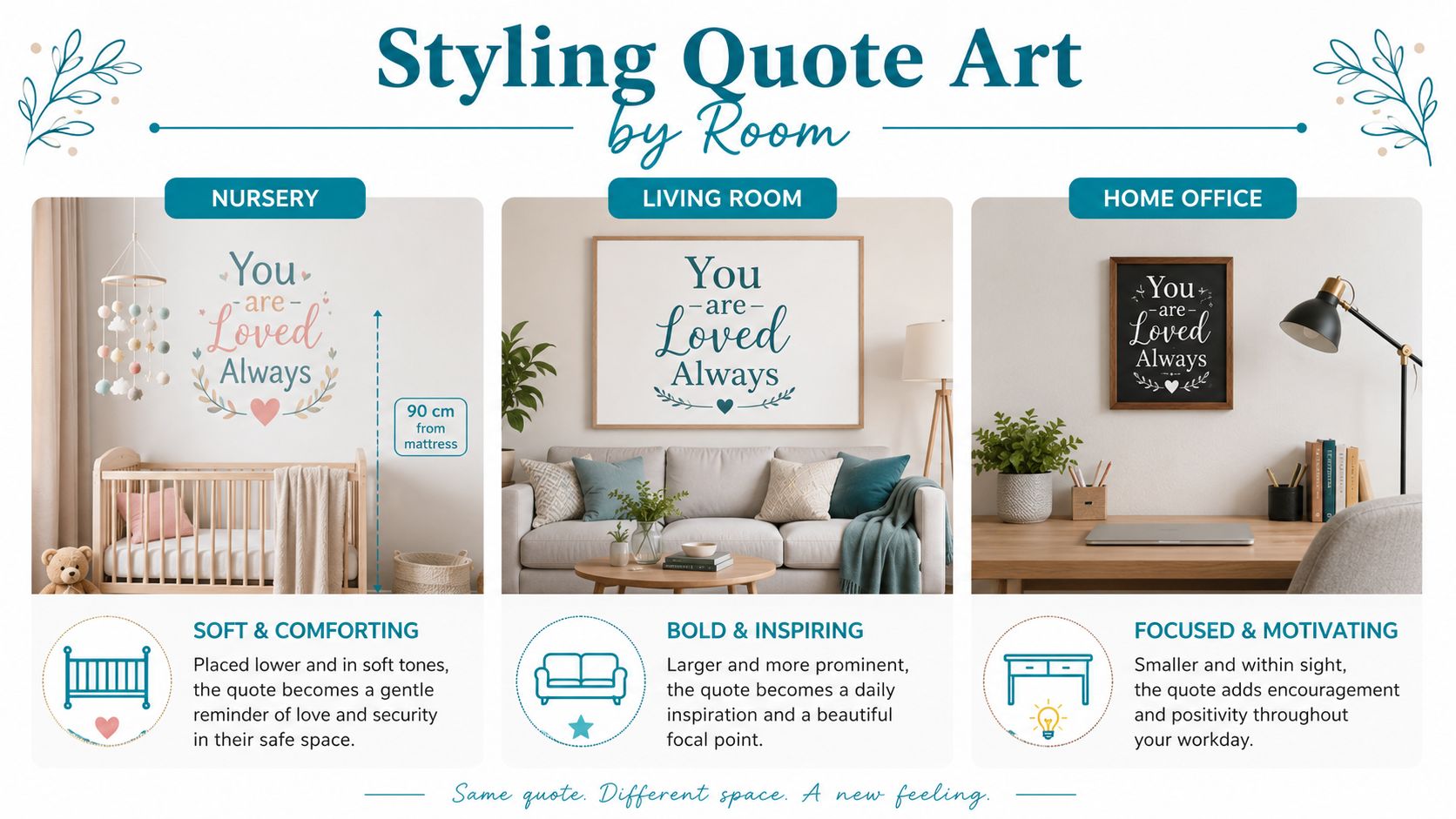
Nursery
A nursery benefits from a design that feels light and easy to update. A soft pastel vinyl decal above the cot can create a gentle focal point without introducing a heavy frame or a hard object near the sleeping area. Position the lettering roughly 90 cm from the mattress, as a visual guide, while checking the actual arrangement against the cot, changing table and any safety guidance relevant to the room.
Keep the quote within a calm sightline rather than placing it where strong contrast dominates the child's view. Soft colours, rounded lettering and generous spacing can make the display feel quieter. Avoid positioning adhesive art where a child could reach, peel or pull at it once they become mobile.
Living room
The living room usually needs a stronger visual anchor. One oversized framed quote centred above the sofa can define the seating zone, provided the artwork is proportionate to the sofa and doesn't collide visually with nearby shelves or lamps. Leave enough breathing room between the furniture and frame so the piece feels intentionally placed rather than pushed down onto the sofa.
An alcove calls for a different treatment. A cluster of smaller framed prints can follow the recess, with the quote acting as the central or most personal element. Gallery walls are increasingly useful for this approach. A 2026 British wall-art report found gallery walls were preferred over statement pieces by 31 to 1, according to its published trend data (British wall-art trend report). The implication for quote art is practical: a phrase doesn't always need to carry the entire wall. It can sit comfortably beside photography, illustration or abstract work.
Home office
In a home office, place the words beside shelving or behind the desk at eye level. You should be able to read the phrase without craning your neck or turning away from the screen. Keep the typography crisp and avoid placing glossy artwork directly under overhead lighting, where reflections can make the message harder to read.
A canvas or wooden sign can give the office a more established feel, while a self-adhesive quote keeps the arrangement flexible if the desk moves. Leave enough clear wall around the lettering so it supports concentration rather than adding another busy layer to the workspace.
Measuring, Ordering and Installing Without Mistakes
Begin with a tape measure and the wall itself. Record the usable width, not the full wall width, because doors, sockets, shelves and furniture may reduce the space available for artwork. Mark the centre point with a small piece of painter's tape, then measure outwards so the quote sits in relation to the room rather than drifting towards one side.
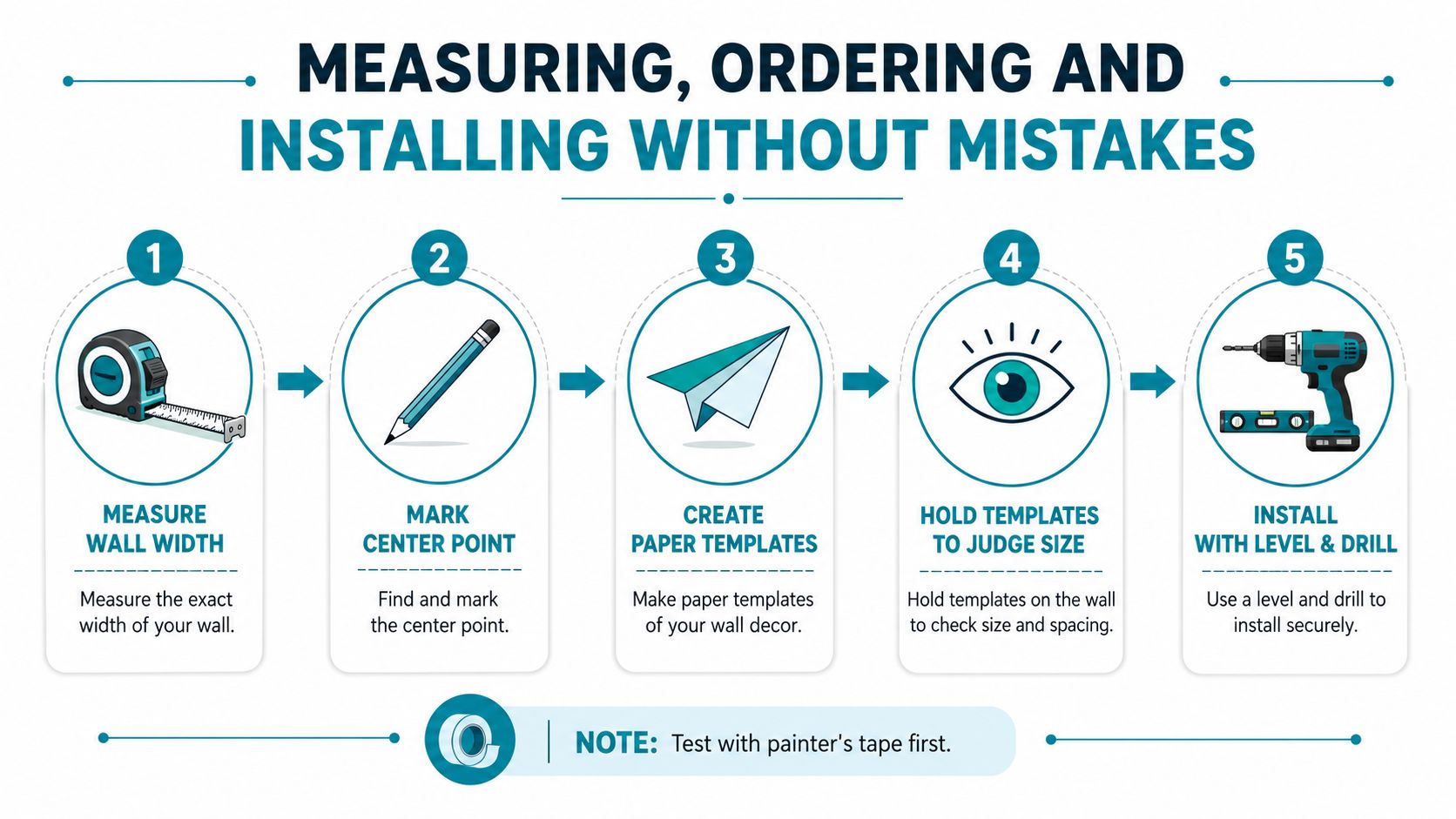
Cut a paper template to the product's proposed dimensions. For lettering, mark the outer edges and approximate the line breaks. Hold it in place with painter's tape, then inspect it from the doorway, the main seat and the normal standing position. This catches a common mistake: a design that looks balanced close up can seem too small or too high from across the room.
Check the product details
Read the specification before you order. Look for the media type, vinyl thickness where provided, paper weight for prints, finish, backing, adhesive description and whether the supplier recommends an indoor wall surface. If you're ordering a custom size, confirm the final width and height in writing.
Personalisation may include a name, colour change, font swap or revised line break. Ask for a digital proof if the wording is important, especially where punctuation, spelling or capitalisation affects the appearance. Custom work may also have different preparation or dispatch times, so check the stated lead time before planning a redecoration.
For peel-and-stick decals, prepare a clean, smooth, dry surface. Apply slowly and use a squeegee, felt applicator or old credit card to press the material down while pushing air towards the edge. Air-release liners create microscopic channels that help air escape as the graphic is smoothed, reducing bubbles and rework. UK self-adhesive wall-media listings describe removable adhesives and air-release constructions for indoor wall graphics (UK self-adhesive print media guidance).
Before applying adhesive: Test an inconspicuous area first, particularly on matt paint, recently emulsion-painted walls or a surface with a delicate finish.
Framed art needs a different approach. Use fixings rated for the frame's weight and suitable for the wall type, whether plasterboard, masonry or a stud. Renters should check the tenancy agreement before making holes. Adhesive strips aren't automatically safe for every frame or paint finish, and a failed fixing can cause more damage than a planned hook.
If you're comparing decal application methods and removable wall options, this guide to wall stick-on quotes provides a useful product-focused reference.
Caring for Your Quote Wall Art So It Lasts
Maintenance should follow the material and the room. Vinyl decals usually need only a dry microfibre cloth, moved gently across the surface rather than scrubbed at the edges. Harsh sprays can weaken adhesive or leave liquid behind the lettering, so spray the cloth only when the product instructions allow it, never the wall graphic itself.
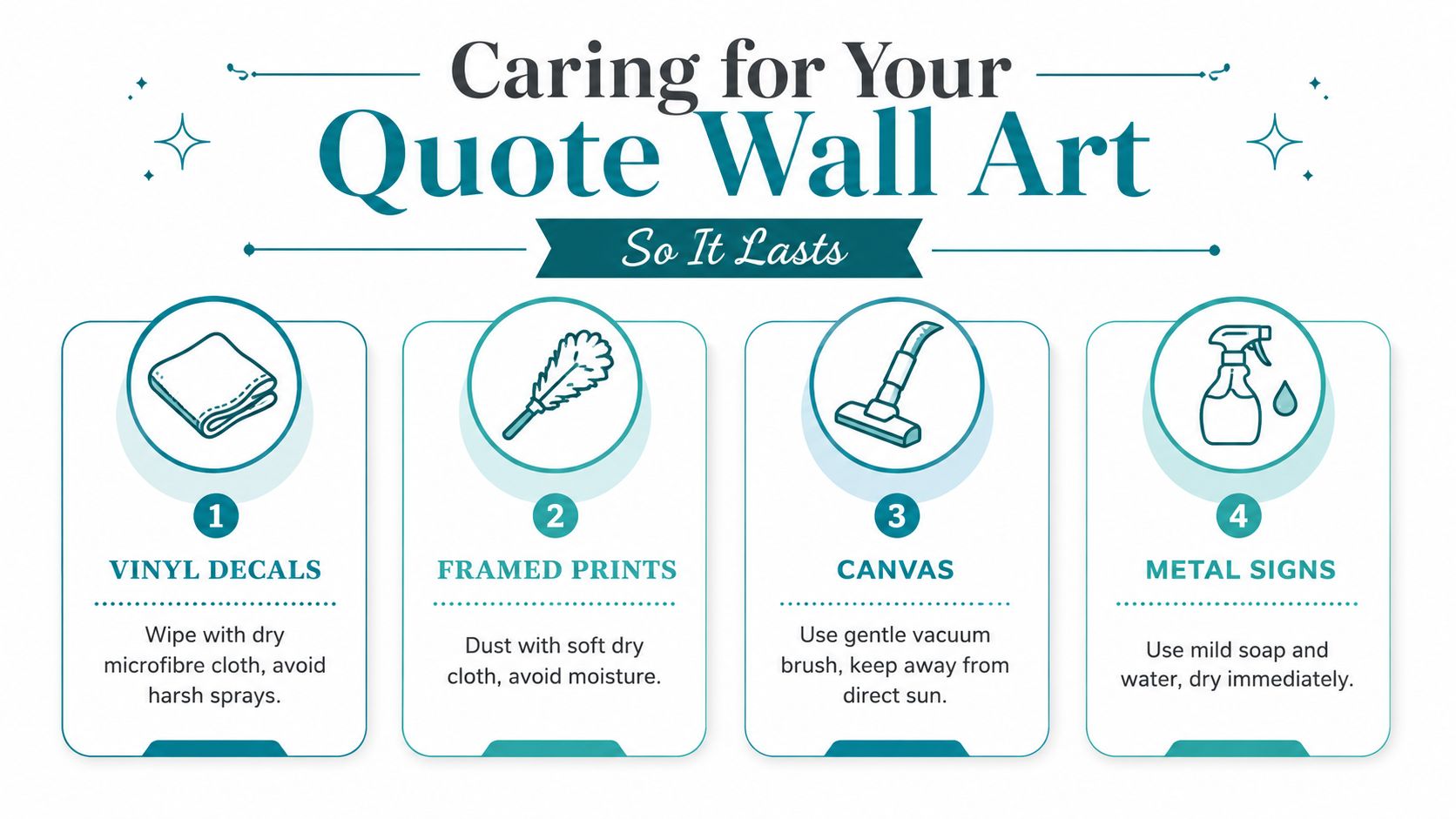
Framed prints benefit from soft dusting and protection from moisture. Kitchens and nurseries may expose frames to steam, splashes or fluctuating humidity, so keep paper artwork away from direct sources of damp. Canvas can be cleaned with a gentle vacuum brush, while wooden and metal pieces should be treated according to their finish.
Protect colour and alignment
Direct sunlight can fade printed artwork faster, particularly when the print hangs close to a bright south-facing window. Place framed or canvas quote art away from direct rays where possible, or choose UV-protective glazing when the artwork's colour matters. Sun protection won't remove every risk, but it reduces the intensity of exposure.
Removable decals should be repositioned only when the product instructions permit it. Peel slowly and close to the wall, rather than pulling sharply away from the surface. If the adhesive edge gathers dust, curls or loses its bond, replacement is usually cleaner than repeatedly pressing the same section down.
A tilted frame is easy to correct if you deal with the fixing rather than nudging the artwork every day. Two hooks can provide better stability for a wider frame, and a spirit level helps you set the line accurately. Check the display more often in busy areas, while a low-traffic bedroom may need little attention beyond dusting.
Care follows conditions: Moisture, touch and sunlight determine the routine more than the quote itself.
Research into wall and ceiling adhesives found the lowest VOC-emission group in the 19–72 µg/m³ range (research on adhesive VOC emissions). UK indoor-air guidance referenced in BREEAM documentation sets an interior-adhesives target of ≤ 0.06 mg/m³, with testing methods including EN 13999 and ISO 16000 in the cited documentation. For nurseries, bedrooms and care settings, ask about the complete printed film and adhesive assembly, not just whether the finished product looks attractive.
Quick Checklist Before You Buy
Save this checklist before browsing. It reduces the chance of choosing a beautiful quote that's too large, difficult to remove or unsuitable for the wall.
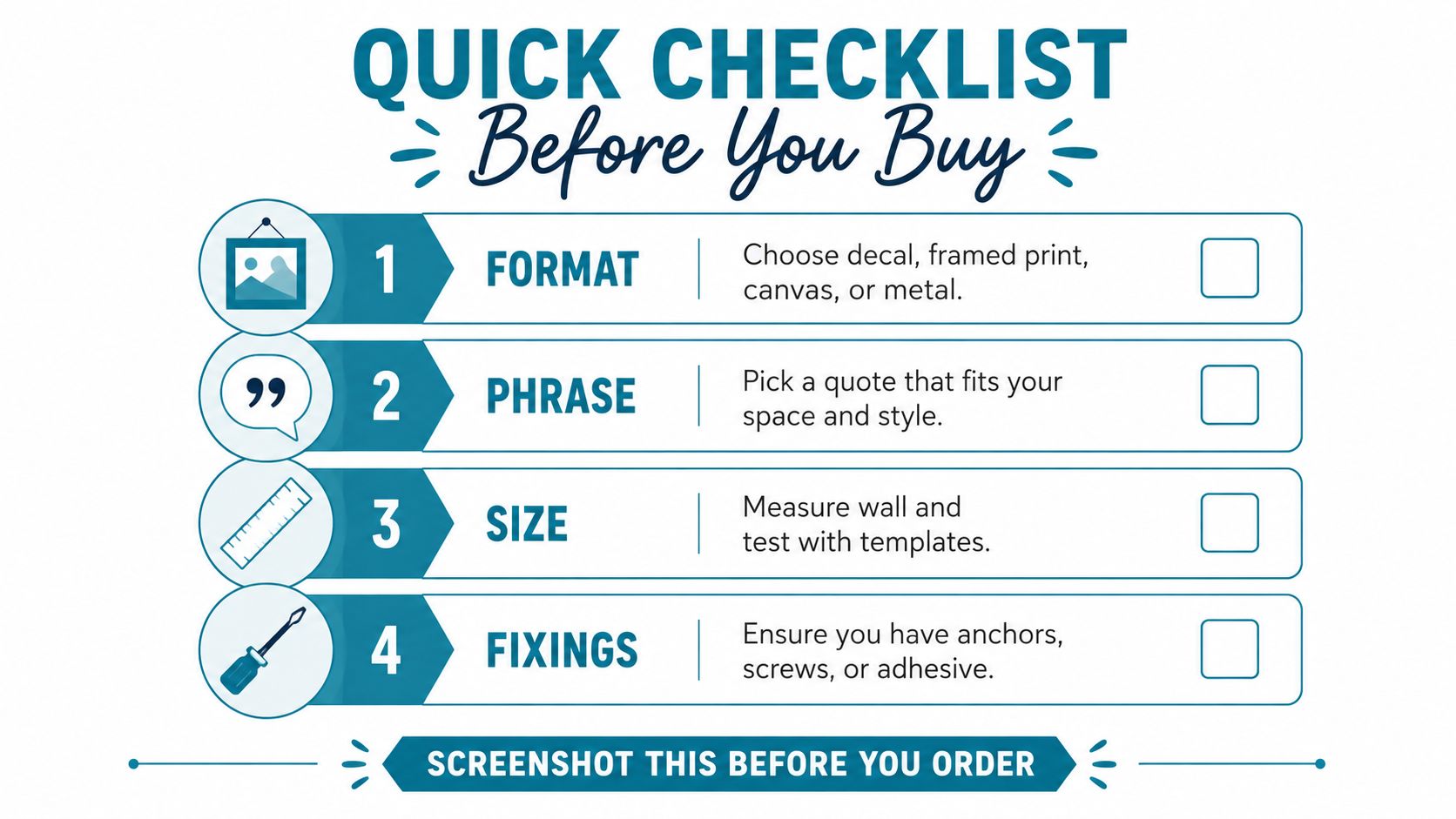
- Format: Do you need a removable decal, a framed print, canvas, wood or metal? Choose the material according to the room, tenancy and expected lifespan.
- Phrase: Can you say the wording naturally, and does its mood suit the room's purpose?
- Size: Have you measured the usable wall and tested a paper or painter's-tape template? Don't skip this step. A small height mismatch can make an entire display look off-centre.
- Surface: Is the wall clean, dry, smooth and fully cured? Textured paint, fresh emulsion and loose surfaces can undermine adhesive products.
- Fixings: Do the supplied or chosen hooks, screws, anchors or adhesive support the product and match the wall type?
- Air quality: For a nursery, bedroom or care setting, can the seller explain the emissions properties of the complete adhesive and printed-media system?
- Proof: Will the seller confirm spelling, line breaks, font and colour before production?
- Colour: Can you request a colour swatch or explain how the on-screen colour may differ from the finished product?
- Removal: What's the recommended removal method, and is the adhesive designed for the surface you have?
If you're still deciding between personalised vinyl lettering and printed wall décor, Quote My Wall offers wall sticker quotes, motivational decals, personalised wall stickers and prints that can be considered against these format and room requirements. Visit Quote My Wall to browse quote-led wall décor and choose a design that fits your phrase, wall surface and installation plans.