
School Uniform Labels UK: Which Type Lasts the Wash?
47% of UK parents say they are concerned about the cost of school uniform, and among parents whose children are eligible for free school meals that figure climbs to 58%, according to a 2024 YouGov survey of 5,490 parents submitted as parliamentary evidence. Hold that number in your head through August, because very little of that worry gets solved by shopping around for a cheaper blazer. It gets solved by the jumper coming home.
Replacements drive the bill. A cardigan left in a cloakroom, a PE top that goes home in the wrong bag, a coat that vanishes from the peg queue: every one of those is a purchase you make twice. A name label costs pennies and attacks the problem at the only point where it can be fixed, which is before the garment walks out of the building with somebody else's child.
Four label types cover almost everything sold as school uniform labels in the UK: stick-on vinyl, iron-on, sew-in tape and fabric markers. They behave very differently in a 40°C wash, and only one deserves to be your default. What separates a label that survives to next September from one that curls off in November comes down to how it bonds, what it tolerates, where you put it, and whether the next child can wear the garment afterwards. Get those four right and labelling takes one evening.
Why School Uniform Labels Earn Their Place
A jumper goes missing on a Tuesday in October. It sits in a lost-property bin for six weeks, unclaimed because nothing on it says whose it is, and by half term the family has bought another one. Multiply that by every child in the school and you have the problem headteachers describe every term.
A survey of UK primary schools run by Label Planet Ltd puts numbers on it. Two-thirds of schools rate their lost-property problem as medium or severe, and almost 90% pick name labels as the best way to reduce it. Top layers cause most of the trouble: jumpers, sweaters, cardigans, sweatshirts and hoodies sit among the top three problem items for 90% of schools, with coats named by 41%.
The labelling rate changes the outcome more than anything else. Where at least half of parents actively label clothing, only 9% of schools classed lost property as severe. Where less than a quarter of kit was labelled, that rose to 49%. Yet just 3% of schools report that most uniform and kit is labelled, even though 98% store lost property, committing staff time and storage space to unclaimed garments.
That gap is why a pack of labels does more for your budget than any other back-to-school purchase. Your job is to choose the right type, apply it properly, and cover every item that comes off during the day.
School Uniform Label Types Compared
Four types dominate the UK market, and they're not interchangeable. Price tells you almost nothing about value here, because the cheap pack that peels in the first half term costs more than the pricier pack that survives two years and two children.
| Label type | How it is applied | Wash and dryer performance | Best for | Typical UK pack price |
|---|---|---|---|---|
| Stick-on vinyl name labels | Peel and stick onto the care label or fabric, no tools | Premium versions survive machine wash, tumble dryer, dishwasher and microwave | Fast labelling of clothes, bottles and stationery | £4-£11 |
| Iron-on name labels | Pressed on with a household iron and baking paper | Wash-fast for dozens of cycles; check tumble-dryer tolerance | Permanent marking of shirts, jumpers and PE kit | £6-£15 |
| Sew-in name tapes | Stitched into a seam or care label by hand or machine | Most durable option; outlasts the garment and unaffected by heat | Boarding kit, care homes and hand-me-downs | £5-£12 |
| Fabric stamps and markers | Ink pressed or written onto the fabric | Fade after repeated hot washes; reapply as needed | Shoes, insoles and backup marking | £3-£8 |
How the four actually divide up the job
Iron-ons are the workhorse for shirts and PE kit if you own an iron and have the patience for baking paper. Per year of wear they're cheap, and the bond is permanent on cotton-rich fabric. Sew-in tapes beat everything on longevity and work out cheapest per garment on kit that gets handed down, because nothing in the laundry can dissolve a stitch.
Stick-on vinyl has improved beyond recognition. The good versions take machine washing, tumble drying, a dishwasher cycle and a microwave without the print lifting, which makes them the only type you can use on a water bottle and a cardigan in the same sitting. Fabric stamps look like the bargain option and often are, but they're a marking tool rather than a system.
My default: high-tack stick-on vinyl for most of a school uniform, iron-on for the shirts that go through a weekly hot wash, and sew-in tape only where a garment is expected to outlive its current owner's surname.
Buy for the whole year in one go. Count the items you send in, add two spare bottles and a pencil case, and order a pack sized for that number rather than topping up in panic during the February lost-property clear-out.
How Each Label Type Bonds to Fabric
Every label fails for a reason you can predict from the way it attaches. Once you see the mechanism, the buying decision stops being a coin toss.
A stick-on label is a plaster for clothing. Its pressure-sensitive, ultra-high-tack adhesive grips the fibres the moment you press it down, so a clean, dry surface and firm thumb pressure matter far more than heat ever will.
An iron-on label is a fusible patch. The adhesive film melts under the iron and locks into the weave as it cools, which is why under-heating is the mistake nearly everyone makes: a lukewarm iron gives a bond that looks fine and lets go in the second wash. Use baking paper, hold the iron still for the full time the pack states, and let the garment cool flat before you move it.
Sew-in tape is a button. Thread holds it, not chemistry, so nothing in a hot wash can dissolve the fixing. That makes it perfect for boarding kit and useless for a jumper heading to a swap shop next summer, because removing it takes scissors and patience.
Fabric ink is a dye, not a fastener. It soaks into the fibres and fades as those fibres abrade, so it belongs on shoes and insoles where nothing flat will sit still.
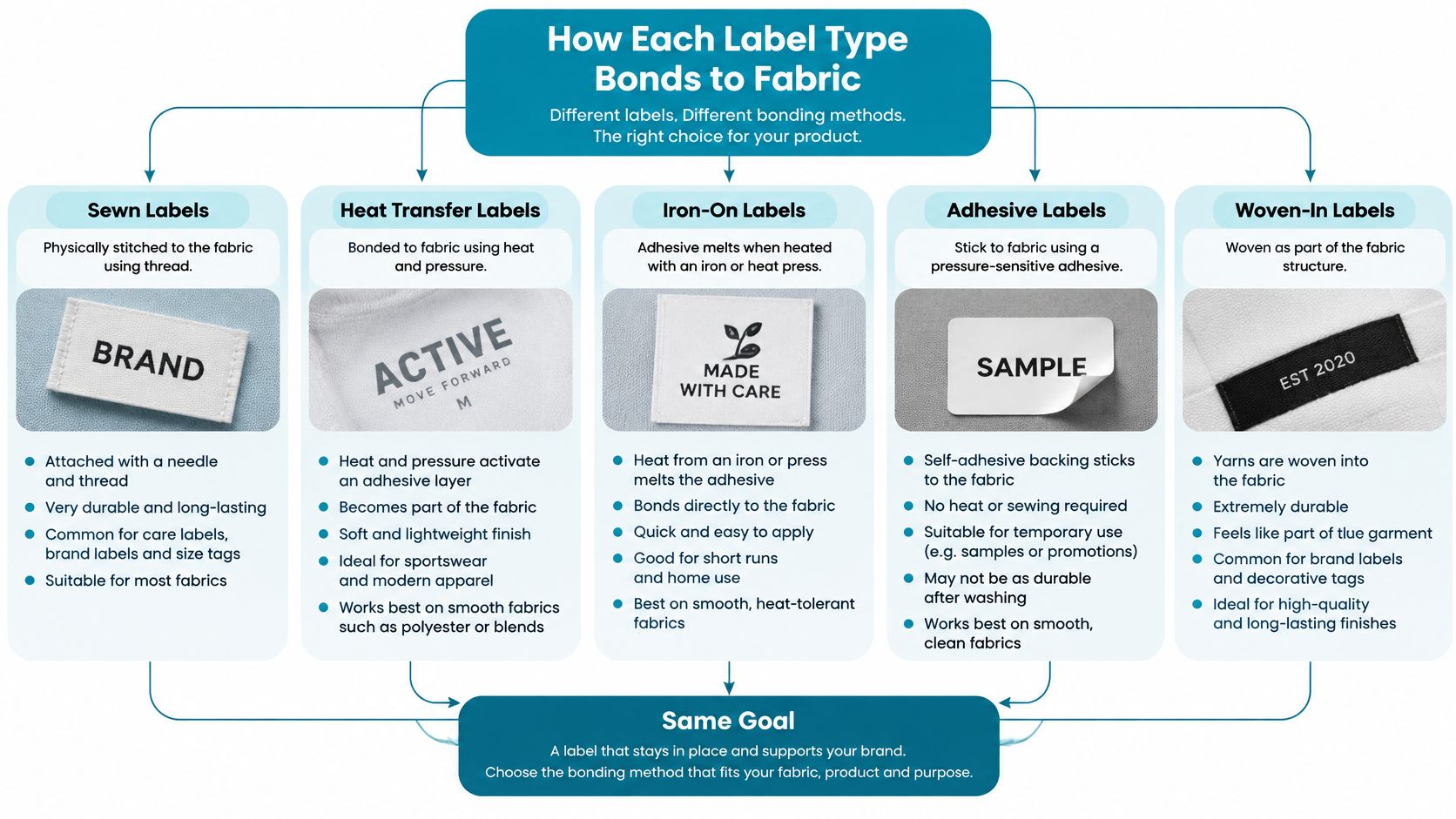
Adhesive labels lift at the edges first, where fabric flexes and rubs against a coat lining or a waistband. Iron-ons peel from a corner when the iron never got hot enough. Ink fades in patches. All three give you warning if you look for it.
Test rule: judge a label after its third wash cycle, not on the day it arrives. The first wash flatters every product on the market.
If you're leaning towards stitching for a child who loses everything, this walkthrough of sew-on clothing tags covers needle, thread and the placement that keeps the tape away from skin.
Durability Checks and Where to Put Labels
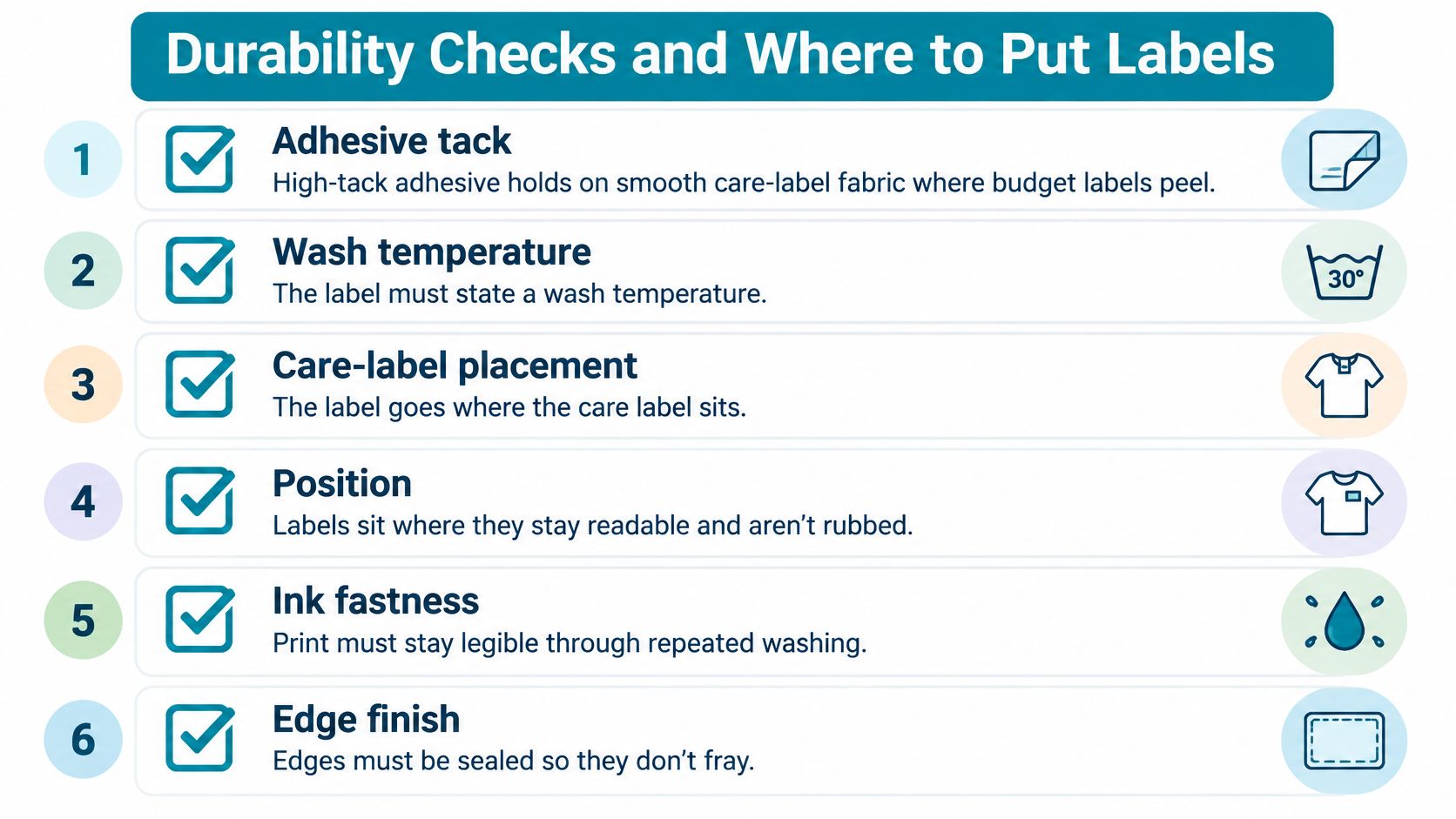
Run six checks before you buy, and again on the first label you open. They separate a product that lasts a school year from one that turns up in the washing machine filter.
- Adhesive tack. High-tack adhesive holds on the smooth, slippy fabric of a care label. Budget labels slide off that surface within weeks, so check the wording for high-tack or ultra-high-tack rather than "self-adhesive".
- Wash temperature. The listing or pack must state a maximum. 40°C covers everyday school washes; 60°C matters when something comes home with a sickness bug and needs a deep clean.
- Tumble-dryer safety. Heat kills adhesives faster than water does, so confirm dryer tolerance explicitly rather than assuming wash-safe means dryer-safe. If the pack is silent on drying, line dry.
- Ink fastness and legibility. High-contrast print, a first name plus surname initial, and a compact format that fits a narrow care label. Faint grey print on white is unreadable at arm's length in a lost-property bin.
- Edge finish and position. Sealed edges resist fraying, and the label needs to sit somewhere it isn't rubbed. Keep it away from seams, stretch zones and direct skin contact, because flexing, abrasion and heat are what accelerate edge lift.
- Test one item first. Check that garment's care label, apply a single label, and put it through a full wash and dry before you commit to the rest of the kit.
UK uniform policy backs this approach rather than fighting it. The UK Parliament briefing on school uniform states that schools should minimise branded items and may use sew-on or iron-on labels to control colour, shade, fabric and fit without requiring branded garments, and government guidance reserves branding for durable items such as ties rather than frequently replaced shirts. A good label system lets generic trousers and shirts meet the policy, which is the whole affordability argument in one sentence.
That makes a specification worth reading properly. It should state the permitted application method, compatibility with cotton and polyester blends, resistance to repeated domestic laundering, and whether the print stays legible after tumble drying.
Where to put each label
| Item | Where to label | Why it works |
|---|---|---|
| Jumpers and cardigans | Care label at the back neck | Flat, low-flex area that survives washing |
| Shirts and polo shirts | Care label or lower hem | Away from collar stretch and skin contact |
| Coats and PE tops | Inside pocket or care label | Hidden spot that avoids abrasion |
| Trousers and skirts | Waistband or care label | Moves less in the wash than hems |
| Shoes | Tongue or removable insole | Survives scuffing and stays readable |
| Water bottles | Side of the bottle | Dishwasher-safe labels survive hot cycles |
| Pencil cases and kit bags | Flat panel away from zips | Zips scrape edges and lift adhesive |
Application follows the same order every time. Work on a clean, dry, flat surface, press stick-on labels firmly from the centre outward for 10 to 15 seconds, and leave them 24 hours before the first wash. Position iron-ons away from printed branding so a school-name change doesn't leave two names showing. If you're buying machine washable labels for the first time, start with the care-label spot on one jumper and let the laundry prove it.
Label every detachable thing, not just the uniform: coats, PE kit, insoles, bottles, bags and lunch textiles. The items that come off are the items that get lost.
Labels for Siblings, Second-Hand Uniforms and School Moves
The most expensive labelling mistake isn't a label that falls off. It's one that never comes off, on a garment that could have gone to another child.
Second-hand uniform is now part of the system rather than a favour between friends. The Department for Education requires schools in England to make second-hand uniforms accessible and to publish how parents can obtain them, and government figures cited alongside that requirement put compulsory branded-item levels at 24% of primary and 70% of secondary schools, with Parliament citing an estimate that more than 1.4 million quality uniform items are lost in the UK each year (Department for Education school uniform guidance).
That reframes what a label is for. A durable label protects the value of a garment still in use. A permanent label can destroy the value of a garment about to be passed on, because the next family either covers it, unpicks it or leaves it on the shelf.
The cover or remove rule
| Situation | Label to use | Cover or remove rule |
|---|---|---|
| Younger sibling or hand-me-down | Surname-only label or cover-up patch | Leave the surname visible; cover the first name for the next child |
| Second-hand or swap shop donation | Coverable stick-on label | Cover the name with a new label or remove it before donating |
| School move | Initial-based label | Initials survive the move; cover a full-name iron-on |
| Care home or boarding kit | Sew-in name tape | Keep permanently; no cover needed |
Siblings are the easy case and the one most families get wrong. A label showing just the surname, or a first initial plus surname, transfers down the line without a single unpicking session. If you've already committed to full names, a plain new label over the top works fine as long as the original wasn't ironed across a seam.
School moves catch people out in July. Initials keep working when a child changes school, a full-name iron-on usually doesn't. For shoes, which get handed down more than anything else in the house, this guide to shoe labels covers tongues, insoles and the spots that survive scuffing.
The contrarian bit: the cheapest label isn't always the most sustainable one. A durable label prevents a replacement purchase; an over-permanent label removes the resale value that makes second-hand uniform work in the first place.
Schools and tutoring settings that keep pupil records in one place can speed recovery by noting which items are labelled at the point of enrolment, and student management tools can hold that kind of detail next to contact and attendance records. Care homes sit at the opposite end of the spectrum from hand-me-downs: permanent, high-legibility sewn identification that survives repeated industrial laundering, with no intention of removal.
Choosing the Right Labels for Your Family
Verdicts first, then the plan. If you're a primary parent who will never thread a needle, buy high-tack stick-on vinyl and put it on the care labels. Boarding school or care-home kit means sew-in tapes, no debate. Secondary PE kit gets stick-on on the kit and bottles plus iron-on on the shirts. A household living on second-hand uniform should choose coverable stick-on labels so the next child starts with a clean name.
The maths supports the fuss. The UK Government estimated that parents paid an average of £343 for primary-school uniforms and £442 for secondary-school uniforms in 2025 (gov.uk announcement on lower uniform costs). One lost jumper a term eats most of a labelling budget for the whole family.
Our stick-on clothing labels need no sewing or ironing: peel, press and it's done. An 84-label pack costs £10.99, and the labels are fully washable and safe in dishwashers, tumble dryers and microwaves.
The weekend plan
- List every detachable item across all children, including coats, PE tops, bottles, bags and insoles.
- Order one pack of the type you've chosen, sized to that list plus a few spares.
- Apply one label and run it through a full wash and dry cycle before you touch the rest.
- Label the remaining kit in one sitting, care labels first, then bottles and bags.
- Recheck at half term and replace any label showing a lifted edge.
Do that in the last week of August and you'll spend September hearing about maths homework instead of lost property.
Quote My Wall sells ultra high tack stick-on clothing labels built for school uniform, PE kit, water bottles and care-home clothing, all fully washable and safe in the tumble dryer and dishwasher. If you want a labelling system that's still legible next September, Quote My Wall has packs of 36, 66 and 84 labels to cover a single child or a whole household. Order one pack, run the test wash, and label the entire uniform in a single evening.