
Clothing Labels and Tags: The Complete UK Guide
You're standing in the laundry room with a stack of jumpers, polo shirts, and care items that all look the same after one week. The problem isn't buying clothing labels and tags, it's buying the right kind for the job, because a legal fibre label and a name label solve completely different problems.
In the UK, textile labelling has been formally regulated for years, and the rules are specific. The Textile Products (Labelling and Fibre Composition) Regulations 2012 require fibre-composition information on textile products, with labels in English and made to be durable, legible, visible and accessible. That's the compliance side. The identification side is separate, and it's the one schools and care homes usually care about day to day, because it stops garments disappearing into shared laundry systems and lost-property bins.
Buyers waste time when they treat every label as if it does the same job. It doesn't. If you manage uniforms, resident clothing, or bulk household kit, you need to separate what the law requires from what makes sorting easier, because those are different purchase decisions.
Understanding the Two Types of Clothing Labels and Tags
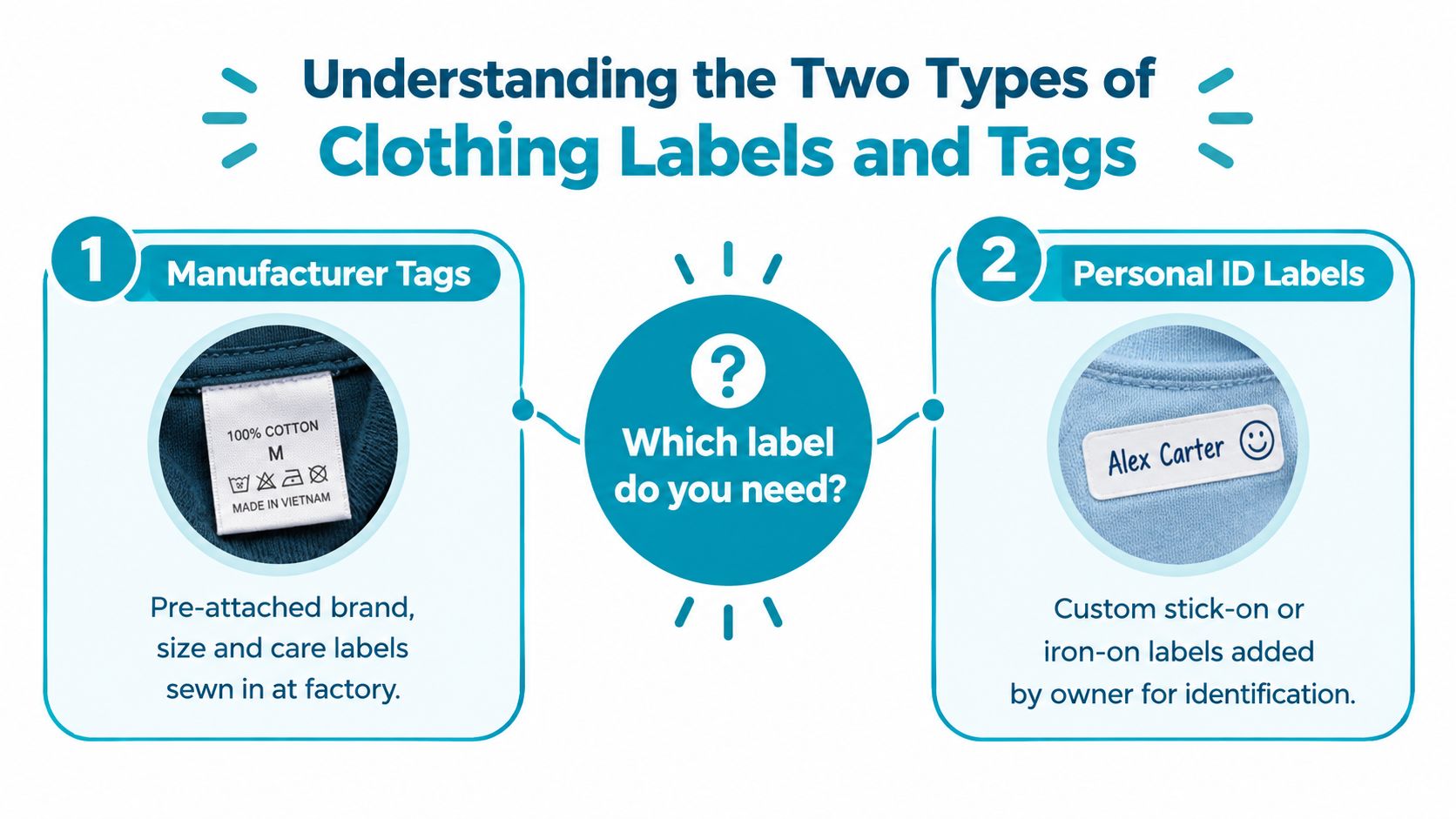
A child brings home a jumper that looks new, then it vanishes into the school lost-property pile by Friday. That's not a compliance failure, it's an identification failure. The garment already has manufacturer information, but it still needs a separate ownership label if you expect staff to return it to the right child.
Compliance labels are about the garment itself
Manufacturer clothing tags are the labels sewn in at source, and they're there to communicate fibre content and care information. Under UK rules, textile products sold to consumers must carry fibre-composition details, labels must be in English, and multi-component items need the fibre content of each component shown where relevant (Textile Products (Labelling and Fibre Composition) Regulations 2012). UK government guidance also makes clear that fibre content labelling is a compliance requirement for almost all textile goods sold to consumers, including products with fur or other animal parts (UK textile labelling guidance).
That is why a brand-new school jumper still isn't “named” just because it has a sewn-in care label. The care tag tells you what the garment is made of and how it should be handled. It does not tell a dinner lady, laundry contractor, or care assistant who owns it.
Identification labels solve the sorting problem
Personal ID labels do a different job. They're added by the owner, usually as stick-on, iron-on, or sewn labels, and they help staff, carers, and laundry teams return items to the right person. If you buy for a school or care home, that distinction matters more than glossy marketing language, because ownership marking and compliance marking are not interchangeable.
If you want a plain-English breakdown of materials and practical use cases, the material guide at Choosing the Right Material for Name Labels is useful as a buyer's reference, especially when you're comparing fabric and adhesive options rather than garment compliance.
One practical source for printed tag stock is Dirt Cheap Product hang tag paper, which sits in the manufacturing and merchandising world. That's the point, really, it belongs on the supplier side, while the owner label belongs on the laundry side.
Practical rule: if the label explains what the garment is, it's compliance. If it explains who owns it, it's identification.
Comparing Stick-On, Iron-On, and Sewn Identification Options
Procurement teams usually overthink the wrong question. They ask which label looks neatest, then discover the issue is whether it survives repeated washing, tumble drying, and hurried staff handling. For schools and care homes, the answer comes down to speed of application, fabric compatibility, and how much punishment the label can take before it fails.
Stick-on labels
Stick-on identification labels are the fastest to deploy. You peel, place, and press, which matters when you're labelling a whole intake of uniforms or resident clothing in one sitting. They're a strong fit for care-label surfaces, printed name tapes, and other smooth areas where a clean bond matters more than visible stitching.
The case for stick-on labels is simple. They save staff time, they don't require heat, and they avoid needlework. If you're ordering for high turnover, that alone makes them easier to manage than iron-on labels or hand-sewn alternatives.
Iron-on labels
Iron-ons suit buyers who want a permanent-looking result and don't mind spending time with an iron and a hard surface. They can work well on compatible fabrics, but they depend on precise heat and pressure. On textured or awkward surfaces, the bond can be less predictable, and that's a poor fit for large-scale uniform processing.
Sewn labels
Sewn labels are the traditional option. They're permanent, but they're also slow, and in some garments they can create an irritation point for sensitive skin. Care homes, in particular, often prefer faster methods because resident items move through laundry systems quickly and staff do not have time to hand-finish every item.
| Label Type | Application Time | Best Fabric Types | Durability Profile |
|---|---|---|---|
| Stick-On | Very fast | Smooth care labels, tags, and many flat garment areas | Good for repeated laundering when applied properly |
| Iron-On | Moderate | Fabrics that tolerate heat and pressure | Strong when applied correctly, weaker on tricky textures |
| Sewn | Slow | Most fabrics, especially where permanence matters | Very durable, but labour-heavy and less flexible |
For a direct comparison of the practical trade-offs, see benefits of stick-on clothing labels compared to iron-on clothing label tags. In procurement terms, the winner is usually the label that reduces labour without compromising wash survival.
Surviving the Laundry Cycle, Heat, Water, and Adhesion
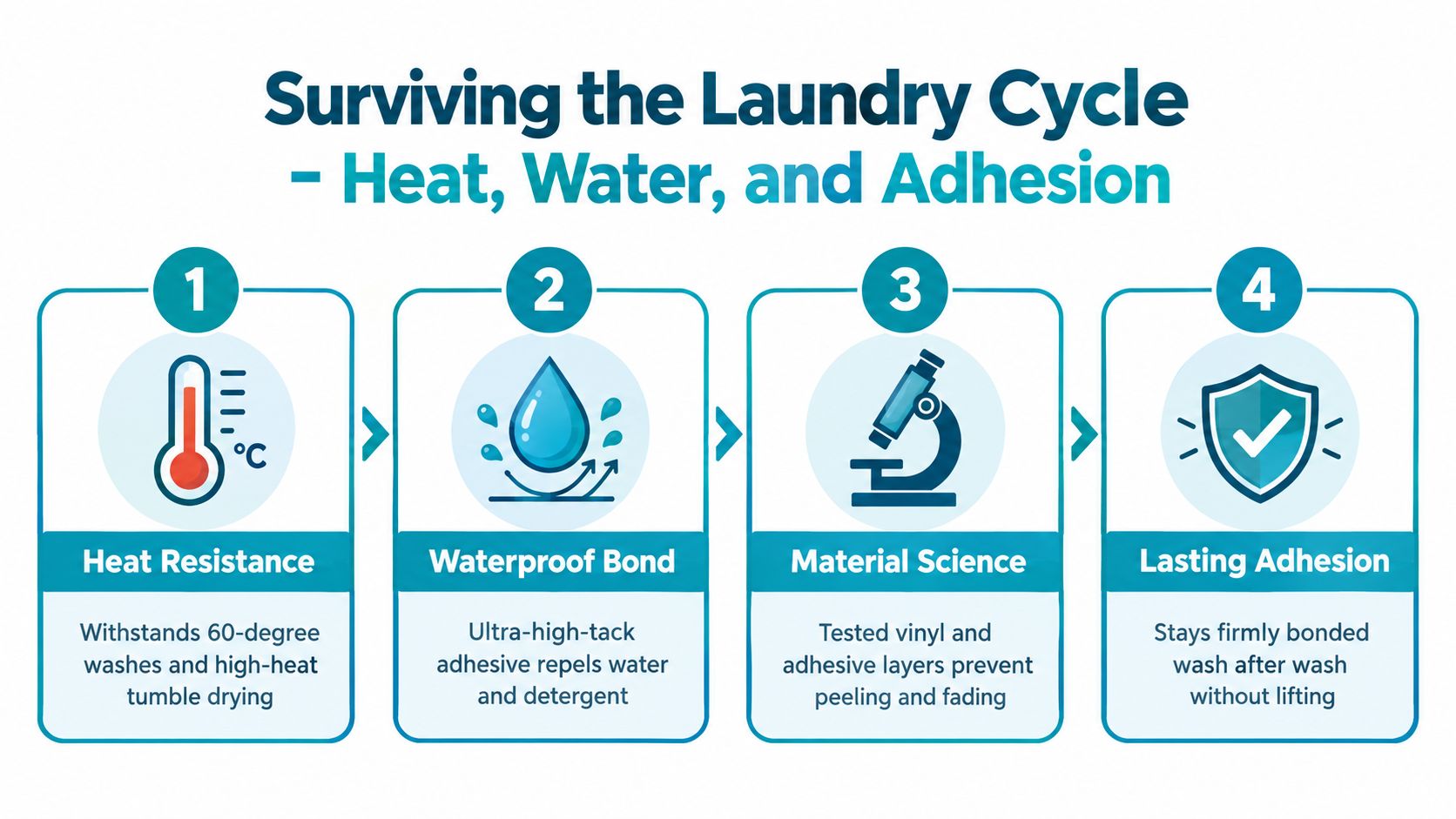
Laundry is where bad labels fail. Water alone won't usually kill a decent identification label, but heat, detergent, and repeated drying cycles will expose weak adhesive, poor inks, and flimsy construction. UK care-label practice also uses the ISO 3758 and GINETEX symbol system, which groups instructions into washing, bleaching, ironing, dry cleaning, and tumble drying, so the garment itself already tells you how much stress it can tolerate (care label requirements UK legal guide).
Read the drying symbol properly
The tumble-dry symbol is simple and useful. A square with a circle means tumble drying is allowed, while the dot count shows heat severity, one dot for low heat, two for medium, and three for high heat. A cross means do not tumble dry. That matters because heat is one of the main reasons labels lift, curl, or lose print quality, and a label that can't handle the drying stage is the wrong label for uniform laundry.
Match the label to the laundry workflow
A care home that runs hot, repetitive wash cycles needs a different label expectation from a parent washing one school uniform set at home. The best labels for high-turnover laundry are the ones matched to the workflow, not the ones sold with the loudest claims. That is why you should care about ink, laminate, and adhesive together, not just the sticker face.
If you're comparing product claims, the machine-washable guidance at machine washable labels is worth reading before you place a bulk order. In practical terms, you want a label that stays bonded, doesn't smear, and doesn't leave sticky residue behind after repeated laundering.
A label that survives a gentle wash but fails in the dryer is not fit for schools or care homes.
Application and Removal Techniques for Maximum Durability
A strong adhesive still fails if staff rush the application. I see this mistake all the time, people blame the label when the problem is dirty fabric, poor placement, or no curing time before the first wash. If you want durable results, the application process has to be boring and consistent.
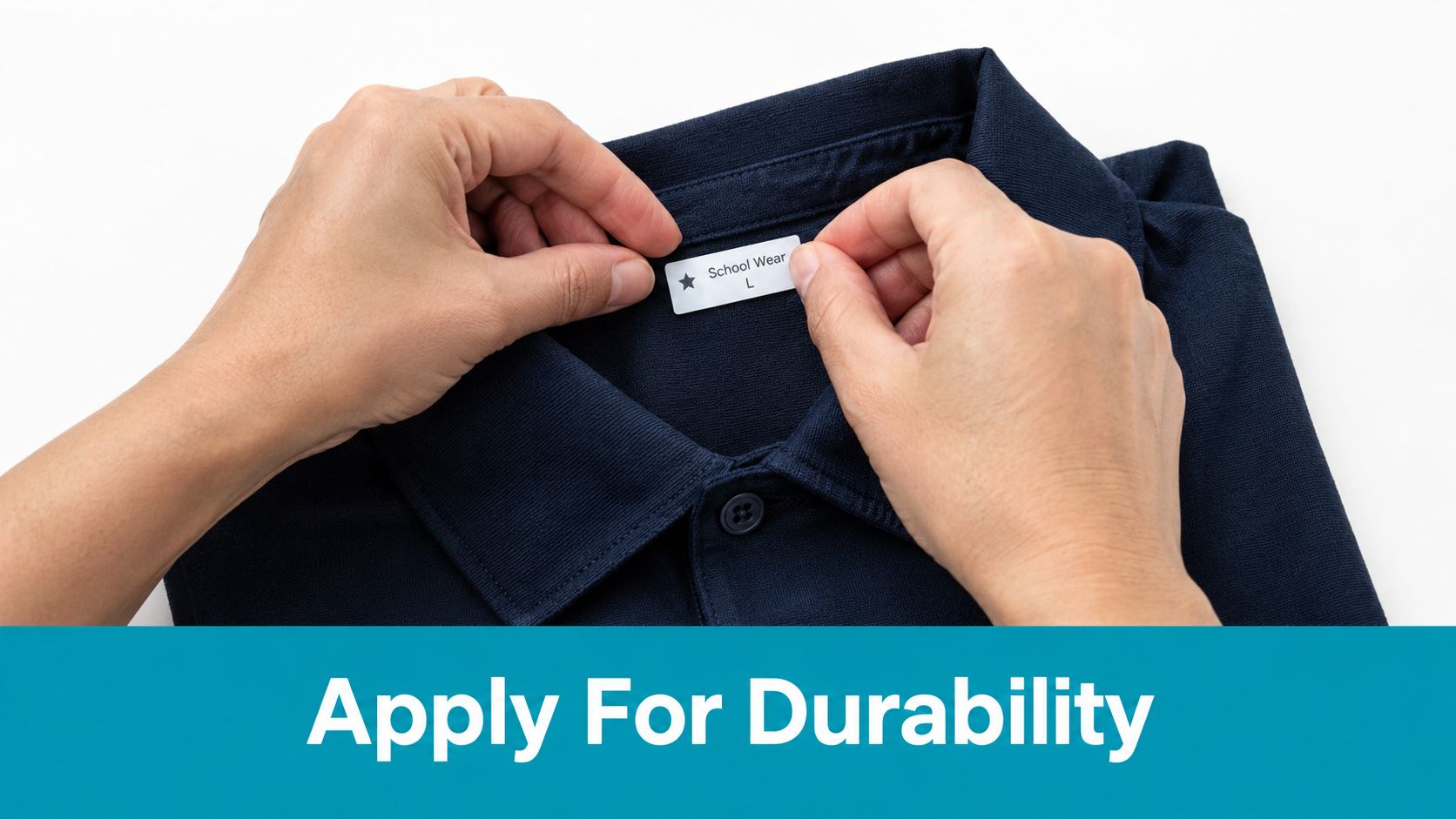
Apply on a clean, dry surface
Start with a clean, dry, flat area. The best target is often the care tag or an inside seam where the fabric is stable and friction is lower. Press the label down firmly and smooth the edges, because trapped air is the enemy of a lasting bond.
Do not apply straight after using fabric softener on the garment. Softener residue reduces adhesion, which is exactly the sort of avoidable mistake that creates call-backs from parents and laundry teams.
Give the adhesive time to settle
Leave the garment alone before the first wash. That settling period matters because the bond needs time to stabilise before water and heat start working on it. If staff rush the item straight into the laundry, they're testing the adhesive before it has had a fair chance to set.
Remove without damaging the garment
Removal is mostly about heat and patience. Warm the area gently, lift one corner slowly, and keep the motion controlled so you don't tear the fibres underneath. This matters when uniforms are handed down, redeployed, or sent back into stock, because the goal is to preserve the garment as well as the label.
Procurement rule: buy labels that fit the workflow, then train staff to apply them the same way every time.
Strategic Placement for Schools and Care Homes
A parent wants a name label to stay hidden but readable. A care home manager wants the same label to stay visible enough for laundry sorting and routine enough to standardise. Those are different operational needs, and they call for different placement habits.
Schools need labels where teachers can find them fast
On schoolwear, the most practical spots are inside the neck, inside the waistband, or on the inner seam of coats and PE kit. These locations keep the label out of the child's way but still visible when staff are checking items after a sports lesson or a lost-property sweep. For active garments, avoid high-friction zones where the fabric bends constantly, because repeated movement wears at the edge of any label.
If you're sourcing uniform items as part of a school wardrobe list, Everyday School Wear is a useful example of the kind of plain, repeat-worn clothing that benefits from consistent ownership marking. The key point is not style, it's predictability, because standard garments are easier to label well.
Care homes need a repeatable laundry system
Care homes should standardise placement. Pick one or two approved positions on garments, then keep them consistent across the whole stock so laundry staff aren't hunting for labels under time pressure. That approach reduces sorting errors, and it also respects the resident, because staff can place labels discreetly and consistently rather than improvising with each item.
The best system is the one the team can repeat without thinking. If your laundry contractor processes mixed loads, consistency beats creativity every time.
Navigating UK Compliance and Common Labelling Myths
A school or care home can buy the toughest ownership label on the market and still fail compliance if it is used as a substitute for the garment's required textile information. The legal label and the owner label serve different jobs. UK guidance says textile labels must be durable, visible, accessible, and in English, with responsibility on the manufacturer or importer side (UK textile labelling guidance).
The law sets disclosure rules, not ownership rules
The regulations set out what manufacturers must declare, including how multi-fibre products are treated and how decorative matter is handled under the fibre-content rules (Textile Products (Labelling and Fibre Composition) Regulations 2012). That is compliance. It is not a shortcut for marking personal property.
A compliant textile label tells you what the garment is made from. A personal identification label tells laundry staff, carers, or teachers who it belongs to. Treat them as separate parts of the same system.
Care labels help, but they do not fix bad labelling
Care information matters because it sets the washing and drying limits for the item. It also does not rescue a poor ownership label from the wrong placement, weak adhesive, or repeated industrial laundry. UK care-label guidance also makes clear that damage risk shifts back to the producer if care information is omitted and the consumer follows a reasonable cleaning process (care label requirements UK legal guide).
Another common mistake is assuming every vinyl sticker is waterproof in practice. Many labels survive one domestic wash and then fail in higher-heat, higher-agitation laundry. If the label will face tumble drying or repeated wash cycles, choose a product built for that duty, not one that only looks durable.
The right buying question is simple. Does the label meet the legal textile requirement, and will the ownership mark survive the actual laundry system? If the answer to either one is no, the product is wrong.
Frequently Asked Questions About Clothing Labels
Can I use the same label on raincoats and knitwear
Not blindly. Smooth, coated surfaces and fuzzy knitwear behave very differently, and the label has to suit the fabric surface as well as the wash routine. A label that holds well on a flat care tag may not bond as reliably on a textured weave, so test the exact garment type before you place a bulk order.
Are clothing labels safe for baby garments
Yes, provided the application method is appropriate and the label sits where it won't rub against skin. Inside seams and care tags are usually the safer choice than exposed edges. For baby clothing, comfort matters as much as retention, because a label that irritates the wearer is the wrong choice even if it stays stuck.
What about heavily soiled care home items
Clean the area before applying or reapplying any label. Dirt, lotion, and detergent residue all weaken the bond, which means the label might survive one wash and fail the next. In a care home setting, the right sequence is cleaning, drying, then labelling, not the other way round.
Should I choose the toughest label available
No, choose the label that matches the laundry workflow, fabric type, and compliance need. Toughness alone is a lazy buying criterion. The right label is the one staff can apply consistently and the laundry system can tolerate without repeated failure.
If you're buying labels for a school, care home, or family laundry system, choose products that are designed for real wash cycles rather than vague marketing claims. Quote My Wall offers stick-on clothing labels for uniforms and care clothing, so you can match identification to the way your garments are handled.